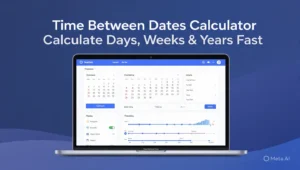
Time Between Dates Calculator
Easily calculate exact time differences in days, weeks, months, years, hours, minutes, and seconds.
Professional Date Difference Calculator: Choose start and end date-time values, set your options, and get complete insight into the elapsed time.
Perfect for project timelines, age checks, contract durations, event countdowns, and schedule planning.
Date & Time Inputs
Calculation Options
Important: Calculations use your browser’s local time zone. If your range crosses a DST/UTC offset change, elapsed hours/days may not match calendar day counting. Month/year totals are approximate (variable month lengths).
Calculation Results
Detailed Calendar Breakdown
Calculation Steps
Educational Notes
Unit Conversion Comparison
| Unit | Approx. Value | Definition Used |
|---|
Time plays a crucial role in almost every aspect of modern life. From managing professional projects to planning personal events, people constantly need to measure the distance between two specific dates. Whether it is calculating the number of days until an important deadline, determining how long a project will take, or tracking the duration between two milestones, accurate date calculations are essential. This is where a Time Between Dates Calculator becomes an incredibly useful digital tool.
In the past, calculating the difference between two dates required manual counting using a calendar or performing mathematical calculations that could easily lead to errors. For example, determining the number of days between January 15 and June 20 might involve counting each month, adjusting for months with different lengths, and remembering whether a leap year is involved. This manual process not only takes time but also increases the likelihood of mistakes, especially when calculating longer time spans.
Today, digital technology has simplified this process dramatically. A Time Between Dates Calculator allows users to instantly determine the difference between two dates with just a few clicks. By entering a start date and an end date, the tool automatically calculates the exact duration in days, weeks, months, or years. This automation removes the need for manual calculations and ensures a high level of accuracy.
The popularity of online date calculation tools has grown significantly as more people rely on digital platforms for productivity and planning. Businesses use them to track project timelines and contract durations, students use them to monitor assignment deadlines, and travelers use them to plan itineraries and calculate trip durations. Even in personal life, people often need to know the exact number of days until a birthday, anniversary, or upcoming event.
Another important reason why the Time Between Dates Calculator has become widely used is its versatility. The tool can serve many different purposes across various industries. For example, human resources departments may calculate employment durations, financial analysts may track investment periods, and event organizers may determine how long they have to prepare for a conference or wedding. In each case, having a quick and reliable way to measure time between two dates improves efficiency and decision-making.
Modern calculators also incorporate advanced features that go beyond simple date subtraction. Some tools allow users to calculate business days between dates, excluding weekends and holidays. Others provide detailed results that break down the difference into years, months, weeks, and days simultaneously. These features make the Time Between Dates Calculator a valuable resource not only for casual users but also for professionals who require precise time measurements.
In an increasingly fast-paced digital world, efficiency and accuracy are more important than ever. Tools that simplify everyday tasks help people focus on more meaningful work instead of spending time on repetitive calculations. The Time Between Dates Calculator represents one of these simple yet powerful tools that streamline time management and planning.
As more organizations and individuals rely on digital solutions for scheduling and productivity, the demand for reliable date calculation tools continues to grow. Understanding how these calculators work, what features they offer, and how they can be used effectively can help users make better decisions when managing timelines and deadlines.
In the following sections, we will explore how a Time Between Dates Calculator works, its key features, practical applications, and why it has become an essential tool for both personal and professional time management.
How a Time Between Dates Calculator Works
A time between dates calculator might look simple on the surface, but behind that clean interface lies a surprisingly detailed system of logic and mathematical precision. These tools are designed to quickly calculate the exact difference between two dates, whether in days, weeks, months, or years. To understand how they deliver accurate results, it helps to break down the internal mechanics that power them.
Understanding Date Calculation Logic
At the core of every date calculator is the structure of the calendar itself. The modern Gregorian calendar consists of 12 months, each with a different number of days, and a year that typically has 365 days. However, this structure is not perfectly uniform, which is where complexity begins.
When a user inputs two dates, the calculator converts them into timestamps—numerical representations of time, often measured in days or seconds from a fixed reference point. The simplest calculation involves subtracting one timestamp from another to find the difference.
While calculating the number of days between two dates is relatively straightforward, determining months and years is more complicated. Months vary in length (28 to 31 days), and years can include leap days. This means a calculator cannot simply divide total days by 30 or 365 to get accurate month or year values. Instead, it must evaluate each component of the date individually—year, month, and day—to produce precise results.
Accounting for Leap Years and Calendar Variations
Leap years are a critical factor in accurate date calculations. A leap year occurs every four years, adding an extra day (February 29) to keep the calendar aligned with Earth’s orbit around the sun. However, the rule is slightly more nuanced: years divisible by 100 are not leap years unless they are also divisible by 400. For example, 2000 was a leap year, but 1900 was not.
This variation means that any reliable time between dates calculator must include logic to detect leap years automatically. When calculating date differences across multiple years, the tool must count how many leap years fall within that range and adjust the total accordingly.
Without this adjustment, results would quickly become inaccurate, especially for long time spans such as age calculations or historical data analysis.
Algorithms Used in Date Calculators
Most modern calculators rely on well-established algorithms to compute date differences. A basic approach involves converting each date into a serial number representing the number of days since a fixed origin date (such as January 1, 1970, commonly used in computing systems). The difference between these numbers gives the total number of days.
More advanced systems go further by breaking down the calculation into components—years, months, and days—using iterative or formula-based approaches. This allows the calculator to present results in a more human-readable format, such as “2 years, 3 months, and 5 days.”
In web-based tools, programming languages like JavaScript or Python handle these calculations using built-in date libraries. These libraries are optimized for accuracy and often include pre-coded logic for leap years, month lengths, and edge cases.
Another important aspect is timezone handling. While basic calculators ignore timezones, advanced tools consider them, especially when calculating differences down to hours or minutes. This is crucial for global users who may be working across different regions.
Key Features of a Modern Time Between Dates Calculator
Today’s users expect more than just a simple day counter. A modern time between dates calculator offers a range of features designed to support both personal and professional needs.
Calculate Days Between Two Dates
This is the most commonly used feature. Users often want to know the exact number of days between two dates for countdowns, deadlines, or tracking durations. Whether it’s counting days until a vacation or measuring the length of a project, this feature provides instant clarity.
Calculate Weeks Between Dates
Weeks are especially useful in structured environments like schools, workplaces, and project management. Instead of thinking in days, users can view timelines in weekly segments, which are easier to manage and visualize.
For example, a 12-week project timeline is more intuitive than a 84-day duration. This feature is widely used in academic planning, sprint cycles, and business scheduling.
Calculate Months Between Dates
Calculating months is particularly important for financial planning, subscriptions, and billing cycles. Since months vary in length, accurate calculation requires careful handling.
Modern calculators determine the number of full months between two dates and may also display remaining days. This is helpful for understanding payment cycles, rental agreements, or installment plans.
Calculate Years Between Dates
Year-based calculations are essential for determining age, anniversaries, and long-term durations. This feature is commonly used in HR systems, legal documentation, and personal milestones.
A precise calculator will account for whether the current year’s date has passed, ensuring accurate age or duration output.
Include or Exclude Start and End Dates
Flexibility is a key feature in modern tools. Some users want to include both the start and end dates in the calculation, while others prefer to exclude one of them.
For example, in event planning, the start date may count as day one. In contrast, in financial calculations, only full days between two dates may be considered. Advanced calculators allow users to toggle these options easily.
Benefits of Using a Time Between Dates Calculator
Using a time between dates calculator offers several advantages over manual counting or basic estimation. These tools are designed to save time, improve accuracy, and support a wide range of use cases.
Saves Time and Reduces Human Error
Manually counting days on a calendar is not only time-consuming but also prone to mistakes. It’s easy to skip a day, miscount a month, or forget a leap year.
A digital calculator eliminates these risks by providing instant and accurate results. This is especially valuable when dealing with long time spans or critical deadlines.
Improves Planning Accuracy
Accurate date calculations lead to better planning. Whether organizing an event, managing a project, or setting personal goals, knowing the exact time frame helps users allocate resources more effectively.
For example, project managers can create realistic timelines, while individuals can plan travel or study schedules with confidence.
Supports Professional Workflows
In professional environments, precise date calculations are essential. Different departments rely on this functionality for various purposes:
- Finance teams use it to calculate interest periods, payment schedules, and billing cycles.
- HR departments depend on it for employee tenure, leave tracking, and contract durations.
- Legal and administrative roles use it to monitor deadlines, agreements, and compliance timelines.
Inaccurate calculations in these areas can lead to financial losses or operational issues, making reliable tools indispensable.
Easy Access Through Online Tools
One of the biggest advantages of modern date calculators is accessibility. Most tools are available online and can be used directly through a web browser without installation.
Many are also optimized for mobile devices, allowing users to calculate date differences on the go. Some platforms even integrate these features into larger systems like project management software, CRM tools, or financial applications.
This convenience ensures that users can access accurate date calculations anytime, anywhere, without needing specialized knowledge or software.
Common Uses of a Time Between Dates Calculator
A time between dates calculator is more than just a simple utility—it’s a practical tool used across many industries and everyday situations. From managing complex projects to planning personal milestones, its ability to deliver precise time differences makes it highly valuable in both professional and casual contexts.
Project Management and Deadline Tracking
In project management, time is one of the most critical resources. A time between dates calculator helps teams determine the exact duration of a project from start to finish. This allows for better planning, resource allocation, and realistic scheduling.
Project managers often use these tools to break down timelines into phases and track milestones. For example, knowing that a project lasts 90 days can help divide it into weekly sprints or monthly goals. It also becomes easier to monitor progress and identify delays early.
Additionally, calculating the time between key milestones ensures that each phase stays aligned with the overall deadline. This is especially important in industries like construction, software development, and marketing campaigns, where timing directly affects outcomes.
Age Calculation
One of the most common everyday uses is calculating age. While it may seem simple, determining someone’s exact age in years, months, and days requires precise date logic.
A time between dates calculator handles this effortlessly by accounting for varying month lengths and leap years. This is particularly useful in official contexts such as filling out legal documents, registering for services, or verifying eligibility based on age requirements.
It’s also helpful for personal curiosity—whether you want to know your exact age down to the day or calculate the age difference between two people.
Travel Planning
Travel planning involves multiple time-sensitive elements, and a date calculator simplifies many of them. Travelers can calculate the duration of their trips to plan itineraries more effectively and ensure they make the most of their time.
Another important use is checking visa validity. Many visas have strict duration limits, such as 30, 60, or 90 days. A calculator helps travelers avoid overstaying by accurately tracking the number of days between entry and exit dates.
It’s also useful for booking accommodations, planning layovers, and organizing multi-destination trips where timing is critical.
Financial and Loan Calculations
In finance, precise time calculations are essential. A time between dates calculator plays a key role in determining interest periods, loan durations, and investment timelines.
For example, lenders often calculate interest based on the exact number of days between two dates. Even a small miscalculation can affect the total amount owed or earned. Similarly, investors use date calculations to track how long their funds have been invested and to estimate returns over time.
This tool is also widely used in subscription billing cycles, where payments depend on monthly or yearly intervals. Accurate date tracking ensures fair and transparent financial transactions.
Event Planning and Countdown Timers
Event planning is another area where date calculators shine. Whether organizing a wedding, conference, or product launch, knowing exactly how much time remains is crucial.
Planners can use the tool to create countdowns, set preparation schedules, and coordinate tasks leading up to the event. For example, if a wedding is 180 days away, tasks can be distributed across that timeline to avoid last-minute stress.
Countdown timers are also लोकप्रिय in marketing, especially for product launches or limited-time offers. Displaying the exact number of days remaining can create urgency and boost engagement.
Step-by-Step Guide to Using a Time Between Dates Calculator
For beginners, using a time between dates calculator is straightforward. Most tools follow a similar structure, making them easy to understand even without technical knowledge.
Step 1 – Enter the Start Date
The first step is selecting the start date. This represents the beginning of the time period you want to measure. It could be the start of a project, a birth date, or the beginning of a contract.
Most calculators provide a calendar interface, allowing users to pick a date easily without typing. Accuracy at this stage is important, as even a one-day error can affect the final result.
Step 2 – Enter the End Date
Next, you’ll choose the end date. This is the point in time you want to measure up to—such as a deadline, event date, or current date.
Some tools automatically fill in the current date for convenience, especially when calculating age or ongoing durations. Users can also manually input a future date for planning purposes.
Step 3 – Select Calculation Units
After entering both dates, users can select how they want the results displayed. Common options include days, weeks, months, or years.
Some advanced calculators allow multiple units at once, showing results like “1 year, 2 months, and 10 days.” This flexibility helps users interpret the data in a way that best suits their needs.
Step 4 – Generate Results
Once all inputs are set, the user simply clicks a button to generate results. The calculator processes the data instantly, applying all necessary logic such as leap year adjustments and month variations.
The output is typically displayed in a clear and readable format, making it easy to understand at a glance.
Step 5 – Interpret the Date Difference
The final step is understanding and applying the results. For example, if a calculator shows that a project will take 45 days, this information can be used to create a work schedule or allocate resources.
In financial contexts, the result might determine interest calculations. In personal use, it could help track progress toward a goal or event.
Learning how to interpret these results effectively ensures that the calculator becomes a practical decision-making tool rather than just a number generator.
Manual Method vs Time Between Dates Calculator
While digital tools are widely used today, some people still rely on traditional methods to calculate date differences. Comparing these approaches highlights why modern calculators have become the preferred choice.
Manual Calendar Counting
The manual method involves counting days directly on a calendar. This process requires moving from the start date to the end date, adding up days across each month.
While this approach works for short time spans, it quickly becomes complicated for longer durations. Variations in month lengths and leap years increase the risk of errors.
It’s also time-consuming, especially when precision is required. Missing even a single day can lead to incorrect results, which may have consequences in professional settings.
Spreadsheet Calculations
Another alternative is using spreadsheet tools like Excel or Google Sheets. These platforms offer built-in formulas to calculate date differences, such as DATEDIF or simple subtraction between date cells.
Spreadsheets are more efficient than manual counting and are commonly used in business environments. They also allow for automation when working with large datasets.
However, they still require some level of technical knowledge. Users must understand formulas and ensure that data is entered correctly to avoid errors.
Advantages of Online Calculators
Online time between dates calculators combine simplicity with accuracy. They provide instant results without requiring manual effort or technical expertise.
Key advantages include:
- Faster results: Calculations are completed in seconds.
- Higher accuracy: Built-in logic handles leap years and calendar variations automatically.
- Easy accessibility: Available on any device with an internet connection.
These benefits make online calculators the most practical choice for both everyday users and professionals. Whether you’re planning a trip, managing a project, or calculating financial timelines, they offer a reliable and efficient solution.
Online Time Between Dates Calculator vs Mobile Apps
As digital tools continue to evolve, users now have multiple ways to calculate date differences. Whether through web-based platforms, mobile apps, or desktop software, each option offers unique advantages depending on the user’s needs. Understanding these differences helps in choosing the right tool for efficiency and accuracy.
Web-Based Date Calculators
Web-based date calculators are the most accessible option for most users. They require no installation and can be used instantly from any device with an internet connection. This makes them ideal for quick calculations, whether you’re working on a laptop, tablet, or shared computer.
One of the biggest strengths of online date calculators is simplicity. Users can input two dates, select the desired units (days, weeks, months, or years), and receive results within seconds. These tools are often updated automatically, ensuring accurate handling of leap years, calendar changes, and edge cases.
Another advantage is cross-platform compatibility. Since they run in a browser, there’s no need to worry about operating systems or software updates. This makes web-based tools a popular choice for students, professionals, and casual users alike.
Mobile Date Calculator Apps
Mobile apps bring convenience to a new level. Designed for smartphones and tablets, these apps allow users to calculate time differences anytime, anywhere—even without an internet connection in some cases.
For people who frequently work with dates, such as project managers, travelers, or freelancers, mobile date calculator apps offer quick access on the go. Many apps also include additional features like countdown widgets, reminders, and calendar integration.
The user interface is typically optimized for touch interaction, making it easy to select dates and navigate between features. Push notifications can also alert users about upcoming deadlines or important milestones, adding a layer of functionality beyond simple calculations.
However, users need to download and occasionally update these apps, which may not be as convenient as using a browser-based tool for one-time use.
Desktop Software for Advanced Date Calculations
Desktop software is often used by professionals who require more advanced capabilities. These tools are typically part of larger systems, such as financial software, enterprise resource planning (ERP) systems, or development environments.
Unlike basic calculators, desktop solutions may include complex scheduling, historical data analysis, and integration with databases. Developers, for example, might use these tools to test date-related functions in applications or simulate timelines.
While desktop software offers powerful features, it usually comes with a steeper learning curve. It may also require installation, licensing, and regular maintenance. For everyday users, this level of complexity is often unnecessary, but for businesses and technical professionals, it can be essential.
Real-Life Examples of Date Difference Calculations
To better understand how a time between dates calculator works in practice, let’s look at some real-life scenarios. These examples highlight how the tool can be applied in everyday situations.
Example 1 – Calculating Age
Imagine someone born on March 15, 1995, who wants to know their exact age today. A date calculator will compare the birth date with the current date and break down the difference into years, months, and days.
Instead of simply saying “30 years,” the tool might display something like “30 years, 0 months, and 21 days,” depending on the current date. This level of precision is useful for official forms, eligibility checks, and personal tracking.
Example 2 – Project Duration
Consider a project that starts on January 1 and ends on April 15. A time between dates calculator can instantly determine the total duration.
Rather than manually counting, the tool might show “104 days” or “3 months and 14 days.” This helps project managers plan resources, assign tasks, and evaluate whether deadlines are realistic.
Example 3 – Vacation Planning
A traveler planning a trip from June 10 to June 25 can use a date calculator to determine the trip length. The result—15 days, for example—helps in booking accommodations, budgeting expenses, and organizing activities.
It also ensures that travel plans align with visa requirements or leave allowances from work.
Example 4 – Subscription Billing Period
Subscription-based services often rely on precise billing cycles. For instance, a monthly subscription starting on February 5 needs to account for different month lengths.
A date calculator can determine when the next billing date occurs and how many days are in each cycle. This is particularly useful for businesses managing recurring payments and for users tracking their subscriptions.
Time Between Dates Calculator for Business and Productivity
In business environments, time is directly linked to productivity and profitability. A time between dates calculator plays a key role in ensuring accurate planning, tracking, and reporting across different departments.
HR and Employment Duration Tracking
Human Resources departments frequently use date calculators to track employee tenure. This includes calculating how long an employee has been with the company, which can impact promotions, benefits, and performance evaluations.
Accurate duration tracking is also important for managing leave balances, probation periods, and contract terms. Automated tools reduce errors and ensure consistency across records.
Contract and Legal Agreement Periods
Contracts often include specific start and end dates, along with deadlines for renewals or terminations. A date calculator helps legal teams monitor these periods and avoid missing critical dates.
For example, knowing that a contract expires in 90 days allows businesses to prepare for renegotiation or renewal well in advance. This reduces risk and ensures compliance with legal obligations.
Financial Reporting Periods
Financial reporting relies heavily on precise date ranges. Companies often work with quarterly and yearly reporting cycles, which must be calculated accurately.
A time between dates calculator helps determine the exact length of these periods, ensuring that reports are aligned with accounting standards. It also assists in tracking fiscal years, tax deadlines, and audit timelines.
Marketing Campaign Timelines
Marketing teams use date calculators to plan and execute campaigns effectively. From product launches to promotional events, timing is critical.
By calculating the duration of a campaign, teams can schedule content,علانات, and outreach activities in a structured way. Countdown strategies, in particular, benefit from precise date tracking, helping to build anticipation and engagement.
Integrating Time Between Dates Calculators into Digital Platforms
As technology advances, date calculation tools are increasingly being integrated into larger digital ecosystems. This allows businesses and developers to automate processes and improve efficiency.
API Integration for Web Applications
Many modern platforms offer APIs (Application Programming Interfaces) that allow developers to embed date calculation functionality directly into their applications.
For example, an e-commerce website might use a date calculator API to estimate delivery times, while a booking platform could calculate stay durations automatically. This integration enhances user experience and reduces manual input.
Use in Project Management Software
Project management tools like task trackers and collaboration platforms often include built-in date calculation features. These tools automatically calculate task durations, deadlines, and dependencies.
For instance, when a task start date and duration are entered, the system can generate an end date instantly. This helps teams stay organized and ensures that timelines remain consistent across projects.
Automation in Productivity Tools
Productivity tools are increasingly using automation to handle repetitive tasks. Date calculators play a key role in this by enabling features like automated reminders, scheduling, and notifications.
For example, a calendar app might automatically remind users of an event a certain number of days in advance. Similarly, workflow automation tools can trigger actions based on date differences, such as sending emails or updating task statuses.
This level of integration transforms a simple date calculator into a powerful component of modern digital workflows, helping users save time and stay organized in an increasingly fast-paced environment.
Limitations of Time Between Dates Calculators
While a time between dates calculator is highly useful, it’s not without limitations. Understanding these potential drawbacks helps users avoid misinterpretation and ensures more reliable results, especially in complex or sensitive scenarios.
Timezone Differences
One of the most common challenges in date calculations is handling timezones. Basic calculators often assume a standard timezone or ignore time differences entirely. This is usually fine for simple date comparisons, but it can create issues in international contexts.
For example, calculating the time between two dates across different countries may lead to slight discrepancies if timezone offsets are not considered. This becomes even more critical when calculations involve exact timestamps, such as hours or minutes.
Advanced date calculators and systems address this by incorporating timezone data, but users still need to ensure they are selecting the correct region or settings when accuracy matters.
Calendar System Differences
Most modern date calculators are based on the Gregorian calendar, which is widely used globally. However, not all cultures and systems follow this calendar exclusively.
Some regions and industries may use alternative calendars, such as the Islamic calendar, Hebrew calendar, or other local systems. These calendars have different structures, month lengths, and year counts, which can lead to inconsistencies if a standard calculator is used.
As a result, users working in multicultural or international environments should be aware of these differences and choose tools that support the appropriate calendar system when necessary.
Input Errors
Even the most advanced calculator cannot produce accurate results if the input data is incorrect. One of the most frequent issues is entering dates in the wrong format.
For instance, confusing MM/DD/YYYY with DD/MM/YYYY can completely change the meaning of a date. Entering 03/04/2026 could represent March 4 or April 3, depending on the format.
Small mistakes like selecting the wrong year or day can also lead to incorrect outputs. This is why careful input and verification are essential when using any date calculation tool.
Tips for Getting Accurate Results
To get the most out of a time between dates calculator, users should follow a few simple best practices. These tips can help ensure that results are both accurate and meaningful.
Always Verify the Date Format
Before entering any dates, check the format used by the calculator. Some tools follow the U.S. format (MM/DD/YYYY), while others use the international format (DD/MM/YYYY).
If the format is unclear, look for labels or examples provided by the tool. Taking a few seconds to confirm this can prevent major calculation errors.
Check Leap Year Adjustments
Leap years can significantly impact results, especially when calculating long time spans. A reliable calculator will automatically account for leap years, but it’s still a good idea to verify this when accuracy is critical.
For example, when calculating age or long-term contracts, even a single extra day can make a difference. Choosing a trusted tool with proper leap year handling ensures consistent results.
Confirm Start and End Date Inclusion
Different calculators may handle start and end dates differently. Some include both dates in the count, while others exclude one of them.
This distinction can affect the final result, particularly in short time ranges. For example, counting from January 1 to January 2 could be interpreted as one day or two days, depending on the method used.
Always check the settings or options available in the calculator and adjust them based on your specific needs.
Future of Online Date Calculation Tools
As technology continues to evolve, time between dates calculators are becoming more advanced and integrated into broader digital ecosystems. The future of these tools is shaped by automation, artificial intelligence, and improved user experience.
AI-Powered Scheduling Tools
Artificial intelligence is transforming how people manage time. Modern scheduling tools are beginning to incorporate AI to provide smarter recommendations based on user behavior, deadlines, and priorities.
Instead of simply calculating date differences, future tools may suggest optimal timelines, identify potential conflicts, and automatically adjust schedules. This turns a basic calculator into a proactive planning assistant.
Integration with Smart Calendars
Another growing trend is integration with smart calendars. Date calculation features are increasingly built into calendar apps, allowing users to calculate durations without switching tools.
For example, selecting two dates in a calendar could instantly display the time difference, along with reminders and notifications. This seamless integration improves productivity and reduces the need for manual calculations.
Voice-Activated Date Calculations
Voice technology is also playing a role in the evolution of date calculators. With the rise of voice assistants, users can now perform calculations using simple voice commands.
For instance, asking “How many days until December 31?” can produce an instant answer without typing anything. This hands-free approach is especially useful in mobile and smart home environments, making date calculations even more accessible.
Conclusion
A time between dates calculator is a powerful yet easy-to-use tool that simplifies one of the most common tasks in daily life—measuring time. From calculating project durations and tracking deadlines to planning trips and managing finances, its applications are both broad and practical.
By eliminating manual counting and reducing the risk of errors, these tools improve accuracy and save valuable time. They also support better decision-making, whether in personal planning or professional workflows.
As digital technology continues to advance, date calculators are becoming smarter, more integrated, and easier to use. Features like AI-powered scheduling, smart calendar integration, and voice activation are shaping the future of time management.
For anyone looking to stay organized and efficient, using an online time between dates calculator is a simple step with significant benefits. In a fast-paced world where every day counts, having a reliable way to measure time can make all the difference.