🔵 Arc Length Calculator
Calculate arc length, sector area, chord length, and all circle sector properties
📐 What is Arc Length?
Arc length is the distance along the curved line making up the arc. It's a portion of the circumference of a circle, determined by the central angle and radius.
Formula: L = r × θ (where θ is in radians) or L = (θ/360°) × 2πr (where θ is in degrees)
📊 Circle Sector Parameters
💡 Note: Enter at least 2 values to calculate the remaining properties. The calculator will automatically compute all related measurements.
✨ Tip: Klik salah satu contoh untuk mengisi nilai sudut dan jari-jari secara otomatis, lalu tekan Calculate.
📊 Calculation Results
📝 Calculation Steps
� Visual Angle Comparison
📚 Understanding Arc Length & Circle Sectors
🎯 What is a Circle Sector?
A sector is the region bounded by two radii and the arc between them. Think of it as a "slice of pie" from a circle. The arc length is the curved distance along the edge of this slice.
📐 Key Formulas:
- Arc Length: L = r × θ (radians) or L = (θ/360°) × 2πr (degrees)
- Sector Area: A = ½ × r² × θ (radians) or A = (θ/360°) × πr² (degrees)
- Chord Length: c = 2r × sin(θ/2)
- Segment Area: A_segment = A_sector - ½r² × sin(θ)
- Segment Height: h = r × (1 - cos(θ/2))
- Sector Perimeter: P = L + 2r
🔄 Important Relationships:
- When θ = 360° (2π rad), the sector becomes a full circle
- When θ = 180° (π rad), the sector becomes a semicircle
- When θ = 90° (π/2 rad), the sector becomes a quarter circle
- Arc length is always greater than chord length (except when θ = 0)
- As angle approaches 0, arc length approaches chord length
- Sector area is proportional to the central angle
🌍 Real-World Applications:
- 🏗️ Architecture: Designing curved structures, arches, domes, and amphitheaters
- 🛣️ Road Design: Calculating curve lengths in highways, railways, and race tracks
- ⚙️ Engineering: Gear design, pulley systems, cam mechanisms, and rotating machinery
- 🎯 Sports: Track design, golf course layout, field measurements, and throwing circles
- 🌍 Navigation: Calculating distances on Earth's surface using latitude/longitude
- 🎨 Design: Creating circular patterns, decorative elements, and artistic compositions
- 🍕 Food Industry: Pizza slicing, cake portions, and pie servings
- 📊 Data Visualization: Pie charts and circular graphs
- 🎡 Amusement Parks: Ferris wheel design and carousel planning
- 🛰️ Astronomy: Calculating orbital paths and celestial measurements
💡 Practical Tips:
- Always convert angles to radians when using the formula L = r × θ
- For small angles (< 10°), arc length ≈ chord length (within 0.5% error)
- The ratio of arc length to radius gives the angle in radians
- Sector area is exactly half the product of arc length and radius: A = ½ × L × r
- Use the chord length to find the straight-line distance between arc endpoints
🧮 Formula Relationships
📏 Unit Conversions & Angle Reference
| Angle Units | Equivalent to 1 Radian |
|---|---|
| Degrees | 57.2958° |
| Gradians | 63.662 gon |
| Turns | 0.159155 tr |
| Arc Minutes | 3437.75′ |
| Arc Seconds | 206265″ |
| Common Angles | Degrees → Radians |
|---|---|
| 30° | π/6 ≈ 0.5236 rad |
| 45° | π/4 ≈ 0.7854 rad |
| 60° | π/3 ≈ 1.0472 rad |
| 90° | π/2 ≈ 1.5708 rad |
| 180° | π ≈ 3.1416 rad |
| 360° | 2π ≈ 6.2832 rad |
📐 Arc Length vs Chord Length Relationship
As the central angle increases, the difference between arc length and chord length grows
⚡ Quick Reference Guide
When to Use Arc Length
Use when measuring the actual curved distance along the circle's edge, such as in road curves or circular tracks.
When to Use Chord
Use when measuring the straight-line distance between two points on a circle, such as in construction or surveying.
Radians vs Degrees
Radians are preferred in calculus and physics. 1 radian = 57.3°. Always use radians in formulas like L = r × θ.
Sector vs Segment
Sector includes the two radii (pie slice). Segment is only the area between chord and arc (no radii).
Common Mistake
Don't forget to convert degrees to radians! Multiply degrees by π/180 or use the calculator's unit selector.
Validation Check
Arc length must always be ≥ chord length. If not, check your angle units and calculations.
In mathematics, measuring distance is usually simple when dealing with straight lines. However, when a path curves—like the edge of a circle, a winding road, or the trajectory of a planet—the calculation becomes more complex. This is where the concept of arc length becomes essential. Arc length refers to the distance measured along the curved line between two points on a circle or any other curve. Instead of drawing a straight line between points, arc length follows the exact shape of the curve itself.
Understanding curved distance is important in many fields of science, engineering, architecture, and computer graphics. For example, engineers use it when designing gears and rotating machinery, architects apply it when constructing arches and domes, and physicists rely on it when studying circular motion. Even in everyday technology such as animation software or navigation systems, curved paths are measured using the same mathematical principles.
One of the most important tools used to measure curved distance is the arc length formula. This mathematical relationship allows us to determine how long a curved segment is based on variables such as the radius of a circle and the central angle that defines the arc. While the concept originates in classical geometry, it also plays a significant role in calculus when dealing with more complex curves that cannot be described by simple circular geometry.
In modern mathematics education and practical applications, many people also rely on an arc length calculator to simplify the process. Instead of manually performing several steps of algebra or calculus, users can enter the required values—such as radius, angle, or a function describing the curve—and receive an instant result. These tools are widely used by students, researchers, engineers, and designers who need accurate measurements quickly.
The study of arc length connects several branches of mathematics. In geometry, it helps explain the relationship between circles, angles, and sectors. In trigonometry, it links angular measurement with real distances along curved paths. In calculus, arc length becomes even more powerful, allowing mathematicians to measure the length of complex curves defined by functions, parametric equations, or polar coordinates.
Another reason arc length is important is its connection to real-world design and technology. Consider highways that curve around mountains, railway tracks that bend smoothly to maintain safe travel speeds, or robotic arms that move along curved trajectories. In each of these examples, accurate measurements of curved distance are necessary to ensure safety, efficiency, and precision. The same mathematical principles also appear in satellite orbit calculations, circular motion in physics, and even digital modeling in video games and 3D animation.
Although the underlying mathematics may seem complicated at first, the basic idea behind arc length is quite intuitive. Imagine taking a piece of string and placing it along the curved edge of a circle. If you then straighten the string and measure it, the result represents the arc length of that curve. Mathematics simply provides a precise formula to calculate that same measurement without physically tracing the curve.
Throughout this article, we will explore how arc length works from both a geometric and calculus perspective. You will learn how the arc length formula is derived, how it can be applied to circles and more complex curves, and how modern tools like an arc length calculator make the process faster and more accessible. By the end, you will have a clear understanding of how mathematicians measure curved distances and why this concept remains so important in science, technology, and everyday problem-solving.
Understanding the Concept of Arc Length
Arc length is one of the most fundamental ideas in geometry and trigonometry. It describes the distance measured along a curved line, especially along the edge of a circle. While straight-line distance is simple to calculate using basic formulas, measuring curved paths requires a different approach.
Arc length appears in many real-world applications such as engineering design, navigation systems, physics calculations, computer graphics, and architecture. From calculating the path of a rotating wheel to designing curved bridges or roads, understanding arc length helps translate curved shapes into measurable distances.
This section explores the meaning of arc length, how it differs from other geometric measurements, and how curved paths are represented mathematically.
Definition of Arc Length
In geometry, arc length refers to the distance measured along the curve of a circle between two points. Instead of measuring the straight distance between those points, arc length follows the curvature of the circle.
What an Arc Is in Geometry
An arc is a portion of the circumference of a circle. It represents a curved segment connecting two points on the circle’s edge.
There are two main elements that determine the arc:
- Radius of the circle
- Central angle that subtends the arc
The larger the central angle, the longer the arc.
For example:
- A 90° central angle corresponds to a quarter of the circle.
- A 180° central angle corresponds to half the circle.
Difference Between Arc Length and Chord Length
Although arc length and chord length both connect two points on a circle, they measure completely different paths.
| Measurement | Description |
|---|---|
| Arc Length | Distance measured along the curved edge of the circle |
| Chord Length | Straight-line distance between two points on the circle |
A chord always creates a shorter distance compared to the arc connecting the same points.
This distinction is important in geometry, trigonometry, and engineering calculations, especially when working with curved structures.
Arc Length vs Linear Distance
Arc length differs from traditional distance measurements because it follows a curved path rather than a straight one.
Straight Line vs Curved Path
Linear distance measures the shortest route between two points, usually represented as a straight line. This is commonly calculated using formulas like the Pythagorean theorem or distance formulas in coordinate geometry.
Arc length, however, measures distance along a curve. Since the path bends continuously, it cannot be measured using simple straight-line formulas.
Instead, arc length relies on:
- Circle geometry
- Angle measurements
- Proportional relationships within a circle
Why Curves Require Special Formulas
Curves require specialized formulas because their distance depends on both radius and angle.
For example:
- Two arcs may have the same central angle but different radii.
- The arc with the larger radius will always have a longer length.
This relationship means curved distances depend on angular measurement and circular proportions, which is why the arc length formula was developed.
Types of Arcs
In circle geometry, arcs are categorized based on their size relative to the circle.
Minor Arc
A minor arc is the smaller portion of a circle between two points.
Characteristics include:
- Central angle less than 180°
- Shorter curved distance
Most arc length calculations in basic geometry involve minor arcs.
Major Arc
A major arc is the longer curved portion between two points on a circle.
Features include:
- Central angle greater than 180°
- Represents most of the circle’s circumference
Major arcs are often used in advanced geometry problems or when analyzing circular motion.
Semicircle
A semicircle arc represents exactly half of a circle.
Key properties:
- Central angle = 180°
- Arc length = half of the circle’s circumference
Semicircles appear frequently in architecture, engineering designs, and mechanical components.
Visualizing Arc Length in Geometry
Understanding arc length becomes easier when visualizing it through geometric structures.
Circles and Sectors
The most common representation of arc length is within a circle sector.
A sector consists of:
- Two radii
- One arc
The arc forms the curved boundary of the sector, and its length depends on the sector’s central angle.
This concept is widely used in trigonometry, area calculations, and rotational mechanics.
Parametric Curves
Arc length is not limited to circles. It can also apply to parametric curves, which are curves defined using equations involving parameters.
Examples include:
- Cycloids
- Spirals
- Ellipses
These curves often appear in physics simulations and computer modeling.
Curved Surfaces
Arc length is also important when working with curved surfaces such as:
- Cylinders
- Spheres
- Cones
In these shapes, arcs define boundaries and help calculate surface areas and curved distances.
Mathematical Representation of Arcs
In mathematics, arcs are represented using equations that describe curves.
Arc length formulas translate these curves into measurable distances using calculus and trigonometric relationships.
Curves in Coordinate Geometry
In coordinate geometry, curves can be represented by functions such as:
- y=f(x)
- Parametric equations x(t),y(t)
The arc length of these curves can be calculated using calculus-based formulas involving derivatives. This allows mathematicians and engineers to measure curved paths accurately.
Arc Length Formula Explained Step by Step
Once the concept of arc length is understood, the next step is learning how to calculate it using mathematical formulas.
The arc length formula connects three key elements:
- Radius of the circle
- Central angle
- Portion of the circumference
By understanding these relationships, you can easily calculate the length of any arc.
Standard Arc Length Formula for a Circle
The most common arc length formula is derived from the circumference of a circle.
The circumference formula is:
C=2πr
r
d=2r≈6.00
C=2πr≈18.85circumferencer = 3.00
Where:
- C = circumference
- r = radius
- π (pi) ≈ 3.14159
Arc length represents a portion of this circumference, depending on the central angle.
Formula Introduction
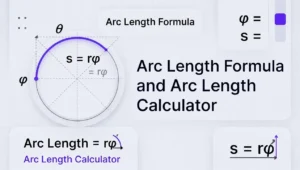
The general arc length formula is:s=rθ
Where:
- s = arc length
- r = radius of the circle
- θ = central angle (in radians)
This formula works when the angle is measured in radians.
Variables Explained (Radius and Central Angle)
Radius (r)
The radius is the distance from the center of the circle to any point on its edge.
Central Angle (θ)
The central angle is the angle formed by two radii that intersect the arc.
A larger central angle results in a longer arc.
Arc Length Formula Using Degrees
Many geometry problems use degrees instead of radians, especially in school-level mathematics.
The formula becomes:s=360∘θ×2πr
Calculation Steps
- Identify the radius of the circle.
- Determine the central angle in degrees.
- Divide the angle by 360°.
- Multiply the result by the circle’s circumference.
Example:
Radius = 10 cm
Angle = 90°s=36090×2π(10) s=41×20π s=5π≈15.7 cm
Converting Angles
Sometimes you must convert degrees to radians before applying formulas.
Conversion formula:Radians=Degrees×180π
Example:90∘=2π
Arc Length Formula Using Radians
Radians are the preferred unit in advanced mathematics and calculus because they simplify many formulas.
Using radians, the arc length formula becomes extremely simple:s=rθ
No additional conversion factors are required.
Why Radians Are Commonly Used in Mathematics
Radians directly relate angles to the circle’s radius and circumference. This makes many trigonometric identities and calculus formulas easier to work with.
Radians are widely used in:
- Physics
- Engineering
- Computer graphics
- Calculus
Relationship Between Radians and Circle Circumference
A full circle equals:2π radians
This corresponds exactly to the full circumference.
Therefore:
- π radians = half a circle
- 2π radians = quarter circle
Deriving the Arc Length Formula
The arc length formula comes from proportional relationships in circles.
A full circle has circumference:2πr
If the central angle represents only a fraction of the full circle, the arc length will represent the same fraction of the circumference.
This leads to the proportional formula:s=360θ×2πr
Or when using radians:s=rθ
Common Mistakes When Applying the Arc Length Formula
Even simple arc calculations can lead to errors if the units or formulas are misunderstood.
Unit Confusion
Students often mix:
- Degrees
- Radians
Using the wrong formula with the wrong unit leads to incorrect results.
Always check the angle format before calculating.
Angle Format Errors
Another common mistake is forgetting to convert degrees into radians when using the simplified formula s=rθ.
This formula only works correctly if θ is measured in radians.
Simplified Arc Length Equation
When working with radians, the equation:s=rθ
is the fastest and most efficient method.
It is widely used in higher mathematics, physics simulations, and engineering computations.
Practical Calculation Examples
Example 1
Radius = 8 m
Angle = 3πs=rθ s=8×3π s=38π≈8.38 meters
Example 2
Radius = 15 cm
Angle = 120°s=360120×2π(15) s=31×30π s=10π≈31.42 cm
Arc Length in Calculus
Arc length is one of the most fascinating concepts in calculus because it allows us to measure the actual length of a curved path. While measuring a straight line is simple, calculating the length of a curve requires more advanced mathematical tools. This is where calculus becomes essential.
Arc length appears in many real-world applications such as engineering design, physics simulations, architecture, robotics, and computer graphics. Whenever a path bends, twists, or forms a smooth curve, arc length provides the mathematical framework needed to determine its precise distance.
In simple terms, arc length represents the distance along a curve between two points. Unlike the straight-line distance, it follows the exact shape of the curve itself.
Understanding arc length is important not only in theoretical mathematics but also in practical fields where precision measurements along curved surfaces or trajectories are required.
Arc Length Formula for Functions
In calculus, many curves are described by functions such as:y=f(x)
To measure the arc length of such a curve between two points x=a and x=b, calculus provides the following formula:L=∫ab1+(dxdy)2dx
This formula calculates the total length of the curve by integrating tiny straight-line approximations along the path.
Curves Defined as Functions
When a curve is defined as a function y=f(x), each value of x corresponds to exactly one value of y. These types of curves are common in calculus and include examples such as:
- Polynomial functions
- Trigonometric functions
- Exponential and logarithmic curves
- Rational functions
For example, the arc length of a parabola such as:
y=x2-10-8-6-4-224681020406080100
between two points can be calculated using the arc length formula above.
Because the derivative dxdy describes the rate of change of the curve, it plays a crucial role in determining how steep the curve is at any point.
Arc Length of a Curve Using Integration
Calculating arc length relies on the idea of breaking a curve into extremely small segments and adding their lengths together. This concept comes from integral calculus.
Concept of Infinitesimal Segments
Imagine zooming in on a tiny portion of a curve. At a very small scale, the curved segment begins to resemble a straight line.
Each tiny piece has a small length ds, and the total arc length is found by summing all these segments:L=∫ds
Using calculus, this differential element becomes:ds=1+(dxdy)2dx
By integrating these small pieces from point a to b, we obtain the full arc length.
Role of Derivatives
The derivative dxdy represents the slope of the curve at a specific point.
The steeper the slope, the longer the small segment becomes. The arc length formula accounts for this by squaring the derivative and incorporating it into the square root.
This ensures the formula correctly measures the actual distance along the curve rather than the horizontal distance.
Arc Length Formula for Parametric Equations
Not all curves can be easily written as y=f(x). Some curves are better represented using parametric equations.
A parametric curve is defined using a parameter, usually t:x=x(t) y=y(t)
The arc length formula for parametric curves becomes:L=∫t1t2(dtdx)2+(dtdy)2dt
Parametric Curves Explained
Parametric equations are commonly used to describe motion or curves that loop or overlap.
Examples include:
- Circular motion
- Cycloids
- Spirals
- Trajectories in physics
For instance, a circle can be expressed parametrically as:x=rcost y=rsint
This form makes it easier to analyze the curve and compute its arc length.
Arc Length for Polar Coordinates
Another important coordinate system used in calculus is polar coordinates, where curves are defined by a radius and an angle.
A polar curve has the form:r=f(θ)
The arc length formula in polar coordinates is:L=∫θ1θ2r2+(dθdr)2dθ
Special Cases in Calculus
Polar arc length calculations are useful when dealing with curves such as:
- Spiral curves
- Rose curves
- Cardioids
- Circular arcs
These shapes appear frequently in fields like antenna design, orbital mechanics, and mechanical engineering.
Why Calculus is Necessary for Complex Curves
Before calculus was developed, measuring the length of irregular curves was extremely difficult. Classical geometry worked well for simple shapes like circles or straight lines but struggled with more complicated curves.
Calculus solved this problem by introducing limits, derivatives, and integrals.
Non-Circular Curves
Many curves found in nature and science are not simple circles or arcs. Examples include:
- Parabolic trajectories
- Wave patterns
- Elliptical paths
- Spiral galaxies
These shapes require calculus to determine their exact arc length.
Natural Shapes and Engineering Designs
Arc length calculations are used in many modern industries, including:
- Civil engineering for designing curved roads and bridges
- Robotics for calculating movement paths
- Computer graphics for rendering smooth curves
- Aerospace engineering for trajectory planning
Because these curves can be mathematically complex, digital tools are often used to assist with the calculations.
Using an Arc Length Calculator
While manual calculations are valuable for learning calculus, real-world problems often involve complex equations that are time-consuming to solve by hand. This is where an arc length calculator becomes extremely useful.
What Is an Arc Length Calculator
An arc length calculator is a digital mathematical tool designed to automatically compute the length of a curve.
It can process different types of inputs, including:
- Radius and central angle
- Function equations
- Parametric equations
- Polar coordinate functions
By applying the correct formulas internally, the calculator produces an accurate arc length result within seconds.
How an Online Arc Length Calculator Works
Modern online calculators rely on symbolic math engines and numerical integration algorithms.
Input Variables
Users typically enter one of the following inputs:
- Curve equation y=f(x)
- Parametric equations
- Polar functions
- Radius and central angle for circular arcs
Automatic Calculations
Once the inputs are provided, the calculator automatically:
- Determines the appropriate arc length formula
- Computes derivatives if needed
- Performs numerical integration
- Displays the final arc length value
Some advanced calculators also provide graphical representations of the curve.
Steps to Use an Arc Length Calculator
Using an online calculator is usually straightforward and requires only a few steps.
Enter Radius or Curve Function
Depending on the problem, the user inputs:
- A function equation
- Parametric expressions
- A circle radius
Input Central Angle or Equation
For circular arcs, the central angle must be entered.
For other curves, the calculator requires the interval limits.
Choose Unit Type
Many calculators allow users to select measurement units such as:
- meters
- centimeters
- feet
- radians or degrees
Generate Result Instantly
After entering the necessary data, clicking the calculate button will generate the arc length immediately.
This eliminates the need for lengthy manual integration.
Benefits of Using a Digital Calculator
Arc length calculators provide several practical advantages for students and professionals.
Saves Time
Manual arc length integration can be complex and time-consuming. A calculator can produce results in seconds.
Reduces Human Error
Mistakes in derivatives or integration steps can lead to incorrect results. Automated tools minimize these risks.
Handles Complex Equations
Advanced calculators can process difficult equations that may require sophisticated numerical methods.
This makes them valuable tools for engineering analysis, scientific research, and advanced mathematics education.
Features of Modern Geometry Calculators
Today’s geometry and calculus calculators are much more advanced than simple numeric tools.
Multi-Curve Support
Modern calculators can handle multiple curve types including:
- Cartesian functions
- Parametric equations
- Polar curves
- Circular arcs
This flexibility allows them to solve a wide range of mathematical problems.
Graph Visualization
Many tools display the curve visually, helping users understand the shape and path of the function.
Graph visualization improves learning and allows quick verification of results.
Step-by-Step Solution
Some advanced arc length calculators provide step-by-step explanations of the calculations.
This feature is particularly helpful for students studying calculus because it shows how the arc length formula is applied in each stage of the solution.
Manual Calculation vs Arc Length Calculator
Arc length is an essential concept in mathematics, engineering, physics, and many real-world applications. It represents the distance along a curved line between two points. Traditionally, arc length has been calculated manually using mathematical formulas. However, with modern technology, automated arc length calculators can instantly compute results.
Both approaches have their own strengths. Understanding when to use manual calculations and when to rely on automated tools can improve accuracy, efficiency, and learning outcomes.
Advantages of Manual Calculations
Manual arc length calculations remain an important skill, especially in education and theoretical mathematics. Even though digital tools exist, solving problems manually provides several valuable benefits.
Deeper Understanding
When calculating arc length manually, students and professionals must apply mathematical formulas and concepts step by step. For example, the arc length of a circle sector is calculated using the formula:
- Arc Length = r × θ (if the angle is in radians)
or
- Arc Length = (θ / 360°) × 2πr (if the angle is in degrees)
Working through these formulas helps build a deeper understanding of geometric relationships between radius, angle, circumference, and curved distance.
Manual calculation also strengthens problem-solving skills. It encourages logical thinking and improves familiarity with mathematical principles such as trigonometry, geometry, and calculus.
Useful in Exams
In academic environments, calculators or online tools are often restricted. Students must know how to calculate arc length using formulas and mathematical reasoning.
Manual knowledge is particularly useful in:
- Mathematics exams
- Engineering entrance tests
- Physics problem solving
- Competitive academic assessments
Students who understand the manual process can also identify mistakes more easily when reviewing their work.
Advantages of Automated Calculators
While manual methods are educational, automated arc length calculators offer powerful benefits for practical applications.
Faster Results
Online calculators and mathematical software can compute arc length instantly. Instead of manually applying formulas and performing multiple steps, users simply enter:
- Radius or function
- Angle or interval
- Units of measurement
The calculator then produces accurate results within seconds. This speed is especially helpful when solving complex equations or working with large datasets.
Ideal for Engineers and Researchers
Professionals working in engineering, architecture, physics, and data science frequently need precise arc length calculations.
Automated tools help them:
- Analyze complex curved structures
- Calculate arc length of parametric or polar functions
- Model curved surfaces and motion paths
- Perform repeated calculations efficiently
Modern tools can even calculate arc length for advanced calculus functions, which would be extremely time-consuming to solve manually.
Accuracy Comparison
Accuracy depends on how calculations are performed.
Manual calculations are accurate when the formulas are applied correctly. However, they are more prone to human error, such as:
- Incorrect formula usage
- Unit conversion mistakes
- Rounding errors
- Calculation slips
Automated calculators reduce these risks by performing computations using precise algorithms.
However, calculators are only as reliable as the input provided. Incorrect values, wrong units, or misunderstanding of the formula can still lead to incorrect results.
For best accuracy, many professionals combine both approaches:
- Understand the theory manually
- Verify results using a calculator or software
When You Should Use Each Method
Choosing between manual calculation and an arc length calculator depends on the situation.
Manual calculation is best when:
- Learning mathematics concepts
- Solving exam questions
- Demonstrating mathematical proofs
- Building conceptual understanding
Automated calculators are better when:
- Working with complex functions
- Performing repetitive calculations
- Solving real engineering problems
- Saving time during research or design processes
In practice, professionals often learn the theory first and then rely on computational tools for efficiency.
Arc Length Applications in Real Life
Arc length is not just a theoretical concept in mathematics. It plays a crucial role in many real-world industries and scientific fields.
Understanding arc length helps engineers design machines, architects build curved structures, and scientists analyze motion along curved paths.
Engineering Applications
Engineering frequently involves curved components and circular motion. Arc length calculations are essential for designing mechanical systems and industrial equipment.
Gear Systems
Gear teeth follow curved paths along circular edges. Engineers use arc length calculations to determine:
- Tooth spacing
- Contact points between gears
- Rotational movement efficiency
Accurate measurements ensure smooth motion and reduce mechanical wear.
Circular Tracks
Arc length is also used when designing circular tracks such as:
- Roller coaster tracks
- Railway curves
- Racing circuits
- Conveyor belt systems
Precise arc measurements help maintain safety, smooth transitions, and structural stability.
Machine Components
Many machine parts contain curved surfaces or rotating components. Examples include:
- Turbines
- Rotating arms
- Industrial rollers
- Mechanical cams
Arc length calculations help engineers determine motion range, component alignment, and structural balance.
Architecture and Structural Design
Architecture often incorporates curves to improve aesthetics, strength, and spatial efficiency.
Dome Structures
Domes are common in stadiums, mosques, cathedrals, and modern architectural designs. Engineers use arc length formulas to calculate:
- Curved surface measurements
- Material distribution
- Structural load balance
Accurate arc calculations help ensure the dome structure remains stable.
Arched Bridges
Arches distribute weight more efficiently than straight beams. Bridge engineers calculate arc length to determine:
- Curvature of the arch
- Stress distribution
- Structural symmetry
This helps create bridges that are both strong and visually impressive.
Physics and Motion
In physics, arc length plays an important role when analyzing motion along curved paths.
Circular Motion
Objects moving in circular paths—such as rotating wheels or satellites—travel along arcs. Physicists use arc length calculations to determine:
- Distance traveled along a circular path
- Angular displacement
- Rotational velocity
These calculations are essential for understanding rotational dynamics.
Wave Paths
Certain wave patterns follow curved trajectories. Arc length helps measure the distance along these waveforms, which is useful in:
- wave mechanics
- signal processing
- electromagnetic field analysis
Computer Graphics and Animation
In computer graphics, curved paths are used to create realistic visual effects and smooth animations.
Curve Modeling
Graphic designers and 3D artists often work with curves such as:
- Bézier curves
- spline curves
- parametric curves
Arc length helps determine accurate spacing along these curves, improving object placement and animation timing.
3D Rendering
Rendering engines calculate curved surfaces for objects like:
- vehicle bodies
- character models
- terrain curves
Arc length calculations help maintain consistent geometry and realistic visual movement.
Navigation and Satellite Orbits
Arc length also plays a significant role in space science and navigation.
Orbital Path Calculations
Satellites orbit Earth along curved paths. Engineers use arc length calculations to determine:
- orbital distance
- satellite travel path
- communication coverage areas
These calculations are crucial for GPS systems and satellite networks.
Planetary Motion
Astronomers use arc length concepts to analyze planetary motion. By measuring the curved distance traveled along an orbital path, scientists can better understand:
- orbital periods
- gravitational interactions
- planetary trajectories
Arc Length in Different Mathematical Fields
Arc length connects multiple branches of mathematics. Each field approaches the concept from a different perspective.
Geometry
In geometry, arc length is primarily associated with circles and sectors.
Common geometric problems include:
- calculating the arc of a circle
- measuring sector length
- determining curved boundaries
These calculations often rely on the relationship between angle, radius, and circumference.
Calculus
Calculus extends the concept of arc length to complex curves and functions.
The general arc length formula for a function y=f(x) is:L=∫ab1+(dxdy)2dx
This formula allows mathematicians to measure the length of curves that cannot be represented by simple circular arcs.
Calculus-based arc length calculations are widely used in advanced mathematics, physics, and engineering.
Trigonometry
Trigonometry plays a major role in arc length calculations because angles determine the portion of the circle being measured.
Key trigonometric concepts include:
- radian measure
- angle conversion
- relationships between radius and angle
Using radians simplifies many arc length formulas and is commonly preferred in higher mathematics.
Physics
In physics, arc length describes motion along curved trajectories.
Examples include:
- rotating wheels
- pendulum motion
- planetary orbits
- curved projectile paths
Arc length allows physicists to measure actual travel distance rather than just straight-line displacement.
Step-by-Step Arc Length Calculation Examples
Arc length is one of the most practical concepts in mathematics and geometry. It helps measure the distance along a curved path, rather than a straight line. This concept is widely used in engineering, architecture, physics simulations, robotics, and even computer graphics.
Understanding how to calculate arc length becomes much easier when you see clear examples step by step. Below are several practical cases, starting from simple circle calculations to more advanced curves and parametric equations.
Example 1: Arc Length of a Circle
The most common arc length problem involves a circle segment. When the radius and central angle are known, the arc length can be calculated using a simple formula.
Arc Length Formula (Circle):s=rθ
Where:
- s = arc length
- r = radius of the circle
- θ = central angle in radians
Known Radius and Angle
Suppose we have:
- Radius r = 10 cm
- Central angle θ = 60°
Because the formula requires radians, we convert degrees to radians.60°=18060π=3π
Now substitute into the formula:s=10×3π s≈10.47 cm
So, the arc length of the circle segment is approximately 10.47 cm.
This type of calculation is commonly used in wheel motion, circular tracks, and rotating machinery design.
Example 2: Using Radians
Radians simplify arc length calculations because the formula works directly without conversion.
Suppose:
- Radius r = 7 m
- Angle θ = 1.8 radians
Apply the formula:s=rθ s=7×1.8 s=12.6 meters
This means the curved path along the circle is 12.6 meters long.
Radians are widely used in physics, engineering calculations, and calculus-based arc length problems because they integrate smoothly into mathematical formulas.
Example 3: Arc Length of a Function
Arc length isn’t limited to circles. You can also calculate the length of a curve defined by a function.
For a function y=f(x), the arc length between x = a and x = b is:L=∫ab1+(dxdy)2dx
Example
Find the arc length of:
y=x2-10-8-6-4-224681020406080100-4.7, 22.3
from x = 0 to x = 1.
Step 1: Find the derivative.dxdy=2x
Step 2: Substitute into the formula.L=∫011+(2x)2dx L=∫011+4×2dx
This integral can be solved using calculus techniques or a symbolic calculator.
The approximate result:L≈1.48
This example demonstrates how arc length applies to parabolic curves, trajectory paths, and mathematical modeling.
Example 4: Parametric Curve Example
Many curves in physics and engineering are expressed using parametric equations.
The arc length formula for parametric curves is:L=∫ab(dtdx)2+(dtdy)2dt
Example
Given:x=t2 y=t3
for t from 0 to 1.
Step 1: Compute derivatives.dtdx=2t dtdy=3t2
Step 2: Substitute into the formula.L=∫01(2t)2+(3t2)2dt L=∫014t2+9t4dt
Step 3: Factor the expression.L=∫01t4+9t2dt
After solving the integral, the arc length is approximately:L≈1.44
Parametric arc length calculations are widely used in robot motion paths, animation curves, and orbital simulations.
Example 5: Using an Arc Length Calculator
In many real-world situations, arc length calculations can become complex. That’s where arc length calculators become useful.
These tools can instantly compute arc length for:
- circular arcs
- polynomial curves
- parametric equations
- polar curves
To use a calculator effectively:
- Enter the function or equation.
- Specify the interval (start and end values).
- Choose the variable format (x, t, or θ).
- Run the calculation.
Modern calculators or math software can handle advanced arc length problems involving integrals and complex curves, making them helpful for students, engineers, and researchers.
Common Errors in Arc Length Calculations
Even simple arc length problems can lead to mistakes if certain details are overlooked. Understanding common errors helps avoid incorrect results.
Mixing Degree and Radian Units
One of the most frequent mistakes is using degrees instead of radians in the arc length formula.
Remember:s=rθ
only works correctly when θ is in radians.
If the angle is given in degrees, convert it first.Radians=Degrees×180π
Failing to convert can lead to results that are off by a large factor.
Incorrect Radius Value
Another common issue is using the wrong radius.
This happens when:
- the diameter is mistaken for the radius
- the radius changes within a geometric diagram
- measurements are not clearly labeled
Always verify that the value used is the actual radius from the center to the curve.
Forgetting Conversion Factors
Arc length problems often involve unit conversions, especially in engineering contexts.
Examples include:
- centimeters to meters
- degrees to radians
- inches to feet
Forgetting conversion factors can cause major calculation inaccuracies.
Misinterpreting Curve Functions
When working with calculus-based arc length formulas, misunderstanding the function can lead to incorrect derivatives.
Typical issues include:
- differentiating incorrectly
- applying the wrong arc length formula
- ignoring limits of integration
Carefully reviewing the function and derivative helps prevent these errors.
Tips to Master Arc Length Problems
Mastering arc length requires more than memorizing formulas. It involves understanding geometry, calculus, and visualization.
Here are several strategies to improve accuracy and speed.
Understanding the Geometry First
Before jumping into calculations, analyze the shape of the curve.
Ask questions like:
- Is the curve part of a circle?
- Is it a function or parametric curve?
- What are the boundaries?
Visualizing the curve helps determine which formula to use.
Memorizing the Core Formula
Three essential arc length formulas cover most problems:
Circle arc lengths=rθ
Function arc lengthL=∫ab1+(f′(x))2dx
Parametric arc lengthL=∫ab(x′(t))2+(y′(t))2dt
Knowing when to apply each formula makes solving problems much faster.
Practicing Different Curve Types
Practice with multiple curve types, such as:
- circular arcs
- parabolas
- exponential curves
- parametric paths
- polar equations
Exposure to diverse examples improves problem-solving flexibility.
Using Visualization Tools
Graphing tools can make arc length concepts clearer.
Helpful tools include:
- graphing calculators
- math visualization software
- interactive geometry apps
Seeing the curve visually helps understand how the arc length relates to the shape.
Combining Formula and Calculator Techniques
The most efficient approach is combining manual understanding with digital tools.
For example:
- Identify the correct formula.
- Simplify the expression analytically.
- Use a calculator or software to evaluate the integral.
This method balances mathematical insight with computational efficiency, which is essential for solving complex arc length problems.
Advanced Arc Length Concepts
Arc length is one of the most practical concepts in geometry and calculus. Instead of simply measuring straight distances, arc length allows us to calculate the actual distance along curved paths. This becomes especially important in engineering, physics, computer graphics, and modern technology systems that rely on precise curved motion.
As mathematics evolved, researchers developed advanced methods to measure arc length for different types of curves. These include parametric curves, polar curves, and complex shapes that cannot be solved using basic geometry formulas. Today, both analytical and numerical techniques are widely used to compute arc length with high precision.
Arc Length of Parametric Curves
Parametric curves describe a path using equations that depend on a parameter, usually denoted as t. Instead of expressing y directly as a function of x, both coordinates are defined separately:
- x = f(t)
- y = g(t)
This representation is very useful when describing motion, trajectories, and complex shapes.
The arc length of a parametric curve between two parameter values is calculated using the formula:L=∫ab(dx/dt)2+(dy/dt)2dt
This formula measures the continuous distance traveled along the curve.
Parametric arc length calculations are widely used in several fields:
- Physics simulations to measure particle trajectories
- Computer animation to control smooth motion paths
- Engineering design for curved components
- Robot movement planning in automated systems
For example, when animating a car moving along a curved road in a simulation, the path is often represented parametrically so the motion remains smooth and realistic.
Arc Length of Polar Curves
Polar coordinates represent curves in a different way compared to Cartesian coordinates. Instead of using x and y, a point is described using:
- r (distance from origin)
- θ (angle)
Many natural and scientific patterns are easier to describe using polar equations. Common examples include spirals, circular waves, and planetary orbits.
The arc length of a polar curve is calculated using:L=∫αβr2+(dθdr)2dθ
This formula allows mathematicians to measure the true length of curves such as:
- Archimedean spirals
- Cardioids
- Rose curves
- Logarithmic spirals
Polar arc length calculations appear in many modern applications including antenna design, signal processing, and orbital modeling.
For instance, engineers designing spiral antennas rely on polar arc length measurements to ensure correct signal coverage and efficiency.
Numerical Methods for Arc Length
In many real-world cases, calculating arc length analytically is either extremely difficult or impossible. When formulas cannot be solved symbolically, numerical methods are used instead.
Numerical arc length estimation works by breaking the curve into many small segments and approximating the total length.
Common numerical techniques include:
- Trapezoidal Rule
- Simpson’s Rule
- Riemann Sum Approximations
- Adaptive Numerical Integration
These methods are widely used in scientific computing software such as MATLAB, Python (NumPy/SciPy), and engineering simulation tools.
Recent developments in computational mathematics allow numerical arc length calculations to achieve extremely high accuracy, even for highly complex curves used in machine learning and computer graphics.
Approximation Techniques
Approximation methods are particularly useful when dealing with irregular curves or real-world measurement data.
Instead of working with exact equations, approximation techniques estimate arc length using discrete data points.
Some commonly used methods include:
Polygonal Approximation
The curve is approximated by connecting nearby points with straight line segments. The total length is calculated by summing the lengths of these segments.
This method is frequently used in:
- GPS path measurements
- Geographic mapping
- Digital drawing tools
Spline Interpolation
Spline curves create smooth approximations between data points. These are commonly used in computer graphics and engineering modeling.
Splines provide a balance between accuracy and computational efficiency, making them ideal for large datasets.
Curve Fitting
Curve fitting techniques approximate a dataset with a mathematical function, after which the arc length can be computed using calculus.
This method is widely used in scientific research, particularly in fields such as astronomy and biomechanics.
Arc Length in Modern Technology
Although arc length originated as a mathematical concept, it has become a critical tool in modern technology. Many systems that involve curved motion, shapes, or trajectories rely on arc length calculations for accuracy and efficiency.
From industrial robotics to space exploration, arc length plays an important role in solving real-world problems.
Computer-Aided Design (CAD)
Computer-Aided Design software uses arc length calculations extensively when creating and measuring curved objects.
Modern CAD tools allow engineers and designers to build complex components such as:
- aerodynamic surfaces
- automotive body panels
- turbine blades
- architectural curves
Arc length measurements help determine:
- material requirements
- structural properties
- manufacturing precision
For example, when designing a curved bridge support, engineers must know the exact arc length to ensure materials are cut accurately.
Popular CAD platforms such as AutoCAD, SolidWorks, and Fusion 360 automatically calculate arc lengths for curves and splines inside their modeling environments.
Robotics Path Planning
In robotics, calculating path length is essential for efficient movement.
Robots rarely move in perfectly straight lines. Instead, their motion often follows curved trajectories to avoid obstacles and optimize energy consumption.
Arc length calculations help robotics systems:
- determine optimal movement paths
- control joint rotation along curves
- maintain smooth velocity changes
- improve navigation accuracy
Autonomous vehicles and warehouse robots rely heavily on these calculations when navigating complex environments.
For example, modern delivery robots use path-planning algorithms that include arc length measurements to travel efficiently through crowded spaces.
Space Science and Astronomy
Arc length calculations also play a role in astrophysics and orbital mechanics.
Scientists use curved path measurements when studying:
- satellite trajectories
- planetary orbits
- gravitational slingshot maneuvers
- telescope scanning paths
Even though planetary motion follows elliptical orbits, measuring arc segments along these paths helps determine travel distances and orbital timing.
NASA and other space agencies rely on arc length calculations when planning spacecraft trajectories and interplanetary missions.
In deep space navigation, small errors in distance measurements can lead to massive deviations over millions of kilometers. Accurate arc length computation helps maintain precision.
Data Visualization and Graphing Tools
Modern data visualization tools often represent information using curved graphs and complex data trends.
Arc length can be used to analyze:
- curve complexity
- graph smoothing
- signal patterns
- trajectory comparisons
Data scientists sometimes use arc length as a metric to quantify how rapidly a function changes over a given interval.
Visualization platforms such as Python Matplotlib, Tableau, and D3.js allow developers to analyze and measure curves in datasets.
Best Tools and Online Arc Length Calculators
With the rise of digital learning and engineering tools, many software platforms now provide arc length calculation features. These tools help students, engineers, and researchers quickly analyze curves without performing manual calculations.
Features to Look For in a Geometry Calculator
When choosing a geometry or arc length calculator, several features can make the tool more useful and accurate.
Important features include:
- symbolic integration capability
- graph visualization
- parametric and polar equation support
- step-by-step solutions
- numerical approximation options
Interactive graph displays are particularly useful because they allow users to visually confirm the curve before calculating its arc length.
Some advanced calculators also provide dynamic sliders that allow users to adjust curve parameters in real time.
Scientific Calculators vs Online Tools
Traditional scientific calculators can compute arc length indirectly, but they usually require manual input of formulas and numerical integration.
Online arc length tools provide several advantages:
- faster computation
- graphical curve visualization
- automatic formula selection
- support for complex functions
However, scientific calculators remain useful for exams, offline calculations, and quick approximations.
Many modern students use a combination of both tools depending on their needs.
Educational Math Platforms
Educational platforms increasingly integrate arc length calculators and interactive learning modules.
Popular platforms include:
- Wolfram Alpha
- Desmos Graphing Calculator
- GeoGebra
- Khan Academy tools
These platforms allow students to explore curves interactively and immediately see how arc length changes when the equation is modified.
Interactive learning has been shown to significantly improve understanding of calculus concepts, especially topics involving geometry and integration.
Graphing Software for Curve Measurement
Professional graphing software provides powerful features for analyzing curves and measuring arc length with high precision.
Examples include:
- MATLAB
- Mathematica
- Python libraries (Matplotlib, SciPy)
- Maple mathematical software
These tools are commonly used in research, engineering analysis, and scientific computing.
For instance, Python’s SciPy integration functions can compute arc lengths for highly complex functions that would be nearly impossible to solve manually.
As computing power continues to grow, these tools are becoming increasingly accessible, making advanced arc length calculations available to students, engineers, and researchers around the world.
Frequently Asked Questions About Arc Length
Understanding arc length becomes much easier once you grasp the basic formula and the concept behind it. However, many students, engineers, and professionals still have practical questions about how arc length works in real situations. Below are some of the most commonly asked questions, explained in a clear and simple way.
What is the easiest way to calculate arc length?
The easiest way to calculate arc length depends on the information you already have. For most basic problems involving circles, the standard arc length formula is the quickest method:
Arc Length = r × θ
Where:
- r = radius of the circle
- θ = central angle in radians
If the angle is given in degrees, you first convert it into radians using the formula:
θ (radians) = θ (degrees) × π / 180
For example, if a circle has a radius of 10 units and a central angle of 60°, the arc length can be calculated as:
- Convert 60° to radians → 60 × π / 180 = π/3
- Arc length = 10 × π/3
- Result ≈ 10.47 units
For more complex curves, such as those found in physics simulations, computer graphics, or engineering designs, arc length may require integral calculus or the use of an arc length calculator.
Today, many people rely on online arc length calculators, which automatically compute the arc length when you input the radius and angle. These tools are especially helpful for students or professionals working with multiple calculations.
When should radians be used instead of degrees?
Radians should be used whenever you apply arc length formulas in mathematics, calculus, physics, and engineering.
The arc length formula works directly with radians because radians naturally describe the relationship between an angle and the circle’s radius. When using radians, the formula becomes extremely simple:
Arc Length = rθ
If degrees were used directly, the formula would need additional conversion factors, making calculations more complicated.
Radians are commonly used in:
- Calculus and advanced mathematics
- Engineering calculations
- Physics formulas
- Computer graphics and simulations
- Trigonometric modeling
For example, when calculating the length of a curved path in robotics or the trajectory of a moving object, radians provide a more precise and consistent measurement.
Degrees are still useful in everyday geometry problems, but in technical calculations, radians are almost always preferred.
Can arc length be calculated without calculus?
Yes, arc length can absolutely be calculated without calculus when dealing with simple circular arcs.
If the curve belongs to a perfect circle, you only need:
- the radius
- the central angle
Then you apply the arc length formula:
Arc Length = rθ
This approach is commonly taught in high school geometry and works perfectly for basic circular arcs.
However, calculus becomes necessary when working with non-circular curves, such as:
- parabolas
- sine waves
- polynomial curves
- parametric curves
- irregular engineering shapes
In these cases, arc length is calculated using an arc length integral formula:
L = ∫ √(1 + (dy/dx)²) dx
This formula measures the exact length of a curve by dividing it into very small segments and summing them together.
Although calculus may sound intimidating, modern graphing software and arc length calculators make these calculations much easier.
Are arc length calculators accurate?
Yes, arc length calculators are generally very accurate, especially when they use precise mathematical algorithms.
Most modern calculators and software tools use advanced computational methods to evaluate arc length formulas. These tools are commonly used in:
- engineering design software
- CAD modeling programs
- architectural tools
- physics simulations
- educational platforms
Accuracy depends on several factors:
- Correct input values (radius, angle, or curve equation)
- Precision settings used by the calculator
- Numerical approximation methods for complex curves
For simple circular arcs, the results are typically exact or extremely precise.
For complex curves, calculators rely on numerical integration techniques, such as:
- Simpson’s Rule
- Trapezoidal Rule
- Adaptive quadrature
These methods approximate the arc length by dividing the curve into smaller segments and calculating the total length.
Overall, arc length calculators are reliable tools and can save a significant amount of time compared to manual calculations.
What is the difference between arc length and sector area?
Arc length and sector area both describe parts of a circle, but they measure different geometric quantities.
Arc Length
Arc length measures the distance along the curved edge of a circle.
Formula:
Arc Length = rθ
It represents a linear measurement, similar to measuring the length of a curved road or track.
Examples:
- the length of a curved bridge
- the path of a rotating wheel
- the curve of a circular track
Sector Area
Sector area measures the two-dimensional area enclosed by the arc and two radii.
Formula:
Sector Area = (1/2) r²θ
This represents a surface area, not a line.
Examples include:
- a slice of pizza
- a wedge of a circular pie chart
- sections of rotating mechanical parts
Key Difference
| Concept | What it Measures | Formula |
|---|---|---|
| Arc Length | Curved distance along a circle | rθ |
| Sector Area | Area of a circular slice | ½ r²θ |
Both concepts are important in geometry, physics, architecture, and engineering, especially when working with circular designs.
Conclusion: Mastering Arc Length Formula and Calculations
Arc length is a fundamental concept in geometry that helps us measure the distance along curved shapes. While the idea may initially seem complicated, it becomes much easier once you understand the relationship between radius, angle, and radians.
Key Concepts Summary
To recap the most important points:
- Arc length represents the distance along a circular curve.
- The basic formula is Arc Length = rθ.
- The angle must be in radians for the formula to work directly.
- Simple circular arcs can be calculated without calculus.
- More complex curves require calculus-based arc length formulas.
Once you become familiar with these principles, calculating arc length becomes a straightforward process.
Importance in Mathematics and Engineering
Arc length plays an important role in many scientific and technical fields.
In mathematics, it helps analyze curves, trigonometric functions, and parametric equations.
In engineering, arc length is used when designing curved structures, including:
- bridges
- tunnels
- roads
- pipelines
- mechanical gears
Architects also rely on arc length calculations when designing domes, arches, and circular layouts.
In physics, arc length helps describe motion along curved paths, such as circular motion, planetary orbits, and rotating systems.
Role of Digital Arc Length Calculator Tools
With modern technology, calculating arc length has become faster and easier than ever.
Many students and professionals now use online arc length calculator tools that can instantly compute results based on input values.
These tools often support:
- circular arc length calculations
- parametric curve arc length
- polar coordinate arc length
- calculus-based curve analysis
Advanced engineering software can even calculate arc length directly from 3D models and CAD drawings.
Digital calculators not only save time but also reduce the chance of human error when performing complex calculations.
Encouragement to Practice and Explore Advanced Curve Calculations
Like any mathematical concept, mastering arc length requires practice and exploration.
Start by solving simple problems involving circles and central angles. Once you feel comfortable, you can move on to more advanced topics such as:
- parametric curve arc length
- polar coordinate curves
- Bezier curves in computer graphics
- numerical approximation methods
These advanced techniques are widely used in fields like robotics, animation, aerospace engineering, and data visualization.
The more you practice calculating arc length, the more intuitive it becomes. With the help of modern calculators, mathematical tools, and visualization software, learning arc length can be both practical and enjoyable.
By understanding how curves work mathematically, you gain valuable insight into the geometry that shapes many systems in the real world.