🔧 Nm to ft-lbs Torque Conversion Calculator
Professional torque converter with complete guide and real-world applications
TORQUE UNITS OVERVIEW
Nm (Newton Meter) – SI Metric Unit
• 1 Nm = Torque produced by 1 Newton force acting 1 meter from pivot point
• Used globally in automotive and engineering
• Standard unit in most modern vehicles
ft-lbs (Foot-Pound) – Imperial Unit
• 1 ft-lb = Torque produced by 1 pound force acting 1 foot from pivot point
• Common in USA and UK automotive industry
• Traditional unit for torque wrenches
Conversion Formulas:
• Nm to ft-lbs: ft-lbs = Nm × 0.737562
• ft-lbs to Nm: Nm = ft-lbs × 1.35582
• These conversion factors are precise and used in professional engineering
⚙️ Torque Conversion Calculator
📊 Display Options
⚠️ Important Tips: Always use a calibrated torque wrench for critical applications. Over-tightening can damage threads, while under-tightening can cause loosening. Follow manufacturer specifications.
📊 Conversion Results
📝 Step-by-Step Calculation
📋 Quick Reference Table (Low-Medium-High Torque)
| Nm | ft-lbs | Common Application |
|---|---|---|
| 10 Nm | 7.38 ft-lbs | Small bolts, electronics |
| 25 Nm | 18.44 ft-lbs | Bicycle components |
| 50 Nm | 36.88 ft-lbs | Motorcycle torque |
| 100 Nm | 73.76 ft-lbs | Car engine bolts |
| 150 Nm | 110.63 ft-lbs | Car wheel lug nuts |
| 250 Nm | 184.39 ft-lbs | Truck bolts |
| 500 Nm | 368.78 ft-lbs | Industrial machinery |
| 1000 Nm | 737.56 ft-lbs | Heavy machinery |
📚 Understanding Torque
What is Torque? Torque is a rotational force that causes an object to rotate around an axis. It's calculated as force multiplied by distance from the pivot point.
Why Different Units? Nm is the SI (metric) standard used globally, while ft-lbs is traditional in the USA and UK. Both measure the same physical quantity.
Torque Wrench Usage: A torque wrench allows you to apply a specific amount of torque to a fastener. This prevents over-tightening (which can strip threads or break bolts) and under-tightening (which can cause loosening).
Digital vs Click Torque Wrenches: Digital wrenches display exact values and can switch units instantly. Click wrenches produce an audible "click" when the set torque is reached.
Calibration: Torque wrenches should be calibrated annually or after heavy use to maintain accuracy. Store them at the lowest setting to preserve spring tension.
🔧 Real-World Applications
- Automotive: Engine head bolts, wheel lug nuts, spark plugs, oil drain plugs, suspension components
- Motorcycle: Engine cases, axle nuts, handlebar clamps, brake calipers, chain adjusters
- Bicycle: Stem bolts, crank arms, pedals, brake calipers, seat posts
- Construction: Structural bolts, scaffolding connections, heavy equipment assembly
- Aerospace: Aircraft engine components, wing attachments, landing gear (requires extreme precision)
- Industrial Machinery: Conveyor systems, pumps, motors, gearboxes, pressure vessels
- DIY & Home: Furniture assembly, appliance repair, deck building, garage projects
- Marine: Boat engines, propeller shafts, rigging hardware, deck fittings
Torque is one of the most important measurements in mechanics, engineering, automotive work, and industrial applications. Whether you’re tightening a car’s lug nuts, assembling heavy machinery, or analyzing engine performance, understanding torque values is essential. And when working across different regions or technical standards, you’ll often need to convert nm to ft lbs accurately and efficiently.
In today’s globalized world, torque specifications are published in both metric and imperial systems. European and international manufacturers typically use Newton meters (Nm), while many American tools, manuals, and torque wrenches display foot-pounds (ft-lbs). This difference creates a common challenge: how to convert torque values correctly without risking over-tightening or under-tightening critical components.
The conversion between Newton meters and foot-pounds may look simple at first glance, but precision matters. A small miscalculation can lead to mechanical failure, stripped threads, compromised safety, or expensive repairs. That’s why professionals, mechanics, DIY enthusiasts, and engineers frequently search for reliable methods to convert nm to ft lbs.
But this topic goes beyond a simple multiplication formula.
Understanding torque conversion also means understanding:
- What torque really represents
- Why different unit systems exist
- How rounding impacts accuracy
- When estimation is acceptable
- How torque affects performance and safety
In automotive applications, for example, torque values determine how tightly bolts secure engine components, brake assemblies, or suspension systems. Too little torque may cause parts to loosen over time. Too much torque can damage threads, warp materials, or even cause structural failure. That’s why mastering torque unit conversion is not just about math — it’s about safety and performance.
For engineers and technicians working internationally, converting newton meters to foot pounds becomes a daily task. Technical documentation may list torque in Nm, while torque wrenches might be calibrated in ft-lbs. Without a clear understanding of the conversion relationship, mistakes become easy to make.
Even in home garages, more people are investing in torque wrenches for proper vehicle maintenance. As vehicles become more advanced and lightweight materials are used in manufacturing, torque accuracy becomes even more critical. Aluminum components, for instance, are far less forgiving than older steel assemblies.
The good news is that converting between these two units is straightforward once you understand the relationship between them. However, knowing when to use exact precision versus practical approximation can make a significant difference in real-world applications.
In this comprehensive guide, we’ll explore everything you need to know about converting nm to ft lbs, including:
- The scientific meaning of torque
- The difference between metric and imperial torque units
- The exact conversion formula and why it works
- Step-by-step manual calculation examples
- Practical torque wrench usage tips
- Conversion charts for quick reference
- Common mistakes to avoid
- Real-world automotive and industrial applications
By the end of this guide, you won’t just know how to convert torque units — you’ll understand why torque measurement matters and how to apply it confidently in professional and everyday scenarios.
Whether you’re a mechanic, engineer, technician, student, or DIY enthusiast, mastering torque conversion is a small skill that delivers big reliability. And once you understand the logic behind nm to ft lbs conversion, you’ll never second-guess a torque specification again.
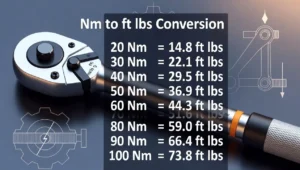
What Does nm to ft lbs Mean?
The phrase nm to ft lbs refers to converting torque values from Newton meters (Nm) to foot-pounds (ft-lbs). Torque is a critical measurement in automotive, engineering, manufacturing, and physics because it describes rotational force—how strongly something twists or turns.
Understanding this conversion is especially important when you work with tools, vehicles, or machinery that use different measurement systems.
What is Newton Meter (Nm)?
Definition in the SI System
A Newton meter (Nm) is the standard SI (International System of Units) measurement for torque.
It represents the amount of force (in newtons) applied at a distance of one meter from a pivot point.
In simple terms:
- 1 Nm = 1 Newton of force applied 1 meter from the center of rotation
Where Newton Meters Are Commonly Used
Newton meters are widely used in:
- Metric-based engineering systems
- Scientific research and physics calculations
- Industrial machinery specifications
- International automotive standards
Most countries outside the United States rely on Nm as the default torque unit.
Examples in Automotive, Machinery, and Physics
- Car engine torque ratings in Europe and Asia
- Bolt tightening specifications on industrial equipment
- Torque calculations in mechanical and rotational physics
What is Foot-Pound (ft-lbs)?
Definition in the Imperial / US Customary System
A foot-pound (ft-lb or ft-lbs) measures torque in the Imperial and US customary system.
It represents one pound of force applied at a distance of one foot from the rotation point.
Difference Between ft-lb and ft-lbs
Technically:
- ft-lb is singular (one unit)
- ft-lbs is plural (multiple units)
In practice, both terms are used interchangeably, especially in automotive manuals and tool descriptions.
Common Usage in US Automotive & Mechanical Fields
Foot-pounds are commonly found in:
- US vehicle torque specs
- Torque wrench settings
- Construction and mechanical maintenance manuals
- Heavy-duty equipment used in North America
Difference Between Nm and ft lbs Units
Metric vs Imperial System
- Nm belongs to the metric (SI) system
- ft-lbs belongs to the Imperial/US system
Both measure the same physical quantity—torque—but use different base units for force and distance.
Regional Usage Comparison
- Europe, Asia, Australia: Newton meters (Nm)
- United States, some UK applications: foot-pounds (ft-lbs)
Why Conversions Are Necessary
Conversions are necessary when:
- Using tools made in different countries
- Reading international technical documentation
- Importing vehicles or machinery
- Comparing torque specifications accurately
nm to ft lbs Conversion Formula Explained
Exact Mathematical Formula for nm to ft lbs
1 Newton meter = 0.737562 ft-lbs
Formula Breakdown
To convert Nm to ft-lbs:
ft-lbs = Nm × 0.737562
Why the Constant 0.737562 Exists
This constant comes from:
- 1 meter = 3.28084 feet
- 1 Newton = 0.224809 pounds-force
When combined mathematically, they produce the conversion factor 0.737562.
Reverse Formula (ft lbs to Nm Conversion)
1 ft-lb = 1.35582 Nm
Formula:
Nm = ft-lbs × 1.35582
When Reverse Conversion Is Needed
Reverse conversion is useful when:
- Reading US torque specs for metric tools
- Calibrating digital torque wrenches
- Working on imported vehicles or engines
Step-by-Step Manual Calculation Example
Example: 100 Nm to ft lbs
100 × 0.737562 = 73.76 ft-lbs
Example: 250 Nm to ft lbs
250 × 0.737562 = 184.39 ft-lbs
Example: 500 Nm to ft lbs
500 × 0.737562 = 368.78 ft-lbs
These values are commonly used in automotive torque settings, especially for wheel nuts and engine components.
Conversion Table (Quick Reference Chart)
| Newton Meters (Nm) | Foot-Pounds (ft-lbs) |
|---|---|
| 10 Nm | 7.38 ft-lbs |
| 25 Nm | 18.44 ft-lbs |
| 50 Nm | 36.88 ft-lbs |
| 100 Nm | 73.76 ft-lbs |
| 150 Nm | 110.63 ft-lbs |
| 200 Nm | 147.51 ft-lbs |
| 250 Nm | 184.39 ft-lbs |
| 300 Nm | 221.27 ft-lbs |
| 400 Nm | 295.02 ft-lbs |
| 500 Nm | 368.78 ft-lbs |
| 750 Nm | 553.17 ft-lbs |
| 1000 Nm | 737.56 ft-lbs |
This table allows fast and accurate torque conversion without manual calculations.
Online Calculator for nm to ft lbs Conversion
An online calculator for Nm to ft lbs conversion is one of the most practical tools for engineers, mechanics, and DIY users who work with torque specifications daily. Newton meters (Nm) and foot-pounds (ft lbs) are the two most commonly used torque units worldwide, and converting between them accurately is essential for safety, performance, and compliance with technical standards.
Instead of relying on manual formulas or rough estimations, a digital torque converter delivers fast, precise, and consistent results—anytime you need them.
How to Use a Torque Converter Tool
Using an online Nm to ft lbs torque converter is straightforward, even for beginners. Most tools are designed with a clean interface and instant response.
Input Value
Simply enter the torque value in Newton meters (Nm) into the input field. Some calculators also allow you to switch units if you want to convert ft lbs back to Nm.
Instant Calculation
Once the value is entered, the calculator immediately displays the converted result in foot-pounds (ft lbs). No need to click multiple buttons or refresh the page.
Accuracy Considerations
A reliable calculator uses the precise conversion factor:
- 1 Nm = 0.737562 ft lbs
High-quality tools apply this factor consistently, ensuring the result matches professional engineering standards.
Why Engineers Prefer Digital Conversion Tools
Modern engineers and technicians increasingly rely on digital torque conversion tools instead of manual calculations.
Precision
Digital calculators eliminate rounding mistakes and apply exact conversion constants, which is critical when working with tight torque tolerances.
Reduces Human Error
Manual calculations can easily go wrong, especially when working under pressure. An online converter minimizes calculation errors that could lead to mechanical failure.
Speed
Instant results save time during inspections, installations, and repairs—especially in professional environments where efficiency matters.
Features of a Reliable nm to ft lbs Calculator
Not all calculators are created equal. A high-quality Nm to ft lbs calculator should include the following features:
Real-Time Conversion
Results update instantly as you type, making it easier to test multiple torque values quickly.
Reverse Calculation
The ability to convert ft lbs to Nm is essential for users who work with both metric and imperial torque specifications.
Mobile-Friendly
A responsive design ensures the tool works smoothly on smartphones and tablets—perfect for workshops or on-site jobs.
Supports Multiple Torque Units
Advanced calculators often support additional units such as in-lbs, kgf·m, and daNm, making them versatile for global use.
Real-World Applications of nm to ft lbs Conversion
Torque conversion is not just a theoretical exercise—it plays a crucial role in many real-world scenarios.
Automotive Industry Torque Specifications
The automotive sector relies heavily on accurate torque values to ensure vehicle safety and longevity.
Engine Bolt Torque
Critical engine components such as cylinder heads and crankshaft bolts require precise torque settings. Incorrect conversion can lead to leaks or engine damage.
Lug Nut Torque
Wheel lug nuts must be tightened within a specific torque range. Too loose can cause wheel wobble; too tight can damage studs.
Motorcycle Torque Settings
Motorcycles often use Nm in manuals, while some torque wrenches are labeled in ft lbs. Accurate conversion ensures rider safety and component durability.
Common Car Torque Specs in Nm and ft lbs
While exact values vary by model, here are typical ranges to illustrate how conversion is applied:
Sedans
- Lug nuts: ~100–120 Nm (74–89 ft lbs)
- Engine components: 30–90 Nm (22–66 ft lbs)
SUVs
- Lug nuts: ~120–140 Nm (89–103 ft lbs)
- Suspension bolts: 100–200 Nm (74–148 ft lbs)
Trucks
- Lug nuts: ~140–180 Nm (103–133 ft lbs)
- Heavy-duty bolts: 200+ Nm (148+ ft lbs)
These examples highlight why a Nm to ft lbs converter is essential when switching between metric and imperial specs.
Construction and Heavy Machinery
In construction and industrial environments, torque accuracy directly impacts structural integrity.
Industrial Bolts
Large machinery uses high-torque fasteners that must meet strict specifications to handle heavy loads and vibrations.
Structural Tightening
Steel structures, bridges, and frameworks rely on properly torqued bolts to maintain long-term stability and safety.
DIY Mechanics and Home Garage Use
Torque conversion tools are equally valuable for non-professionals.
Torque Wrench Settings
Many DIY mechanics own torque wrenches marked in ft lbs, while repair manuals may specify Nm. An online converter bridges this gap instantly.
Avoiding Over-Tightening
Over-tightening bolts can strip threads or crack components. Accurate conversion helps apply the correct torque every time, even for home projects.
Torque Wrench Settings – Nm vs ft lbs
Torque settings matter more than many people realize. Whether you’re tightening lug nuts, engine components, or industrial fasteners, using the correct torque unit is critical for safety, performance, and durability. The most common comparison you’ll see is Nm (Newton meter) versus ft lbs (foot-pounds).
This guide explains the difference clearly, shows how to convert correctly, and helps you avoid costly mistakes—using fresh, original explanations and practical workshop insight.
Understanding Torque Wrench Units
Torque is a measure of rotational force. Different regions of the world use different units, which is why confusion often happens.
Adjustable torque wrench
An adjustable torque wrench is the most common type used in automotive and mechanical work.
- Usually marked in Nm, ft lbs, or both
- Uses a mechanical spring system
- “Clicks” when the preset torque is reached
- Requires manual setting before use
These wrenches are popular because they’re affordable, durable, and reliable when properly calibrated.
Digital torque wrench
A digital torque wrench offers higher precision and flexibility.
- Displays torque in multiple units (Nm, ft lbs, in-lbs)
- Uses electronic sensors instead of springs
- Often includes audible alerts, vibration, or LED signals
- Stores torque data for quality control
Digital models are ideal for professional workshops and applications where accuracy matters most.
How to Convert Nm to ft lbs on a Torque Wrench
The standard conversion formula is:
1 Nm = 0.73756 ft lbs
You don’t need to memorize the number if you understand the process.
Manual adjustment
When using a mechanical torque wrench:
- Check the required torque spec (usually given in Nm or ft lbs)
- Convert the value using the formula
- Set the wrench to the converted number
- Double-check the unit marking before tightening
Example:
100 Nm × 0.73756 = 73.76 ft lbs
Always round carefully (see common mistakes below).
Conversion chart usage
Conversion charts are faster and reduce human error.
- Ideal for busy workshops
- Useful when switching between European and US torque specs
- Best laminated or printed for long-term use
A chart is especially helpful when working on mixed-brand vehicles or imported machinery.
Common Torque Wrench Mistakes
Even experienced technicians make these errors.
Mixing units
One of the most common problems is confusing Nm with ft lbs.
- Setting 100 ft lbs instead of 100 Nm results in over-tightening
- Over-torqued bolts can stretch, crack, or fail
Always confirm the unit before applying force.
Rounding errors
Small rounding mistakes can cause big problems.
- 75 Nm is not the same as 75 ft lbs
- Rounding up aggressively increases stress on threads
Use at least one decimal place for critical components.
Calibration issues
Torque wrenches drift over time.
- Mechanical wrenches lose accuracy if stored under tension
- Digital wrenches need battery health and periodic testing
Professional calibration is recommended at least once a year or after heavy use.
Nm to ft lbs Conversion Chart (Extended Reference)
Below is an extended, easy-to-read torque conversion reference suitable for automotive, motorcycle, and industrial applications.
Low Range Torque Conversion (1–100 Nm)
- 10 Nm = 7.38 ft lbs
- 20 Nm = 14.75 ft lbs
- 30 Nm = 22.13 ft lbs
- 40 Nm = 29.50 ft lbs
- 50 Nm = 36.88 ft lbs
- 75 Nm = 55.32 ft lbs
- 100 Nm = 73.76 ft lbs
Common uses: valve covers, small engine bolts, bicycle components.
Medium Range Torque Conversion (100–500 Nm)
- 120 Nm = 88.51 ft lbs
- 150 Nm = 110.63 ft lbs
- 200 Nm = 147.51 ft lbs
- 300 Nm = 221.27 ft lbs
- 400 Nm = 295.02 ft lbs
- 500 Nm = 368.78 ft lbs
Common uses: lug nuts, suspension parts, brake assemblies.
High Range Torque Conversion (500–2000 Nm)
- 600 Nm = 442.53 ft lbs
- 800 Nm = 590.04 ft lbs
- 1000 Nm = 737.56 ft lbs
- 1500 Nm = 1106.34 ft lbs
- 2000 Nm = 1475.12 ft lbs
Common uses: heavy-duty trucks, industrial machinery, structural fasteners.
Printable Conversion Chart Option
A printed chart is still one of the most practical tools in a workshop.
How to format printable chart
- Use clear columns (Nm | ft lbs)
- Large, bold numbers for quick reading
- Group by torque range (low, medium, high)
- Print on A4 or Letter size
Workshop use
- Laminate to protect from oil and grease
- Mount near tool storage or workbench
- Share a standard chart across the team to avoid inconsistency
Common Questions About nm to ft lbs
Is 1 Nm Equal to 1 ft lb?
No.
Although the numbers look similar, 1 Nm is about 25% less than 1 ft lb. Treating them as equal can lead to serious torque errors.
Why Are Torque Units Different in the US?
The difference comes from measurement systems:
- Nm is part of the metric (SI) system
- ft lbs comes from the imperial system
The US automotive industry historically uses imperial units, while most global manufacturers use metric standards.
How Accurate Is Online nm to ft lbs Conversion?
Online calculators are generally accurate if the source is reliable.
However:
- Rounding rules may vary
- Some tools simplify values too much
For precision work, cross-check with a trusted chart or digital torque wrench.
What Happens If You Use the Wrong Torque Unit?
Using the wrong unit can cause:
- Loose fasteners
- Stripped threads
- Warped components
- Sudden part failure
In critical systems, the consequences go beyond repairs.
Safety Risks in Automotive Applications
Incorrect torque can directly affect safety:
- Wheels may loosen at high speed
- Brake components may fail under heat
- Engine parts may crack or leak
Correct torque isn’t just about specs—it’s about protecting lives, equipment, and reputation.
Nm to ft lbs in Different Industries
Torque conversion from newton-meters (Nm) to foot-pounds (ft lbs) is more than a math exercise. It plays a critical role across many industries where accuracy, safety, and performance matter. Below is how Nm to ft lbs is used in real-world applications, explained in a clear and practical way.
Aerospace Engineering
In aerospace engineering, torque specifications are extremely strict. Components such as turbine blades, engine mounts, and structural fasteners must be tightened within precise torque ranges.
Many aircraft manufacturers use Nm as the standard unit, while maintenance manuals in the US often reference ft lbs. Engineers and technicians regularly convert Nm to ft lbs to ensure compliance across international teams.
Renewable Energy (Wind Turbines)
Wind turbines rely heavily on torque control. Large bolts securing nacelles, rotor hubs, and tower sections are torqued using values commonly specified in Nm, often exceeding several thousand Nm.
However, service tools and documentation may still reference ft lbs, especially for international contractors. Converting Nm to ft lbs ensures:
- proper load distribution
- reduced mechanical stress
- longer turbine lifespan
In renewable energy projects, torque accuracy directly affects efficiency and long-term reliability.
Manufacturing & Industrial Equipment
Manufacturing environments depend on consistent torque to maintain quality control. Assembly lines, CNC machines, and heavy industrial equipment often combine metric and imperial systems.
For example:
- European machinery may list torque in Nm
- American torque wrenches may display ft lbs
Technicians frequently convert Nm to ft lbs to avoid over-tightening or under-tightening, both of which can lead to downtime or equipment damage.
Common related terms include:
- industrial torque tools
- assembly line torque settings
- mechanical torque standards
Motorsport and Performance Tuning
In motorsport and high-performance tuning, torque values affect both safety and performance. Suspension bolts, engine components, and drivetrain parts all require precise torque settings.
Car manufacturers usually specify torque in Nm, while many performance mechanics in the US prefer ft lbs. Accurate conversion helps ensure:
- consistent lap performance
- reduced risk of mechanical failure
- compliance with racing regulations
In this industry, even small torque differences can impact handling and engine reliability.
Common Conversion Examples People Search For
Below are some of the most searched Nm to ft lbs conversions. These values are rounded for practical use.
Conversion factor:
1 Nm ≈ 0.73756 ft lbs
100 Nm to ft lbs
100 Nm ≈ 73.76 ft lbs
This value is common for wheel lug nuts on passenger vehicles and light mechanical assemblies.
150 Nm to ft lbs
150 Nm ≈ 110.63 ft lbs
Often used for suspension components and medium-duty automotive bolts.
200 Nm to ft lbs
200 Nm ≈ 147.51 ft lbs
A frequent torque range for crankshaft bolts and industrial fasteners.
300 Nm to ft lbs
300 Nm ≈ 221.27 ft lbs
Common in trucks, SUVs, and heavy machinery applications.
400 Nm to ft lbs
400 Nm ≈ 295.02 ft lbs
Typically seen in drivetrain components and large structural bolts.
500 Nm to ft lbs
500 Nm ≈ 368.78 ft lbs
Used in heavy-duty equipment, wind turbine maintenance, and industrial torque tools.
Nm to ft lbs vs ft lb vs lb-ft – Are They the Same?
Yes, they represent the same physical quantity: torque, but the way they are written can vary depending on context and discipline.
Terminology Differences Explained
- Nm (Newton-meter): Metric SI unit, widely used worldwide.
- ft lb / ft lbs: Common in automotive manuals and consumer tools.
- lb-ft: Preferred in engineering and technical documentation.
All describe rotational force, but clarity in notation helps prevent mistakes.
Why Engineers Write lb-ft Instead of ft-lb
Engineers often write lb-ft to emphasize that torque is:
- pounds-force × distance (feet)
- not a simple linear force
Writing lb-ft reduces confusion with foot-pounds, which can sometimes be mistaken for energy rather than torque in technical discussions.
Avoiding Unit Confusion
To prevent errors:
- Always check whether the value refers to torque, not energy
- Match your torque wrench units with the specification
- Clearly label units in reports and documentation
In critical applications, misinterpreting ft lbs vs lb-ft can lead to costly or dangerous outcomes.
How to Memorize Nm to ft lbs Conversion Easily
Converting Newton meters (Nm) to foot-pounds (ft lbs) is a common task in automotive work, mechanical engineering, cycling maintenance, and even DIY projects. While calculators and apps are everywhere, being able to recall the conversion quickly can save time and reduce mistakes—especially when working with torque specs.
The key fact to remember is:
1 Nm ≈ 0.7376 ft lbs
From this single number, you can mentally convert most torque values with confidence.
Quick Mental Math Trick
A simple mental shortcut is to think in three-quarters.
- Nm to ft lbs → multiply by about 0.75
- ft lbs to Nm → multiply by about 1.36
For example:
- 100 Nm × 0.75 ≈ 75 ft lbs
(Exact value: ~73.8 ft lbs)
This method is not perfectly precise, but it’s fast and practical for everyday use.
Rounding Rule for Fast Estimation
Another easy approach is rounding the conversion factor:
- Use 0.74 instead of 0.73756
- Or even 0.7 if you only need a rough idea
Example:
- 60 Nm × 0.74 ≈ 44 ft lbs
- 60 Nm × 0.7 ≈ 42 ft lbs
This is especially helpful when checking torque values on the fly, such as tightening bolts, lug nuts, or bicycle components.
When Estimation Is Acceptable
Estimation works well in situations like:
- Initial setup before final torque tightening
- Comparing torque ranges between tools
- Learning or teaching torque basics
- Non-critical mechanical applications
However, never rely on estimation for:
- Engine internals
- Aircraft or aerospace components
- Safety-critical fasteners
- Manufacturer torque specifications with tight tolerances
In these cases, always use a calibrated torque wrench and exact values.
Advanced Torque Conversion Concepts
Understanding torque conversion goes beyond memorization. Knowing why these units exist makes the numbers easier to remember and apply correctly.
Torque in Physics Equations
In physics, torque is defined as:
Torque = Force × Lever Arm Distance
- In SI units: Newton × meter (Nm)
- In US customary units: pound-force × foot (ft lbs)
Although both measure rotational force, they originate from different measurement systems. That’s why a conversion factor is required.
Torque appears in many equations involving:
- Rotational motion
- Angular acceleration
- Mechanical equilibrium
- Energy transfer in rotating systems
Relationship Between Torque and Horsepower
Torque is often mentioned together with horsepower (HP), especially in automotive and engine discussions.
Torque tells you how much twisting force an engine produces. Horsepower tells you how quickly that force is delivered.
HP vs Torque Explained Simply
Think of it this way:
- Torque = how strong the push is
- Horsepower = how fast that push is applied
An engine with high torque feels strong at low speeds (great for towing), while high horsepower helps maintain speed at higher RPM.
In imperial units, the relationship is often expressed as:
HP = (Torque × RPM) ÷ 5252
This formula is one reason ft lbs are still widely used in performance discussions, especially in the US automotive industry.
International Standards for Torque Measurement
Torque units are standardized globally to ensure safety, compatibility, and clear communication across industries.
SI Unit System
The International System of Units (SI) uses:
- Newton meter (Nm) as the official torque unit
This system is used in:
- Europe
- Asia
- Scientific research
- Most international engineering standards
SI units are preferred for their consistency and ease of use in calculations.
US Customary System
The US customary system commonly uses:
- Foot-pounds (ft lbs) for torque
You’ll find ft lbs in:
- American vehicles
- US-made torque wrenches
- Older technical manuals
- Motorsports and performance tuning content
Because both systems are still widely used, Nm to ft lbs conversion remains highly relevant.
ISO and Engineering Standards
Organizations like ISO (International Organization for Standardization) define how torque values should be measured, reported, and applied.
Key principles include:
- Clear unit labeling (Nm or ft lbs, never mixed)
- Specified tightening methods (dry, lubricated, angle-tightening)
- Consistent calibration of torque tools
Following these standards reduces mechanical failure, improves safety, and ensures global compatibility in manufacturing and maintenance.
Related Torque Unit Conversions
Torque unit conversion is a daily necessity in mechanical work, automotive repair, engineering, and industrial applications. Different regions and industries use different torque units, so understanding how to convert between them helps avoid costly mistakes, damaged components, and safety risks.
Below, we break down the most common related torque unit conversions, explain how they work, and show when each one is used in real-world situations.
Nm to lb ft
Newton meters (Nm) and pound-feet (lb ft) are the most widely used torque units globally.
- Nm is the SI (metric) unit, common in Europe and most international standards.
- lb ft is primarily used in the United States and some automotive manuals.
Conversion Formula
- 1 Nm = 0.73756 lb ft
- 1 lb ft = 1.35582 Nm
Practical Example
If a bolt requires 100 Nm:
- 100 × 0.73756 = 73.76 lb ft
This conversion is especially important when using torque wrenches calibrated in different systems.
Newton meter to foot pound converter
A Newton meter to foot pound converter can be either a manual formula or a digital tool. Many mechanics rely on converters when working with imported vehicles or machinery.
When to Use a Converter
- Switching between metric and imperial torque specs
- Reading service manuals from different countries
- Calibrating torque tools correctly
Manual vs Digital Conversion
- Manual calculation is fast for simple values
- Online converters reduce human error and save time
- Torque calculator apps are ideal for workshops and field work
Torque unit conversion calculator
A torque unit conversion calculator instantly converts between multiple torque units, including:
- Nm
- lb ft
- in-lbs
- kg·m
- kNm
Benefits of Using a Calculator
- Eliminates rounding errors
- Supports complex conversions
- Ideal for engineering and precision work
Who Should Use It
- Automotive technicians
- Mechanical engineers
- Industrial maintenance teams
- DIY enthusiasts working on engines or machinery
ft lbs to Nm formula
Converting foot-pounds to Newton meters is just as common as Nm to lb ft.
Formula
- Nm = ft lbs × 1.35582
Example
A torque setting of 50 ft lbs:
- 50 × 1.35582 = 67.79 Nm
This formula is frequently used when torque specs come from US-based manuals but tools are metric-based.
kNm to ft lbs
Kilonewton meters (kNm) are used for extremely high torque values, often in heavy machinery, wind turbines, and industrial equipment.
Conversion Formula
- 1 kNm = 737.56 ft lbs
Example
- 2.5 kNm = 2.5 × 737.56 = 1,843.9 ft lbs
This conversion is critical in structural engineering and large-scale mechanical systems.
in-lbs to Nm
Inch-pounds (in-lbs) are used for low-torque applications such as electronics, small fasteners, and delicate assemblies.
Conversion Formula
- 1 in-lb = 0.11298 Nm
Example
- 80 in-lbs = 80 × 0.11298 = 9.04 Nm
Using the wrong torque unit at this scale can easily strip threads or crack components.
kg m to ft lbs
Kilogram-meter (kg·m) is an older metric torque unit still used in some regions and technical documents.
Conversion Formula
- 1 kg·m = 7.23301 ft lbs
Example
- 10 kg·m = 72.33 ft lbs
Understanding this conversion helps when working with legacy equipment or older service manuals.
Final Thoughts on nm to ft lbs Conversion
Torque conversions may look simple, but they play a huge role in safety, performance, and durability. Even small conversion errors can lead to under-tightened bolts or over-stressed components.
Why Every Mechanic Should Understand Torque Units
Torque values are not just numbers—they are engineering limits.
Key Reasons
- Prevents bolt failure and component damage
- Ensures manufacturer compliance
- Improves safety in automotive and industrial systems
- Builds professional credibility
Modern vehicles and machines often mix metric and imperial standards, making torque knowledge essential.
Best Way to Ensure Accurate Conversions
Accuracy is not optional when dealing with torque.
Recommended Best Practices
- Use calibrated torque wrenches
- Double-check manual calculations
- Rely on trusted torque conversion calculators
- Avoid guessing or rounding aggressively
Bookmarking Conversion Charts & Tools
Keeping reliable resources close can save time and prevent mistakes.
Smart Tips
- Bookmark torque conversion charts
- Save an online torque calculator
- Use mobile apps for on-site conversions
- Print a workshop torque reference sheet
By mastering Nm to ft lbs conversion and related torque units, you’ll work faster, safer, and more confidently—whether in a professional workshop or a home garage.