⏱️ Minutes to Seconds Converter
Fast & Accurate Time Conversion Tool for precise calculations
📊 Professional Time Conversion: Convert minutes to seconds instantly with our advanced calculator. Perfect for timing exercises, cooking, sports, and scientific calculations.
🎯 Features: Real-time conversion, detailed breakdown, educational insights, comprehensive time unit comparisons, conversion history, and real-world application examples.
🌍 International Standard: Based on SI (International System of Units) where 1 minute = 60 seconds precisely.
⚙️ Conversion Settings
⚡ Quick Examples
🔧 Advanced Options
⚠️ Important:
📊 Conversion Results
📋 Detailed Breakdown
🧮 Calculation Steps
🎓 Educational Information
Understanding Time Conversion: One minute consists of exactly 60 seconds. This fundamental relationship is based on the ancient Babylonian system of dividing time into units of 60.
Real-World Applications: Converting minutes to seconds is essential in sports timing, cooking durations, scientific experiments, and digital media processing where precise timing measurements are crucial.
Historical Context: The division of time into 60 units dates back to Sumerian and Babylonian civilizations, who used a sexagesimal (base-60) number system that influenced modern timekeeping.
Fun Facts: The word "minute" comes from Latin "pars minuta prima" meaning "first small part", while "second" comes from "pars minuta secunda" meaning "second small part".
Scientific Context: In physics, the second is the base unit of time in the International System of Units (SI), while a minute is exactly 60 seconds for precise calculations.
💡 Time Conversion Tips & Tricks
- Quick Mental Math: For common conversions, remember: 1 min = 60 sec, 5 min = 300 sec, 10 min = 600 sec, 30 min = 1,800 sec, 60 min = 3,600 sec
- Large Numbers: For hours to seconds: multiply hours by 3,600 (60 × 60). For days to seconds: multiply by 86,400
- Decimal Minutes: 0.5 minutes = 30 seconds, 0.25 minutes = 15 seconds, 0.1 minutes = 6 seconds, 0.75 minutes = 45 seconds
- Programming: Most programming languages use milliseconds or seconds as base units. JavaScript uses milliseconds (1 sec = 1000 ms)
- Audio/Video: Media duration is often displayed in minutes:seconds format (MM:SS). For editing, use frame-accurate timing
- Sports Timing: Track and field events use hundredths of seconds. Convert minutes to seconds first, then add decimal precision
- Scientific Notation: For very large time periods, use scientific notation (e.g., 1.0e+6 seconds = ~11.57 days)
- Reverse Conversion: To convert seconds back to minutes, divide by 60. Use modulo (%) to get remaining seconds
📊 Time Unit Comparisons
| Time Unit | Equivalent | Common Uses |
|---|
🌍 Real-World Applications
📜 Recent Conversions
❓ Frequently Asked Questions (FAQ)
How many seconds are in a minute?
There are exactly 60 seconds in 1 minute. This is a fundamental time conversion based on the International System of Units (SI). The relationship is constant and universal: 1 minute = 60 seconds.
How do I convert minutes to seconds?
To convert minutes to seconds, simply multiply the number of minutes by 60. For example: 5 minutes × 60 = 300 seconds. If you have additional seconds, add them to the result. Our calculator does this automatically with high precision.
Can I convert decimal minutes to seconds?
Yes! Decimal minutes work perfectly. For example, 2.5 minutes = 2.5 × 60 = 150 seconds. Our calculator supports decimal inputs with up to 5 decimal places of precision for accurate scientific and professional calculations.
What are common minute to second conversions?
Common conversions include: 1 min = 60 sec, 5 min = 300 sec, 10 min = 600 sec, 15 min = 900 sec, 30 min = 1,800 sec, and 60 min (1 hour) = 3,600 sec.
Why do we use 60 seconds in a minute?
The 60-second minute comes from ancient Babylonian mathematics, which used a base-60 (sexagesimal) number system. This system was adopted because 60 is highly divisible (by 1, 2, 3, 4, 5, 6, 10, 12, 15, 20, 30, and 60), making calculations easier.
What are practical uses for minutes to seconds conversion?
Common applications include: sports timing (races, workouts), cooking (recipe timers), video editing (timecodes), scientific experiments (precise measurements), programming (time calculations), and music production (track lengths).
How accurate is this minutes to seconds converter?
Our converter is 100% accurate with support for up to 5 decimal places. It uses the standard conversion factor (1 minute = 60 seconds) and performs calculations using JavaScript's native number precision, suitable for both everyday and professional use.
Can I convert large numbers of minutes?
Yes! Our calculator supports values up to 999,999,999 minutes, which equals approximately 1,902 years. This range covers virtually all practical applications from milliseconds to geological timescales.
Is this calculator free to use?
Yes, this minutes to seconds converter is completely free with no registration required. All calculations are performed in your browser for instant results and complete privacy. No data is sent to external servers.
Does this work on mobile devices?
Absolutely! Our calculator is fully responsive and optimized for mobile phones, tablets, and desktop computers. It works on all modern browsers including Chrome, Firefox, Safari, and Edge.
Time plays a crucial role in nearly every aspect of modern life. From scheduling daily tasks to managing complex technological systems, accurate time measurement helps people stay organized and efficient. One of the most common forms of time conversion involves transforming minutes into seconds. This is where a Minutes to Seconds Converter becomes an extremely practical tool. Whether someone is calculating exercise intervals, editing video content, programming software, or solving math problems, converting time units quickly and accurately can save both time and effort.
In today’s digital world, simple tasks often require precise timing. For example, a fitness trainer may design workout routines measured in seconds, even though the plan was initially created in minutes. A video editor may need to convert a five-minute clip into seconds to align it with a project timeline. Similarly, software developers frequently rely on time conversions when coding timers, animations, or system processes. Because of these real-world applications, tools that simplify time conversion have become widely used across many industries.
A Minutes to Seconds Converter is essentially a calculation tool that automatically transforms minutes into seconds based on a simple mathematical relationship. Since one minute equals sixty seconds, the conversion process only requires multiplication. However, when working with larger values, decimals, or repeated calculations, performing these conversions manually can become inconvenient. Digital converters solve this problem by delivering instant and accurate results, allowing users to focus on their tasks without worrying about mathematical errors.
Another reason these converters are so popular is their accessibility. Many online platforms, calculators, and mobile apps provide easy-to-use time conversion tools. Users only need to input a number of minutes, and the tool instantly displays the equivalent number of seconds. This convenience makes such tools especially useful for students, educators, engineers, athletes, and content creators who frequently deal with time-based measurements.
Beyond simple convenience, understanding how to convert minutes into seconds also strengthens fundamental knowledge of time measurement systems. Time units form the backbone of scheduling, scientific observation, and technological processes. By learning how these units relate to one another, individuals can better understand how time is measured and managed in both everyday activities and professional environments.
In this comprehensive guide, we will explore how a Minutes to Seconds Converter works, why it is useful, and how it can be applied in different fields. The article will also explain manual conversion methods, practical examples, and real-life scenarios where accurate time conversion becomes essential. By the end, readers will have a clear understanding of how to convert minutes to seconds efficiently and how modern conversion tools can simplify this everyday calculation.
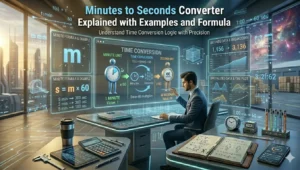
Why Time Conversion Matters in Everyday Life
Time conversion might look like a small, almost trivial skill, but in modern life it plays a surprisingly central role. Whether you are managing a workout, editing a video, preparing a recipe, or scheduling tasks across different systems, converting time units—especially minutes to seconds—helps ensure accuracy, efficiency, and clarity.
The Role of Time Conversion in Modern Digital Activities
In today’s digital environment, time is often measured in seconds rather than minutes. Applications, software, and devices rely heavily on precise time inputs. For example, video editing tools display timelines in seconds, fitness apps track intervals down to the second, and coding environments frequently require time values in milliseconds or seconds.
Without proper conversion, even simple tasks can become inefficient. Imagine setting a timer for 2 minutes in an app that only accepts seconds—you need to know it equals 120 seconds. This small conversion ensures seamless interaction with digital tools.
Use of Time Conversion in Technology, Sports, Education, and Productivity
Time conversion is widely used across multiple domains:
- Technology: Developers often convert time units when configuring delays, animations, or performance benchmarks.
- Sports: Coaches and athletes rely on seconds for precision timing, especially in interval training or race tracking.
- Education: Students learn time relationships early, and accurate conversion supports math, physics, and engineering concepts.
- Productivity: Time-blocking techniques and task timers often require conversion between minutes and seconds for better control.
Importance of Understanding the Relationship Between Minutes and Seconds
Understanding how minutes relate to seconds is foundational. It allows individuals to move fluidly between different time scales without hesitation. This is especially important in environments where accuracy matters, such as scientific experiments, competitive sports, or technical workflows.
What Is a Minutes to Seconds Converter
Definition of a Time Conversion Tool
A minutes to seconds converter is a tool—either manual or digital—that transforms a value in minutes into its equivalent in seconds. It simplifies calculations and reduces the chance of error, especially when dealing with large numbers or repeated conversions.
How Automatic Converters Work
Digital converters operate using a simple mathematical rule: multiply the number of minutes by 60. When you input a value, the tool instantly applies this formula and displays the result.
For example:
- Input: 3 minutes
- Output: 180 seconds
Behind the scenes, the process is straightforward but optimized for speed and usability.
Manual Conversion vs Digital Tools
Manual conversion requires you to remember and apply the formula yourself. While this builds understanding, it can be slower and more prone to mistakes.
Digital tools, on the other hand:
- Provide instant results
- Reduce calculation errors
- Handle large values easily
Both methods have their place, depending on the situation.
Understanding the Relationship Between Minutes and Seconds
Basics of the International Time System
The global time system is based on standardized units:
- 1 minute = 60 seconds
- 1 hour = 60 minutes
This system is part of the broader International System of Units (SI), which ensures consistency worldwide.
Why 1 Minute Equals 60 Seconds
The origin of this relationship dates back to ancient civilizations, particularly the Babylonians, who used a base-60 (sexagesimal) number system. This system proved highly practical for dividing time into smaller, evenly distributed units.
Influence of Time Measurement Systems in Science and Technology
Accurate time measurement is critical in fields like:
- Physics (measuring motion and speed)
- Computing (processing time and delays)
- Astronomy (tracking celestial events)
The minute-second relationship enables precise calculations and synchronization across systems.
How a Minutes to Seconds Converter Works
Basic Formula for Converting Minutes to Seconds
The formula is simple:
Seconds = Minutes × 60
This equation forms the basis of all conversions between these two units.
Quick Calculation Examples
- 1 minute × 60 = 60 seconds
- 5 minutes × 60 = 300 seconds
- 10 minutes × 60 = 600 seconds
Logic Behind Time Conversion
The logic is rooted in proportional scaling. Since one minute contains 60 seconds, multiplying any number of minutes by 60 expands it into its equivalent in seconds.
Step-by-Step Manual Conversion Method
How to Calculate Without a Calculator
- Take the number of minutes
- Multiply it by 60
- Write down the result
Example:
- 7 minutes → 7 × 60 = 420 seconds
Tips to Avoid Conversion Errors
- Double-check multiplication
- Break numbers into smaller parts (e.g., 6 × 60 = 360)
- Use mental math shortcuts (e.g., 60 × 10 = 600)
Practical Calculation Example
If you need to convert 12 minutes:
- 12 × 60 = 720 seconds
Using Online Minutes to Seconds Converter Tools
Advantages of Online Time Conversion Tools
Online converters offer several benefits:
- Fast and accurate: Results appear instantly
- User-friendly: Simple input fields
- Versatile: Suitable for different contexts
Common Features in Modern Time Converter Tools
- Real-time calculation: Updates as you type
- Multi-unit conversion: Minutes, seconds, hours, milliseconds
- Mobile-friendly interface: Easy to use on smartphones
Practical Examples of Minutes to Seconds Conversion
Simple Everyday Examples
- 1 minute to seconds = 60 seconds
- 5 minutes to seconds = 300 seconds
- 10 minutes to seconds = 600 seconds
These basic examples form the foundation for more complex applications.
Common Time Conversion Scenarios
Converting Workout Durations
Fitness routines often rely on seconds for precision.
Interval Training
A typical interval might be:
- 30 seconds active
- 60 seconds rest
If a workout lasts 15 minutes:
- 15 × 60 = 900 seconds
HIIT Timers
High-Intensity Interval Training requires exact timing. Converting total workout duration into seconds helps maintain structure and consistency.
Cooking and Kitchen Timers
Recipes often include short durations that are easier to manage in seconds.
Quick Recipes
For example:
- 2 minutes = 120 seconds
- 3 minutes = 180 seconds
Kitchen Timer Settings
Digital timers may display seconds, making conversion essential for accuracy.
Video and Media Duration
Time conversion is especially important in media production.
Video Duration
A 4-minute clip equals:
- 4 × 60 = 240 seconds
Editing Timeline
Video editing software often uses seconds for precision trimming and synchronization.
Expanding the Use of Minutes to Seconds Conversion
Beyond everyday scenarios, time conversion plays a deeper role in advanced workflows.
In Software Development
Developers frequently work with time in seconds or milliseconds. For example:
- Setting animation durations
- Configuring system delays
- Measuring execution time
Understanding conversions ensures correct implementation.
In Project Management
Breaking tasks into smaller time units improves tracking and accountability. Converting minutes into seconds allows for more granular scheduling.
In Scientific Research
Experiments often require precise timing. Even a small miscalculation can affect results, making accurate conversion essential.
Benefits of Using a Minutes to Seconds Converter
Time conversion sounds simple, but in practice it often becomes a source of small yet impactful errors. Converting minutes into seconds is one of the most common operations across education, technology, and everyday tasks. A reliable minutes to seconds converter helps eliminate friction, reduce mistakes, and improve efficiency in both simple and complex workflows.
Speed and Accuracy in Time Calculations
Converting time manually requires multiplying by 60. While this is straightforward, repetitive calculations increase the risk of human error—especially when dealing with large datasets, decimal values, or time-sensitive tasks.
Avoiding Manual Errors
Manual calculations often lead to small mistakes such as misplacing digits or forgetting to multiply correctly. These errors can compound when used in programming scripts, scientific experiments, or scheduling systems. A converter ensures consistent and precise results every time.
Efficiency in Workflows
Instead of repeatedly calculating values, a converter allows users to focus on more critical aspects of their tasks. Whether it’s analyzing data, coding, or managing projects, eliminating repetitive calculations saves time and mental energy.
Convenience for Students and Professionals
A minutes to seconds converter is not limited to technical users. It is equally useful for students, teachers, engineers, and professionals in various fields.
Used in Mathematics
Students frequently encounter time unit conversions in math problems. Using a converter helps them verify answers and understand relationships between units. It also supports faster problem-solving during exams or assignments.
Used in Engineering and Programming
Engineers and developers often work with time-based calculations, especially in systems that rely on precise timing such as embedded systems, simulations, or performance measurements. Converting minutes into seconds is essential for consistency in code and calculations.
Enhancing Productivity Through Quick Time Conversion
Time is a critical resource in any task. Quick conversions contribute directly to productivity improvements.
Efficiency in Time Management
Accurate time conversion helps in scheduling tasks, estimating durations, and tracking productivity. For example, converting meeting durations or work sessions into seconds can simplify automation or tracking systems.
Application in Digital Projects
Digital tools such as video editors, animation software, and project management systems often require time inputs in seconds. A converter ensures seamless integration and reduces delays during project execution.
Minutes to Seconds Conversion in Technology and Digital Tools
Technology heavily relies on precise time measurements. From backend systems to user-facing applications, converting minutes into seconds is a fundamental operation.
Time Conversion in Programming
Programming languages often standardize time in seconds or milliseconds. This makes conversion from minutes necessary in many scenarios.
How Developers Convert Minutes to Seconds in Code
Developers typically multiply the number of minutes by 60. In more advanced cases, conversions may involve floating-point values, timestamps, or integration with time libraries.
Common use cases include:
- Setting timeouts or delays
- Scheduling tasks
- Measuring execution time
- Handling user input in apps
Examples in Popular Programming Languages
Python
Python makes time conversion simple and readable:
minutes = 5
seconds = minutes * 60
print(seconds)
Python libraries such as datetime also support more advanced time handling.
JavaScript
JavaScript is widely used in web development and relies heavily on time calculations:
let minutes = 5;
let seconds = minutes * 60;
console.log(seconds);
This is often used for countdown timers or animations.
C++
In C++, time conversion is used in system-level programming and performance measurement:
#include <iostream>
using namespace std;

int main() {
    int minutes = 5;
    int seconds = minutes * 60;
    cout << seconds;
    return 0;
}
C++ applications often require precise and efficient calculations, making correct conversions essential.
Applications in Mobile Apps and Software
Many digital tools rely on accurate time conversion behind the scenes.
Stopwatch Apps
Stopwatch applications track time in seconds or milliseconds. Converting minutes ensures proper display and calculation of elapsed time.
Countdown Timers
Timers in cooking apps, fitness apps, or productivity tools often require users to input minutes. Internally, these are converted into seconds for accurate countdown functionality.
Productivity Applications
Apps like task managers or focus timers (e.g., Pomodoro tools) rely on time conversion to manage work sessions and breaks efficiently.
Minutes to Seconds Converter for Education
Education is one of the most important areas where time conversion plays a foundational role.
Learning Time Units in Mathematics
Understanding time units is a basic skill introduced early in education.
Basic Concepts of Time Units
Students learn that:
- 1 minute = 60 seconds
- 1 hour = 60 minutes
- 1 day = 24 hours
These relationships form the basis of more complex calculations.
Learning from Elementary to Secondary School
In elementary school, students practice simple conversions. In secondary education, they apply these concepts to algebra, physics, and real-world problems.
Teaching Students Time Conversion Skills
Teaching methods have evolved with technology, making learning more interactive.
Interactive Learning Methods
Teachers now use visual aids, games, and digital tools to make time conversion engaging. For example:
- Interactive quizzes
- Animated timelines
- Real-life problem simulations
Use of Online Calculators
Online converters allow students to check answers instantly. This reinforces learning and builds confidence.
Practice Exercises for Students
Practice is essential for mastering time conversion.
Beginner Level Conversion Problems
- Convert 2 minutes to seconds
- Convert 10 minutes to seconds
- Convert 0.5 minutes to seconds
These problems focus on basic multiplication.
Intermediate Level Conversion Problems
- Convert 3.75 minutes to seconds
- Convert 12.5 minutes to seconds
- Convert 1.2 minutes to seconds
These involve decimals and require careful calculation.
Advanced Time Calculation Exercises
- Convert mixed units (e.g., 2 minutes 30 seconds into total seconds)
- Solve word problems involving time intervals
- Apply conversions in physics formulas
These exercises build deeper understanding and problem-solving skills.
Real-Life Applications of Minutes to Seconds Conversion
Time conversion is not just theoretical—it has practical applications in everyday life and professional fields.
Sports and Fitness Timing
Precise timing is crucial in sports and fitness.
Athletics
In track events, performance is measured in seconds or milliseconds. Coaches and athletes convert minutes into seconds to analyze performance accurately.
Sports Competitions
In competitive sports, even a fraction of a second can determine the winner. Accurate time conversion ensures fairness and precision in scoring.
Science and Engineering Measurements
Scientific and engineering fields rely heavily on precise time measurement.
Laboratory Experiments
Experiments often require exact timing for reactions or processes. Converting minutes into seconds ensures consistency and accuracy.
Precision Time Measurement
Engineering systems, such as robotics or automation, depend on precise timing. Incorrect conversions can lead to system errors or inefficiencies.
Media Production and Broadcasting
Time conversion plays a critical role in content creation and media workflows.
Film Editing
Editors work with timelines measured in seconds or frames. Converting minutes helps in organizing scenes and transitions accurately.
Audio Production
Audio engineers use seconds to align tracks, adjust timing, and ensure synchronization.
Content Timing
Digital content creators must manage durations precisely to meet platform requirements and audience expectations.
Online Minutes to Seconds Converter vs Manual Calculation
Time conversion looks simple on the surface, yet it plays a critical role in many everyday and professional scenarios. Whether you’re tracking workout durations, analyzing data logs, or working through math problems, converting minutes into seconds is a fundamental skill. Today, people often rely on online tools to perform this conversion instantly. However, manual calculation still has its place.
Understanding the differences between using an online minutes to seconds converter and doing it manually helps you choose the best method for your situation. Both approaches have strengths and limitations, and knowing when to use each one can save time, improve accuracy, and reduce frustration.
Accuracy Comparison
Accuracy is often the first concern when dealing with numerical conversions. Even a small mistake in time calculation can lead to larger errors, especially when used in scheduling, programming, or scientific analysis.
Human Error vs Automated Systems
Manual calculations rely entirely on human input. While the formula for converting minutes to seconds is straightforward—multiplying the number of minutes by 60—mistakes can still occur. These errors often come from:
- Miscalculating multiplication
- Misreading numbers
- Skipping steps in long calculations
- Fatigue or distraction
On the other hand, online converters are designed to eliminate these issues. Once the correct value is entered, the system applies a consistent formula without deviation. Modern tools are built with high precision and are rarely prone to computational errors.
However, automated systems are not entirely foolproof. Errors can still occur if:
- Incorrect input is entered
- The tool has a bug or outdated code
- The user misunderstands the output format
In general, automated systems provide higher consistency, while manual methods depend heavily on the user’s attention and mathematical skill.
Efficiency and Speed
Speed is another major factor when choosing between manual and digital conversion methods.
Time Required for Conversion
Manual conversion can be quick for simple numbers. For example, converting 5 minutes to seconds takes only a few seconds mentally:
5 × 60 = 300 seconds
However, when dealing with larger or more complex values, the time required increases. Converting 125.75 minutes into seconds, for instance, may take longer and require careful calculation.
Online converters, by contrast, provide near-instant results regardless of the number size. This makes them especially useful in situations such as:
- Data processing
- Time-sensitive tasks
- Repetitive calculations
- Professional workflows
For frequent conversions, digital tools significantly improve productivity.
When Manual Conversion Is Still Useful
Despite the convenience of online tools, manual calculation remains relevant in several situations.
Math Exams
In academic settings, especially during exams, students are often required to perform conversions without digital assistance. Understanding the logic behind time conversion ensures that students can:
- Solve problems accurately
- Show step-by-step reasoning
- Build foundational math skills
Relying solely on tools without understanding the concept can lead to difficulties in exam scenarios.
Situations Without Internet Access
There are still many situations where internet access is limited or unavailable. These include:
- Traveling in remote areas
- Technical outages
- Fieldwork environments
In such cases, the ability to manually convert minutes to seconds becomes a practical and necessary skill.
Common Mistakes When Converting Minutes to Seconds
Even though the formula is simple, errors in time conversion are surprisingly common. These mistakes can affect everything from daily scheduling to complex data analysis.
Misunderstanding the Conversion Factor
Common Basic Math Errors
The most fundamental rule in converting minutes to seconds is:
1 minute = 60 seconds
Despite its simplicity, people sometimes:
- Multiply by 100 instead of 60
- Add 60 instead of multiplying
- Confuse seconds with milliseconds
These mistakes usually stem from a lack of clarity about basic time units. Reinforcing the correct conversion factor is essential for avoiding these issues.
Calculation Errors in Large Numbers
Long Duration Conversions
When converting large time values, such as several hours expressed in minutes, errors become more likely. For example:
240 minutes × 60 = 14,400 seconds
Mistakes may occur due to:
- Incorrect multiplication
- Misplacement of zeros
- Rushing through calculations
Breaking large numbers into smaller parts can help reduce errors. For example:
200 × 60 = 12,000
40 × 60 = 2,400
Total = 14,400 seconds
This step-by-step approach improves accuracy.
Rounding Errors in Digital Calculations
Digital tools are generally precise, but rounding can still create issues, especially with decimal values.
For example:
2.333 minutes × 60 = 139.98 seconds
Some systems may round this to:
140 seconds
While this may seem insignificant, rounding errors can accumulate in large datasets or repeated calculations. Always check whether precision matters in your specific context.
Tips for Faster Time Conversion
Improving your speed in time conversion can make a noticeable difference in both academic and professional settings.
Mental Math Tricks for Converting Minutes to Seconds
Fast Multiplication Techniques
One of the easiest tricks is to break down multiplication by 60:
Multiply by 6, then add a zero.
Example:
7 × 60
= (7 × 6) × 10
= 42 × 10
= 420 seconds
This shortcut simplifies mental math and reduces calculation time.
Math Shortcuts
Another useful method is splitting numbers:
15 × 60
= (10 × 60) + (5 × 60)
= 600 + 300
= 900 seconds
This approach works well for larger numbers and improves accuracy.
Using Calculators and Conversion Charts
While mental math is helpful, tools can enhance both speed and reliability.
Quick Reference Table for Minutes to Seconds
| Minutes | Seconds |
|---|---|
| 1 | 60 |
| 5 | 300 |
| 10 | 600 |
| 15 | 900 |
| 30 | 1800 |
| 60 | 3600 |
This type of table is useful for quick lookups without performing calculations.
Printable Time Conversion Chart
Printable charts are especially helpful in environments where repeated conversions are needed, such as classrooms, offices, or workshops. Having a visual reference reduces cognitive load and speeds up decision-making.
Advanced Time Conversion Concepts
Once you understand the basics, time conversion can be expanded into more complex scenarios.
Converting Seconds Back to Minutes
Reverse Conversion Formula
To convert seconds into minutes, divide by 60:
Seconds ÷ 60 = Minutes
Example:
300 seconds ÷ 60 = 5 minutes
This reverse conversion is commonly used in:
- Data analysis
- Performance tracking
- Media duration calculations
Understanding both directions ensures flexibility in working with time data.
Minutes to Hours and Seconds Conversion
Multi-Unit Conversion
Sometimes, you need to convert minutes into both hours and seconds.
Example:
150 minutes
Step 1: Convert to hours
150 ÷ 60 = 2.5 hours
Step 2: Convert to seconds
150 × 60 = 9,000 seconds
Multi-unit conversion is useful in:
- Project planning
- Scientific measurements
- Time tracking systems
Being able to move between units helps maintain clarity in complex calculations.
Time Conversion in Scientific Calculations
In scientific and technical fields, time conversion must be precise and consistent. Small discrepancies can lead to incorrect results in:
- Physics experiments
- Engineering calculations
- Data modeling
For example, in motion analysis:
Velocity = Distance ÷ Time
If time is incorrectly converted, the final result becomes unreliable. This is why professionals often use standardized units, such as seconds, in all calculations.
Additionally, scientific tools often require inputs in seconds, making accurate conversion essential.
Frequently Asked Questions About Minutes to Seconds Converter
Time conversion might seem like a simple concept, but in reality, it plays a crucial role in many aspects of modern life—from productivity tracking to digital content creation and scientific calculations. A minutes to seconds converter is one of the most commonly used tools when dealing with time-based data, and understanding how it works can significantly improve efficiency.
Below are some of the most frequently asked questions about converting minutes into seconds, explained in a clear and practical way.
How Many Seconds Are in One Minute
At its core, the conversion between minutes and seconds is based on a fixed and universally accepted rule:
1 minute = 60 seconds
This means that to convert minutes into seconds, you simply multiply the number of minutes by 60.
For example:
- 1 minute = 60 seconds
- 5 minutes = 300 seconds
- 10 minutes = 600 seconds
- 30 minutes = 1800 seconds
This relationship is constant and does not change regardless of context—whether you’re measuring time for a workout, cooking, coding, or scientific experiments.
Why this matters in daily life
Understanding this simple conversion helps in:
- Managing time more precisely
- Breaking down tasks into smaller units
- Tracking performance in sports or workouts
- Measuring durations in digital tools like video editing or animations
Even though the math is straightforward, manually calculating time repeatedly can become inefficient. That’s where a time converter tool becomes valuable.
Why Is One Minute Equal to Sixty Seconds
The reason behind this conversion traces back thousands of years to ancient civilizations, particularly the Babylonians. They used a base-60 numbering system, also known as the sexagesimal system.
Historical background
- The Babylonians found 60 to be a highly practical number because it has many divisors (2, 3, 4, 5, 6, etc.)
- This made calculations easier compared to base-10 in certain contexts
- Their system influenced how we measure time today
As a result:
- 1 hour = 60 minutes
- 1 minute = 60 seconds
This structure has been preserved across centuries and is still used globally in modern timekeeping systems.
Why base-60 still works today
Even in a digital world dominated by binary and decimal systems, base-60 remains useful because:
- It allows flexible division of time
- It simplifies fractions of time (e.g., half a minute = 30 seconds)
- It aligns with traditional clocks and global standards
So while it may seem arbitrary at first, the 60-second minute is actually a well-thought-out system rooted in mathematical convenience and historical continuity.
Is There an Easy Way to Convert Minutes to Seconds
Yes, there are several easy ways to convert minutes into seconds, depending on your preference and situation.
1. Manual calculation
The simplest method:
Multiply the number of minutes by 60
Example:
- 12 minutes × 60 = 720 seconds
This works well for quick calculations but can become tedious for repeated or complex conversions.
2. Using a calculator
A basic calculator speeds up the process:
- Input the number of minutes
- Multiply by 60
- Get instant results
This is especially useful for larger numbers or decimal values like:
- 2.5 minutes = 150 seconds
3. Using an online minutes to seconds converter
This is the fastest and most convenient method:
- Enter the value
- Click convert
- Instantly get accurate results
Many online tools also support:
- Bulk conversions
- Reverse conversion (seconds to minutes)
- Fractional inputs
4. Spreadsheet formulas
If you work with data regularly:
- Use tools like Excel or Google Sheets
- Apply formulas like:
=A1*60
This is ideal for handling large datasets efficiently.
Can I Convert Time Units Automatically Online
Absolutely. Online time conversion tools have become increasingly advanced and user-friendly.
Features of modern online converters
Most tools today offer:
- Instant conversion results
- Support for multiple time units (minutes, seconds, hours, milliseconds)
- Mobile-friendly interfaces
- Real-time updates as you type
Some advanced platforms even include:
- API integration for developers
- Batch processing
- Time format conversions (e.g., HH:MM:SS)
Benefits of automatic conversion
Using an online converter saves time and reduces errors. It is especially useful for:
- Students working on math or physics problems
- Developers handling time-based data
- Content creators editing videos or audio
- Professionals managing schedules
Instead of repeating manual calculations, automation allows you to focus on more important tasks.
Are Time Conversion Tools Accurate
Yes, minutes to seconds converters are extremely accurate when designed properly.
Why they are reliable
Time conversion is based on fixed mathematical relationships:
- No approximations are needed
- No external variables affect the result
This means that:
- 1 minute will always equal 60 seconds
- The calculation is deterministic and precise
When errors might occur
Accuracy issues usually come from:
- User input mistakes
- Incorrect formulas in custom tools
- Poorly designed websites
To ensure accuracy:
- Double-check your input values
- Use trusted tools
- Avoid unnecessary rounding
Accuracy in professional use
In fields like engineering, science, and software development:
- Time conversions are often automated
- Systems rely on precise calculations
- Even milliseconds matter
This makes reliable conversion tools essential for maintaining consistency and correctness.
Conclusion
Time conversion may seem like a small detail, but it plays a significant role in how we organize, measure, and optimize our daily activities. A minutes to seconds converter simplifies this process and helps eliminate unnecessary mental effort.
Why a Minutes to Seconds Converter Is Useful in Modern Life
In today’s fast-paced digital environment, precision and efficiency are more important than ever. Converting time units quickly is no longer optional—it’s a necessity.
Key benefits at a glance
- Saves time on repetitive calculations
- Reduces human error
- Improves productivity
- Enhances accuracy in professional tasks
- Supports digital workflows
From fitness tracking apps to video editing software, time conversion is embedded in many tools we use daily.
Real-world applications
A minutes to seconds calculator is useful in:
- Workout routines (tracking intervals)
- Cooking and baking (precise timing)
- Programming (timeouts and delays)
- Education (math and science problems)
- Media production (editing timelines)
By using a reliable converter, you can streamline these activities and work more efficiently.
The Importance of Understanding Time Conversion
While tools make conversion easier, understanding the concept itself is equally important.
Why knowledge still matters
Knowing how to convert time manually helps you:
- Verify results from tools
- Develop better numerical intuition
- Avoid dependency on technology
It also builds a foundation for more advanced concepts like:
- Speed and distance calculations
- Data analysis
- Algorithm timing in programming
Relevance in the digital world
In a data-driven era:
- Time is often stored in seconds or milliseconds
- Systems rely on standardized units
- Accurate conversion ensures compatibility across platforms
Whether you’re working with APIs, databases, or analytics tools, understanding time units is essential.
Final Thoughts on Efficient Time Calculations
Efficient time management isn’t just about planning—it’s also about precision. Small improvements in how you handle time calculations can lead to noticeable gains in productivity.
The role of conversion tools
A good minutes to seconds converter:
- Simplifies complex tasks
- Eliminates repetitive work
- Provides instant and accurate results
It acts as a small but powerful utility that supports larger workflows.
Boosting productivity through simplicity
When you remove friction from basic tasks like time conversion:
- You reduce cognitive load
- You make fewer mistakes
- You work faster and smarter
In the end, tools like these are not just about convenience—they’re about enabling better performance in both personal and professional contexts.