How Many Seconds Are in an Hour?
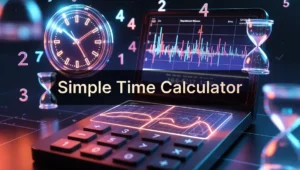
International time calculator for converting hours, minutes and seconds into total seconds. Learn the exact value, see a detailed breakdown, and use popular quick presets.
Quick answer: 1 hour is always equal to 3600 seconds. This calculator helps you convert any combination of hours, minutes and seconds into total seconds.
Designed for international learners, educators, students and professionals looking for a clean, accessible time conversion tool with detailed explanations.
⌨️ Keyboard shortcuts: Ctrl+Enter to calculate | Ctrl+R to reset | Ctrl+C to copy results
⏱️ Live Demonstration: Seconds Counting in Real Time
Watch how seconds accumulate in real-time! Every 3,600 seconds = 1 hour.
⚡ Popular quick presets (Most Used)
Time input
This calculator uses standard time conversion rules. If you convert exactly 1 hour, you will get 3600 seconds.
Conversion result
Detailed breakdown
- Hours: hours × 3600 = 0 seconds
- Minutes: minutes × 60 = 0 seconds
- Seconds: direct seconds = 0
- Total: 0 seconds after adding all parts.
Calculation steps
Step 1: Convert hours to seconds by multiplying by 3600.
Step 2: Convert minutes to seconds by multiplying by 60.
Step 3: Add the converted hours, minutes and the original seconds together.
Step 4: The final value is the total amount of seconds in the entered time period.
📚 Why this matters: Educational insights
Universal Standard: Time conversion is a fundamental skill across mathematics, science, programming, and daily life. The definition that 1 hour equals 3600 seconds is universally accepted worldwide.
Historical Context: The division of an hour into 60 minutes and a minute into 60 seconds comes from ancient Babylonian mathematics, which used a base-60 (sexagesimal) number system. This system is still used globally for measuring time and angles.
Practical Applications:
- Programming & Computing: Unix timestamps measure time in seconds since January 1, 1970. Understanding second conversions is crucial for scheduling tasks, timeouts, and performance measurements.
- Science & Physics: Many scientific calculations require time in seconds (SI base unit). Speed calculations (m/s), acceleration (m/s²), and frequency (Hz = 1/s) all use seconds.
- Media & Animation: Video frame rates (24 fps = 24 frames per second), audio sample rates (44,100 samples per second), and animation timing all depend on accurate second calculations.
- Sports & Fitness: Race times, workout intervals, and heart rate measurements use seconds for precision tracking.
- Aviation & Navigation: Flight times, fuel consumption rates, and navigation calculations require converting between different time units.
Key Formula: Total Seconds = (Hours × 3600) + (Minutes × 60) + Seconds
Memory Trick: Remember "60-60-24" → 60 seconds in a minute, 60 minutes in an hour, 24 hours in a day. Therefore: 1 hour = 60 × 60 = 3,600 seconds.
Common time comparisons
| Unit | Seconds | Practical example |
|---|---|---|
| 1 second | 1 | Heartbeat duration |
| 1 minute | 60 | Brewing instant coffee |
| 5 minutes | 300 | Boiling an egg |
| 15 minutes | 900 | Short break at work |
| 30 minutes | 1,800 | TV episode length |
| 1 hour | 3,600 | Standard lesson/lecture |
| 2 hours | 7,200 | Average movie length |
| 8 hours | 28,800 | Standard workday |
| 12 hours | 43,200 | Half day |
| 24 hours (1 day) | 86,400 | Full solar day |
| 1 week | 604,800 | 7 full days |
| 30 days (1 month) | 2,592,000 | Typical month |
| 365 days (1 year) | 31,536,000 | Solar year |
📜 Your calculation history
No calculations yet. Click "Calculate" to see your history here.
💡 Did you know?
Loading interesting fact...
❓ Frequently Asked Questions (FAQ)
Q: Why is 1 hour exactly 3600 seconds?
A: 1 hour contains 60 minutes, and each minute contains 60 seconds. Therefore: 60 × 60 = 3,600 seconds.
Q: Does this work the same way in all countries?
A: Yes! The second is the base unit of time in the International System of Units (SI) and is used worldwide. All countries use the same time measurement system.
Q: How many seconds are in a day?
A: 1 day = 24 hours = 24 × 3,600 = 86,400 seconds.
Q: What about leap seconds?
A: Leap seconds are occasionally added to Coordinated Universal Time (UTC) to account for Earth's irregular rotation. However, for everyday calculations, we use the standard 3,600 seconds per hour.
Q: Why do we use 60 for time instead of 10 or 100?
A: The sexagesimal (base-60) system came from ancient Babylon around 3000 BCE. 60 is highly divisible (by 1, 2, 3, 4, 5, 6, 10, 12, 15, 20, 30, 60), making mental calculations easier.
Q: How accurate is this calculator?
A: This calculator uses standard mathematical operations and provides exact results for all time conversions up to 9,999 hours.
Time is one of the most fundamental measurements in everyday life, yet many people still search for simple conversions such as how many seconds in an hour. Whether you’re solving a math problem, writing computer code, tracking exercise sessions, analyzing scientific data, or simply satisfying your curiosity, understanding time conversions can make calculations much easier and more accurate.
The answer is straightforward: there are 3,600 seconds in one hour. This result comes from multiplying the number of minutes in an hour (60) by the number of seconds in a minute (60), giving us 60 × 60 = 3,600 seconds. While the calculation itself is simple, knowing how it works is valuable because it forms the basis of many other time conversions used in education, technology, engineering, business, sports, and daily life.
Time conversion is more important than many people realize. Programmers often calculate time in seconds when building applications, countdown timers, or scheduling software. Scientists and engineers use seconds as the standard unit for measuring experiments and recording precise observations. Athletes monitor performance down to fractions of a second, while students frequently encounter hour-to-second conversions in mathematics and physics. Even everyday activities like cooking, driving, streaming videos, or planning work schedules involve understanding the relationship between hours, minutes, and seconds.
Although digital clocks automatically display the current time, being able to convert hours into seconds manually remains a useful skill. It improves mental math, helps prevent calculation mistakes, and allows you to understand time-related formulas without relying entirely on calculators or conversion tools. Once you understand the simple relationship between these units, converting any amount of time becomes quick and intuitive.
In this comprehensive guide, you’ll learn far more than just the answer to how many seconds in an hour. We’ll explain how the conversion works step by step, explore the history behind the 60-based time system, provide practical conversion formulas, share easy-to-follow examples, present detailed conversion tables, and discuss real-world applications across education, science, computing, sports, and everyday activities. You’ll also discover helpful memory tricks, common conversion mistakes to avoid, and answers to frequently asked questions so you can confidently work with hours, minutes, and seconds in any situation.
How Many Seconds in an Hour?
Time conversion is one of the most common calculations used in everyday life, education, science, sports, and technology. Many people search for answers like how many seconds are in an hour, convert hours to seconds, or one hour in seconds because understanding time units helps simplify schedules, calculations, and productivity tracking.
Whether you are a student solving math problems, a programmer working with timestamps, or someone timing a workout, knowing how to convert hours into seconds is extremely useful.
The Simple Answer
The answer is straightforward:
- 1 hour = 60 minutes
- 1 minute = 60 seconds
Final calculation:
60 × 60 = 3,600 seconds
So:
1 hour = 3,600 seconds
This is the standard hour-to-second conversion used worldwide.
Why the Answer Is 3,600 Seconds
Understanding why there are 3,600 seconds in one hour becomes easier when you break the calculation into smaller parts.
Multiplication Explained
An hour contains 60 minutes, and every minute contains 60 seconds.
The formula looks like this:
60 minutes × 60 seconds = 3,600 seconds
That means every full hour always contains exactly 3,600 seconds.
Easy Visualization
Imagine a digital clock running for one hour:
- Every minute adds 60 seconds
- After 60 minutes, the clock reaches 3,600 seconds total
This simple structure makes time calculations consistent and predictable.
Formula for Converting Hours to Seconds
The universal formula is:
Hours × 60 × 60 = Seconds
Or simplified:
Hours × 3,600 = Seconds
Examples
| Hours | Calculation | Seconds |
|---|---|---|
| 1 hour | 1 × 3,600 | 3,600 |
| 2 hours | 2 × 3,600 | 7,200 |
| 5 hours | 5 × 3,600 | 18,000 |
| 10 hours | 10 × 3,600 | 36,000 |
These calculations are commonly used in science, productivity apps, timers, and software systems.
Understanding Units of Time
Time is measured using standard units that help people organize daily life, science, transportation, and communication.
What Is a Second?
A second is the basic international unit of time in the International System of Units (SI).
Modern scientific standards define one second using atomic measurements based on cesium atoms. In simple terms, a second is the smallest commonly used everyday unit of time.
Examples:
- A camera shutter click
- A heartbeat
- A quick blink
What Is a Minute?
A minute equals:
60 seconds
Minutes are used for everyday scheduling such as meetings, cooking, workouts, and transportation.
Examples:
- A short phone call
- Heating food in a microwave
- A classroom activity
What Is an Hour?
An hour equals:
- 60 minutes
- 3,600 seconds
Hours are used to measure larger periods of time like work shifts, classes, flights, and sleep duration.
Examples:
- A business meeting
- A gym session
- Watching a movie
Why Time Uses Base-60 Instead of Base-10
Many people wonder why time uses 60 instead of 10 like most modern math systems.
Ancient Babylonian Mathematics
The base-60 system originated thousands of years ago in ancient Babylon. The Babylonians used a numbering system called sexagesimal.
The number 60 was practical because it can be divided evenly by many numbers:
- 2
- 3
- 4
- 5
- 6
- 10
- 12
- 15
This made calculations easier before calculators existed.
Historical Development of Timekeeping
Ancient civilizations used sundials and astronomical observations to divide the day into smaller units.
Over time:
- Egyptians divided daylight into hours
- Greeks improved astronomical calculations
- Medieval clockmakers standardized hourly measurement
The 60-minute and 60-second structure survived because it worked efficiently.
Modern SI Time Standards
Today, time measurement is standardized globally through atomic clocks and international scientific organizations.
Modern systems still use:
- 60 seconds per minute
- 60 minutes per hour
This consistency allows accurate communication worldwide.
Hours to Seconds Conversion Explained
Converting hours into seconds is simple once you know the formula.
Conversion Formula
Use this equation:
Hours × 3,600 = Seconds
This works for whole numbers and decimals.
Step-by-Step Examples
0.5 Hour
0.5 × 3,600 = 1,800 seconds
1 Hour
1 × 3,600 = 3,600 seconds
1.5 Hours
1.5 × 3,600 = 5,400 seconds
2 Hours
2 × 3,600 = 7,200 seconds
3 Hours
3 × 3,600 = 10,800 seconds
6 Hours
6 × 3,600 = 21,600 seconds
8 Hours
8 × 3,600 = 28,800 seconds
12 Hours
12 × 3,600 = 43,200 seconds
24 Hours
24 × 3,600 = 86,400 seconds
A full day contains exactly 86,400 seconds.
Seconds to Hours Conversion
Sometimes you need to convert seconds back into hours.
Reverse Formula
Use this formula:
Seconds ÷ 3,600 = Hours
This is useful for data analysis, sports timing, and computer systems.
Practical Examples
3,600 Seconds
3,600 ÷ 3,600 = 1 hour
7,200 Seconds
7,200 ÷ 3,600 = 2 hours
18,000 Seconds
18,000 ÷ 3,600 = 5 hours
86,400 Seconds
86,400 ÷ 3,600 = 24 hours
Complete Hours to Seconds Conversion Table
Table from 1 to 24 Hours
| Hours | Minutes | Seconds |
|---|---|---|
| 1 | 60 | 3,600 |
| 2 | 120 | 7,200 |
| 3 | 180 | 10,800 |
| 4 | 240 | 14,400 |
| 5 | 300 | 18,000 |
| 6 | 360 | 21,600 |
| 7 | 420 | 25,200 |
| 8 | 480 | 28,800 |
| 9 | 540 | 32,400 |
| 10 | 600 | 36,000 |
| 11 | 660 | 39,600 |
| 12 | 720 | 43,200 |
| 13 | 780 | 46,800 |
| 14 | 840 | 50,400 |
| 15 | 900 | 54,000 |
| 16 | 960 | 57,600 |
| 17 | 1,020 | 61,200 |
| 18 | 1,080 | 64,800 |
| 19 | 1,140 | 68,400 |
| 20 | 1,200 | 72,000 |
| 21 | 1,260 | 75,600 |
| 22 | 1,320 | 79,200 |
| 23 | 1,380 | 82,800 |
| 24 | 1,440 | 86,400 |
Extended Table (25–100 Hours)
| Hours | Seconds |
|---|---|
| 25 | 90,000 |
| 30 | 108,000 |
| 40 | 144,000 |
| 50 | 180,000 |
| 60 | 216,000 |
| 70 | 252,000 |
| 80 | 288,000 |
| 90 | 324,000 |
| 100 | 360,000 |
Complete Minutes to Seconds Conversion Table
1–60 Minutes
| Minutes | Seconds |
|---|---|
| 1 | 60 |
| 5 | 300 |
| 10 | 600 |
| 15 | 900 |
| 20 | 1,200 |
| 25 | 1,500 |
| 30 | 1,800 |
| 35 | 2,100 |
| 40 | 2,400 |
| 45 | 2,700 |
| 50 | 3,000 |
| 55 | 3,300 |
| 60 | 3,600 |
Common Everyday Values
5 Minutes
5 × 60 = 300 seconds
10 Minutes
10 × 60 = 600 seconds
15 Minutes
15 × 60 = 900 seconds
20 Minutes
20 × 60 = 1,200 seconds
30 Minutes
30 × 60 = 1,800 seconds
45 Minutes
45 × 60 = 2,700 seconds
60 Minutes
60 × 60 = 3,600 seconds
Complete Seconds to Minutes Conversion Table
Frequently Used Values
| Seconds | Minutes |
|---|---|
| 60 | 1 |
| 120 | 2 |
| 300 | 5 |
| 600 | 10 |
| 900 | 15 |
| 1,200 | 20 |
| 1,800 | 30 |
| 2,700 | 45 |
| 3,600 | 60 |
Real-Life Examples of 3,600 Seconds
Understanding 3,600 seconds becomes easier when connected to real situations.
Office Work
A standard meeting often lasts one hour, which equals 3,600 seconds of discussion and planning.
School Classes
Many schools schedule classes between 45 and 60 minutes.
A one-hour lecture contains exactly 3,600 seconds.
Fitness Workouts
An hour-long workout includes:
- Cardio
- Strength training
- Stretching
Total workout time: 3,600 seconds.
Cooking
Recipes frequently require timing in minutes and seconds.
Baking for one hour means waiting 3,600 seconds.
Gaming Sessions
Gamers often track session durations for performance and screen-time management.
One gaming hour equals 3,600 seconds of gameplay.
Movie Watching
Many TV episodes and documentaries run close to one hour.
That equals 3,600 seconds of entertainment.
Sports
Professional sports use precise timing systems measured in seconds.
Training for one hour means:
- 3,600 seconds of exercise
- Thousands of movements and reactions
Travel
Driving, flying, and commuting schedules rely heavily on time conversion calculations.
A one-hour commute contains exactly 3,600 seconds.
Why Knowing Time Conversion Is Useful
Time conversion skills are valuable in many professions and industries.
Students
Students use time conversion in:
- Mathematics
- Physics
- Science experiments
- Exams
Engineers
Engineers work with timing systems, automation, and calculations requiring precise second measurements.
Scientists
Scientific experiments often depend on exact timing accuracy down to milliseconds and seconds.
Programmers
Software developers regularly convert hours into seconds for:
- Timers
- Databases
- APIs
- System logs
- Video processing
Unix timestamps and server systems commonly rely on second-based calculations.
Video Editors
Editors manage video timelines using frames, seconds, and hours.
Precise conversion helps synchronize audio and visual content.
Athletes
Athletes and coaches measure:
- Speed
- Endurance
- Recovery time
- Performance intervals
Seconds are critical in competitive sports.
Teachers
Teachers organize lessons, exams, and classroom schedules using standardized time calculations.
Financial Analysts
Financial systems use precise timestamps for:
- Stock trading
- Market analysis
- Transaction records
- Algorithmic trading systems
Even a few seconds can matter in financial markets.
Time Conversion in Mathematics
Time conversion is one of the most common mathematical skills used in daily life, education, engineering, and digital technology. Converting hours into seconds may sound simple, but it forms the foundation of many calculations in science, computing, and real-world scheduling.
The standard formula is straightforward:
- 1 hour = 60 minutes
- 1 minute = 60 seconds
- Therefore, 1 hour = 3,600 seconds
Understanding this relationship helps improve speed, accuracy, and confidence when solving time-based problems.
Basic Arithmetic
The easiest way to convert hours into seconds is by multiplying twice:
Hours × 60 × 60 = SecondsExample:
2 hours × 60 × 60 = 7,200 secondsAnother example:
5 hours × 3,600 = 18,000 secondsThis method is widely used because it is fast and reliable.
Word Problems
Time conversion often appears in math exercises and practical situations.
Example 1:
A movie lasts 2.5 hours. How many seconds is that?
Solution:
2.5 × 3,600 = 9,000 secondsExample 2:
A runner trains for 45 minutes. Convert this into seconds.
Solution:
45 × 60 = 2,700 secondsWord problems help students understand how time measurements apply in real situations like sports, transportation, and productivity tracking.
Mental Math Tricks
Mental calculation can save time during exams or quick estimations.
A simple trick:
- Remember that 1 hour = 3,600 seconds
- Multiply the number of hours directly by 3,600
Examples:
- 3 hours = 10,800 seconds
- 10 hours = 36,000 seconds
This shortcut reduces unnecessary steps.
Shortcut Method
Instead of multiplying by 60 twice, memorize these quick patterns:
| Hours | Seconds |
|---|---|
| 1 | 3,600 |
| 2 | 7,200 |
| 4 | 14,400 |
| 6 | 21,600 |
| 12 | 43,200 |
| 24 | 86,400 |
Once these values become familiar, conversions become almost automatic.
Time Conversion in Computer Science
In computer science, time conversion is extremely important. Computers process operations in milliseconds, microseconds, and nanoseconds, making accurate conversions essential for software performance and synchronization.
Unix Timestamp
A Unix timestamp represents the number of seconds since:
January 1, 1970 (UTC)This format is widely used in:
- Databases
- APIs
- Operating systems
- Web applications
Example:
86,400 seconds = 1 dayDevelopers often convert hours into seconds when setting expiration timers, cache durations, or session limits.
System Timers
Operating systems use timers to schedule tasks and monitor processes.
Examples include:
- CPU scheduling
- Animation timing
- Game loops
- Background services
Many systems internally calculate time in seconds or milliseconds to maintain consistency.
Programming Languages
Different programming languages handle time conversion using built-in libraries and functions.
Python
Python makes time conversion simple:
hours = 2
seconds = hours * 3600
print(seconds)
Output:
7200Python is commonly used in automation, data science, and backend development.
JavaScript
JavaScript often handles time in milliseconds.
Example:
let hours = 2;
let seconds = hours * 3600;
console.log(seconds);
This is useful for countdown timers and browser-based applications.
Java
Java provides precise time APIs for enterprise systems.
Example:
int hours = 2;
int seconds = hours * 3600;
System.out.println(seconds);
Java is popular in banking systems, Android development, and cloud infrastructure.
C++
C++ is frequently used in game engines and embedded systems where precise timing matters.
Example:
int hours = 2;
int seconds = hours * 3600;
cout << seconds;
Because C++ offers high performance, it is often used for real-time applications.
Time Conversion in Science
Scientific fields rely heavily on precise time measurement. Even tiny errors can affect experiments, calculations, or engineering systems.
Physics
Physics uses time conversion in formulas involving:
- Velocity
- Acceleration
- Motion
- Wave frequency
Example:
If a machine runs for 0.5 hours:
0.5 × 3600 = 1,800 secondsAccurate timing is critical in mechanics and quantum experiments.
Astronomy
Astronomers measure massive periods of time with extreme precision.
Time conversion helps calculate:
- Planet rotation
- Orbital periods
- Light travel time
- Satellite movement
Modern observatories rely on atomic clocks for highly accurate synchronization.
Chemistry
Chemical reactions often depend on timing.
Scientists convert hours into seconds to monitor:
- Reaction speed
- Heat transfer
- Molecular activity
- Laboratory experiments
Small timing differences can change experimental results significantly.
Engineering
Engineers use time conversion in:
- Electrical systems
- Mechanical automation
- Signal processing
- Construction planning
Industrial machines frequently operate using second-based control systems.
Common Mistakes When Converting Hours into Seconds
Even simple calculations can produce errors if basic rules are ignored.
Forgetting to Multiply Twice
One common mistake is multiplying by 60 only once.
Incorrect:
2 hours × 60 = 120Correct:
2 × 60 × 60 = 7,200 secondsAlways remember that hours must first become minutes, then seconds.
Confusing Minutes with Seconds
Some people accidentally treat minutes as seconds.
Example:
30 minutes ≠ 30 secondsCorrect conversion:
30 × 60 = 1,800 secondsThis error is very common in school assignments and programming.
Decimal Hour Errors
Decimals can also create confusion.
Example:
1.5 hoursSome incorrectly calculate:
1.5 × 60 = 90 secondsCorrect answer:
1.5 × 3600 = 5,400 secondsAlways multiply decimal hours by 3,600.
Calculator Mistakes
Typing errors can easily happen.
Common problems include:
- Missing zeros
- Using the wrong operation
- Multiplying in the wrong order
Double-checking calculations improves accuracy.
Quick Tricks to Remember the Conversion
Memorizing a few simple patterns can make time conversion much easier.
The 60 × 60 Rule
The golden rule:
1 hour = 60 × 60 = 3,600 secondsThis formula works every time.
Memory Shortcuts
Useful memory references:
- 30 minutes = 1,800 seconds
- 12 hours = 43,200 seconds
- 24 hours = 86,400 seconds
These values are frequently used in technology and science.
Visual Diagrams
A simple mental diagram helps many learners:
Hours → Minutes → Seconds
   ×60        ×60
Visual learning techniques improve long-term memory.
Hours, Minutes, and Seconds Comparison
Understanding the relationship between these units makes conversions easier.
Comparison Table
| Hours | Minutes | Seconds |
|---|---|---|
| 1 | 60 | 3,600 |
| 2 | 120 | 7,200 |
| 3 | 180 | 10,800 |
| 6 | 360 | 21,600 |
| 12 | 720 | 43,200 |
| 24 | 1,440 | 86,400 |
Visual Breakdown
Here is a simple breakdown:
1 Hour
├── 60 Minutes
│   ├── 3,600 Seconds
This structure clearly shows how each unit connects.
Frequently Used Time Conversions
Some time conversions appear more often than others in everyday situations.
Half Hour
0.5 hour = 1,800 secondsQuarter Hour
0.25 hour = 900 secondsThree Quarters of an Hour
0.75 hour = 2,700 secondsOne Day
24 hours = 86,400 secondsOne Week
7 days = 604,800 secondsOne Month (Average)
Average month:
30.44 days ≈ 2.63 million secondsBecause months vary in length, averages are commonly used in statistics.
One Year
Standard year:
365 days = 31,536,000 secondsLeap years contain slightly more seconds.
How Online Time Conversion Calculators Work
Online calculators make conversions fast and accurate.
Automatic Formula
Most calculators use a simple formula:
Input Hours × 3,600The result appears instantly.
Accuracy
Digital calculators reduce human error and improve precision, especially with:
- Decimal hours
- Large numbers
- Scientific calculations
Advantages
Benefits include:
- Faster calculations
- Better accuracy
- Easy unit switching
- Convenient for students and professionals
Many calculators also convert:
- Minutes to seconds
- Days to hours
- Milliseconds to seconds
When to Use a Calculator
A calculator is especially useful when:
- Working with large datasets
- Programming applications
- Conducting scientific research
- Managing schedules and payroll
Manual calculations are fine for basic problems, but automation saves time in complex tasks.
Interesting Facts About Time Measurement
Time measurement has a fascinating history connected to astronomy, mathematics, and technology.
Why There Are 60 Seconds in a Minute
The base-60 system originated from ancient Babylonian mathematics thousands of years ago.
Why base 60?
Because 60 divides evenly by many numbers:
- 2
- 3
- 4
- 5
- 6
- 10
- 12
This made calculations easier long before calculators existed.
Atomic Clocks
Atomic clocks are the most accurate timekeeping devices ever created.
Modern atomic clocks can remain accurate to within:
1 second over millions of yearsThese clocks support:
- GPS systems
- Internet synchronization
- Space missions
- Scientific research
Leap Seconds
Earth’s rotation is not perfectly constant.
To keep clocks aligned with Earth’s movement, scientists occasionally add a leap second to global time standards.
This ensures synchronization between astronomical time and atomic time.
Earth’s Rotation
A full Earth rotation takes approximately:
24 hoursHowever, tiny variations occur because of:
- Gravitational effects
- Earthquakes
- Climate changes
- Ocean movement
Scientists continuously monitor these variations.
International Time Standards
Global time coordination relies on international standards such as:
- UTC (Coordinated Universal Time)
- Atomic time systems
- GPS timing networks
These standards keep communication systems, airlines, financial markets, and satellites synchronized worldwide.
Frequently Asked Questions
How many seconds are in exactly one hour?
There are exactly 3,600 seconds in one hour.
This calculation comes from the standard time conversion formula:
- 1 minute = 60 seconds
- 1 hour = 60 minutes
So:
60 × 60 = 3,600 seconds
This is one of the most common basic time conversions used in mathematics, science, education, sports, programming, and everyday life.
Is every hour always 3,600 seconds?
In normal daily use, yes — an hour is considered to contain 3,600 seconds.
However, there are rare scientific exceptions related to leap seconds. Occasionally, international timekeeping organizations add an extra second to Coordinated Universal Time (UTC) to keep clocks aligned with Earth’s rotation.
In practical situations such as:
- school calculations,
- office schedules,
- digital timers,
- gaming,
- software development,
- workout tracking,
an hour is always treated as 3,600 seconds.
How many seconds are in 24 hours?
A full day contains 86,400 seconds.
Here’s the calculation:
- 1 hour = 3,600 seconds
- 24 hours × 3,600 seconds = 86,400 seconds
This conversion is commonly used in:
- server uptime monitoring,
- countdown timers,
- astronomy,
- productivity tracking,
- digital systems,
- scientific measurements.
Quick reference:
| Time | Seconds |
|---|---|
| 1 hour | 3,600 seconds |
| 12 hours | 43,200 seconds |
| 24 hours | 86,400 seconds |
How many seconds are in half an hour?
Half an hour equals 1,800 seconds.
Calculation:
- 30 minutes × 60 seconds = 1,800 seconds
This conversion is useful for:
- cooking timers,
- exercise sessions,
- study schedules,
- online exams,
- meeting durations.
How many seconds are in two hours?
Two hours contain 7,200 seconds.
Formula:
- 2 × 3,600 = 7,200 seconds
This is frequently used in:
- event planning,
- movie runtimes,
- streaming analytics,
- project management,
- transportation schedules.
How do I convert hours into seconds?
The easiest way is to use this simple formula:
Basic Formula
Hours × 3,600 = Seconds
Examples:
| Hours | Seconds |
|---|---|
| 1 hour | 3,600 |
| 2 hours | 7,200 |
| 5 hours | 18,000 |
| 10 hours | 36,000 |
Step-by-Step Method
- Take the number of hours
- Multiply by 60 to get minutes
- Multiply again by 60 to get seconds
Or simply multiply by 3,600 directly.
This method works for both whole numbers and decimals.
Example:
- 1.5 hours × 3,600 = 5,400 seconds
Why does time use 60 instead of 100?
The modern time system comes from ancient civilizations, especially the Babylonians, who used a base-60 numbering system thousands of years ago.
The number 60 was practical because it can be divided evenly by many numbers:
- 2
- 3
- 4
- 5
- 6
- 10
- 12
- 15
- 20
- 30
This made calculations easier long before calculators existed.
Even today, we still use this historical system for:
- seconds,
- minutes,
- angles,
- navigation,
- astronomy.
Although a base-100 system might seem simpler today, the base-60 system remains the global standard for timekeeping.
What is the fastest way to calculate seconds?
The fastest method is to remember this shortcut:
Quick Conversion Rule
1 hour = 3,600 seconds
Then multiply instantly:
| Hours | Quick Result |
|---|---|
| 2 hours | 7,200 seconds |
| 3 hours | 10,800 seconds |
| 4 hours | 14,400 seconds |
| 8 hours | 28,800 seconds |
Mental Math Tip
Break large numbers into smaller parts.
Example:
6 hours:
- 3,600 × 6
- (3,600 × 3) × 2
- 10,800 × 2 = 21,600 seconds
This technique helps students and professionals calculate faster without a calculator.
How many seconds are in one day?
One full day has 86,400 seconds.
Detailed breakdown:
Hours to Seconds
- 24 hours × 3,600 seconds = 86,400 seconds
Minutes to Seconds
- 1,440 minutes × 60 = 86,400 seconds
This number is important in many industries, including:
- cybersecurity,
- software engineering,
- telecommunications,
- digital marketing,
- cloud computing,
- scientific research.
Many automated systems measure performance and activity in seconds because it provides more precise timing data.
Is there an easy conversion chart?
Yes. A simple time conversion chart can make calculations much faster.
Hours to Seconds Conversion Chart
| Hours | Seconds |
|---|---|
| 1 | 3,600 |
| 2 | 7,200 |
| 3 | 10,800 |
| 4 | 14,400 |
| 5 | 18,000 |
| 6 | 21,600 |
| 12 | 43,200 |
| 24 | 86,400 |
Minutes to Seconds Quick Chart
| Minutes | Seconds |
|---|---|
| 1 | 60 |
| 5 | 300 |
| 10 | 600 |
| 30 | 1,800 |
| 60 | 3,600 |
Keeping a simple chart nearby can help with:
- homework,
- scheduling,
- fitness tracking,
- online testing,
- technical calculations.
Conclusion
Understanding how to convert hours into seconds is a simple but valuable skill that applies to many parts of daily life. Whether you are studying math, managing work schedules, programming software, tracking workouts, or analyzing digital data, time conversion helps improve accuracy and efficiency.
Here are the key takeaways:
- 1 hour = 3,600 seconds
- 24 hours = 86,400 seconds
- To convert hours into seconds, simply multiply by 3,600
- The time system uses base 60, a method inherited from ancient civilizations
The conversion formula is easy to remember:
Simple Formula Recap
Hours × 3,600 = Seconds
With regular practice, converting time units becomes quick and automatic. This skill is useful in education, business, science, technology, sports, and many everyday activities.
By understanding basic time calculations, you can work more confidently with schedules, timers, deadlines, and digital systems in both personal and professional situations.