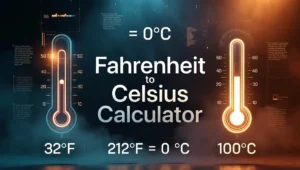
🌡️ Fahrenheit to Celsius Converter
Professional Temperature Conversion Calculator with Educational Insights & History
Convert Fahrenheit to Celsius with precision using: °C = (°F - 32) × 5/9
✓ Accurate to 4 decimal places
Get instant conversions to Celsius (°C) and Kelvin (K) simultaneously
✓ Perfect for scientific calculations
10 popular temperatures ready to convert instantly - from freezing point to oven temperature
✓ One-click conversion shortcuts
Learn with step-by-step calculations, real-world examples, and temperature comparisons
✓ Perfect for students & professionals
🌍 Travel & Weather: Understand temperatures when traveling abroad
👨🍳 Cooking & Baking: Convert recipe temperatures accurately
🔬 Science & Research: Scientific calculations and experiments
🏥 Health & Medical: Body temperature monitoring
🏠 HVAC & Climate: Home temperature control systems
📖 Education: Learning temperature scales and conversions
⚠️ Physical Limit: Absolute zero is -459.67°F (-273.15°C). No temperature can go below this point.
📊 Temperature Input
📈 Conversion Results
🔢 Calculation Steps
📋 Temperature Context
📚 Educational Information
🔬 Understanding the Formula: °C = (°F - 32) × 5/9
Why subtract 32? The Fahrenheit scale sets water's freezing point at 32°F, while Celsius uses 0°C. Subtracting 32 aligns both scales at the freezing point.
Why multiply by 5/9? Between freezing and boiling, Fahrenheit spans 180 degrees (212°F - 32°F), while Celsius spans 100 degrees (100°C - 0°C). The ratio 100/180 = 5/9 converts the scale.
⚡ Quick Mental Math Trick: For rough estimates, subtract 30 and divide by 2. Example: 68°F ≈ (68-30)/2 = 19°C (actual: 20°C)
🔄 Reverse Formula (C to F): °F = (°C × 9/5) + 32. To convert back, multiply by 1.8 and add 32.
📏 Temperature Differences: A change of 1°F = 0.556°C. A change of 1°C = 1.8°F.
🌡️ Real-World Examples:
• Freezing: 32°F (0°C) - Water freezes, ice forms
• Cold Day: 41°F (5°C) - Need a jacket
• Room Temperature: 68°F (20°C) - Comfortable indoors
• Body Temperature: 98.6°F (37°C) - Healthy human
• Boiling: 212°F (100°C) - Water boils at sea level
• Oven Temperature: 350°F (176.7°C) - Baking standard
📊 Interesting Facts:
• At -40°, Fahrenheit and Celsius are equal: -40°F = -40°C
• Kelvin starts at absolute zero (-273.15°C / -459.67°F)
• Kelvin doesn't use degree symbol, just K
📊 Temperature Reference Points
| Description | Fahrenheit | Celsius | Kelvin |
|---|---|---|---|
| Absolute Zero | -459.67°F | -273.15°C | 0 K |
| Coldest Winter Ever | -128.6°F | -89.2°C | 184 K |
| Water Freezes | 32°F | 0°C | 273.15 K |
| Cold Winter Day | 0°F | -17.8°C | 255.4 K |
| Room Temperature | 68-72°F | 20-22°C | 293-295 K |
| Human Body Temperature | 98.6°F | 37°C | 310.15 K |
| Fever Threshold | 100.4°F | 38°C | 311.15 K |
| Water Boils (Sea Level) | 212°F | 100°C | 373.15 K |
| Hottest Day Ever Recorded | 134°F | 56.7°C | 329.85 K |
| Oven (Baking) | 350°F | 176.7°C | 449.85 K |
| Pizza Oven | 450-500°F | 232-260°C | 505-533 K |
| Perfect Swimming Pool | 78-82°F | 25.5-27.8°C | 298.5-301 K |
Temperature affects nearly every part of our daily lives. Whether you’re checking the weather before a trip, following an international recipe, monitoring body temperature during an illness, or conducting scientific research, understanding how to convert farenheit a celsius is an essential skill. While many countries rely on the Celsius scale, others—most notably the United States—continue to use Fahrenheit in everyday life. As a result, millions of people search for reliable temperature conversions every day.
Although modern smartphones and online calculators can instantly convert temperatures, knowing the basics of Fahrenheit and Celsius helps you better understand weather reports, cooking instructions, health information, and technical data from around the world. Instead of simply entering numbers into a converter, understanding the relationship between these two temperature scales gives you greater confidence when interpreting temperature values in different contexts.
The Fahrenheit and Celsius scales measure the same physical property—temperature—but they use different reference points and intervals. For example, water freezes at 32°F (0°C) and boils at 212°F (100°C) under standard atmospheric pressure. Because of these differences, converting temperatures requires a specific mathematical formula. Fortunately, the process is straightforward once you understand the logic behind it.
Today, Celsius is the official temperature scale in most countries and is widely used in science, education, healthcare, engineering, and international weather reporting. Fahrenheit, however, remains deeply integrated into daily life in the United States and a few other regions. This means travelers, students, professionals, home cooks, and anyone consuming international content frequently need to switch between the two systems.
Temperature conversion is also more important than many people realize. A weather forecast of 95°F may not immediately make sense if you’re accustomed to Celsius, while an oven instruction of 180°C could be confusing for someone using a Fahrenheit-based appliance. Even medical information often requires quick conversions, especially when comparing normal body temperature or determining whether a fever is present.
This comprehensive guide explores everything you need to know about farenheit a celsius conversion. You’ll learn how both temperature scales were developed, understand the standard conversion formula, discover practical mental math shortcuts, and explore detailed conversion charts for common temperatures. We’ll also explain how temperature conversion is used in weather forecasting, cooking, healthcare, science, engineering, and international travel.
In addition to step-by-step examples, this guide includes frequently searched Fahrenheit-to-Celsius conversions, practical tips for avoiding common mistakes, and helpful reference tables that make temperature conversion faster and easier. Whether you’re a student learning about temperature scales, a traveler preparing for another country, a home chef following global recipes, or simply curious about how these measurement systems work, you’ll find clear explanations and practical examples throughout this article.
By the end of this guide, you’ll not only know how to convert farenheit a celsius accurately but also understand when each temperature scale is used, why both systems continue to coexist, and how to interpret temperature readings with confidence in everyday situations.
Understanding the Fahrenheit Temperature Scale
The Fahrenheit temperature scale is one of the oldest temperature measurement systems still used today. It remains common in the United States and a few other regions, especially for weather forecasts, cooking, and daily conversations.
Fahrenheit measures temperature using degrees symbolized as °F. On this scale, water freezes at 32°F and boils at 212°F under standard atmospheric pressure.
History of the Fahrenheit Scale
The Fahrenheit scale was introduced in the early 18th century. Before modern scientific standards existed, different scientists used different temperature references. This created confusion in trade, science, and daily life.
The Fahrenheit system became popular because it provided more detailed temperature intervals for weather and human comfort. For many years, it was one of the most accurate temperature systems available.
Who Invented Fahrenheit?
The Fahrenheit scale was invented by Daniel Gabriel Fahrenheit, a physicist and instrument maker born in 1686. He developed mercury thermometers that were more reliable than earlier alcohol-based devices.
Fahrenheit selected reference points based on practical measurements available at the time. Although modern science later standardized Celsius, Fahrenheit’s system remained deeply rooted in American culture.
Why Some Countries Still Use Fahrenheit
Most countries now use Celsius officially, but Fahrenheit is still widely used in:
- United States
- Bahamas
- Cayman Islands
- Belize
People in these countries are familiar with Fahrenheit because weather forecasts, appliances, and educational systems have used it for generations.
Advantages of Fahrenheit Measurements
Fahrenheit offers several practical advantages:
- More precise temperature intervals for weather
- Easier distinction between mild changes in outdoor temperatures
- Commonly used in household appliances and ovens in the US
For example:
- 70°F feels noticeably different from 75°F
- Small weather changes are easier to communicate
Many people believe Fahrenheit provides a more intuitive understanding of daily climate conditions.
Understanding the Celsius Temperature Scale
Celsius is the most widely used temperature scale in the world. It is used in science, medicine, education, and international weather reporting.
The Celsius symbol is °C.
What Is Celsius?
Celsius is a metric temperature scale where:
- Water freezes at 0°C
- Water boils at 100°C
This simple structure makes calculations easier in science and engineering.
The History of Celsius
The Celsius scale was created by Swedish astronomer Anders Celsius in 1742. His original version was later reversed into the modern format we use today.
Because of its logical structure and compatibility with the metric system, Celsius spread rapidly across Europe and eventually worldwide.
Why Celsius Became the Global Standard
Celsius became the international standard because it is:
- Simple to understand
- Compatible with the metric system
- Easy for scientific calculations
- Widely accepted internationally
Nearly every scientific institution uses Celsius or Kelvin for temperature measurements.
Countries That Use Celsius
Most countries officially use Celsius, including:
- United Kingdom
- Canada
- Australia
- Indonesia
- Germany
- Japan
- France
- India
Weather forecasts, schools, hospitals, and scientific industries typically rely on Celsius.
Farenheit a Celsius Formula Explained
Converting Fahrenheit to Celsius is straightforward once you understand the formula.
Standard Fahrenheit to Celsius Formula
The standard formula is:°C=(°F−32)×95
This formula subtracts the freezing point difference and adjusts the scale ratio.
Step-by-Step Conversion Process
To convert Fahrenheit to Celsius:
- Subtract 32 from the Fahrenheit value
- Multiply the result by 5
- Divide by 9
Example:
- Convert 68°F to Celsius
- 68 – 32 = 36
- 36 × 5 = 180
- 180 ÷ 9 = 20°C
How the Formula Works
The formula works because Fahrenheit and Celsius scales have different freezing and boiling reference points.
- Fahrenheit freezing point: 32°F
- Celsius freezing point: 0°C
Additionally, Celsius degrees are larger intervals than Fahrenheit degrees.
Mathematical Explanation
The ratio between the two scales is based on:
- 180 Fahrenheit degrees between freezing and boiling
- 100 Celsius degrees between freezing and boiling
This simplifies to:180100=95
Example 1
Convert 32°F:(32−32)×95=0°C
Example 2
Convert 98.6°F:(98.6−32)×95≈37°C
Example 3
Convert 212°F:(212−32)×95=100°C
Farenheit a Celsius Conversion Chart
Temperature conversion charts help users quickly compare Fahrenheit and Celsius values without calculations.
Common Everyday Temperatures
| Fahrenheit | Celsius |
|---|---|
| 0°F | -17.8°C |
| 10°F | -12.2°C |
| 20°F | -6.7°C |
| 30°F | -1.1°C |
| 32°F | 0°C |
| 40°F | 4.4°C |
| 50°F | 10°C |
| 60°F | 15.6°C |
| 70°F | 21.1°C |
| 80°F | 26.7°C |
| 90°F | 32.2°C |
| 98.6°F | 37°C |
| 100°F | 37.8°C |
| 120°F | 48.9°C |
| 150°F | 65.6°C |
| 180°F | 82.2°C |
| 200°F | 93.3°C |
| 212°F | 100°C |
Printable Conversion Table
Many people print conversion charts for:
- Kitchens
- Science classrooms
- Workshops
- Weather stations
- Travel reference guides
Printable tables are especially useful when internet access is unavailable.
How to Convert Farenheit a Celsius Without a Calculator
Mental conversion methods are useful when traveling or reading international weather reports.
Mental Math Tricks
One common shortcut:
- Subtract 30 from Fahrenheit
- Divide by 2
Example:
- 70°F
- 70 – 30 = 40
- 40 ÷ 2 = 20°C
The exact answer is 21.1°C, so the estimate is close.
Quick Estimation Method
Another fast method:
- Fahrenheit 50 = Celsius 10
- Every additional 18°F ≈ 10°C
This helps estimate temperatures quickly in conversations.
Everyday Shortcuts
Useful benchmarks include:
- 32°F = freezing
- 68°F ≈ room temperature
- 98.6°F = body temperature
- 212°F = boiling water
Memorizing these values makes daily conversion easier.
Online Farenheit a Celsius Calculator
Online conversion tools simplify temperature calculations instantly.
Benefits of Using an Online Converter
Advantages include:
- Fast results
- Accurate calculations
- No manual math
- Easy mobile access
Instant Temperature Conversion
Modern calculators can convert:
- Fahrenheit to Celsius
- Celsius to Fahrenheit
- Kelvin conversions
Many tools update results automatically while typing.
Mobile-Friendly Conversion Tools
Smartphone apps and responsive websites allow quick conversions during:
- Travel
- Cooking
- Scientific work
- Outdoor activities
Offline Conversion Methods
Offline options include:
- Printable charts
- Calculator apps
- Smartwatch converters
- Built-in smartphone assistants
These methods are helpful when internet connections are weak.
Common Fahrenheit to Celsius Conversions
These are some of the most searched temperature conversions online.
32 Fahrenheit to Celsius
32°F = 0°C
Water freezes at this temperature.
50 Fahrenheit to Celsius
50°F = 10°C
Cool but comfortable weather.
68 Fahrenheit to Celsius
68°F = 20°C
Typical indoor room temperature.
70 Fahrenheit to Celsius
70°F = 21.1°C
Pleasant spring weather.
75 Fahrenheit to Celsius
75°F = 23.9°C
Warm and comfortable.
80 Fahrenheit to Celsius
80°F = 26.7°C
Common summer temperature.
90 Fahrenheit to Celsius
90°F = 32.2°C
Hot weather conditions.
95 Fahrenheit to Celsius
95°F = 35°C
Very hot outdoor temperature.
98.6 Fahrenheit to Celsius
98.6°F = 37°C
Average human body temperature.
100 Fahrenheit to Celsius
100°F = 37.8°C
Extremely hot weather in many regions.
104 Fahrenheit to Celsius
104°F = 40°C
Dangerous heat levels.
120 Fahrenheit to Celsius
120°F = 48.9°C
Extreme desert heat.
150 Fahrenheit to Celsius
150°F = 65.6°C
Low oven baking temperature.
180 Fahrenheit to Celsius
180°F = 82.2°C
Used in slow cooking.
200 Fahrenheit to Celsius
200°F = 93.3°C
Warm oven setting.
212 Fahrenheit to Celsius
212°F = 100°C
Boiling point of water.
Celsius to Fahrenheit Conversion
Sometimes you need to convert Celsius into Fahrenheit instead.
Reverse Formula
The reverse formula is:°F=(°C×59)+32
When You Need Celsius to Fahrenheit
Common situations include:
- Reading American recipes
- Traveling to the United States
- Using imported appliances
- Medical temperature interpretation
Common Celsius Values
| Celsius | Fahrenheit |
|---|---|
| 0°C | 32°F |
| 10°C | 50°F |
| 20°C | 68°F |
| 25°C | 77°F |
| 30°C | 86°F |
| 37°C | 98.6°F |
| 40°C | 104°F |
| 100°C | 212°F |
Farenheit a Celsius for Weather Forecasts
Temperature conversion is especially important in global weather reporting.
Reading International Weather Reports
Travelers often encounter unfamiliar temperature scales abroad. Understanding both systems prevents confusion and helps with trip planning.
Understanding Winter Temperatures
Examples:
- 32°F = freezing point
- 14°F = very cold winter weather
- -4°F = dangerous cold exposure
In Celsius:
- 0°C = freezing
- -10°C = severe cold
- -20°C = extreme winter conditions
Understanding Summer Temperatures
Warm weather comparisons:
| Fahrenheit | Celsius |
|---|---|
| 75°F | 24°C |
| 85°F | 29°C |
| 95°F | 35°C |
These temperatures help travelers prepare clothing and hydration needs.
Extreme Weather Temperatures
Extreme heat and cold can impact health, transportation, and infrastructure. Accurate conversion becomes important during:
- Heat waves
- Snowstorms
- Desert travel
- Mountain expeditions
Farenheit a Celsius in Cooking
Cooking temperatures often require quick conversion between systems.
Oven Temperature Conversion
| Fahrenheit | Celsius |
|---|---|
| 250°F | 120°C |
| 300°F | 150°C |
| 350°F | 177°C |
| 400°F | 204°C |
| 450°F | 232°C |
Baking Temperatures
Baking recipes commonly use precise temperatures because small differences affect:
- Texture
- Moisture
- Browning
- Cooking time
Roasting Temperatures
Roasting meats and vegetables usually occurs between:
- 375°F to 450°F
- 190°C to 232°C
Air Fryer Temperature Conversion
Many air fryers support both systems, but older models may only display one format. Understanding conversions helps prevent undercooking or burning food.
Farenheit a Celsius in Science
Temperature conversion plays a critical role in scientific work.
Laboratory Applications
Scientists often convert temperatures during experiments involving:
- Heat transfer
- Chemical reactions
- Biological testing
Physics
Physics calculations may require switching between Celsius, Fahrenheit, and Kelvin depending on international standards.
Chemistry
Chemical reactions depend heavily on temperature accuracy. Incorrect conversions can change experimental results significantly.
Engineering
Engineers use temperature conversions in:
- Manufacturing
- HVAC systems
- Automotive industries
- Aerospace technology
Medical Uses of Fahrenheit and Celsius
Healthcare systems worldwide use both temperature scales.
Body Temperature
Normal body temperature averages:
- 98.6°F
- 37°C
However, slight variations are normal depending on activity and environment.
Fever Conversion
Common fever ranges:
| Fahrenheit | Celsius |
|---|---|
| 100.4°F | 38°C |
| 102.2°F | 39°C |
| 104°F | 40°C |
High fevers may require medical attention.
Medical Thermometers
Modern digital thermometers can switch between:
- Fahrenheit
- Celsius
This feature helps international travelers and healthcare professionals.
Normal Human Temperature
Recent medical research shows normal body temperature can vary slightly between individuals. Factors include:
- Age
- Time of day
- Physical activity
- Health conditions
Even so, 37°C or 98.6°F remains the globally recognized standard reference point.
Why the United States Uses Fahrenheit
The Fahrenheit temperature scale remains the standard system for everyday temperature measurements in the United States. While most countries around the world use Celsius, Americans still rely on Fahrenheit for weather forecasts, cooking, household thermostats, and daily conversations.
Understanding why the United States continues to use Fahrenheit requires looking at history, culture, and practical habits that developed over centuries.
Historical Reasons
The Fahrenheit scale was created in 1724 by German physicist Daniel Gabriel Fahrenheit. Before Celsius became widely accepted, Fahrenheit was already commonly used in English-speaking countries, including early America.
When the United States was forming its national systems of measurement, Fahrenheit thermometers were already available and widely trusted. By the time Celsius gained global popularity in the 19th and 20th centuries, Fahrenheit had become deeply embedded in American society.
Another important reason is the historical influence of the British Empire. Early American colonies inherited many British measurement standards. Although the United Kingdom later shifted toward Celsius, the United States largely kept the older system.
In the 1970s, the U.S. government considered transitioning to Celsius as part of metrication efforts. However, the process faced resistance from industries, businesses, and the public. The change was never fully implemented.
Cultural Factors
Temperature is part of everyday communication. Americans grow up learning that:
- 32°F means freezing
- 70°F feels comfortable indoors
- 90°F indicates hot summer weather
These benchmarks become second nature over time. Switching systems would require millions of people to relearn temperature references they use daily.
Media also reinforces Fahrenheit usage. Weather broadcasts, smartphone apps, newspapers, schools, and household appliances in the U.S. still default to Fahrenheit. Because everyone around them uses the same system, there is little pressure for Americans to change.
Sports culture, cooking recipes, and automotive systems also contribute to the continued use of Fahrenheit in daily life.
Practical Reasons
Many Americans argue that Fahrenheit provides more precise everyday temperature readings without needing decimals.
For example:
- 68°F vs 69°F shows a small but noticeable temperature difference
- In Celsius, both temperatures might simply be rounded to 20°C
Because Fahrenheit has more degrees between freezing and boiling points of water, some people feel it offers finer detail for weather discussions.
Another practical reason is infrastructure. Replacing thermometers, industrial equipment, educational materials, product packaging, and appliance settings nationwide would cost billions of dollars.
For most Americans, there is no strong practical advantage to changing systems, especially when Fahrenheit already works effectively for daily life.
Countries That Use Fahrenheit vs Celsius
Today, Celsius is the global standard for temperature measurement. However, a few countries and territories still use Fahrenheit in certain situations.
Fahrenheit Countries
The United States is the primary country that still uses Fahrenheit for everyday purposes.
Other places that may use Fahrenheit partially or historically include:
- Bahamas
- Cayman Islands
- Liberia
- Palau
- Some Caribbean territories
Even in these regions, Celsius is often used in science, medicine, and international communication.
The U.S. remains the largest economy where Fahrenheit dominates weather reports and household temperature settings.
Celsius Countries
Almost every country worldwide officially uses Celsius.
Examples include:
- Canada
- Australia
- United Kingdom
- Germany
- France
- Japan
- South Korea
- Indonesia
- Brazil
- India
Celsius became internationally popular because it aligns well with the metric system. Scientific organizations, educational institutions, and global industries generally prefer Celsius for consistency.
The Celsius scale is especially practical because:
- 0°C represents freezing water
- 100°C represents boiling water
This structure makes it easy to understand and teach.
Mixed Systems
Some countries use both Fahrenheit and Celsius depending on the situation.
Canada is a common example:
- Weather forecasts mainly use Celsius
- Cooking appliances may still include Fahrenheit
- Older generations sometimes understand both systems
The United Kingdom also uses a mixed approach. Official weather forecasts use Celsius, but some people still refer to Fahrenheit during heatwaves or older conversations.
Global travel and digital technology have made dual-scale understanding more common than ever.
Fahrenheit vs Celsius Comparison
Both Fahrenheit and Celsius are widely used temperature scales, but they differ in structure, practicality, and global acceptance.
Key Differences
The main difference lies in how each scale defines temperature points.
| Benchmark | Fahrenheit | Celsius |
|---|---|---|
| Water freezes | 32°F | 0°C |
| Water boils | 212°F | 100°C |
| Average room temperature | 68–72°F | 20–22°C |
| Normal body temperature | 98.6°F | 37°C |
Fahrenheit divides the freezing and boiling points of water into 180 degrees, while Celsius uses 100 degrees.
Because Fahrenheit has smaller increments, it can provide more detailed readings without decimals.
Advantages
Advantages of Fahrenheit
- More precise for weather discussions
- Smaller degree intervals
- Familiar to Americans
- Useful for household temperature adjustments
Many people feel Fahrenheit better reflects human comfort levels because everyday outdoor temperatures often fall between 0°F and 100°F.
Advantages of Celsius
- Simpler mathematical structure
- Easier for scientific calculations
- Compatible with the metric system
- Globally recognized standard
Celsius is commonly preferred in education, engineering, medicine, and international communication.
Disadvantages
Disadvantages of Fahrenheit
- Less intuitive scientifically
- Not aligned with the metric system
- Limited international usage
- Requires conversions for global communication
Disadvantages of Celsius
- Larger degree gaps reduce precision without decimals
- Less familiar in the United States
- Weather discussions sometimes feel less detailed
For example, a 1°C change equals a 1.8°F change, making Celsius increments broader.
Which Scale Is More Accurate?
Neither Fahrenheit nor Celsius is inherently more accurate. Both scales measure the same physical temperature.
Accuracy depends on the thermometer and measurement method, not the scale itself.
However, Fahrenheit can appear more precise in everyday use because it uses smaller degree intervals. Celsius often relies on decimal values for similar precision.
For scientific work, Celsius is generally preferred because it integrates directly with the metric system and Kelvin scale.
Common Temperature Benchmarks
Understanding common temperature references helps people compare Fahrenheit and Celsius more easily in everyday situations.
Freezing Point of Water
Water freezes at:
- 32°F
- 0°C
This benchmark is one of the most important temperature references globally. It is commonly used in weather forecasts, winter safety information, and science education.
Roads may become icy when temperatures fall below these levels.
Boiling Point of Water
Water boils at:
- 212°F
- 100°C
This occurs at standard atmospheric pressure at sea level.
Cooking, industrial processes, and laboratory experiments frequently use this benchmark as a reference point.
At higher altitudes, water boils at lower temperatures because air pressure decreases.
Room Temperature
Typical room temperature is around:
- 68–72°F
- 20–22°C
This range is considered comfortable for most indoor environments.
Office buildings, homes, hotels, and shopping centers usually maintain temperatures within this range to improve comfort and energy efficiency.
Human Body Temperature
Average normal human body temperature is:
- 98.6°F
- 37°C
Small variations are normal depending on activity level, age, and time of day.
A fever is generally considered:
- Above 100.4°F
- Above 38°C
Medical professionals worldwide commonly use Celsius, although Fahrenheit remains standard in many U.S. hospitals and clinics.
Outdoor Comfort Temperature
Most people consider comfortable outdoor weather to be around:
- 65–77°F
- 18–25°C
This range is often associated with pleasant spring or early summer conditions.
However, comfort levels vary depending on:
- Humidity
- Wind
- Sun exposure
- Personal preference
- Local climate adaptation
Someone living in a tropical country may tolerate higher temperatures more comfortably than someone from a colder region.
Understanding these benchmarks makes it easier to compare weather conditions and communicate temperatures internationally.
Frequently Asked Questions About Fahrenheit to Celsius
How do I convert Fahrenheit to Celsius quickly?
The fastest way to convert Fahrenheit to Celsius is by using a simple math formula:
Celsius = (Fahrenheit − 32) × 5/9
For example:
- 68°F → (68 − 32) × 5/9 = 20°C
- 95°F → (95 − 32) × 5/9 = 35°C
If you do not want to calculate exact numbers, you can use a quick mental shortcut:
- Subtract 30 from the Fahrenheit temperature
- Divide the result by 2
This method is not perfectly accurate, but it works well for everyday estimates.
Example:
- 86°F
- 86 − 30 = 56
- 56 ÷ 2 = 28°C
The exact conversion is 30°C, so the estimate is close enough for casual use.
Quick Conversion Examples
| Fahrenheit | Celsius |
|---|---|
| 32°F | 0°C |
| 50°F | 10°C |
| 68°F | 20°C |
| 77°F | 25°C |
| 86°F | 30°C |
| 104°F | 40°C |
What is the easiest conversion formula?
The easiest and most accurate formula is:
°C = (°F − 32) × 5/9
This formula is widely used in weather forecasting, science, cooking, healthcare, and education.
If you need to convert Celsius back to Fahrenheit, use:
°F = (°C × 9/5) + 32
These formulas remain the global standard for temperature conversion in 2026 because they provide consistent and reliable results.
Why the Formula Works
The Fahrenheit and Celsius scales measure temperature differently:
- Water freezes at 32°F and 0°C
- Water boils at 212°F and 100°C
That difference creates a ratio of 180°F to 100°C, which simplifies to 9:5.
Why is 32°F equal to 0°C?
The Celsius scale was designed around the freezing and boiling points of water. Water freezes at:
- 0°C
- 32°F
This means 32°F represents the exact same physical temperature as 0°C.
The two systems simply use different numbering methods.
Historical Background
The Fahrenheit scale was created by German physicist Daniel Gabriel Fahrenheit in the early 1700s. Later, Swedish astronomer Anders Celsius introduced the Celsius scale based on water’s natural freezing and boiling points.
Because Celsius uses water-based reference points, it became easier for scientific and international use.
Why do Americans use Fahrenheit?
The United States continues using Fahrenheit mainly because of historical adoption and infrastructure.
Many Americans grew up with Fahrenheit in:
- Weather reports
- Household thermostats
- Cooking instructions
- Industrial systems
- Education
Changing an entire country’s temperature system would require major updates across businesses, schools, and technology.
Fahrenheit Offers More Detail for Weather
Some people prefer Fahrenheit because it provides smaller increments between temperatures.
For example:
- 70°F to 71°F feels like a small change
- 21°C to 22°C represents a larger temperature jump
This makes Fahrenheit feel more precise for daily weather discussions.
Is Celsius more accurate?
Celsius is not inherently more accurate than Fahrenheit. Both scales measure temperature accurately when used correctly.
The main difference is how temperatures are divided.
Celsius Advantages
Celsius is preferred globally because:
- It is easier for scientific calculations
- It aligns with the metric system
- Water-based reference points are simple to understand
- Most countries use it for weather and public communication
Fahrenheit Advantages
Fahrenheit can feel more detailed for everyday weather ranges because it uses more degrees between freezing and boiling points.
Neither system is technically “better.” The best scale depends on the context.
What temperature is considered a fever?
A fever is generally considered:
- 100.4°F
- 38°C
Anything above this level usually indicates the body is responding to infection or illness.
Common Fever Temperature Ranges
| Fahrenheit | Celsius | Meaning |
|---|---|---|
| 98.6°F | 37°C | Normal body temperature |
| 100.4°F | 38°C | Mild fever |
| 102°F | 38.9°C | Moderate fever |
| 104°F | 40°C | High fever |
Body temperature may vary slightly depending on age, activity, and time of day.
Which countries still use Fahrenheit?
Most countries use Celsius today. However, Fahrenheit is still commonly used in:
- United States
- Some Caribbean nations
- A few territories influenced by American systems
Countries like Canada and the United Kingdom may still reference Fahrenheit informally in certain situations, especially among older generations.
Global Temperature Trends
As of 2026:
- Celsius dominates international weather reporting
- Scientific communities universally use Celsius or Kelvin
- Most smartphones and smart devices support both scales
Can I convert Fahrenheit to Celsius in my head?
Yes, you can estimate Fahrenheit to Celsius mentally using simple shortcuts.
Easy Mental Method
- Subtract 30 from Fahrenheit
- Divide by 2
Example:
- 90°F
- 90 − 30 = 60
- 60 ÷ 2 = 30°C
The exact conversion is 32.2°C.
This shortcut works best for weather temperatures.
Common Mental Benchmarks
| Fahrenheit | Celsius |
|---|---|
| 32°F | 0°C |
| 50°F | 10°C |
| 68°F | 20°C |
| 86°F | 30°C |
| 104°F | 40°C |
Memorizing these points makes quick estimation easier.
Is 100°F hot?
Yes, 100°F is considered very hot for outdoor weather.
100°F equals approximately 37.8°C.
At this temperature:
- Heat exhaustion risk increases
- Hydration becomes extremely important
- Outdoor activities may become dangerous during peak sunlight
Effects of Extreme Heat
When temperatures exceed 100°F:
- The body cools less efficiently
- Sweating increases rapidly
- Heatstroke risk rises
- Vulnerable groups face higher health risks
In many regions, temperatures above 100°F are considered heatwave conditions.
Is 0°F dangerous?
0°F is extremely cold and potentially dangerous.
0°F equals approximately −17.8°C.
At this level:
- Frostbite can develop quickly
- Hypothermia becomes a serious concern
- Roads may freeze rapidly
- Outdoor exposure should be limited
Cold Weather Safety Tips
During temperatures near 0°F:
- Wear insulated clothing
- Cover exposed skin
- Limit outdoor activity
- Keep emergency supplies available
- Monitor weather alerts
Strong wind can make temperatures feel even colder through wind chill effects.
Common Mistakes When Converting Fahrenheit to Celsius
Formula Errors
One of the most common mistakes is using the wrong formula order.
Correct formula:
(°F − 32) × 5/9
Incorrect methods often include:
- Multiplying before subtracting 32
- Reversing the formula
- Forgetting parentheses
Example of a Common Error
Wrong:
- 68 × 5/9 − 32
Correct:
- (68 − 32) × 5/9
Even a small formula mistake can produce inaccurate results.
Calculator Mistakes
Typing errors are another major issue during temperature conversion.
Common calculator problems include:
- Missing parentheses
- Using division incorrectly
- Accidentally converting Celsius to Fahrenheit instead
Tips to Avoid Calculator Errors
- Double-check numbers before pressing enter
- Use scientific calculators for precision
- Compare results with a conversion chart
Digital weather apps can also help verify calculations instantly.
Decimal Rounding Issues
Rounding numbers too early may reduce accuracy.
Example:
- 98.6°F = 37°C exactly
- Premature rounding may create slight differences
Best Practice for Precision
For medical, scientific, or engineering purposes:
- Keep at least one decimal place
- Round only at the final step
For casual weather discussions, whole numbers are usually acceptable.
Confusing Fahrenheit with Celsius
Mixing the two scales can create major misunderstandings.
For example:
- 40°C is dangerously hot
- 40°F is actually cold weather
This confusion often happens in international travel, recipes, or weather forecasts.
How to Prevent Confusion
Always include:
- °F for Fahrenheit
- °C for Celsius
Clear labeling helps avoid mistakes.
Tips for Remembering Fahrenheit and Celsius Conversions
Memory Tricks
Simple memory tricks can make temperature conversion easier.
Popular Conversion Shortcuts
- Double Celsius and add 30 for a rough Fahrenheit estimate
- Subtract 30 and divide by 2 for rough Celsius conversion
Easy Reference Points
Remember these common temperatures:
| Celsius | Fahrenheit |
|---|---|
| 0°C | 32°F |
| 20°C | 68°F |
| 25°C | 77°F |
| 30°C | 86°F |
| 40°C | 104°F |
These benchmarks cover most daily weather conditions.
Everyday Reference Points
Using real-world experiences helps people remember temperatures naturally.
Useful Temperature References
- 0°C / 32°F → Water freezes
- 20°C / 68°F → Comfortable room temperature
- 30°C / 86°F → Hot summer day
- 37°C / 98.6°F → Average body temperature
- 100°C / 212°F → Water boils
Associating temperatures with familiar situations improves memory retention.
Visual Temperature Guide
Visualizing temperature ranges can make conversions feel more intuitive.
Basic Temperature Feel Guide
| Celsius | Fahrenheit | Feeling |
|---|---|---|
| -10°C | 14°F | Freezing cold |
| 0°C | 32°F | Ice forming |
| 10°C | 50°F | Cool |
| 20°C | 68°F | Comfortable |
| 30°C | 86°F | Hot |
| 40°C | 104°F | Extreme heat |
This guide helps travelers, students, and weather enthusiasts quickly interpret temperatures.
Final Thoughts on Fahrenheit to Celsius
Key Takeaways
Understanding Fahrenheit to Celsius conversion is useful for:
- International travel
- Weather interpretation
- Cooking
- Science and education
- Healthcare monitoring
The most important formula to remember is:
°C = (°F − 32) × 5/9
Even simple mental shortcuts can help with quick daily estimates.
Best Practices for Accurate Temperature Conversion
For the best results:
- Use the correct formula order
- Avoid early rounding
- Double-check calculator entries
- Memorize key temperature benchmarks
- Label units clearly
These habits improve both speed and accuracy.
Recommended Tools
Helpful conversion tools include:
- Smartphone weather apps
- Digital assistants
- Online temperature calculators
- Smart home devices
Modern technology makes temperature conversion easier than ever.
Choosing the Right Temperature Scale
Both Fahrenheit and Celsius remain valuable temperature systems.
When Celsius Works Best
Celsius is ideal for:
- International communication
- Scientific measurements
- Educational use
- Metric-based calculations
When Fahrenheit Works Best
Fahrenheit is often preferred for:
- Detailed weather discussions
- Everyday American usage
- Home temperature settings
Learning both systems improves global communication and practical understanding of temperature in daily life.