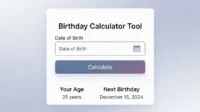
Find your exact age, countdown to your next birthday, zodiac profile, and life stats with this educational tool.
Explore your life journey
Get a full breakdown of your age in years, months, weeks, days, and seconds. Explore astrology, biological milestones, and even your age on other planets in the solar system.
📅 Personal information
Used to personalize your results.
Please enter a valid date of birth (not in the future).
⚡ Quick Access (Popular Dates)
⚙️ Calculation Options
📊 Your birthday stats
Hello, -! Here are your results:
🎂 YOUR CURRENT AGE
0 years, 0 months, 0 days
From [DOB] to [REF]
⏰ NEXT BIRTHDAY
0
days to go
-
🌍 Cultural & calendar
DAY OF WEEK
-
Day you were born
HIJRI CALENDAR
-
Estimated Islamic date
LEAP YEAR?
-
Calendar check
Did you know? The day of the week you were born can reveal interesting cultural traditions across different societies. Many cultures attribute significance to birth days throughout history.
📋 Your lifetime in numbers
TOTAL MONTHS
0
TOTAL WEEKS
0
TOTAL DAYS
0
TOTAL HOURS
0
TOTAL MINUTES
0
TOTAL SECONDS
0
Note: Age uses the Gregorian calendar, with an average of 365.2425 days per year to account for leap years.
♈ Astrology & zodiac
WESTERN ZODIAC
-
Traits: -
CHINESE ZODIAC
-
Element: -
BIRTHSTONE
-
BIRTH FLOWER
-
🔢 LIFE PATH NUMBER
-
Numerology
🔮 Today’s zodiac snapshot
❤️ LOVE
-
💼 CAREER
-
💰 MONEY
-
Numerology: The life path number sums the digits of your birth date to a single digit (except master numbers 11, 22, 33). It reflects core personality themes.
💓 Biological journey (estimated)
HEARTBEATS
0
beats (est.)
BREATHS
0
breaths (est.)
SLEEP
0
hours (est.)
Biology note: The human heart beats roughly 100,000 times per day; we spend about a third of life asleep for brain and body recovery.
🚀 Your age across the solar system
Planet
Age (local years)
Year length (Earth days)
Astronomy note: A “year” is how long a planet takes to orbit the Sun once. Mercury is fast (~88 Earth days per orbit); Neptune is slow (~165 Earth years per orbit)!
🏆 Life milestones
Milestone
Date
Status
👥 Generation
-
🌊 Biorhythm cycles
Biorhythm theory suggests physical, emotional, and intellectual cycles affect your daily performance.
💪 Physical (23d)
0%
❤️ Emotional (28d)
0%
🧠 Intellectual (33d)
0%
How to read: Values near +100% suggest peak performance; near -100% suggest low energy in that cycle. 0% indicates a critical transition day.
📜 Historical context (birth year)
Fun fact: Understanding the historical context of your birth year connects you to global events that shaped your generation!
🌟 Famous people born on your date
Loading celebrity matches...
🎲 Fun facts about your birthday
✅ Copied to clipboard!
Copied to clipboard!
Have you ever needed to estimate someone’s birthday but didn’t have their exact birth date? Whether you’re organizing family records, planning a special celebration, researching genealogy, or calculating an estimated date of birth from a known age or pregnancy due date, a birthday estimator can be an incredibly useful tool. Instead of relying on rough guesses or manual calendar calculations, modern birthday estimation tools provide quick, logical, and reliable results based on available information.
As digital calculators continue to evolve, birthday estimation has become much more accurate and accessible than ever before. Many online tools can estimate a birth date using only a few details, such as a person’s current age, expected due date, conception date, or even historical records. While these estimations may not always produce an exact birthday, they offer a practical starting point for personal, educational, medical, and administrative purposes.
A birthday estimator works by applying date calculation methods, calendar rules, and mathematical algorithms to determine the most likely birthday based on the information provided. Depending on the available inputs, the estimation may involve counting backward from a due date, calculating from a person’s age, or analyzing calendar intervals. Advanced calculators also account for leap years, varying month lengths, and standard calendar conventions to improve overall accuracy.
These tools are widely used by parents tracking pregnancy milestones, healthcare professionals estimating birth timelines, educators teaching date calculations, genealogists researching family history, software developers building calendar applications, and individuals simply curious about an estimated birth date. Businesses may also use birthday estimation methods when historical records are incomplete or when validating archived information.
Although a birthday estimator is designed to simplify date calculations, it is important to understand its limitations. The quality of the estimate depends heavily on the accuracy of the information entered. Missing data, incorrect assumptions, or unknown historical details can all affect the final result. For this reason, birthday estimation should be viewed as an informed approximation rather than an official confirmation of someone’s date of birth.
This comprehensive guide explores everything you need to know about using a birthday estimator effectively. You’ll learn how these tools work, the different calculation methods they use, the factors that influence accuracy, and the situations where birthday estimation is most valuable. We’ll also compare birthday estimators with birthday calculators, explain how leap years and calendar systems affect results, discuss pregnancy-related estimations, highlight common mistakes to avoid, and answer frequently asked questions to help you make the most of these practical online tools.
Whether you’re looking to estimate a birthday for personal curiosity, family research, healthcare planning, software development, or educational purposes, understanding the principles behind birthday estimation will help you interpret results with greater confidence and choose the right approach for your specific needs.
A birthday estimator is a digital or manual tool used to predict or estimate someone’s date of birth based on available information. Instead of requiring an exact birth date, it works with partial details such as age, conception date, due date, or known timelines to generate an estimated birthday.
Birthday estimators are commonly used in healthcare, genealogy, education, demographic research, and personal planning. With modern date algorithms and calendar systems, these tools can produce highly accurate estimates in many situations.
Definition
A birthday estimator is a system that calculates a possible birth date using indirect information. The tool analyzes data points like current age, expected delivery date, conception period, or historical records to narrow down an estimated date of birth.
Unlike simple date lookup tools, a birthday estimator focuses on approximation and prediction rather than exact confirmation.
How It Differs from a Birthday Calculator
Although the terms are often used interchangeably, a birthday estimator and a birthday calculator serve different purposes.
A birthday calculator typically works with exact input data. For example, if someone enters a birth date, the calculator can determine age, zodiac sign, weekday of birth, or the number of days lived.
A birthday estimator, on the other hand, works when complete information is unavailable. It predicts a likely birth date based on patterns, timelines, or related dates.
Common Uses
Birthday estimators are useful in many real-world situations.
Personal Planning
People may use a birthday estimator to predict future milestones, age-related events, or approximate birthdays when official records are missing.
Family Records
Genealogists and family historians often estimate birth dates when historical documents are incomplete or damaged.
Pregnancy Estimation
Medical professionals and expecting parents use estimation tools to calculate expected delivery dates and pregnancy timelines.
Educational Purposes
Teachers, researchers, and students may use birthday estimation methods in demographic studies, mathematics exercises, or historical analysis.
How a Birthday Estimator Works
Birthday estimators rely on mathematical formulas, calendar systems, and date-based logic to generate possible birth dates.
Date-Based Calculations
Most birthday estimators start with a known reference point. This could be:
Current age
Due date
Conception date
Historical event
Approximate year
The system then adds or subtracts days, months, or years to estimate a likely birthday.
Calendar Algorithms
Modern estimators use calendar algorithms that account for month lengths, leap years, and date transitions. These algorithms help improve precision and reduce calculation errors.
Many online tools use the Gregorian calendar because it is the international standard in most countries today.
Leap Year Considerations
Leap years add an extra day to February every four years. This can slightly shift calculations when estimating birthdays across long periods.
For people born on February 29, estimators may provide alternative celebration dates during non-leap years.
Time Zone Differences
Time zones can affect birthday estimation, especially for births occurring close to midnight.
For example, a baby born at 11:30 PM in one country could already have the next calendar date in another region. Advanced birthday estimators may include time zone conversion features for better accuracy.
Accuracy Factors
Several elements influence the reliability of birthday estimates:
Quality of input information
Correct calendar system
Time zone handling
Human data entry accuracy
Leap year adjustments
The more complete the data, the more accurate the estimated result becomes.
Birthday Estimator vs Birthday Calculator
Although both tools involve date calculations, they are designed for different tasks.
Main Differences
A birthday calculator uses exact birth data to calculate age or related information.
A birthday estimator predicts a possible birth date using incomplete or indirect information.
Which Tool Is More Accurate?
A birthday calculator is generally more accurate because it works with confirmed dates.
A birthday estimator provides estimated results, which may vary depending on the quality of available information.
When to Use Each One
Use a birthday calculator when the exact birth date is already known.
Use a birthday estimator when only partial details are available, such as age, pregnancy timeline, or historical references.
Comparison Table
Feature
Birthday Estimator
Birthday Calculator
Requires Exact Birth Date
No
Yes
Works With Partial Data
Yes
Limited
Provides Estimated Results
Yes
No
Calculates Exact Age
Sometimes
Yes
Useful for Pregnancy Planning
Yes
Limited
Accuracy Level
Moderate to High
Very High
Common Use Cases
Estimation & prediction
Exact date calculations
Common Methods Used in a Birthday Estimator
Different estimation methods are used depending on the available information.
Estimating from Current Age
One of the simplest methods involves subtracting the current age from the current year.
For example, if someone is 30 years old in 2026, the estimated birth year would likely be 1995 or 1996 depending on whether their birthday has already occurred.
Estimating from Due Date
Pregnancy estimators often use due dates to calculate an estimated birth date.
Most medical systems assume pregnancy lasts around 40 weeks from the first day of the last menstrual period.
Estimating from Conception Date
If the conception date is known, estimators typically add approximately 38 weeks to predict the expected birth date.
This method is commonly used in fertility tracking applications.
Reverse Date Calculation
Reverse calculations work backward from a known event.
For example, if a document states that a person was 10 years old during a specific year, the estimator can predict an approximate birth year.
Calendar-Based Estimation
Some systems analyze historical calendar patterns, seasonal records, or age ranges to narrow down possible birth periods.
This approach is often used in genealogy and historical research.
Birthday Estimator for Pregnancy Planning
Pregnancy planning tools are among the most common applications of birthday estimation technology.
Understanding Due Dates
A due date represents the estimated day a baby may be born. However, only a small percentage of babies arrive exactly on that date.
Most births occur within a two-week range before or after the estimated due date.
Estimated Date of Birth
Healthcare providers use medical data, ultrasounds, and menstrual cycle information to estimate a baby’s birth date.
Online estimators can provide general predictions, but medical evaluation remains more reliable.
Pregnancy Timeline
Pregnancy is commonly divided into three trimesters:
Trimester
Duration
First Trimester
Weeks 1–12
Second Trimester
Weeks 13–26
Third Trimester
Weeks 27–40
Birthday estimators often calculate these stages automatically.
Conception Date Estimation
Conception usually occurs about two weeks after the first day of the last menstrual cycle in a standard 28-day cycle.
Estimators use this information to predict both conception and delivery timelines.
Medical Limitations
No estimator can guarantee an exact delivery date.
Factors such as genetics, maternal health, lifestyle, and premature labor can significantly affect the actual birth date.
Birthday Estimator Using Age
Age-based estimation is useful when exact birth records are unavailable.
Estimate Birth Year
The easiest approach is subtracting the person’s age from the current year.
However, estimators must also determine whether the birthday has already occurred this year.
Estimate Birth Month
Additional clues such as school enrollment dates, seasonal memories, or family records can help narrow down the birth month.
Estimate Birth Date
Estimating an exact day is more difficult without official records. In these cases, estimators may generate a probable date range instead of a single day.
Handling Unknown Information
When information is incomplete, estimators often use assumptions or averages.
For example:
Using mid-year estimates
Applying average gestation periods
Assuming standard calendar rules
The final estimate should always be treated as approximate rather than absolute.
How Leap Years Affect Birthday Estimation
Leap years create unique challenges for date calculations.
February 29 Birthdays
People born on February 29 only experience their exact birth date every four years.
During non-leap years, celebrations usually occur on February 28 or March 1 depending on local customs.
Leap Year Rules
In the Gregorian calendar:
A year is a leap year if divisible by 4
Century years must also be divisible by 400
For example:
2024 was a leap year
2100 will not be a leap year
2000 was a leap year
Common Errors
Common estimation mistakes include:
Ignoring leap days
Incorrect year subtraction
Miscounting February days
Using outdated calendar systems
Even a single missed leap year can shift calculations by several days over time.
Best Practices
To improve estimation accuracy:
Use updated calendar algorithms
Verify leap year rules
Double-check date formats
Confirm time zone information
Reliable software tools usually automate these adjustments.
Birthday Estimator and Calendar Systems
Calendar systems play an important role in date estimation accuracy.
Gregorian Calendar
The Gregorian calendar is the most widely used calendar system worldwide today.
Introduced in 1582, it corrected inaccuracies found in the older Julian calendar.
Most birthday estimators rely on Gregorian calculations.
Julian Calendar
The Julian calendar was used before the Gregorian system in many countries.
Historical birth records may require conversion between these systems for accurate estimation.
International Date Formats
Different countries use different date formats:
Region
Common Format
United States
MM/DD/YYYY
Europe
DD/MM/YYYY
ISO Standard
YYYY-MM-DD
Incorrect formatting can lead to major estimation errors.
ISO Date Standards
The ISO 8601 standard is widely used in software and databases because it reduces confusion between international date formats.
Many modern birthday estimation systems now follow ISO formatting standards.
Factors That Influence Birthday Estimation Accuracy
Even advanced tools depend heavily on data quality.
Missing Information
Incomplete records reduce estimation reliability.
Missing details may include:
Birth month
Birth year
Time of birth
Location
The fewer known details available, the wider the estimated range becomes.
Calendar Errors
Using the wrong calendar system can create historical date mismatches.
This issue is especially common in genealogy and archival research.
Time Zone Adjustments
International births may require time zone conversion for precise calculations.
A difference of several hours can change the official birth date.
Daylight Saving Time
Daylight saving time adjustments may also influence birth records near midnight transitions.
Modern medical systems usually account for these changes automatically.
Human Input Mistakes
Typing errors remain one of the most common problems in birthday estimation.
Examples include:
Reversed numbers
Incorrect month selection
Wrong year entry
Confusing international date formats
Careful verification greatly improves accuracy.
Benefits of Using a Birthday Estimator
A birthday estimator is a practical tool designed to estimate someone’s date of birth based on available information such as age, graduation year, historical records, or timeline events. In 2026, birthday estimators are widely used in genealogy, healthcare, administration, and digital applications because they simplify calculations and reduce human error.
Unlike manual calculations, modern birthday estimation tools rely on smart algorithms, date libraries, and automated calendar systems to generate more accurate results. Whether you are researching family history or organizing employee records, a birthday estimator can save time and improve efficiency.
Saves Time
One of the biggest advantages of using a birthday estimator is speed. Calculating estimated birth dates manually can become complicated, especially when dealing with leap years, varying month lengths, or incomplete information.
A digital birthday calculator can process large amounts of date-related data within seconds. This is especially useful for:
HR departments managing employee records
Researchers analyzing historical data
Schools organizing student information
Healthcare providers tracking patient age groups
Instead of spending hours checking calendars and documents, users can receive accurate estimates instantly.
Improves Planning
Birthday estimators help individuals and organizations improve planning. Event organizers, schools, and businesses often need approximate age information to create schedules, invitations, or eligibility requirements.
For example:
Marketing teams can create age-targeted campaigns
Schools can group students by estimated age range
Families can organize milestone birthday celebrations
Sports organizations can verify age categories
Accurate birthday estimation reduces scheduling conflicts and helps improve coordination.
Helpful for Family Research
Genealogy research often involves incomplete or damaged records. Many historical documents only mention a person’s age at the time of an event rather than their exact birthday.
A birthday estimator helps researchers estimate:
Birth years from census records
Approximate birth dates from marriage documents
Family timelines across generations
Migration and historical event connections
This makes family tree reconstruction more accurate and organized.
Useful for Education
Educational institutions use age estimation tools for admissions, record verification, and historical research projects.
Teachers and students may use birthday estimation when:
Studying historical populations
Creating demographic charts
Conducting social science research
Organizing school competitions by age group
Because modern estimators are easy to use, they also support digital literacy in classrooms.
Supports Digital Applications
Many apps and online platforms now integrate birthday estimation technology into their systems. From productivity software to AI-powered assistants, date estimation tools improve automation and user experience.
Popular uses include:
Calendar scheduling
Reminder systems
User verification
Smart notifications
Digital forms and onboarding systems
As automation grows in 2026, birthday estimators are becoming more important in modern software ecosystems.
Practical Uses of a Birthday Estimator
Birthday estimators are no longer limited to simple age calculations. Today, they are used across industries to improve accuracy, organization, and workflow efficiency.
Event Planning
Event planners often need estimated ages to organize seating arrangements, invitations, and age-specific activities.
Examples include:
Family reunions
School reunions
Corporate celebrations
Community events
A birthday estimator helps organizers prepare personalized experiences without requiring exact birth records from every participant.
Birthday Reminders
Many people forget birthdays because of busy schedules. Birthday estimators integrated with calendar systems can automatically generate reminders based on available data.
Modern reminder systems may include:
Mobile notifications
Email reminders
Smartwatch alerts
AI-generated event suggestions
This reduces missed celebrations and improves personal organization.
Family History
Researchers and historians frequently use birthday estimation to build accurate family timelines. In older documents, exact birth dates are often missing, making estimation tools extremely valuable.
Estimated birthdays can help identify:
Family relationships
Generational patterns
Migration history
Historical context
School Projects
Students use birthday estimation in mathematics, history, and social studies projects.
Examples include:
Population age analysis
Historical demographic studies
Statistical exercises
Timeline creation
These tools also teach practical problem-solving and data interpretation skills.
HR and Administration
Human resources departments often handle incomplete employee records, especially when migrating older databases.
Birthday estimators help with:
Employee verification
Retirement planning
Benefits eligibility
Compliance documentation
This improves administrative efficiency and reduces data inconsistencies.
Data Verification
Organizations use birthday estimators to validate suspicious or incomplete information.
For example, systems can compare:
Age claims
Event dates
Employment records
Educational history
If inconsistencies appear, administrators can investigate further.
Birthday Estimator for Genealogy Research
Genealogy has become increasingly digital in recent years. Millions of people now use online family tree platforms to explore their ancestry. Birthday estimators play a major role in filling gaps within historical records.
Estimating Ancestor Birth Dates
Many ancestors lived before standardized birth registration existed. Researchers often estimate birth dates using known life events.
Useful reference points include:
Marriage dates
Military service
Immigration records
Death certificates
An estimated birth year can significantly improve family tree accuracy.
Historical Records
Historical documents frequently contain incomplete information. Birthday estimation tools analyze timelines and event patterns to generate realistic estimates.
Examples of historical records include:
Land ownership documents
Tax records
War registration papers
Local archives
Census Information
Census records usually list ages rather than full birth dates. By combining census years with reported ages, estimators can predict approximate birthdays.
This helps researchers:
Track family movements
Identify relatives
Verify identities
Organize historical timelines
Church Records
Church baptism and marriage records are valuable genealogy sources. Even when exact birthdays are unavailable, related religious records provide clues for estimation.
Modern genealogy software can automatically process these records using date estimation algorithms.
Birthday Estimator in Healthcare
Healthcare systems depend heavily on accurate age information. Even small errors can affect treatment plans, eligibility, and medical analysis.
Pediatric Records
Children’s healthcare requires precise age tracking because developmental milestones change rapidly.
Birthday estimators help healthcare providers:
Estimate missing birth dates
Track growth patterns
Organize patient records
Schedule age-based screenings
Medical Documentation
Hospitals and clinics often migrate old paper records into digital systems. Missing dates can create problems during digitization.
Birthday estimation tools assist with:
Data cleanup
Record standardization
Archive management
Insurance verification
Vaccination Schedules
Vaccines are commonly scheduled by age group. Accurate birth estimation ensures patients receive vaccines at appropriate times.
This is particularly useful in:
Rural healthcare systems
Emergency response situations
International aid programs
Historical medical record updates
Public Health Research
Researchers use estimated birth data to study population trends and disease patterns.
Public health applications include:
Age demographic studies
Mortality analysis
Healthcare forecasting
Epidemiological research
Reliable estimates improve the quality of statistical analysis.
Birthday Estimator for Digital Applications
Digital tools increasingly rely on date intelligence and automated calculations. Birthday estimators now support many consumer and enterprise applications.
Mobile Apps
Mobile applications use birthday estimation for reminders, onboarding, and personalization.
Examples include:
Fitness apps
Social networking platforms
Health tracking apps
Productivity tools
Users receive customized experiences based on estimated age data.
Calendar Apps
Calendar systems can automatically estimate upcoming birthdays based on partial information.
Features may include:
Smart reminders
Event synchronization
Shared family calendars
Automated notifications
This improves personal time management.
AI Assistants
AI assistants in 2026 are more context-aware than ever. Birthday estimation allows virtual assistants to provide personalized recommendations and scheduling support.
Examples include:
Sending birthday reminders
Suggesting gift ideas
Planning celebrations
Organizing invitations
AI-powered date prediction continues to improve with machine learning.
Productivity Software
Business productivity tools often require age-based scheduling and verification.
Birthday estimators help automate:
Employee onboarding
Membership renewals
Compliance checks
Customer segmentation
This reduces manual administrative work.
How Developers Build a Birthday Estimator
Behind every birthday estimator is a combination of logic, algorithms, and date-processing technology.
Date Libraries
Developers use specialized date libraries to handle calculations accurately.
Popular options include:
Moment.js alternatives
Luxon
date-fns
Java Time API
Python datetime
These libraries simplify handling leap years, time zones, and calendar formatting.
Programming Languages
Birthday estimators can be built using many programming languages.
Common choices include:
JavaScript
Python
Java
PHP
C#
Each language offers unique advantages depending on the project type.
Calendar APIs
Modern applications often connect to calendar APIs for automation and synchronization.
Examples include:
Google Calendar API
Microsoft Graph API
Apple Calendar integrations
These APIs allow birthday estimators to generate reminders and event schedules automatically.
Date Validation
Input validation is critical for preventing inaccurate calculations.
Developers typically check:
Invalid dates
Impossible ages
Future birth years
Incorrect formatting
Good validation improves reliability and user trust.
Performance Optimization
Large systems processing millions of records require optimized performance.
Optimization techniques include:
Database indexing
Cached calculations
Lightweight algorithms
Batch processing
Efficient birthday estimators reduce server load and improve response times.
Building Your Own Birthday Estimator
Creating a simple birthday estimator is easier than many people expect.
Required Inputs
A basic estimator may require:
Current age
Event year
Approximate timeline
Calendar reference date
Additional inputs improve accuracy.
Calculation Logic
The system calculates an estimated birth date by subtracting age from a reference year while accounting for months and leap years.
Advanced tools may also include:
Probability ranges
Historical calendar adjustments
AI-assisted predictions
Error Handling
Every estimator should manage invalid or incomplete data properly.
Examples include:
Missing inputs
Negative values
Unrealistic ages
Unsupported date formats
Clear error messages improve usability.
User Interface Tips
A clean interface makes the tool easier to understand.
Good UI practices include:
Simple date pickers
Mobile responsiveness
Clear instructions
Instant results
Modern users expect fast and intuitive experiences.
Testing Accuracy
Testing ensures reliable performance across different scenarios.
Developers should test:
Leap years
Historical dates
Different time zones
Edge-case calculations
Frequent testing improves long-term accuracy.
Common Mistakes When Using a Birthday Estimator
Even advanced tools can produce inaccurate results if users enter incorrect information.
Incorrect Birth Year
Entering the wrong year creates inaccurate calculations immediately.
Always verify:
Source documents
Historical references
User input
Wrong Calendar Format
Different countries use different date formats.
For example:
MM/DD/YYYY
DD/MM/YYYY
YYYY-MM-DD
Using the wrong format can completely change the estimated result.
Ignoring Leap Years
Leap years add complexity to date calculations. Manual estimations often overlook February 29.
Modern birthday estimators automatically account for leap-year adjustments.
Manual Calculation Errors
Human calculations are more likely to include mistakes, especially with large datasets.
Automated estimators reduce risks related to:
Arithmetic errors
Timeline confusion
Calendar inconsistencies
Misunderstanding Estimated Results
Estimated birthdays are approximations, not guaranteed facts.
Users should understand that results may vary depending on:
Data quality
Historical accuracy
Missing records
Assumptions used in calculations
Birthday Estimator Privacy and Data Security
As digital tools collect more personal information, privacy and security become increasingly important.
Why Privacy Matters
Birth dates are sensitive personal data that can affect identity verification and account security.
Poor data handling may lead to:
Identity theft
Fraud risks
Unauthorized access
Privacy violations
Local vs Cloud Processing
Some birthday estimators process data locally on the device, while others use cloud servers.
Local processing offers:
Better privacy
Faster offline access
Reduced data sharing
Cloud systems provide:
Cross-device synchronization
AI integration
Large-scale analytics
Data Encryption
Secure birthday estimation platforms use encryption to protect user information.
Important security measures include:
HTTPS connections
Encrypted databases
Secure authentication
Access controls
Encryption helps prevent unauthorized access.
Safe Online Calculators
Users should only trust reputable birthday estimator websites and applications.
Safe platforms usually provide:
Transparent privacy policies
Secure browser connections
Minimal data collection
Reliable user reviews
Always avoid suspicious websites requesting unnecessary personal details.
Birthday Estimator Trends in 2026
Birthday estimation technology continues evolving alongside AI, automation, and mobile computing.
AI-Powered Date Calculators
Artificial intelligence can now analyze incomplete information more effectively than traditional calculators.
AI-powered estimators may use:
Pattern recognition
Historical comparisons
Predictive analytics
Machine learning models
This improves estimation accuracy over time.
Personalized Birthday Predictions
Modern systems provide more personalized insights based on user behavior and digital history.
Examples include:
Smart age recommendations
Customized reminders
Personalized event suggestions
Automated milestone tracking
Mobile-First Experiences
Most users now access birthday tools through smartphones rather than desktop computers.
Modern mobile experiences focus on:
Fast loading times
Touch-friendly design
Offline support
App integration
Responsive design is essential in 2026.
Voice Assistant Integration
Voice assistants are becoming more capable of handling date-related tasks.
Users can now ask:
“When is my cousin’s estimated birthday?”
“Remind me about upcoming birthdays.”
“Estimate birth year from graduation date.”
Voice interaction makes date estimation more convenient and accessible.
Smart Calendar Automation
Smart calendars automatically connect birthdays with reminders, scheduling tools, and event planning systems.
Advanced automation may include:
Gift reminders
Travel planning
Family event coordination
Automated invitations
As AI ecosystems expand, birthday estimators will become even more integrated into daily digital life.
Frequently Asked Questions About Birthday Estimator
Birthday estimators have become increasingly popular for personal, educational, healthcare, and business purposes. Whether you want to estimate a birth date based on age or calculate an approximate birthday from a due date, these tools provide a fast and convenient solution. Below are the most common questions people ask about birthday estimators and how they actually work.
Is a Birthday Estimator Accurate?
A birthday estimator can be very accurate when the correct information is provided. Most tools use date-based algorithms that calculate possible birth dates using factors such as current age, conception date, due date, or historical records.
However, accuracy depends on several important elements:
The quality of the input data
Correct calendar formatting
Leap year adjustments
Exact age details
Time zone considerations in advanced systems
For example, if someone only knows they are “25 years old,” the estimator may provide a date range instead of one exact birthday. On the other hand, entering a complete birth year, month estimate, and supporting information can produce highly reliable results.
Modern online birthday estimators are much more advanced than older manual calculators because they automatically handle calendar differences and date math.
Factors That Affect Accuracy
Incomplete Information
Missing details reduce precision significantly.
Human Error
Entering the wrong month or year can change results entirely.
Calendar Variations
Different regions may use different date formats such as:
MM/DD/YYYY
DD/MM/YYYY
YYYY/MM/DD
Can It Predict My Exact Birthday?
No birthday estimator can guarantee your exact birthday unless enough verified information is already available. These tools are designed for estimation, not prediction.
A birthday estimator works by analyzing known data points and calculating the most likely date. If only partial information exists, the tool generates an approximation.
For instance:
Knowing your exact age and current date narrows the range
Knowing your due date improves estimation accuracy
Having conception data may provide closer results
Still, there is always a margin of uncertainty.
Why Exact Prediction Is Difficult
Biological Variations
Human pregnancies and birth timelines naturally vary.
Limited Historical Data
Older records may be incomplete or inaccurate.
Estimation Models
Most calculators use probability-based formulas rather than official records.
Is It the Same as a Due Date Calculator?
A birthday estimator and a due date calculator are related, but they are not exactly the same.
A due date calculator estimates when a baby may be born based on pregnancy information. A birthday estimator can work in reverse by estimating a birth date from age, conception date, or related information.
Main Differences
Tool Type
Primary Purpose
Due Date Calculator
Predict expected delivery date
Birthday Estimator
Estimate birth date from known data
Many modern tools combine both functions into a single date estimation platform.
Can I Estimate Someone’s Birthday From Age?
Yes, estimating a birthday from age is one of the most common uses of these tools.
For example:
If someone is currently 30 years old
And today’s date is June 2026
Their estimated birth year would likely be 1995 or 1996 depending on whether their birthday has passed this year
Some advanced birthday calculators can narrow the estimate further using:
Month clues
School records
Public information
Demographic patterns
Common Uses
Genealogy Research
Researchers estimate birthdays from census records and age data.
Marketing Segmentation
Businesses categorize customer age groups for campaigns.
Personal Curiosity
People often estimate birthdays for social or family purposes.
Does It Work for Leap Years?
Yes, most modern birthday estimators account for leap years automatically.
Leap years occur every four years, adding February 29 to the calendar. Estimation systems must consider this extra day to avoid calculation errors.
Without leap year adjustments:
Age calculations may be off by one day
Due date estimates may shift
Historical birthday estimates can become inaccurate
Why Leap Year Handling Matters
Long-Term Calculations
A difference of several leap years affects total day counts.
February Birthdays
People born on February 29 require special handling in non-leap years.
Medical and Legal Accuracy
Certain industries require precise date tracking.
Are Birthday Estimators Free?
Most online birthday estimators are free to use. Basic tools typically provide:
Birth date estimation
Age calculation
Day-of-week identification
Simple due date estimates
Some premium platforms may include advanced features such as:
Historical date analysis
Data export
API integration
Bulk birthday estimation
Predictive analytics
Free vs Premium Features
Free Tools
Best for casual users and quick calculations.
Paid Platforms
Useful for healthcare providers, researchers, and businesses.
Can Businesses Use Birthday Estimators?
Yes, businesses frequently use birthday estimation tools for customer analytics, marketing automation, and demographic research.
Companies often estimate customer age ranges to improve:
Personalized promotions
Birthday email campaigns
Audience targeting
Loyalty programs
Industries That Use Birthday Estimators
E-Commerce
Online stores create birthday discounts and rewards.
Healthcare
Clinics estimate patient age timelines and records.
Education
Schools organize student data by age groups.
Insurance
Age estimation may support eligibility analysis.
Is My Information Stored?
This depends on the website or software you use.
Many trusted birthday estimation tools process calculations instantly without storing user information. However, some platforms may save data for analytics or account-based services.
Before using any tool, review:
Privacy policy
Data retention rules
Security standards
Cookie settings
Tips for Protecting Privacy
Avoid Sharing Sensitive Data
Do not enter unnecessary personal information.
Use Secure Websites
Look for HTTPS encryption.
Read Terms Carefully
Understand how your data may be used.
Can I Estimate a Birth Date From a Conception Date?
Yes, conception dates are commonly used to estimate approximate birthdays.
A standard pregnancy lasts around 38 weeks from conception or about 40 weeks from the last menstrual period (LMP). Birthday estimators apply these averages to predict likely birth dates.
However, actual birth timing varies due to:
Individual health conditions
Premature delivery
Delayed labor
Medical interventions
Common Medical Applications
Pregnancy Tracking
Parents monitor estimated delivery windows.
Fertility Planning
Doctors estimate conception timelines.
Health Monitoring
Medical professionals track fetal development milestones.
What Information Do I Need?
The required information depends on the type of birthday estimate you want.
Common inputs include:
Current age
Approximate birth year
Conception date
Due date
Current date
Age range
The more precise your information, the more accurate the estimate becomes.
Helpful Optional Details
Exact Month
Improves narrowing of date ranges.
Historical Records
School or hospital records can support estimates.
Family Information
Family timelines may provide additional clues.
Best Practices for Getting Accurate Results
Using a birthday estimator correctly can significantly improve the quality of your results. Even small errors in date entry may lead to incorrect calculations.
Double-Check Dates
Always verify the dates you enter before running calculations.
Simple mistakes such as:
Incorrect birth year
Swapped day and month
Typing errors
can completely change the estimated result.
Quick Verification Tips
Compare Multiple Sources
Check IDs, records, or family documents.
Review Before Submission
Take a few seconds to confirm all inputs.
Use Correct Calendar Format
Different countries use different date formats, which can create confusion.
Examples:
United States: MM/DD/YYYY
United Kingdom: DD/MM/YYYY
International standard: YYYY-MM-DD
Using the wrong format may produce invalid estimates.
Best Practice
Use ISO Format
YYYY-MM-DD is the clearest and most universally accepted format.
Verify Leap Years
Leap years can affect calculations involving long periods of time.
If your estimate involves February dates or age calculations across decades, ensure the system properly accounts for leap years.
Important Reminder
February 29 Birthdays
Special handling may be needed in non-leap years.
Update Your Information
Old or incomplete information may reduce estimation accuracy.
Whenever possible:
Use recent records
Correct outdated data
Verify age calculations regularly
Why Updates Matter
Better Precision
Fresh data improves estimate quality.
Reduced Errors
Updated records minimize inconsistencies.
Use Reliable Calculation Methods
Not all birthday estimators use the same algorithms.
Choose tools that:
Handle leap years
Support multiple date formats
Use verified date logic
Offer transparent calculation methods
Signs of a Reliable Tool
Clear Methodology
Good platforms explain how calculations work.
Responsive Design
Modern tools function well on desktop and mobile devices.
Privacy Protection
Trusted services clearly explain data handling.
Conclusion
Birthday estimators are useful tools for quickly calculating approximate birth dates, age ranges, conception timelines, and related calendar information. Whether used for personal curiosity, healthcare tracking, genealogy research, or business analytics, these calculators save time and simplify complex date calculations.
Key Takeaways
Birthday estimators provide approximate results based on available data
Accuracy improves with complete and correct information
Leap year handling is essential for reliable calculations
Businesses and healthcare professionals commonly use these tools
Privacy policies should always be reviewed before sharing information
When to Use a Birthday Estimator
Birthday estimation tools are ideal when:
Exact birth records are unavailable
You need quick age calculations
Estimating due dates or conception dates
Organizing demographic information
Conducting family history research
They are especially useful for online users who need fast and accessible date calculations without manual counting.
Understanding Estimation Limitations
While birthday estimators are highly useful, they still have limitations.
No calculator can guarantee perfect accuracy without verified official records. Factors such as incomplete data, biological variation, and calendar interpretation can influence outcomes.
Understanding these limitations helps users interpret results realistically.
Future Improvements in Date Calculation Tools
Date estimation technology continues to improve rapidly. Future birthday estimators may include:
AI-powered prediction systems
Improved medical timeline calculations
Better historical data analysis
Enhanced personalization
Real-time demographic modeling
As technology evolves, estimators will likely become more precise, faster, and more user-friendly.
Final Thoughts
A birthday estimator is a practical digital tool that simplifies complex date calculations for everyday users and professionals alike. By entering accurate information and using reliable platforms, users can generate useful estimates for birthdays, due dates, and age-related timelines within seconds.
Whether you are researching family history, planning a marketing campaign, or simply curious about date calculations, a modern birthday estimator offers a convenient and efficient solution.