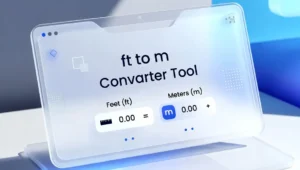
📏 ft ↔ m Converter
Quick, accurate feet ↔ meters conversion with full unit breakdown
How it works: Enter your measurement in feet (or meters) to instantly convert to meters, centimeters, millimeters, and more. Supports decimal feet, feet+inches input, and bidirectional conversion.
Formula: 1 foot = 0.3048 meters exactly (international standard since 1959). The US Survey Foot = 0.3048006096 m is also supported.
Note: Maximum input is 999,999 ft / 304,799 m. The US survey foot (0.3048006096 m) differs slightly from the international foot — relevant only for large-scale land surveys.
📥 Enter Your Measurement
📊 Conversion Results
Formula:
📐 Full Unit Breakdown
🧮 Step-by-Step Calculation
📚 Educational Context
📋 Common Reference Table (highlighted row = closest to your input)
| Feet (ft) | Meters (m) | Centimeters (cm) | Inches (in) | Yards (yd) |
|---|
🕐 Conversion History
In today’s increasingly connected world, measurements play a crucial role in everyday activities, professional work, education, and global communication. Whether someone is designing a building, measuring the height of a structure, planning a construction project, or simply converting personal height for international understanding, accurate measurement conversion has become essential. One of the most common conversions used worldwide is the transformation of feet into meters. This is where an ft to m Converter becomes incredibly useful.
Different countries rely on different measurement systems. Some regions use the imperial system, where feet are commonly used to measure height, distance, and dimensions. Meanwhile, most countries across the globe rely on the metric system, where meters serve as the standard unit for measuring length. Because of this difference, people often need a reliable and quick way to convert measurements between the two systems. A modern conversion tool provides an efficient solution, helping users translate measurements accurately in just seconds.
The growing need for measurement conversions is closely related to globalization. Professionals from different parts of the world collaborate on projects every day. Engineers, architects, scientists, and designers frequently encounter measurement units that differ from the ones used in their local systems. Without an accurate conversion method, even small miscalculations could lead to significant problems in planning or design. Using a simple digital conversion tool ensures precision and prevents costly mistakes.
An ft to m Converter works by applying a standard mathematical formula that converts feet into meters. The internationally accepted conversion rate states that one foot equals exactly 0.3048 meters. By multiplying the number of feet by this constant value, users can instantly determine the equivalent measurement in meters. While the formula itself is straightforward, many people prefer using automated tools because they provide faster results and reduce the risk of calculation errors.
Another reason conversion tools have become increasingly popular is convenience. In the past, people relied on printed conversion tables, manual calculations, or scientific calculators. Today, online converters, mobile applications, and digital calculators can perform the same task instantly. Users simply input a number and receive the converted measurement immediately. This ease of use makes conversion tools accessible not only to professionals but also to students, travelers, and everyday users.
Measurement conversion is also important in many real-life situations. For example, construction workers may receive building plans created using the metric system while working in a country that commonly uses feet. Athletes may need to compare track distances or field measurements expressed in different units. Even travelers sometimes need to convert measurements when reading maps, hiking guides, or international specifications. In all of these situations, a quick conversion tool becomes an essential resource.
Technology has made these tools even more accessible. Many modern websites and applications offer conversion calculators that work across smartphones, tablets, and desktop devices. These tools are designed with simple interfaces so users can perform conversions quickly without needing advanced mathematical knowledge. With just a few clicks, anyone can convert measurements and obtain accurate results.
Another important advantage of digital conversion tools is consistency. The metric system is widely recognized as the international standard for scientific and technical measurements. When converting values from feet to meters, accuracy is crucial to ensure that the data remains consistent across different countries and industries. Reliable conversion tools use standardized formulas to guarantee precise results every time.
Education also plays a role in the popularity of measurement converters. Students learning mathematics, physics, or engineering often encounter unit conversion problems in their studies. A reliable conversion calculator helps them verify answers and better understand how measurement systems relate to one another. Over time, this improves their familiarity with both imperial and metric units.
In addition, the increasing availability of online resources has transformed the way people perform everyday calculations. Instead of memorizing formulas or carrying conversion charts, users can access digital tools anytime they need them. Whether working on a professional project, completing academic assignments, or solving practical measurement problems, a conversion calculator offers a fast and efficient solution.
As industries become more global and technology continues to advance, the demand for reliable measurement tools will continue to grow. Tools designed for converting feet into meters are now widely integrated into calculators, engineering software, and educational platforms. These tools not only save time but also ensure precision across multiple fields and applications.
Understanding how these converters work and why they are important helps users appreciate their value in modern life. By simplifying the process of converting measurements between imperial and metric systems, an ft to m Converter has become a practical and essential tool for people around the world.
Understanding the Measurement Systems Behind ft to m Converter
The Imperial Measurement System Explained
Origins of feet as a unit
The foot (ft) is one of the oldest units of measurement, historically based on the length of a human foot. Ancient civilizations like the Egyptians, Greeks, and Romans used variations of this unit. Over time, it became standardized, especially within the British Imperial system. Today, one foot is officially defined as 0.3048 meters, ensuring consistency in modern conversions such as ft to m.
Countries that still use feet
Although most of the world has adopted the metric system, a few countries still rely on feet for everyday measurements. The United States is the most prominent example, where feet are used in construction, real estate, and personal height. The United Kingdom also uses feet in certain contexts, such as measuring height and road distances (alongside miles).
Applications in construction and aviation
Feet remain highly relevant in industries like construction and aviation. In construction, especially in the U.S., building dimensions and blueprints often use feet and inches. In aviation, altitude is universally measured in feet, even in countries that otherwise use the metric system. This makes ft to m conversion essential for global coordination.
The Metric System and Its Global Standardization
Development of the metric system
The metric system was developed in France during the late 18th century to create a universal, logical measurement system. It is based on powers of ten, making it easy to scale and calculate. The meter (m) became the base unit for length, replacing inconsistent regional units like the foot.
Why meters are widely used worldwide
Meters are widely used because they offer simplicity and global consistency. Almost every country has adopted the metric system, making it easier to communicate measurements across borders. Whether in science, education, or manufacturing, meters provide a standardized approach that reduces confusion.
Scientific and engineering advantages
In science and engineering, precision is critical. The metric system allows for easy conversions between units (millimeters, centimeters, kilometers) without complex fractions. This is why meters are preferred in technical fields and why tools like a feet to meter converter are frequently used in global projects.
Why Metric Units Dominate Modern Technology
International scientific standards
Modern science relies on the International System of Units (SI), where the meter is the standard unit of length. This ensures consistency in research, experiments, and data sharing worldwide.
Global trade and engineering compatibility
In global trade and manufacturing, using metric units simplifies communication between countries. Products designed in one country can be easily manufactured in another without conversion confusion, though ft to m conversion is still needed when dealing with legacy systems.
Data precision in digital tools
Digital tools and software systems are optimized for metric units due to their decimal-based structure. This improves accuracy and reduces rounding errors, especially in fields like engineering design and 3D modeling.
How to Use an ft to m Converter Correctly
Step-by-Step Guide to Convert Feet to Meters
Inputting measurements
Start by entering the value in feet into the converter. Make sure the number is accurate and includes decimals if necessary (e.g., 5.5 ft).
Instant calculation process
Once the value is entered, the ft to m converter automatically multiplies it by 0.3048 to generate the equivalent in meters.
Reading the results correctly
The result will appear in meters, often with decimal precision. For example, 10 ft equals 3.048 meters. Always check the number of decimal places depending on your required accuracy.
Manual Conversion Using the Feet to Meter Formula
Multiplication method
To convert manually, use this simple formula:
meters = feet × 0.3048
Practical calculation examples
- 3 ft × 0.3048 = 0.9144 m
- 8 ft × 0.3048 = 2.4384 m
This method is useful when you don’t have access to an online feet to meter calculator.
Common Conversion Examples
- 1 ft to m = 0.3048 m
- 5 ft to meters = 1.524 m
- 10 ft to meters = 3.048 m
- 100 ft to meters = 30.48 m
Avoiding Common Conversion Mistakes
Rounding errors
Rounding too early in calculations can lead to inaccurate results. Always round at the final step for better precision.
Misinterpreting decimal values
Confusing decimals (e.g., 0.304 vs 0.3048) can cause small but significant differences, especially in engineering contexts.
Incorrect unit assumptions
Always confirm whether the measurement is in feet or another unit like inches. Mixing units can lead to incorrect conversions.
Real-World Applications of ft to m Converter
Construction and Architecture
Building plans and engineering drawings
Architects and engineers often need to convert measurements when working on international projects. A reliable ft to m converter ensures accuracy in blueprints and structural designs.
Converting international project measurements
Projects involving multiple countries require consistent units. Converting feet to meters helps maintain alignment between teams using different systems.
Sports and Athletics Measurements
Track and field distances
Some sports events still use feet for measurements, especially in the U.S. Converting these to meters ensures compatibility with international standards.
Stadium dimensions
Stadium sizes and field layouts may require conversion when hosting global events, making feet to meter conversion tools highly useful.
Aviation and Altitude Measurements
Flight altitude conversion
Pilots measure altitude in feet, but ground systems or international reports may require meters. Accurate conversion is critical for safety.
International aviation standards
Even though aviation uses feet globally, conversion to meters is often needed for compliance with international reporting systems.
Interior Design and Home Improvement
Furniture dimensions
When purchasing furniture from international suppliers, dimensions may be listed in feet or meters. Conversion ensures proper fitting.
Room size measurements
Home improvement projects often require converting room dimensions to match design plans or material specifications.
Education and Academic Calculations
Math learning tools
Students frequently use ft to m converters to understand unit conversion concepts and improve problem-solving skills.
Science experiments
Accurate measurements are essential in experiments, making conversion tools an important part of academic work.
Benefits of Using an Online ft to m Converter
Speed and Accuracy in Measurement Conversion
Instant results
Online converters provide immediate answers, saving time compared to manual calculations.
Eliminating calculation errors
Automated tools reduce the risk of human error, especially in complex or repetitive conversions.
Accessibility Across Devices
Mobile phones
You can quickly convert feet to meters on the go using a smartphone.
Tablets
Tablets offer a larger interface, making them convenient for educational or professional use.
Desktop computers
Desktop access is ideal for detailed work, such as engineering or architectural planning.
User-Friendly Interfaces for Beginners
Simple input systems
Most converters feature straightforward input fields, making them easy to use even for beginners.
Real-time conversion display
Results update instantly as you type, improving efficiency and usability.
Free Tools Available Anytime
No installation required
Most online ft to m converters are web-based, so there’s no need to download software.
Easy access worldwide
Anyone with an internet connection can use these tools, making them universally accessible.
ft to m Converter vs Manual Calculation
Converting feet to meters is one of the most common unit conversions in engineering, construction, travel, and education. While the basic formula is simple (1 foot = 0.3048 meters), the way you perform the conversion can significantly impact accuracy, speed, and usability. Today, users typically choose between manual calculation and ft to m converter tools.
Accuracy Comparison
Human error vs automated systems
Manual calculations rely entirely on the user’s attention and mathematical accuracy. Even a small mistake—like misplacing a decimal or using an incorrect factor—can lead to significant discrepancies, especially in large-scale measurements.
On the other hand, a feet to meters converter eliminates most human errors. Modern digital tools use fixed conversion constants and are often tested across thousands of scenarios. This makes them highly reliable for both simple and complex conversions.
For example:
- Manual: 25 ft × 0.3048 = 7.62 m (requires careful multiplication)
- Converter tool: instant result with minimal input
In professional settings, even a 0.01 m difference can matter, making automated systems the safer choice.
Time Efficiency
Faster results through online tools
Time is a critical factor, especially when dealing with multiple conversions. Manual calculations can become repetitive and time-consuming, particularly when working with large datasets.
Online length conversion tools provide near-instant results. Many platforms allow batch conversions, saving significant time for engineers, students, and analysts. With features like auto-fill and real-time updates, users can convert dozens of values in seconds.
When Manual Conversion Is Still Useful
Exams and academic exercises
Manual conversion is still essential in educational environments. Students are often required to demonstrate understanding of formulas and conversion logic without relying on tools.
Offline environments
In situations where internet access or digital devices are unavailable—such as remote fieldwork or emergency scenarios—manual calculation remains a reliable fallback. Knowing the formula ensures you’re never completely dependent on technology.
Popular Tools and Platforms Offering ft to m Converter
The rise of digital tools has made unit conversion more accessible than ever. Whether you prefer web-based tools, mobile apps, or spreadsheets, there are multiple options available.
Online Measurement Converter Websites
Features and advantages
Online ft to m converters are widely used due to their simplicity and accessibility. Key features include:
- Instant conversion results
- Support for multiple units (feet, meters, inches, kilometers)
- Clean, user-friendly interfaces
- No installation required
Mobile Apps for Length Conversion
Portable conversion tools
Mobile apps bring conversion tools directly to your pocket. These apps are ideal for professionals on-site or travelers who need quick measurements.
Common features:
- Offline functionality
- Multi-unit conversion support
- Voice input and smart suggestions
- Lightweight and fast performance
Apps are especially useful in industries like construction, where quick decisions must be made on location.
Spreadsheet Conversion Methods
Using formulas in spreadsheets
For users dealing with large datasets, spreadsheets like Excel or Google Sheets offer powerful conversion capabilities. A simple formula can automate hundreds of conversions.
Example formula:
= A1 * 0.3048
Benefits include:
- Bulk conversion for large data sets
- Easy integration with existing workflows
- Customizable formulas for complex calculations
This method is widely used in data analysis, engineering reports, and research documentation.
ft to m Converter for Professionals
Different industries rely heavily on accurate unit conversions. A feet to meter calculator is not just a convenience—it’s often a necessity.
Engineers and Construction Specialists
Precision measurements
In construction and civil engineering, precise measurements are critical. A small miscalculation can affect structural integrity and safety. Using a reliable unit conversion calculator ensures accuracy in blueprints, material estimates, and site measurements.
Architects and Designers
International project standards
Architects often work on global projects where both imperial and metric systems are used. Converting feet to meters accurately helps maintain consistency across international standards and prevents design errors.
Aviation Experts and Pilots
Accurate altitude conversions
Aviation still uses feet for altitude measurements, but many systems and countries rely on metric units. Pilots and aviation professionals frequently use ft to m converters to ensure accurate communication and navigation.
Researchers and Scientists
Data measurement accuracy
Scientific research demands high precision. Whether it’s environmental studies, physics experiments, or geographic data analysis, converting measurements accurately is essential for valid results and reproducibility.
Practical ft to m Conversion Table
Having a quick reference table can be extremely helpful when you need fast answers without opening a tool.
Quick Reference Table for Common Conversions
1–10 feet to meters
- 1 ft = 0.3048 m
- 2 ft = 0.6096 m
- 3 ft = 0.9144 m
- 4 ft = 1.2192 m
- 5 ft = 1.524 m
- 6 ft = 1.8288 m
- 7 ft = 2.1336 m
- 8 ft = 2.4384 m
- 9 ft = 2.7432 m
- 10 ft = 3.048 m
10–100 feet conversions
- 20 ft = 6.096 m
- 30 ft = 9.144 m
- 40 ft = 12.192 m
- 50 ft = 15.24 m
- 60 ft = 18.288 m
- 70 ft = 21.336 m
- 80 ft = 24.384 m
- 90 ft = 27.432 m
- 100 ft = 30.48 m
Extended Conversion Examples
Large measurements
- 500 ft = 152.4 m
- 1,000 ft = 304.8 m
- 5,000 ft = 1,524 m
Industrial-scale measurements
- 10,000 ft = 3,048 m
- 50,000 ft = 15,240 m
- 100,000 ft = 30,480 m
These examples are especially useful in aviation, infrastructure projects, and large-scale engineering operations.
Tips for Accurate Feet to Meter Conversions
Even with modern tools, accuracy still depends on how carefully you approach the process.
Always Verify Units Before Conversion
Make sure you’re converting from feet (ft) and not inches or yards. Misidentifying units is a common source of errors.
Use Reliable Conversion Tools
Choose trusted platforms or apps with consistent performance. Avoid unreliable calculators that may use incorrect formulas.
Understand Decimal Precision
Depending on your use case, you may need different levels of precision. Engineering projects may require up to four decimal places, while general use may only need two.
Double-Check Results for Critical Calculations
For important tasks—like construction or scientific research—always verify results using a second method or tool.
Future of Digital Measurement Tools
The evolution of technology continues to improve how we perform unit conversions.
Smart Calculators and AI Conversion Tools
AI-powered tools are becoming more advanced, offering predictive suggestions, voice-based input, and context-aware conversions. These tools can understand phrases like “convert 12 feet to meters” instantly.
Integration With Engineering Software
Modern engineering and design software now include built-in conversion features. This reduces the need for external tools and ensures consistency throughout the workflow.
Real-Time Conversion in Smart Devices
Smart devices, including wearables and IoT tools, are beginning to offer real-time unit conversion. For example, measuring devices can instantly display both feet and meters, improving efficiency in the field.
Frequently Asked Questions About ft to m Converter
What is the fastest way to convert feet to meters?
The fastest way to convert feet to meters is by using a simple multiplication formula:
1 foot = 0.3048 meters
So, you just multiply the number of feet by 0.3048. For example:
10 ft × 0.3048 = 3.048 meters
If you’re working frequently with measurements—like in construction, fitness tracking, or travel—using an online ft to m converter or a mobile app is even faster. Many modern tools provide instant conversion results, eliminating manual calculation errors.
For everyday use, a quick mental shortcut can also help:
- Multiply feet by 0.3 for a rough estimate
- This won’t be perfectly precise, but it’s useful for quick decisions
How many meters are in one foot?
There are exactly 0.3048 meters in one foot. This value is standardized internationally and has been officially defined since 1959 under the International Yard and Pound Agreement.
This precise number is important in fields like:
- Engineering
- Architecture
- Aviation
- Science and research
Even a small rounding difference can affect outcomes in technical projects. That’s why professional environments always use the exact conversion factor rather than approximations.
Can I convert feet to meters without a calculator?
Yes, you absolutely can convert feet to meters without a calculator using a few simple techniques:
1. Approximation Method
Multiply the number of feet by 0.3
Example: 20 ft ≈ 6 meters
2. Fraction Trick
Think of 1 foot as slightly less than 1/3 meter
This works well for mental estimation
3. Break It Down
If you know:
- 10 ft ≈ 3.048 m
You can scale from there easily
While these methods are helpful, they are best used for quick estimates, not for situations requiring high precision like construction layouts or scientific measurements.
Are online converters accurate?
Yes, most online ft to m converters are highly accurate—especially those that use the exact conversion factor of 0.3048.
Reliable converters today are:
- Based on standardized formulas
- Frequently updated
- Designed to minimize rounding errors
However, accuracy can depend on:
- The number of decimal places shown
- The quality of the tool or platform
- Whether the converter uses rounding or truncation
For critical tasks, it’s always a good idea to:
- Double-check results
- Use trusted tools or official measurement apps
Overall, digital conversion tools are considered safe, fast, and precise for both casual and professional use.
Why do some countries still use feet?
Despite the global adoption of the metric system, some countries—most notably the United States—still use feet as part of the imperial system.
Here’s why:
1. Historical Legacy
Measurement systems often stick due to long-standing tradition and infrastructure.
2. Industry Standards
Certain industries like aviation and construction still rely on feet for consistency across regions.
3. Cultural Familiarity
People are more comfortable with units they’ve grown up using.
4. Transition Costs
Switching entirely to metric requires updating systems, tools, and education, which can be expensive and time-consuming.
Because of this mix of systems, tools like ft to m converters play a crucial role in bridging measurement differences globally.
Conclusion
Why ft to m Converter Is Essential in Modern Measurements
In today’s interconnected world, accurate measurement conversion is more important than ever. Whether you’re working on international projects, traveling, or simply comparing data, a feet to meters converter ensures clarity and precision.
From construction sites to fitness tracking apps, the ability to instantly convert units helps:
- Reduce errors
- Improve communication
- Maintain consistency across systems
With the rise of digital tools, converting ft to m has become effortless, making it accessible to everyone—from professionals to everyday users.
Embracing Accurate and Global Measurement Standards
As global collaboration continues to grow, adopting standardized measurement systems becomes increasingly important. The metric system, including meters, is widely recognized and used in most countries.
By understanding and using conversion tools like ft to meter calculators, individuals and businesses can:
- Work more efficiently across borders
- Avoid costly mistakes
- Align with international standards
In the end, mastering simple conversions isn’t just about numbers—it’s about staying connected in a world that depends on accuracy, speed, and shared understanding.