📏 Inches to CM Converter
Professional Length Conversion Tool with Detailed Analysis
🎯 About This Converter: Convert inches to centimeters with precision using the international standard conversion factor of 2.54 cm per inch.
✨ Features: Supports decimal values, fractions, multiple units, precision control, and provides detailed educational information.
⚡ Quick Converter
Enter value in either field for instant conversion
Click '=' for results
Click '=' for results
📊 Input Values
💡 Tip: You can enter either a decimal value (e.g., 12.5) OR use the fraction fields (e.g., 5 3/8). The calculator will combine them automatically.
📊 Conversion Results
🧮 Calculation Steps
📋 Detailed Breakdown
📚 Educational Information
📊 Quick Reference Comparison
In a world that runs on precision, even a small measurement mistake can create serious consequences. A miscalculated screen size, an incorrectly labeled product dimension, or a wrong fabric measurement can lead to financial losses, design errors, and customer dissatisfaction. That is why understanding inches to cm conversion remains more important than ever — especially in 2026, when global collaboration and digital commerce are growing faster than at any time in history.
Although the metric system dominates most countries, the imperial system is still widely used in key markets such as the United States. This creates a daily need for accurate conversion between systems. Whether you are shopping online, working on construction plans, designing furniture, managing international shipments, or developing digital products, you will likely encounter situations that require an accurate in to cm Converter.
The reason is simple: measurements must be consistent across borders.
For example, a product manufactured in Europe may list its dimensions in centimeters, while customers in the US expect inches. A laptop advertised as 15 inches needs to be clearly understood in metric terms for global buyers. Engineers collaborating across continents must ensure that every unit conversion is exact — because a minor rounding error can affect structural integrity, manufacturing tolerance, or material efficiency.
The foundation of this conversion is straightforward:
1 inch equals exactly 2.54 centimeters.
This value is not an approximation. It is an internationally agreed standard that ensures consistency in scientific, industrial, and commercial applications. However, while the formula may look simple, applying it correctly in real-world situations often requires attention to detail — especially when dealing with fractions, large dimensions, or precision-sensitive environments.
Today, digital tools make conversion faster and easier than manual calculation. Modern online converters allow instant transformation between imperial and metric units, reducing the risk of human error. Still, understanding the logic behind the formula is essential. Relying solely on automation without comprehension can lead to mistakes when rounding, estimating, or interpreting technical specifications.
In addition, global e-commerce growth has significantly increased the search demand for terms related to length unit conversion. Consumers frequently look up queries such as “how many cm in an inch,” “convert inches to centimeters,” or “inch to cm formula” before making purchasing decisions. Accurate measurement knowledge is no longer limited to engineers and mathematicians — it has become a practical life skill.
Education systems worldwide continue emphasizing metric units, yet industries such as construction, aviation, manufacturing, and screen technology still heavily use inches. This dual-system environment means professionals, students, business owners, and everyday users must feel comfortable switching between units quickly and confidently.
This comprehensive guide will help you fully understand the logic, formula, applications, and practical tools behind converting measurements. You will learn not only how to calculate manually, but also when to rely on digital tools, how to avoid common mistakes, and how measurement accuracy impacts industries in 2026.
By the end of this article, you will be able to convert values confidently, interpret measurement labels correctly, and understand why mastering this simple yet essential skill continues to matter in our increasingly connected global economy.
Let’s begin with the fundamentals.
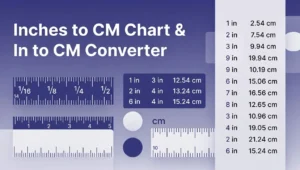
Understanding Inches and Centimeters – The Foundation of an In to CM Converter
Accurate unit conversion starts with understanding the units themselves. Inches and centimeters are two of the most commonly used length measurements in the world, yet they come from completely different measurement systems. Knowing how each unit works—and why they are different—makes using an inches to centimeters (in to cm) converter much more intuitive and reliable.
What Is an Inch? (Imperial System Explained)
The inch is a unit of length from the Imperial and US Customary measurement systems. It is widely recognized, especially in English-speaking countries, and still plays an important role in many modern industries.
Definition of an Inch
An inch is a standardized unit of length used primarily in the United States, the United Kingdom (in some contexts), and a few other countries.
- 1 inch = 2.54 centimeters
- This value is exact and not an approximation
Because the value is fixed, any accurate inch to cm conversion always uses the same multiplier.
1 Inch = 2.54 Centimeters (Exact International Agreement)
In 1959, an international agreement between the US, UK, Canada, Australia, and other countries officially defined the inch as exactly 2.54 cm.
This agreement eliminated inconsistencies between countries and ensured that measurements in science, engineering, and trade would always match globally.
Historical Origin of the Inch
The inch has a long and fascinating history.
- In ancient times, an inch was loosely based on the width of a human thumb
- Medieval definitions varied from region to region
- Some versions defined an inch as three barleycorns placed end to end
These variations made precise measurement difficult, which is one reason modern standardization became essential.
Industries Still Using Inches Today
Despite the global dominance of the metric system, inches remain common in several fields:
- Construction and carpentry (lumber sizes, tools)
- Manufacturing (machine parts, tolerances)
- Electronics (screen sizes, display panels)
- Aviation and aerospace (altitude, component dimensions)
For professionals in these industries, fast and accurate inch to cm conversion is a daily necessity.
What Is a Centimeter? (Metric System Explained)
The centimeter is part of the metric system, which is the most widely used measurement system in the world. It is designed for simplicity, scalability, and scientific accuracy.
Definition of a Centimeter
A centimeter (cm) is a unit of length used in the metric system. It is ideal for measuring everyday objects such as books, furniture, body dimensions, and small distances.
- 1 centimeter = 0.01 meter
- 100 centimeters = 1 meter
This clear structure makes calculations fast and intuitive.
Relationship to the Meter (1 cm = 0.01 Meter)
The metric system is built on powers of ten. This means conversions are done by simply moving decimal points:
- Millimeter → centimeter → meter → kilometer
- No complex fractions or irregular numbers
This logical design is one of the main reasons the metric system is favored worldwide.
Why the Metric System Dominates Globally
More than 95% of the world uses the metric system as the official standard. Key reasons include:
- International consistency
- Easy learning curve
- Compatibility with science and technology
- Simplified global trade and manufacturing
Countries that still use inches often rely on converters when working with international partners.
Scientific and Educational Advantages
In science, medicine, and education, precision matters. The metric system offers:
- Clear decimal-based calculations
- Fewer conversion errors
- Universal standards in research papers and textbooks
This is why centimeters are commonly used in labs, classrooms, and healthcare settings.
Key Differences Between Imperial and Metric Systems
Understanding the differences between these systems helps explain why inch to cm conversion is sometimes confusing for beginners.
Simplicity vs Traditional Measurement
- The Imperial system evolved over centuries and is rooted in tradition
- The Metric system was designed intentionally for clarity and consistency
Metric units follow a logical pattern, while Imperial units often require memorization.
Decimal vs Fractional Measurement
- Metric measurements use decimals (10, 100, 1000)
- Imperial measurements often use fractions (1/2, 1/4, 1/8, 1/16)
Fractions can be practical in crafts, but they complicate calculations.
Conversion Complexity
Converting within the metric system is simple. Converting between Imperial and metric systems requires fixed formulas, which is why online in to cm calculators are so popular today.
The Exact Formula for Inches to CM Conversion
Once you understand the units, the conversion itself becomes straightforward.
The Official Mathematical Formula
The standard formula for converting inches to centimeters is:
Inches × 2.54 = Centimeters
This formula works for any value—whole numbers, decimals, or fractions.
Why 2.54 Is Fixed (International Standard)
The number 2.54 is not rounded or estimated. It is an exact value defined by international agreement.
This guarantees:
- Consistent results across all calculators
- Accurate measurements in engineering and science
- Zero ambiguity in global communication
Reverse Formula (CM to Inches)
Sometimes you need to convert in the opposite direction. The reverse formula is just as simple:
Centimeters ÷ 2.54 = Inches
This is commonly used for:
- Converting metric product specifications for US markets
- Understanding body measurements or clothing sizes
- Translating scientific data into Imperial units
Quick Mental Math Tricks for Fast Conversion
While calculators are convenient, mental math can be useful in everyday situations.
Rounding Techniques
For quick estimates:
- Multiply inches by 2.5 instead of 2.54
- This gives a close approximation with minimal effort
Example:
- 10 inches × 2.5 ≈ 25 cm (exact value is 25.4 cm)
Estimation for Everyday Use
Estimation works well for:
- Home projects
- Rough measurements
- Visual comparisons
It’s not ideal for technical or professional work, but it’s fast.
Accuracy vs Approximation
- Exact formula (× 2.54): Best for engineering, design, and science
- Rounded estimates: Fine for casual use
Knowing when to use precision versus approximation is a key skill when converting inches to centimeters.
Inches to CM Conversion Chart (Updated 2026 Reference Table)
Understanding how to convert inches to centimeters (cm) is still highly relevant in 2026. While inches are widely used in the United States and a few other countries, centimeters remain the global standard under the metric system. Whether you’re shopping online, working on a technical project, or simply double-checking measurements, a reliable inch-to-cm reference saves time and avoids costly mistakes.
The basic formula remains unchanged:
- 1 inch = 2.54 centimeters
Below is an updated, easy-to-read reference designed for everyday use.
Common Everyday Conversions
These are the most frequently searched inch-to-centimeter conversions, especially for daily tasks, shopping, and DIY projects.
| Inches | Centimeters (cm) | Common Use Case |
|---|---|---|
| 1 inch | 2.54 cm | Small objects, jewelry |
| 5 inches | 12.7 cm | Phone width, small tools |
| 10 inches | 25.4 cm | Tablets, notebooks |
| 12 inches | 30.48 cm | Rulers, vinyl records |
| 24 inches | 60.96 cm | Furniture depth |
| 36 inches | 91.44 cm | Table height, signage |
Quick explanation
- 1 inch to cm is often used for precision tasks.
- 5 inches to cm appears frequently in gadget specs.
- 10–12 inches to cm is common for screens and household items.
- 24–36 inches to cm is widely used in furniture and construction measurements.
Fractional Inches Conversion Table
Fractional inches are common in carpentry, engineering drawings, and mechanical tools. Converting them accurately to centimeters is essential for precision work.
| Fraction (Inches) | Decimal (Inches) | Centimeters (cm) |
|---|---|---|
| ½ inch | 0.5 | 1.27 cm |
| ¼ inch | 0.25 | 0.635 cm |
| ¾ inch | 0.75 | 1.905 cm |
| ⅛ inch | 0.125 | 0.3175 cm |
Why fractional conversions matter
- Used heavily in workshops and machining
- Common in imperial-based blueprints
- Critical for accurate fitting and alignment
Printable In to CM Converter Chart for Quick Reference
Having a printable inches-to-centimeters chart is still extremely useful in 2026, especially in environments where digital devices aren’t always practical.
Structured conversion table
A good printable chart usually includes:
- Whole inches from 1 to 100
- Common fractions (¼, ½, ¾)
- Clear alignment for quick scanning
- Large, readable font for workshops
Use cases in workshop, school, or office
- Workshop: Fast reference during cutting or drilling
- School: Math, physics, and technical drawing classes
- Office: Product design, packaging, and documentation
Many professionals keep a laminated version on the wall or inside a toolbox for instant access.
Practical Applications of Inches to CM in Daily Life
Converting inches to centimeters isn’t just about numbers—it directly impacts accuracy, comfort, and compatibility in everyday situations.
Clothing and Fashion Sizing
Global fashion brands still mix measurement systems, making inch-to-cm conversion essential for buyers and retailers.
Shoe sizes
- Insoles are often listed in centimeters
- US and UK shoe sizes frequently reference inches
- Accurate conversion helps avoid wrong fits
Waist measurement
- Jeans and trousers often use inches
- International size charts rely on cm
- Converting ensures better sizing when ordering online
International apparel standards
- Asian and European brands mostly use cm
- American brands often use inches
- Knowing both systems improves cross-border shopping accuracy
Interior Design and Furniture Dimensions
Interior designers frequently switch between inches and centimeters when working with international catalogs or clients.
Sofa dimensions
- Width, depth, and height are often mixed-unit specs
- Converting inches to cm helps visualize real space usage
TV size in inches to cm
TV sizes are advertised in inches, measured diagonally.
Examples:
- 43-inch TV ≈ 109.22 cm
- 55-inch TV ≈ 139.7 cm
- 65-inch TV ≈ 165.1 cm
Understanding this helps with:
- Wall mounting
- Cabinet fitting
- Viewing distance planning
Cabinet measurements
- Imported cabinets may list dimensions in cm
- Local plans might use inches
- Accurate conversion avoids installation issues
Construction and Engineering Projects
In professional environments, incorrect unit conversion can lead to serious delays or financial losses.
Blueprint measurements
- Older or US-based blueprints often use inches
- Metric-based teams rely on centimeters
- Consistent conversion ensures structural accuracy
International project collaboration
- Global teams often work across unit systems
- Engineers must convert inches to cm for:
- Material specifications
- Load calculations
- Safety compliance
Clear conversion standards improve communication and reduce errors.
Technology and Screen Sizes
Technology specs still heavily rely on inches, even though most users think in centimeters.
Laptop screen size
- A 13.3-inch laptop ≈ 33.78 cm
- A 15.6-inch laptop ≈ 39.62 cm
- Helps users understand actual screen space
Smartphone display measurement
- Phone screens are measured diagonally in inches
- Converting to cm makes size comparisons easier, especially for first-time buyers
Monitor sizing guide
- 24-inch monitor ≈ 60.96 cm
- 27-inch monitor ≈ 68.58 cm
- 32-inch monitor ≈ 81.28 cm
This is especially useful for:
- Desk setup planning
- Ergonomic workspace design
- Multi-monitor configurations
Digital In to CM Converter – Why Online Tools Are More Reliable
In today’s digital-first world, converting inches to centimeters is no longer a task that requires pen, paper, and mental math. A digital in to cm converter offers speed, consistency, and accuracy that manual methods often struggle to match. Whether you are a student, engineer, designer, or DIY enthusiast, online conversion tools have become the preferred choice for precise measurement conversion.
Modern online converters are built with updated mathematical logic, responsive design, and error-prevention features. This makes them more reliable than traditional calculation methods, especially when dealing with decimals, fractions, or bulk data.
Advantages of Using a Real-Time Converter Tool
Using a real-time inches to centimeters converter brings several practical benefits that directly impact efficiency and accuracy.
Instant Calculation
A real-time converter delivers results immediately. You enter the value in inches, and the centimeter result appears without delay. This is especially useful when working under time pressure, such as during presentations, client discussions, or fast-paced projects.
Eliminate Manual Errors
Manual calculations often fail due to small mistakes like misplacing decimals or forgetting the correct conversion factor (1 inch = 2.54 cm). An online tool eliminates these risks by applying the correct formula automatically every time.
Mobile-Friendly Access
Most modern online unit converters are optimized for mobile devices. This allows users to perform conversions anywhere—on-site, in workshops, or while shopping for materials—without needing a calculator or notebook.
Features of a Smart Inches to CM Calculator
A smart inches to cm calculator goes beyond basic number conversion. It includes advanced features designed for both casual users and professionals.
Fraction Support
Many real-world measurements are written as fractions (e.g., 3 1/4 inches). A high-quality converter can interpret these fractional inches correctly and convert them into accurate centimeter values without extra steps.
Batch Conversion
Batch conversion allows users to convert multiple inch values at once. This is ideal for architects, manufacturers, and data analysts who work with large measurement lists and need consistent results.
Reverse Conversion
A good converter also supports cm to inches conversion, making it flexible for international projects where metric and imperial systems are used interchangeably.
Copy Result Button
The copy result feature saves time and reduces transcription errors. With one click, users can paste the converted value directly into documents, spreadsheets, or design software.
When to Use Manual Calculation vs Online Converter
While online tools are powerful, there are still situations where manual calculation may be appropriate.
Academic Exams
In some exams, digital tools are not allowed. Students must rely on memory and manual formulas. Understanding the conversion logic is essential here, even if online tools are used during practice.
Fieldwork
In remote locations without internet access, manual calculation becomes necessary. However, many professionals now download offline converter apps to bridge this gap.
Professional Documentation
For official reports, blueprints, and technical documentation, online converters ensure consistent formatting and standardized precision, making them the preferred option over manual math.
Common Conversion Mistakes and How to Avoid Them
Even simple conversions can go wrong if common mistakes are overlooked. Understanding these errors helps improve accuracy and confidence.
Confusing Inches with Feet
This is one of the most frequent measurement errors.
12 Inches = 1 Foot
Some users mistakenly apply the inch-to-centimeter formula to feet values. Always confirm the unit before converting. Remember, feet must be converted to inches first.
Double Conversion Errors
Converting feet to inches and then accidentally converting again can double the result. To avoid this, clearly label your units and use a reliable online measurement converter.
Incorrect Rounding Errors
Rounding mistakes may seem minor but can have serious consequences in technical fields.
Decimal Precision Issues
Rounding too early in the calculation process can lead to inaccurate final results. Always round at the final step, not during intermediate calculations.
Industrial Accuracy Requirements
In manufacturing and engineering, even a 0.01 cm difference can affect product compatibility. Use converters that allow adjustable decimal precision for higher accuracy.
Misreading Fractional Inches
Fractions are a common source of confusion, especially for beginners.
Example Breakdown
For example, 5 3/8 inches equals 5.375 inches. Misreading this as 5.38 or 5.3 inches leads to incorrect centimeter values.
Practical Correction Tips
Always convert fractions to decimals carefully or use a fraction-friendly inches to cm converter. Double-check the input before finalizing the result to ensure measurement accuracy.
Inches to CM in International Trade and E-Commerce
In today’s borderless digital economy, inches to centimeters (in to cm) conversion plays a bigger role than many businesses realize. From global marketplaces to international shipping, accurate unit conversion directly affects customer trust, logistics efficiency, and regulatory compliance. As e-commerce continues to scale in 2026, understanding and applying correct measurement standards is no longer optional—it’s a competitive advantage.
Cross-Border Product Listings
Selling products internationally means speaking the measurement language your customers understand. While inches are common in the United States and a few other regions, most global buyers rely on the metric system, especially centimeters.
Amazon, eBay, Alibaba Measurement Issues
Major platforms like Amazon, eBay, and Alibaba host sellers from dozens of countries. Common challenges include:
- Product dimensions listed in inches without metric equivalents
- Auto-conversion errors in marketplace systems
- Customer confusion leading to higher return rates
For example, a product listed as 12 inches wide may not clearly communicate size to European or Southeast Asian buyers. Adding a clear inch to cm conversion (12 in = 30.48 cm) improves transparency and reduces disputes.
Shipping and Packaging Standards
Shipping is where incorrect unit conversion becomes expensive. Carriers calculate costs based not only on weight but also on package size.
Dimensional Weight Calculation
Most international couriers use dimensional (volumetric) weight, calculated using metric units:
- Length (cm) × Width (cm) × Height (cm) ÷ carrier divisor
If sellers input dimensions in inches without proper conversion, the system may underestimate or overestimate shipping costs. This can result in:
- Unexpected shipping surcharges
- Delayed customs clearance
- Profit margin erosion
Conversion Impact on Logistics
Accurate in to cm conversion improves:
- Warehouse space optimization
- Pallet loading efficiency
- International freight planning
Logistics providers increasingly require metric-based documentation, making centimeters the default for global supply chains.
Global Standardization Trends 2026
The push toward global measurement consistency continues to accelerate.
Metric Expansion
By 2026, the metric system dominates:
- International trade documentation
- Customs declarations
- E-commerce product databases
Emerging markets and digital-first economies are adopting centimeters as the standard unit for product dimensions, especially in B2B transactions.
Remaining Imperial Markets
The imperial system remains relevant mainly in:
- The United States
- Limited UK consumer contexts
- Niche industries (construction, legacy manufacturing)
However, even these markets increasingly display dual measurements (inches and centimeters) to accommodate international buyers and partners.
Scientific and Educational Importance of In to CM Conversion
Beyond commerce, inch to centimeter conversion is foundational in science, education, and research. Accuracy here directly impacts learning outcomes and scientific integrity.
STEM Education and Unit Accuracy
Why Students Must Understand Unit Conversion
In STEM education, unit conversion is more than math—it’s critical thinking. Students who understand how to convert inches to centimeters develop:
- Measurement literacy
- Error-detection skills
- Real-world problem-solving ability
Misunderstanding basic conversions can lead to incorrect formulas, failed experiments, and flawed conclusions.
Laboratory and Research Measurements
Precision is non-negotiable in scientific environments.
Precision Requirements
Laboratories worldwide standardize on metric units because:
- Centimeters and millimeters allow finer measurement
- Data consistency improves reproducibility
- Instruments are calibrated in metric units
An incorrect inch-to-cm calculation, even by a small margin, can invalidate experimental results or compromise safety protocols.
International Academic Collaboration
Global research depends on shared standards.
Publishing Standards
Most international journals and academic publishers require metric measurements. Researchers converting from inches to centimeters must ensure:
- Correct decimal precision
- Consistent unit usage across datasets
- Clear methodology documentation
Using standardized in to cm conversion (1 inch = 2.54 cm) ensures research can be understood, replicated, and trusted worldwide.
Advanced Inches to CM Topics for Professionals
Inches to centimeters conversion may look basic on the surface, but for professionals in engineering, manufacturing, design, and digital platforms, it goes far beyond simple math. Precision, consistency, automation, and even SEO strategy all depend on how well measurement conversions are handled. This section explores advanced, real-world use cases where inches to cm conversion plays a critical role.
High-Precision Industrial Conversions
In industrial environments, inches to centimeters conversion is not just about accuracy—it is about reliability at scale. A small rounding error can lead to material waste, product defects, or failed compliance checks.
Engineering Tolerances
Engineering tolerances define how much variation is acceptable in a component’s dimensions. When converting inches to cm, especially in cross-border projects, tolerance stacking can become a serious issue.
For example, converting 0.001 inch into centimeters results in 0.00254 cm. Rounding this incorrectly may seem harmless, but across multiple components, the deviation can exceed acceptable limits. This is why professional engineers often:
- Use full decimal precision during unit conversion
- Avoid manual rounding until the final validation stage
- Apply consistent conversion standards across teams
Manufacturing Precision
Modern manufacturing relies heavily on CNC machines, robotics, and automated quality control systems. Many machines are configured in metric units, while design specifications may still be provided in inches.
To avoid misalignment between design and production:
- Conversion factors must be standardized (1 inch = 2.54 cm exactly)
- Measurement data should be stored in a single base unit
- Conversion logs are often kept for audit and traceability
In high-volume manufacturing, consistent inches to cm conversion directly affects production speed, defect rates, and long-term equipment calibration.
Conversion in CAD and 3D Modeling Software
Computer-Aided Design (CAD) and 3D modeling tools are at the heart of modern product development. Incorrect unit conversion can distort entire models, leading to costly redesigns.
Software Settings
Most professional CAD software such as AutoCAD, SolidWorks, Fusion 360, and Blender allow users to define default units. However, problems arise when files are shared between teams using different measurement systems.
Best practices include:
- Setting a clear base unit before modeling begins
- Embedding unit metadata inside project files
- Using built-in inches to cm conversion tools rather than manual scaling
This ensures that dimensions remain consistent when models are exported, imported, or rendered.
Unit Scaling Issues
Unit scaling errors are common when converting legacy designs from inches to centimeters. A model intended to be 10 inches wide may accidentally become 10 cm wide if scaling is overlooked.
To prevent this:
- Always verify scale after importing external files
- Use reference objects with known dimensions
- Perform test renders or simulations before final approval
Data Entry Automation and API-Based Converters
As businesses grow, manual conversion becomes inefficient and error-prone. Automation is now a standard approach for handling inches to cm conversion at scale.
Spreadsheet Formula Integration
Spreadsheets are still widely used for engineering calculations, inventory management, and pricing tables. Automating conversion inside spreadsheets saves time and reduces human error.
Common approaches include:
- Using formulas such as
=A1*2.54for instant conversion - Locking conversion cells to prevent accidental edits
- Applying data validation rules for unit consistency
This method is especially useful for bulk product data, technical specs, and reporting workflows.
Smart Calculator Tools
API-based converters and smart calculators are increasingly popular in web applications and internal systems. These tools allow real-time conversion between inches and centimeters without user intervention.
Key benefits include:
- High accuracy with standardized conversion logic
- Easy integration into websites, apps, and ERP systems
- Support for multi-unit conversion beyond inches and cm
Frequently Asked Questions About Inches to CM Conversion
Understanding how inches convert to centimeters is a basic but powerful skill. It helps in daily life, education, international trade, design, and digital work. Below are the most common questions people ask, explained in a simple, professional, and practical way.
How many centimeters are in 1 inch?
One inch is equal to 2.54 centimeters.
This value is the global standard used in science, engineering, manufacturing, and education. Anytime you see inches converted to centimeters, this number is the foundation.
Formula reminder:
1 inch × 2.54 = centimeters
Is 2.54 exact or rounded?
2.54 is an exact value, not a rounded estimate.
Since 1959, international agreements have defined one inch as exactly 2.54 centimeters. This precision matters in industries like aerospace, construction, product design, and medical equipment, where even small measurement errors can cause serious issues.
How to convert inches to cm without a calculator?
You can convert inches to centimeters mentally using a few easy tricks:
- Quick estimate:
Multiply inches by 2.5, then add a small adjustment. - Example:
10 inches × 2.5 = 25 cm
Add about 0.4 cm → ≈ 25.4 cm
For everyday use—DIY projects, clothing sizes, or screen measurements—this method is usually accurate enough.
Why does the US still use inches?
The United States continues to use inches due to a mix of history, infrastructure, and cost.
Key reasons include:
- Long-standing use before the metric system became global
- Expensive transition for roads, tools, machinery, and education
- Cultural familiarity with imperial units like inches, feet, and miles
That said, many US industries (science, medicine, military, and tech) already rely heavily on metric measurements behind the scenes.
What is 6 inches to cm?
To convert 6 inches to centimeters:
6 × 2.54 = 15.24 cm
This conversion is common for:
- Smartphone sizes
- Small furniture dimensions
- Hand tools and accessories
What is 12 inches to cm?
12 inches equals 30.48 cm.
This is especially useful because:
- 12 inches = 1 foot
- 30.48 cm is a frequently used metric reference in design and architecture
Knowing this conversion helps bridge imperial and metric systems smoothly.
Future of Measurement Systems – Will Inches Disappear?
As globalization and technology evolve, measurement systems are also changing. While inches remain widely used, their role may shift over time.
Metric Expansion in Global Industries
Most global industries already operate using the metric system:
- Manufacturing
- Automotive
- Electronics
- Medical and pharmaceutical sectors
International standards favor centimeters and millimeters because they are easier to scale, calculate, and standardize across borders.
Hybrid Measurement Systems
Instead of fully replacing inches, many countries and industries now use hybrid systems:
- Screen sizes in inches, resolution in centimeters or millimeters
- Construction plans mixing feet, inches, and metric units
- Consumer products labeled with both inch and cm measurements
This hybrid approach makes products accessible to global markets without confusing users.
Digital Standardization
Digital tools are accelerating metric adoption:
- CAD software defaults to metric units
- Online converters provide instant accuracy
- E-commerce platforms show dual-unit sizing
As automation and AI-driven manufacturing grow, precise metric measurements will likely dominate technical workflows.
Conclusion – Mastering Inches to CM Conversion with Confidence
Recap of Formula
The core rule is simple and reliable:
Centimeters = Inches × 2.54
This formula works for all conversions, from small objects to large-scale projects.
Importance of Accuracy
Accurate measurement matters when:
- Designing products
- Ordering materials internationally
- Working in engineering, healthcare, or science
- Comparing global product specifications
Using the exact 2.54 conversion prevents costly mistakes.
When to Use a Converter
Use an online inches to cm converter when:
- You need fast, error-free results
- Working with decimals or large numbers
- Handling professional or technical tasks
Manual conversion is great for learning, but digital tools save time and reduce risk.
Final Practical Advice
- Memorize key conversions (1, 6, and 12 inches)
- Use mental math for quick estimates
- Rely on exact formulas for precision work
- Think in both systems to stay flexible globally
Mastering inches to centimeters isn’t just about math—it’s about communicating clearly and working confidently in a connected world.