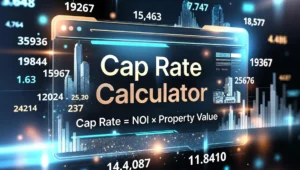
Cap Rate Calculator
International real estate tool for global investors: calculate cap rate, NOI, and cash flow with complete expense detail.
Cap Rate formula: Net Operating Income ÷ Property Value. Fill every income and expense field for the most accurate international result.
💡 New User? Click any preset button below to see example calculations, or use the "Conservative/Balanced/Aggressive" scenarios to explore different investment strategies.
🏘️ Quick Property Type Presets
💡 Quick Investment Scenarios
💡 Pro Tip: Cap rate doesn't include financing costs. For leveraged returns, check the Cash-on-Cash Return metric above. Lower cap rates often mean lower risk but also lower returns.
Note: Always compare properties in similar locations and conditions. A 6% cap rate in Manhattan differs greatly from 6% in a rural market.
Making smart real estate investment decisions requires more than simply choosing a property in a desirable location. Successful investors rely on financial metrics that help them evaluate profitability, compare opportunities, and estimate potential returns before committing significant capital. Among these metrics, the cap rate calculator has become one of the most practical and widely used tools for analyzing residential, commercial, and rental properties.
Whether you’re purchasing your first rental home, expanding a real estate portfolio, or evaluating commercial buildings, understanding capitalization rate can help you make more informed investment decisions. Rather than relying on assumptions or market hype, investors use cap rate to measure how efficiently a property generates income relative to its current market value or purchase price. This simple yet powerful calculation provides a quick snapshot of a property’s earning potential and allows investors to compare multiple opportunities using a consistent benchmark.
A cap rate calculator simplifies this process by automatically determining the capitalization rate once you enter key financial information, such as the property’s market value and Net Operating Income (NOI). Instead of spending time performing manual calculations or worrying about mathematical errors, investors can instantly analyze different scenarios, adjust assumptions, and compare potential investments with greater confidence.
As global real estate markets continue to evolve, investment analysis has become more important than ever. Rising interest rates, fluctuating property prices, changing rental demand, and increasing operating costs all influence the profitability of investment properties. In today’s competitive market, relying solely on intuition is no longer enough. Investors need objective data and reliable financial metrics to identify opportunities while managing risk effectively.
Although the capitalization rate is a valuable indicator, it should never be viewed in isolation. Experienced investors often combine cap rate with other financial metrics such as cash flow, return on investment (ROI), cash-on-cash return, debt service coverage ratio (DSCR), and internal rate of return (IRR). Together, these measurements provide a more complete picture of an investment property’s financial performance and long-term potential.
One of the greatest advantages of using a cap rate calculator is its versatility. It can be applied to a wide range of property types, including:
- Single-family rental homes
- Multi-family apartment buildings
- Condominiums
- Office buildings
- Retail centers
- Industrial warehouses
- Mixed-use developments
- Vacation rentals
- Self-storage facilities
- Hospitality and hotel properties
Each property category carries different levels of risk, operating expenses, occupancy rates, and income potential. A reliable cap rate calculation helps investors compare these differences using a standardized approach, making it easier to prioritize investment opportunities.
For beginners, the concept of capitalization rate may initially seem technical. However, once you understand how Net Operating Income and property value work together, the calculation becomes surprisingly straightforward. More importantly, learning how to interpret cap rate results is often more valuable than simply knowing how to calculate them. A higher cap rate may indicate stronger income potential but could also reflect higher investment risk, while a lower cap rate often suggests greater market stability, premium locations, or stronger long-term appreciation prospects.
Throughout this comprehensive guide, you’ll learn everything you need to know about using a cap rate calculator effectively. We’ll explain the capitalization rate formula, break down the components of Net Operating Income, demonstrate step-by-step calculations with real-world examples, compare cap rate with other investment metrics, and discuss how market conditions influence investment decisions. You’ll also discover common mistakes investors make when calculating cap rates and learn practical strategies for evaluating both residential and commercial properties with greater accuracy.
By the end of this guide, you’ll have a clear understanding of how a cap rate calculator works, when to use it, how to interpret the results, and how to combine it with other financial indicators to make smarter, more confident real estate investment decisions.
What Is a Cap Rate Calculator?
A cap rate calculator is one of the most useful tools in real estate investing. Whether you are buying your first rental property or analyzing a large commercial building, understanding the capitalization rate can help you make smarter financial decisions.
In today’s competitive property market, investors need quick ways to evaluate profitability, compare opportunities, and reduce investment risks. A cap rate calculator simplifies this process by helping investors estimate the expected return from a real estate property based on its income potential.
Real estate professionals, landlords, and even beginner investors use cap rate calculations to understand whether a property is worth buying, holding, or selling.
Definition of Cap Rate
Cap rate stands for capitalization rate. It is a real estate metric used to estimate the potential rate of return on an investment property.
The cap rate shows how much annual income a property generates compared to its market value or purchase price.
The formula is simple:
Cap Rate = Net Operating Income (NOI) ÷ Property Value × 100
For example, if a property generates $20,000 in annual NOI and is worth $400,000, the cap rate is 5%.
This percentage helps investors compare different real estate opportunities quickly.
What Does a Cap Rate Calculator Do?
A cap rate calculator automatically computes the capitalization rate after you enter key property details such as:
- Property purchase price
- Annual rental income
- Operating expenses
- Vacancy costs
- Additional property income
Instead of calculating manually, investors can use the calculator to save time and reduce errors.
Many modern cap rate calculators also estimate:
- Net operating income
- Annual cash flow
- Rental yield
- Investment property profitability
- Potential return scenarios
Why Investors Use Cap Rate Calculators
Real estate investors rely on cap rate calculators because they provide fast financial insights.
Benefits include:
- Easier property comparison
- Faster investment analysis
- Better risk evaluation
- Improved decision-making
- More accurate investment projections
A cap rate calculator is especially useful when evaluating multiple properties in different markets.
For example, a 4% cap rate property in a stable downtown area may be safer than an 8% cap rate property in a declining neighborhood.
Who Should Use a Cap Rate Calculator?
A cap rate calculator is valuable for almost anyone involved in real estate.
Beginner Investors
New investors use cap rate calculators to understand basic property profitability before making their first purchase.
Rental Property Owners
Landlords use cap rate analysis to monitor investment performance and identify opportunities to improve income.
Commercial Investors
Commercial real estate investors often compare office buildings, retail spaces, warehouses, and industrial properties using cap rates.
House Flippers
House flippers may use cap rate estimates to determine future rental potential after renovations.
Property Managers
Property managers can evaluate operational efficiency and recommend improvements to increase property value.
Real Estate Agents
Agents use cap rate calculations to help clients analyze income-producing properties more professionally.
Understanding Capitalization Rate in Real Estate
Capitalization rate is one of the most important metrics in property investing because it helps investors estimate profitability without considering financing methods.
What Is Capitalization Rate?
Capitalization rate measures the expected annual return generated by a property based on its income.
Unlike mortgage-focused calculations, cap rate focuses purely on property performance.
It answers questions like:
- How profitable is this rental property?
- Is this property overpriced?
- How does this investment compare to others?
Why Cap Rate Matters
Cap rate matters because it helps investors:
- Estimate investment risk
- Compare properties quickly
- Understand income potential
- Evaluate market trends
- Analyze property value
Generally:
- Lower cap rates often indicate lower risk and stable markets
- Higher cap rates may indicate higher risk but greater return potential
For example:
| Cap Rate | Typical Interpretation |
|---|---|
| 3%–5% | Lower risk, premium locations |
| 5%–8% | Balanced investment |
| 8%+ | Higher return but higher risk |
Cap Rate vs Return on Investment (ROI)
Although both measure profitability, they are different.
Cap Rate
- Focuses on property income
- Ignores financing
- Useful for quick property comparison
ROI
- Includes financing and loan structure
- Measures overall investment performance
- More personalized to the investor
Cap Rate vs Cash-on-Cash Return
Cash-on-cash return focuses on actual cash invested.
Cap rate ignores financing entirely, while cash-on-cash return considers:
- Down payment
- Loan payments
- Financing terms
Investors often use both metrics together.
Cap Rate vs Internal Rate of Return (IRR)
IRR is more advanced and includes:
- Future cash flow projections
- Property appreciation
- Holding period
- Exit strategy
Cap rate is simpler and better for quick evaluation.
Cap Rate vs Gross Rent Multiplier
Gross Rent Multiplier (GRM) only compares property price to gross rental income.
Cap rate is more accurate because it includes operating expenses.
Cap Rate Formula Explained
Understanding the cap rate formula helps investors analyze properties more confidently.
Standard Cap Rate Formula
The standard formula is:
Cap Rate = Net Operating Income ÷ Property Value × 100
Net Operating Income (NOI)
NOI represents the property’s annual income after operating expenses are deducted.
Property Market Value
This is the current estimated market value of the property.
Current Purchase Price
Investors often use the actual purchase price instead of market value during acquisition analysis.
Step-by-Step Formula Breakdown
Step 1: Calculate annual rental income
Step 2: Add additional property income
Step 3: Subtract vacancy losses
Step 4: Subtract operating expenses
Step 5: Divide NOI by property value
Step 6: Multiply by 100
Manual Cap Rate Calculation
Example:
- Annual rental income: $48,000
- Operating expenses: $18,000
- Property value: $500,000
NOI = $48,000 − $18,000 = $30,000
Cap Rate = $30,000 ÷ $500,000 × 100
Cap Rate = 6%
Formula Examples
Example 1: Small Rental Home
- NOI: $12,000
- Property Value: $200,000
Cap Rate = 6%
Example 2: Apartment Building
- NOI: $120,000
- Property Value: $1,500,000
Cap Rate = 8%
Example 3: Commercial Office Space
- NOI: $300,000
- Property Value: $5,000,000
Cap Rate = 6%
How to Use a Cap Rate Calculator
Using a cap rate calculator is simple, even for beginners.
Enter Property Purchase Price
Start by entering:
- Purchase price
- Current market value
- Estimated property valuation
Accuracy matters because property value directly affects the final cap rate.
Calculate Net Operating Income
Next, determine total annual income.
Include:
- Rental payments
- Parking fees
- Laundry income
- Storage fees
- Additional tenant charges
Add Operating Expenses
Operating expenses reduce the final NOI.
Common expenses include:
- Property taxes
- Insurance
- Repairs
- Maintenance
- Utilities
- Management fees
Exclude Mortgage Payments
Mortgage payments should not be included in NOI calculations.
Cap rate measures property performance independently from financing structure.
Calculate Final Cap Rate
Once all numbers are entered, the calculator automatically provides the cap rate percentage.
Interpret the Results
The final result helps investors determine whether the property aligns with their investment goals.
A higher cap rate may indicate:
- Higher income potential
- Increased market risk
A lower cap rate may indicate:
- Stable locations
- Lower investment risk
- Strong appreciation potential
What Is Net Operating Income (NOI)?
Net Operating Income is one of the most important concepts in real estate investing.
Without accurate NOI calculations, cap rates become unreliable.
NOI Definition
NOI is the annual income generated by a property after subtracting operating expenses.
It does not include:
- Mortgage payments
- Depreciation
- Income taxes
- Capital expenditures
Rental Income
Rental income is the main source of revenue for most investment properties.
Examples include:
- Monthly rent
- Lease payments
- Commercial tenant rent
Additional Property Income
Many properties generate extra income streams.
Examples:
- Parking fees
- Laundry machines
- Pet fees
- Storage rentals
- Vending machines
Vacancy Loss
Vacancy loss represents potential income lost when units remain empty.
Even high-demand properties experience some vacancy periods.
Professional investors usually estimate:
- 3%–5% vacancy in strong markets
- 8%–10% in weaker markets
Operating Expenses
Operating expenses are necessary costs required to maintain the property.
Property Taxes
Taxes vary significantly depending on location and property type.
Insurance
Insurance protects against property damage, liability, and unexpected events.
Maintenance
Routine maintenance keeps the property functional and attractive.
Repairs
Repairs include fixing plumbing, electrical systems, roofing, and appliances.
Utilities
Landlords sometimes pay:
- Water
- Electricity
- Gas
- Trash collection
Property Management Fees
Professional management companies usually charge:
- 8%–12% of rental income
HOA Fees
Condominiums and planned communities may require monthly HOA payments.
Landscaping
Landscaping improves curb appeal and tenant satisfaction.
Security Costs
Commercial properties often include:
- Security guards
- Surveillance systems
- Access control systems
How to Calculate Net Operating Income
Calculating NOI accurately is essential for reliable investment analysis.
NOI Formula
NOI = Gross Operating Income − Operating Expenses
Where:
Gross Operating Income = Rental Income + Additional Income − Vacancy Loss
Residential Property Example
Single-family rental property:
- Annual rent: $24,000
- Vacancy loss: $1,200
- Operating expenses: $6,000
Gross Operating Income = $24,000 − $1,200 = $22,800
NOI = $22,800 − $6,000 = $16,800
Commercial Property Example
Office building:
- Rental income: $250,000
- Parking income: $20,000
- Vacancy loss: $15,000
- Operating expenses: $90,000
Gross Operating Income = $255,000
NOI = $255,000 − $90,000 = $165,000
Multi-Family Property Example
10-unit apartment building:
- Annual rent: $180,000
- Laundry income: $6,000
- Vacancy loss: $9,000
- Operating expenses: $55,000
Gross Operating Income = $177,000
NOI = $177,000 − $55,000 = $122,000
If the property value is $1.8 million:
Cap Rate = $122,000 ÷ $1,800,000 × 100
Cap Rate = 6.78%
How to Calculate Cap Rate Manually
A cap rate, or capitalization rate, is one of the most popular metrics in real estate investing. It helps investors estimate the potential return of a property without including financing costs. Whether you invest in rental homes, commercial buildings, or vacation rentals, understanding cap rate is essential for smarter property analysis.
The basic cap rate formula is:
Cap Rate = Net Operating Income (NOI) ÷ Property Value × 100
Net Operating Income means the annual rental income after operating expenses are deducted, but before mortgage payments and taxes.
Example 1 Single-Family Rental
Imagine you own a single-family rental property worth $300,000.
- Annual rental income: $30,000
- Annual operating expenses: $8,000
- Net Operating Income: $22,000
Calculation:
$22,000 ÷ $300,000 × 100 = 7.33%
This means the property generates a 7.33% annual return before financing costs.
Example 2 Apartment Building
An apartment building generates stronger cash flow because of multiple tenants.
- Property value: $1,500,000
- Annual rental income: $180,000
- Operating expenses: $55,000
- NOI: $125,000
Calculation:
$125,000 ÷ $1,500,000 × 100 = 8.33%
Many investors consider apartment buildings attractive because vacancy risk is spread across several units.
Example 3 Office Building
Commercial office investments usually involve longer lease agreements.
- Property value: $4,000,000
- Annual rental income: $420,000
- Operating expenses: $120,000
- NOI: $300,000
Calculation:
$300,000 ÷ $4,000,000 × 100 = 7.5%
Office property cap rates often vary depending on location and tenant quality.
Example 4 Retail Property
Retail properties include strip malls, shopping centers, and standalone stores.
- Property value: $2,200,000
- Annual rental income: $260,000
- Operating expenses: $70,000
- NOI: $190,000
Calculation:
$190,000 ÷ $2,200,000 × 100 = 8.64%
Retail investments can produce stable returns when located in high-traffic areas.
Example 5 Vacation Rental
Short-term rentals can produce higher income but often involve seasonal fluctuations.
- Property value: $500,000
- Annual rental income: $72,000
- Operating expenses: $25,000
- NOI: $47,000
Calculation:
$47,000 ÷ $500,000 × 100 = 9.4%
Vacation rentals may deliver strong cap rates in popular tourist destinations.
What Is Considered a Good Cap Rate?
A “good” cap rate depends on market conditions, property type, investment goals, and risk tolerance. There is no universal number that works for every investor.
Low Cap Rate
A low cap rate usually ranges between 3% and 5%.
These properties are commonly found in prime locations with high demand and lower investment risk. Investors often accept lower returns because the property value tends to appreciate steadily.
Examples include:
- Luxury apartments
- Downtown office towers
- Premium urban real estate
Medium Cap Rate
Medium cap rates typically range from 5% to 8%.
This range is considered balanced because it offers moderate risk and stable cash flow. Many residential rental properties fall into this category.
High Cap Rate
High cap rates are generally above 8%.
These properties may provide stronger cash flow but often carry higher risks, such as:
- Higher vacancy rates
- Economic uncertainty
- Older buildings
- Less desirable locations
High cap rate investments can still be profitable when managed correctly.
Market Conditions
Real estate markets constantly change based on interest rates, inflation, and local demand. During economic uncertainty, cap rates often rise because investors expect higher returns.
In competitive markets with limited inventory, cap rates tend to decline.
Risk vs Return
Cap rate reflects the relationship between risk and reward.
- Lower cap rate = lower risk, lower return
- Higher cap rate = higher risk, higher potential return
Smart investors balance both factors before purchasing a property.
Investor Goals
Different investors pursue different strategies.
Some prioritize:
- Long-term appreciation
- Stable passive income
- Tax advantages
- Portfolio diversification
A retiree seeking predictable cash flow may prefer a medium cap rate, while aggressive investors may target higher returns.
Average Cap Rates by Property Type
Average cap rates vary by property category and local market trends.
Single Family Homes
Typical cap rates range from 4% to 7%.
Single-family rentals remain popular because they are easier to manage and attract long-term tenants.
Duplex Properties
Duplex properties often generate cap rates between 5% and 8%.
Multiple rental units help reduce vacancy risk.
Apartment Buildings
Apartment cap rates commonly range from 5% to 9%.
Larger multifamily buildings can create strong economies of scale.
Office Buildings
Office buildings generally range from 5% to 8%.
Remote work trends continue to influence office property values in many cities.
Retail Properties
Retail cap rates usually range between 6% and 10%.
Tenant quality and foot traffic strongly impact returns.
Industrial Properties
Industrial real estate has become increasingly popular due to e-commerce growth.
Average cap rates typically range from 5% to 8%.
Warehouses
Warehouse investments often produce stable returns because logistics demand remains strong.
Typical cap rates range from 5.5% to 8%.
Hotels
Hotels can deliver high returns but involve operational complexity.
Average cap rates often range from 7% to 12%.
Self Storage
Self-storage facilities have become attractive due to low operating costs.
Cap rates commonly range from 5% to 8%.
Mixed-Use Properties
Mixed-use developments combine residential and commercial spaces.
Typical cap rates range from 6% to 9%.
Factors That Affect Cap Rate
Several economic and property-specific factors influence cap rates.
Property Location
Location remains one of the biggest drivers of property value and rental demand.
Properties near business districts, schools, transportation, and entertainment often have lower cap rates because demand is stronger.
Rental Demand
High rental demand supports stable occupancy and rental growth.
Strong demand can reduce investment risk and compress cap rates.
Vacancy Rate
Higher vacancy rates reduce NOI and increase investment uncertainty.
Properties with consistent occupancy usually command stronger valuations.
Interest Rates
When interest rates rise, borrowing becomes more expensive.
This often pushes cap rates upward as investors seek higher returns.
Inflation
Inflation impacts property expenses, construction costs, and rental prices.
Real estate is often considered a hedge against inflation because rents can increase over time.
Property Condition
Well-maintained properties attract better tenants and lower maintenance costs.
Older buildings may show higher cap rates due to repair risks.
Economic Growth
Cities with strong job growth and expanding industries often experience healthier real estate demand.
Economic growth can support long-term appreciation and rental increases.
Neighborhood Development
New infrastructure projects, shopping centers, and public transportation can improve neighborhood desirability.
Emerging neighborhoods sometimes offer attractive investment opportunities.
Market Cycles
Real estate markets move through expansion, peak, correction, and recovery phases.
Cap rates fluctuate depending on investor sentiment and market conditions.
Cap Rate Calculator for Rental Property
A rental property cap rate calculator helps investors analyze cash flow potential quickly.
Long-Term Rentals
Long-term rentals provide stable monthly income and predictable tenant relationships.
Investors should include:
- Annual rent
- Property taxes
- Insurance
- Maintenance
- Property management fees
Short-Term Rentals
Short-term rentals can generate higher nightly rates but often involve fluctuating occupancy.
Expense calculations should include:
- Cleaning fees
- Platform commissions
- Utilities
- Furnishing costs
Airbnb Investments
Airbnb properties require detailed income tracking because seasonal demand changes throughout the year.
Successful Airbnb investments often depend on:
- Location
- Guest reviews
- Tourism demand
- Local regulations
Vacation Homes
Vacation homes can produce strong rental income during peak travel seasons.
However, investors should account for slower months and maintenance costs.
Student Housing
Student housing properties often maintain consistent demand near universities.
Turnover rates may be higher, but occupancy can remain strong throughout the academic year.
Commercial Real Estate Cap Rate Calculator
Commercial property investors frequently rely on cap rate calculators to evaluate deals quickly.
Office Buildings
Office investments require careful analysis of tenant leases, occupancy levels, and market demand.
Long-term corporate tenants may improve investment stability.
Retail Centers
Retail centers benefit from strong anchor tenants and high customer traffic.
Investors should evaluate tenant mix and lease terms carefully.
Shopping Malls
Shopping mall investments have changed significantly due to online shopping trends.
Successful malls often focus on entertainment, dining, and lifestyle experiences.
Industrial Facilities
Industrial facilities continue to benefit from logistics and supply chain growth.
Warehouse demand has increased substantially in recent years.
Medical Offices
Medical office buildings often provide stable tenants because healthcare demand remains consistent.
These properties can offer reliable long-term cash flow.
Mixed Commercial Assets
Mixed commercial properties diversify income sources by combining different tenant types.
This can help reduce risk during market fluctuations.
Residential Property Cap Rate Calculator
Residential investors often use cap rate calculators to compare rental opportunities.
Single Family Homes
Single-family homes remain one of the easiest entry points for beginner investors.
They typically require lower capital than larger multifamily properties.
Duplex
Duplex investments allow owners to generate multiple rental streams from one property.
Many investors live in one unit while renting the other.
Triplex
Triplex properties can improve cash flow and reduce vacancy exposure.
Financing options may still qualify under residential lending programs.
Fourplex
Fourplex properties maximize residential unit density while remaining manageable for small investors.
They often generate stronger cash flow than single-family homes.
Condominiums
Condominiums may involve lower maintenance responsibilities but often include HOA fees.
These fees should always be included in cap rate calculations.
Common Mistakes When Using a Cap Rate Calculator
Cap rate calculations are useful, but errors can lead to poor investment decisions.
Ignoring Vacancy Costs
Every rental property experiences vacancy periods.
Ignoring vacancy assumptions can inflate projected returns.
Underestimating Expenses
Many investors forget to include:
- Repairs
- Property management
- Insurance
- Utilities
- Maintenance reserves
Accurate expenses are critical for realistic NOI calculations.
Including Mortgage Payments
Cap rate calculations should exclude financing costs.
Mortgage payments vary by investor and are not part of NOI.
Using Outdated Property Values
Property values change with market conditions.
Always use updated market data when calculating cap rates.
Ignoring Capital Expenditures
Large expenses such as roof replacement, HVAC systems, and structural repairs can significantly impact profitability.
Comparing Different Markets Incorrectly
A 9% cap rate in one city may involve much higher risk than a 5% cap rate in another market.
Always analyze local economic conditions before comparing investments.
Advantages of Using a Cap Rate Calculator
Cap rate calculators simplify investment analysis and improve decision-making.
Faster Investment Analysis
Investors can evaluate multiple properties quickly without complicated spreadsheets.
Better Property Comparisons
Cap rate provides a standardized way to compare different investment opportunities.
Improved Investment Decisions
Using accurate calculations helps investors avoid emotionally driven purchases.
Reduced Financial Errors
Automated calculations reduce mistakes in estimating returns and expenses.
Easy Scenario Planning
Investors can test different assumptions, including:
- Rent increases
- Vacancy changes
- Expense growth
- Property appreciation
Scenario planning helps investors prepare for changing market conditions.
Cap rate remains one of the most valuable tools in real estate investing because it provides a simple yet powerful way to evaluate profitability, compare properties, and manage investment risk.
Limitations of Cap Rate
Cap rate is one of the most popular metrics in real estate investing because it gives a quick snapshot of a property’s potential return. However, relying only on cap rate can lead to incomplete analysis. Investors should understand its limitations before making decisions.
No Financing Consideration
Cap rate does not include financing details such as mortgage payments, loan terms, or interest rates. It only focuses on the property’s net operating income (NOI) compared to its market value.
For example, two investors may buy the same property with different financing structures:
- Investor A pays cash
- Investor B uses a high-interest loan
Both properties may have the same cap rate, but their actual profits and monthly cash flow will be very different.
This is why many investors combine cap rate analysis with cash-on-cash return and debt service calculations.
No Appreciation Forecast
Cap rate measures current income performance, not future property appreciation.
A property with a low cap rate in a growing city may generate stronger long-term gains than a high cap rate property in a declining market. Areas with new infrastructure, population growth, and business expansion often experience higher appreciation over time.
Cap rate alone cannot predict:
- Future property value increases
- Neighborhood development
- Economic growth trends
- Demand changes
Investors should always study market fundamentals alongside cap rate calculations.
Market Volatility
Real estate markets can change quickly due to economic conditions, inflation, interest rates, or government regulations.
A property with an attractive cap rate today may become less profitable if:
- Rental demand drops
- Vacancy rates increase
- Interest rates rise
- Local businesses leave the area
Market volatility can affect both rental income and property values, reducing overall investment performance.
Future Rental Changes
Cap rate calculations are usually based on current rental income. However, rents may increase or decrease over time.
Factors affecting future rental income include:
- New competing developments
- Tenant demand
- Local wage growth
- Economic recessions
- Short-term rental regulations
A property with stable long-term tenants may offer lower risk compared to one relying on unpredictable rental markets.
Unexpected Maintenance Costs
Cap rate calculations often use estimated operating expenses. In reality, maintenance costs can rise unexpectedly.
Common surprise expenses include:
- Roof replacement
- Plumbing repairs
- HVAC system failure
- Structural issues
- Insurance premium increases
Older buildings especially may require major repairs that significantly reduce profitability.
Smart investors usually maintain reserve funds to handle unexpected expenses without affecting cash flow.
Cap Rate vs Other Investment Metrics
Cap rate is useful, but it should never be the only metric used when evaluating a property. Professional investors combine several metrics to get a more complete financial picture.
ROI
Return on Investment (ROI) measures total profitability compared to the total amount invested.
Formula
ROI = Total Profit / Total Investment × 100%Unlike cap rate, ROI can include:
- Financing costs
- Property appreciation
- Renovation expenses
- Tax benefits
ROI provides a broader overview of investment performance over time.
Cash Flow
Cash flow measures the actual money left after all expenses and loan payments are paid.
Positive cash flow means the property generates profit monthly, while negative cash flow means the investor must contribute additional funds.
Many investors prioritize strong cash flow for financial stability and passive income generation.
Gross Yield
Gross yield measures annual rental income before expenses.
Formula
Gross Yield = Annual Rental Income / Property Price × 100%This metric is simple but less accurate because it ignores operating costs.
Net Yield
Net yield includes operating expenses, making it more realistic than gross yield.
Formula
Net Yield = Net Rental Income / Property Price × 100%Net yield is often closer to cap rate calculations.
Cash-on-Cash Return
Cash-on-cash return focuses on the return generated from the actual cash invested.
This metric is especially useful for leveraged properties financed through loans.
Formula
Cash-on-Cash Return = Annual Pre-Tax Cash Flow / Total Cash Invested × 100%Investors using mortgages frequently rely on this metric to evaluate deal performance.
IRR
Internal Rate of Return (IRR) estimates the annualized return over the entire holding period of an investment.
IRR considers:
- Rental income
- Future sale price
- Holding period
- Financing
- Cash flow timing
This makes IRR one of the most advanced and comprehensive real estate metrics.
Equity Multiple
Equity multiple measures how much total cash an investment returns compared to the original equity invested.
Formula
Equity Multiple = Total Cash Returned / Total Equity InvestedAn equity multiple of 2.0 means the investor doubled the original investment.
DSCR
Debt Service Coverage Ratio (DSCR) measures a property’s ability to cover loan payments.
Formula
DSCR = Net Operating Income / Debt ObligationsLenders often require minimum DSCR levels before approving commercial real estate loans.
How Investors Use Cap Rate for Property Comparison
Cap rate becomes especially useful when comparing multiple investment opportunities quickly.
Comparing Multiple Properties
Investors often compare cap rates across several properties in the same market.
For example:
| Property | Price | NOI | Cap Rate |
|---|---|---|---|
| Property A | $300,000 | $24,000 | 8% |
| Property B | $400,000 | $28,000 | 7% |
| Property C | $500,000 | $45,000 | 9% |
Higher cap rates may indicate stronger income potential, though they can also signal higher risk.
Finding Undervalued Properties
Some investors use cap rate analysis to identify undervalued properties.
If similar buildings in an area trade at a 6% cap rate but one property offers 8%, it may indicate:
- Underpricing
- Operational inefficiency
- Opportunity for renovation
- Rental upside potential
This strategy is common among value-add investors.
Evaluating Investment Risk
Cap rate often reflects market risk levels.
Lower Cap Rates
Usually associated with:
- Prime locations
- Stable tenants
- Strong economies
- Lower risk
Higher Cap Rates
Often linked to:
- Emerging markets
- Older properties
- Higher vacancy risk
- Economic uncertainty
Investors balance risk tolerance with expected returns.
Portfolio Diversification
Experienced investors diversify their portfolios using different cap rate profiles.
For example:
- Low cap rate properties for stability
- Medium cap rate assets for balanced growth
- High cap rate investments for aggressive income
Diversification helps reduce overall portfolio risk.
Real Estate Investment Strategies Based on Cap Rate
Different cap rate levels often align with different investing strategies.
Conservative Investing
Conservative investors usually target low-risk properties with lower cap rates.
Typical characteristics include:
- Prime urban locations
- Long-term tenants
- Stable occupancy
- Strong local economies
These properties may produce lower immediate returns but often provide reliable income and lower volatility.
Growth Investing
Growth investors prioritize appreciation potential over immediate cash flow.
They may accept lower cap rates in rapidly developing markets where property values are expected to rise significantly.
Common growth markets include:
- Tech hubs
- Expanding suburbs
- Transit-oriented developments
- High-population-growth cities
Value Investing
Value investors search for properties priced below market value.
They often target:
- Distressed properties
- Underperforming buildings
- Poorly managed assets
The goal is to improve operations, increase rent, reduce vacancies, and eventually raise the property’s value and cap rate performance.
Income Investing
Income-focused investors prioritize steady monthly cash flow.
They typically seek:
- Strong tenant demand
- High occupancy rates
- Stable rental income
- Predictable operating costs
Retirees and passive income investors commonly prefer this strategy.
Long-Term Buy and Hold
Buy-and-hold investors focus on long-term wealth accumulation.
They benefit from:
- Rental income
- Property appreciation
- Loan amortization
- Tax advantages
Cap rate helps determine whether the property can generate sustainable income during the holding period.
Cap Rate Calculator Examples
The following examples demonstrate how cap rate calculations work in real-world scenarios.
Example 1 Rental House
Property Details
- Purchase Price: $250,000
- Annual Rental Income: $30,000
- Operating Expenses: $10,000
NOI Calculation
NOI = $30,000 − $10,000 = $20,000Cap Rate Calculation
Cap Rate = $20,000 / $250,000 × 100 = 8%This rental house produces an 8% cap rate.
Example 2 Commercial Building
Property Details
- Property Price: $1,200,000
- Annual Rental Income: $180,000
- Operating Expenses: $60,000
NOI
NOI = $180,000 − $60,000 = $120,000Cap Rate
Cap Rate = $120,000 / $1,200,000 × 100 = 10%Commercial buildings often generate higher cap rates compared to residential properties due to increased operational complexity.
Example 3 Multifamily Apartment
Property Details
- Purchase Price: $2,500,000
- Gross Rental Income: $320,000
- Operating Costs: $110,000
NOI
NOI = $320,000 − $110,000 = $210,000Cap Rate
Cap Rate = $210,000 / $2,500,000 × 100 = 8.4%Multifamily properties are popular because multiple tenants reduce vacancy risk.
Example 4 Retail Property
Property Details
- Property Price: $3,000,000
- Annual Rental Revenue: $360,000
- Expenses: $90,000
NOI
NOI = $360,000 − $90,000 = $270,000Cap Rate
Cap Rate = $270,000 / $3,000,000 × 100 = 9%Retail investments may provide strong income, but tenant stability is very important.
Example 5 Industrial Warehouse
Property Details
- Purchase Price: $5,000,000
- Annual Lease Income: $650,000
- Operating Expenses: $150,000
NOI
NOI = $650,000 − $150,000 = $500,000Cap Rate
Cap Rate = $500,000 / $5,000,000 × 100 = 10%Industrial real estate has become increasingly attractive in recent years due to e-commerce growth and logistics demand.
Frequently Asked Questions
What is a cap rate calculator?
A cap rate calculator is a real estate investment tool used to estimate the profitability of an income-generating property. It helps investors quickly measure potential returns by comparing a property’s Net Operating Income (NOI) with its current market value or purchase price.
The basic formula is:
Cap Rate = Net Operating Income (NOI) ÷ Property Value × 100
For example:
- Annual rental income: $48,000
- Operating expenses: $18,000
- Property value: $400,000
NOI = $30,000
Cap Rate = $30,000 ÷ $400,000 × 100 = 7.5%
A cap rate calculator simplifies this process and reduces calculation errors. Many online calculators also include advanced features such as vacancy rates, property taxes, insurance costs, maintenance expenses, and projected cash flow analysis.
Why investors use cap rate calculators
- Quickly compare multiple investment properties
- Evaluate rental property performance
- Estimate return on investment (ROI)
- Analyze commercial real estate opportunities
- Identify undervalued properties in competitive markets
Today, cap rate calculators are commonly used for residential rentals, multifamily units, office buildings, retail spaces, vacation rentals, and Airbnb investments.
How accurate is a cap rate calculator?
A cap rate calculator can be highly accurate if the financial data entered is correct and up to date. However, the quality of the result depends entirely on the accuracy of the inputs.
Factors affecting accuracy
Rental Income Estimates
If projected rent is too optimistic, the cap rate may appear stronger than reality.
Operating Expenses
Many beginner investors underestimate costs such as:
- Repairs and maintenance
- Property management fees
- Vacancy losses
- Insurance
- Taxes
- Utilities
- HOA fees
Market Value Fluctuations
Real estate prices can change quickly depending on interest rates, supply, and local demand.
Vacancy Rates
Ignoring vacancies may lead to unrealistic returns.
Real-world limitation
A cap rate calculator measures current performance, not future appreciation or market shifts. It is a snapshot tool rather than a long-term forecasting system.
For the best results, investors should combine cap rate analysis with:
- Cash flow analysis
- Comparative market analysis
- Debt service calculations
- Internal Rate of Return (IRR)
- Cash-on-cash return
Is a higher cap rate always better?
Not necessarily. A higher cap rate often means higher potential returns, but it may also indicate greater investment risk.
Understanding high vs low cap rates
| Cap Rate | Typical Meaning |
|---|---|
| 3%–5% | Lower risk, premium markets |
| 5%–8% | Balanced opportunity |
| 8%+ | Higher returns but higher risk |
Why high cap rates can be risky
Properties with unusually high cap rates may have:
- Poor locations
- High crime rates
- Declining neighborhoods
- Older buildings needing repairs
- High vacancy risks
- Unstable tenant demand
Why lower cap rates can still be attractive
Lower cap rate properties are often located in:
- Major cities
- Strong economic regions
- High-demand rental markets
- Areas with long-term appreciation potential
Investors should focus on the balance between risk, stability, and growth potential rather than chasing the highest number.
What is a good cap rate in today’s market?
A good cap rate depends on property type, location, interest rates, and market conditions.
As of recent real estate trends in 2026:
Typical cap rate ranges
Residential Rental Properties
- 4%–7%
Multifamily Properties
- 5%–7.5%
Commercial Real Estate
- 6%–9%
Vacation Rentals and Airbnb
- 8%–12% in strong tourism markets
Market conditions matter
Higher interest rates have pushed investors to seek stronger returns, causing cap rates in some markets to rise slightly compared to previous years.
Choosing the right target
A “good” cap rate should align with:
- Your investment goals
- Risk tolerance
- Financing strategy
- Market outlook
- Expected appreciation
Some investors prefer stable long-term properties with lower cap rates, while others pursue aggressive growth opportunities with higher yields.
Can I calculate cap rate manually?
Yes, calculating cap rate manually is very simple.
Manual cap rate formula
Cap Rate = NOI ÷ Property Price × 100
Step-by-step example
Step 1: Calculate Gross Rental Income
Monthly rent: $3,000
Annual rent: $36,000
Step 2: Subtract Operating Expenses
Expenses:
- Taxes: $4,000
- Insurance: $1,200
- Repairs: $2,500
- Property management: $2,300
Total expenses: $10,000
NOI = $26,000
Step 3: Divide by Property Value
Purchase price: $350,000
Cap Rate = $26,000 ÷ $350,000 × 100 = 7.43%
Manual calculations help investors better understand the financial health of a property before relying on software tools.
Does cap rate include mortgage payments?
No. Cap rate calculations do not include mortgage payments or financing costs.
Why financing is excluded
Cap rate focuses only on the property’s operating performance. This allows investors to compare properties objectively regardless of financing structure.
Expenses included in NOI
- Property taxes
- Insurance
- Repairs
- Maintenance
- Property management
- Utilities
- HOA fees
- Vacancy allowance
Expenses excluded
- Mortgage principal
- Mortgage interest
- Loan fees
- Income taxes
- Depreciation
For financing analysis, investors usually combine cap rate with:
- Cash-on-cash return
- Debt service coverage ratio (DSCR)
- Monthly cash flow analysis
Is cap rate useful for Airbnb?
Yes, cap rate can be useful for Airbnb and short-term rental investments, but calculations may require more detailed income and expense tracking.
Why Airbnb properties differ
Short-term rentals often experience:
- Seasonal demand
- Dynamic pricing
- Higher maintenance costs
- Increased management expenses
- Variable occupancy rates
Airbnb expenses to consider
Cleaning Costs
Frequent guest turnover increases expenses.
Platform Fees
Airbnb service fees impact profitability.
Furnishing Costs
Vacation rentals require higher upfront investment.
Utilities and Internet
Hosts often cover all utility expenses.
Example
An Airbnb property generating strong seasonal income may show a cap rate above 10%, but actual profitability can fluctuate significantly throughout the year.
Investors should use realistic occupancy assumptions when calculating Airbnb cap rates.
Can cap rate predict future returns?
Cap rate alone cannot predict future returns accurately.
What cap rate actually measures
Cap rate reflects a property’s current income performance based on today’s numbers.
It does not account for:
- Future appreciation
- Rent increases
- Economic downturns
- Market cycles
- Unexpected repairs
- Financing changes
Better forecasting methods
To estimate long-term returns, investors often combine cap rate with:
Cash Flow Forecasting
Projects future income and expenses.
Appreciation Analysis
Estimates future property value growth.
IRR Calculations
Measures long-term profitability.
Market Trend Analysis
Tracks supply, demand, and local growth.
Cap rate is best used as an initial screening tool rather than a full predictive model.
Why is NOI important?
Net Operating Income (NOI) is one of the most important metrics in real estate investing because it represents the actual income generated after operating expenses.
NOI formula
NOI = Gross Income – Operating Expenses
Why NOI matters
Determines Cap Rate
Cap rate calculations rely entirely on NOI.
Measures Property Performance
It shows whether the property generates healthy operational income.
Helps Secure Financing
Lenders often review NOI before approving commercial real estate loans.
Evaluates Investment Stability
A strong NOI may indicate consistent tenant demand and efficient management.
Improving NOI
Investors can increase NOI by:
- Raising rental income
- Reducing vacancies
- Lowering maintenance costs
- Improving operational efficiency
- Renovating units strategically
A growing NOI generally increases both property value and investor confidence.
Should beginners use a cap rate calculator?
Absolutely. A cap rate calculator is one of the easiest and most beginner-friendly tools in real estate investing.
Benefits for beginners
Faster Property Analysis
New investors can evaluate deals quickly.
Better Investment Decisions
Cap rate helps compare opportunities objectively.
Reduced Calculation Errors
Automated tools minimize mistakes.
Improved Financial Understanding
Investors learn how income and expenses affect returns.
Common beginner mistakes
- Ignoring vacancy rates
- Underestimating repairs
- Forgetting property management fees
- Using unrealistic rent projections
Beginners should combine cap rate analysis with local market research and professional advice whenever possible.
Can commercial properties have different cap rates?
Yes. Different commercial property types often have very different cap rates.
Typical commercial property cap rates
| Property Type | Typical Cap Rate |
|---|---|
| Office Buildings | 5%–8% |
| Retail Centers | 6%–9% |
| Industrial Properties | 5%–7% |
| Hotels | 8%–12% |
| Self-Storage | 5%–8% |
Why cap rates vary
Tenant Stability
Long-term corporate tenants may reduce investment risk.
Industry Demand
Some sectors perform better during economic changes.
Property Condition
Newer buildings usually command lower cap rates.
Lease Structure
Triple-net leases can improve predictability.
Commercial investors often analyze cap rates together with lease agreements and tenant quality.
What expenses should be included?
A realistic cap rate calculation should include all recurring operating expenses.
Common operating expenses
Property Taxes
Usually one of the largest costs.
Insurance
Protects against property damage and liability.
Repairs and Maintenance
Routine upkeep is essential.
Property Management
Professional management fees are common for rental properties.
Utilities
Applies when landlords cover services.
HOA Fees
Common in condos and some communities.
Vacancy Costs
Smart investors include a vacancy allowance.
Expenses not included
- Mortgage payments
- Capital expenditures (sometimes separated)
- Income taxes
- Personal expenses
Including accurate expenses creates a more realistic investment analysis.
Does property appreciation affect cap rate?
Indirectly, yes.
Relationship between appreciation and cap rate
As property values increase, cap rates may decrease if NOI stays the same.
Example:
- NOI: $40,000
- Property value rises from $500,000 to $700,000
Original cap rate:
8%
New cap rate:
5.7%
Why this matters
Growing property values can make investments look less profitable from a cap rate perspective, even though equity gains may be strong.
This is why experienced investors analyze:
- Appreciation potential
- Rental growth
- Long-term equity accumulation
- Market expansion trends
Cap rate should never be viewed in isolation.
How often should I calculate cap rate?
Investors should calculate cap rate regularly, especially when market conditions change.
Recommended schedule
Before Buying
Evaluate whether the property meets investment goals.
During Ownership
Monitor property performance annually or quarterly.
After Renovations
Updated rents and expenses may significantly change returns.
During Market Changes
Interest rates and local demand can impact profitability.
Why ongoing analysis matters
Regular cap rate reviews help investors:
- Adjust rental pricing
- Identify expense problems
- Evaluate refinancing opportunities
- Decide when to sell
Real estate markets evolve constantly, so updated analysis is essential.
Which investment metric should I use together with cap rate?
Cap rate is powerful, but combining it with other metrics provides a more complete investment picture.
Important metrics to combine with cap rate
Cash-on-Cash Return
Measures returns based on actual cash invested.
Internal Rate of Return (IRR)
Analyzes long-term profitability over time.
Gross Rent Multiplier (GRM)
Provides quick property comparisons.
Debt Service Coverage Ratio (DSCR)
Evaluates ability to cover loan payments.
Occupancy Rate
Shows rental demand and property stability.
Cash Flow
Tracks monthly profitability after financing costs.
Using multiple metrics reduces investment risk and improves decision-making quality.
Final Thoughts
Key Takeaways
A cap rate calculator is one of the most valuable tools for evaluating real estate investments. It helps investors measure property performance, compare opportunities, and estimate potential returns quickly.
However, cap rate should not be the only factor guiding investment decisions. Market trends, financing structure, appreciation potential, and operational risks all play major roles in long-term profitability.
The most successful real estate investors use cap rate as part of a broader investment strategy rather than relying on a single number.
Best Practices for Using a Cap Rate Calculator
Use Accurate Data
Always verify income and expense numbers carefully.
Include Vacancy Estimates
Ignoring vacancies creates unrealistic projections.
Compare Similar Properties
Analyze cap rates within the same market and property type.
Update Calculations Regularly
Market conditions can change rapidly.
Combine with Other Metrics
Cash flow, IRR, and ROI analysis improve investment accuracy.
A disciplined approach helps investors avoid emotional decision-making and focus on real financial performance.
Combining Cap Rate with Other Investment Metrics
Cap rate works best when combined with deeper financial analysis.
Smart investor strategy
Cap Rate
Measures operational efficiency.
Cash Flow
Shows monthly income after debt payments.
Appreciation Potential
Estimates future equity growth.
ROI Analysis
Measures total profitability.
Market Analysis
Identifies future demand and growth areas.
Using multiple metrics creates a more balanced investment evaluation process and reduces exposure to hidden risks.
Making Smarter Real Estate Investment Decisions
Modern real estate investing requires more than guesswork. Investors today have access to advanced analytics, property data, rental trends, and financial calculators that improve decision-making significantly.
A cap rate calculator remains one of the fastest ways to evaluate opportunities, but true success comes from understanding the bigger financial picture.
Whether investing in residential rentals, commercial real estate, multifamily units, or Airbnb properties, combining accurate data with strategic analysis helps investors build stronger portfolios and achieve more consistent long-term returns.