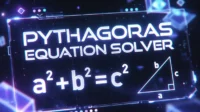
Right Triangle Calculator - Hypotenuse, Area & Angle Solver
Solve a right triangle from multiple known values with detailed math, validation, and educational insights.
How to use: Fill any valid combination (recommended: at least 2 independent values), then click Calculate.
Supported combinations include side-side, side-hypotenuse, side-angle, and area with one leg.
Triangle Inputs
Result Details
Note: Provide a mathematically valid combination. Inputs are validated for max value and geometric consistency.
Calculation Result
Dynamic Triangle Diagram
Diagram scales to fit viewport while preserving side ratio from your calculated result.
Computed Metrics
Step-by-Step Math
Educational Notes
Quick Formula Table
| Quantity | Formula | Meaning |
|---|---|---|
| Hypotenuse | c = sqrt(a² + b²) | Longest side in right triangle |
| Area | A = (a x b) / 2 | Half of rectangle with same legs |
| Angle A | A = atan(a / b) | Opposite leg a, adjacent leg b |
| Angle B | B = 90 - A | The other acute angle |
| Inradius | r = (a + b - c) / 2 | Radius of inscribed circle |
Mathematics has always played an important role in understanding shapes, structures, and measurements in the real world. Among the many geometric forms studied in math, the right triangle is one of the most fundamental and widely used. From architecture and engineering to navigation and computer graphics, right triangles help professionals calculate distances, heights, and angles accurately. In the modern digital era, tools such as a right triangle calculator have made these calculations faster, easier, and more accessible for everyone.
A right triangle is a triangle that contains one angle measuring exactly 90 degrees. This special angle creates a unique relationship between the three sides of the triangle, making it possible to determine unknown sides or angles using mathematical formulas. Traditionally, solving these problems required manual calculations using formulas such as the Pythagorean theorem and trigonometric ratios. While these methods remain essential for learning mathematics, modern digital tools now simplify the process significantly.
A right triangle calculator is an online or software-based tool designed to compute the missing sides, angles, area, and perimeter of a right triangle automatically. By entering a few known values—such as two sides or one side and an angle—the calculator instantly applies the correct mathematical formulas and provides precise results. This not only saves time but also reduces the possibility of human error when performing complex calculations.
The popularity of geometry calculators has grown rapidly in recent years, especially with the increasing availability of educational technology and online learning platforms. Students use these tools to better understand geometry concepts, while professionals rely on them to perform accurate measurements in practical applications. For example, architects may use triangle calculations to determine roof slopes, engineers may calculate structural angles, and surveyors may measure distances across land areas.
Another reason why digital calculation tools have become essential is their accessibility. Today, anyone with a smartphone, tablet, or computer can use an online calculator to solve geometry problems within seconds. Many modern tools even include visual diagrams, step-by-step solutions, and unit conversion features to make the learning process more intuitive.
Understanding how a right triangle calculator works can also improve your comprehension of fundamental mathematical principles. Behind every automated calculation lies the logic of classical geometry and trigonometry. When users see how sides and angles relate to one another, they gain a deeper understanding of mathematical relationships that apply far beyond the classroom.
In addition, right triangle calculations are not limited to academic exercises. They are widely used in real-world scenarios such as determining the height of a building, calculating the length of a ladder leaning against a wall, estimating distances between two points, or designing mechanical structures. Because of these practical applications, mastering triangle calculations is a valuable skill in many technical and scientific fields.
This article will explore everything you need to know about using a right triangle calculator, including the mathematical principles behind it, the formulas used for solving triangles, practical applications in everyday life, and tips for achieving accurate results. Whether you are a student learning geometry, a teacher explaining trigonometry concepts, or a professional working with measurements and design, understanding this powerful tool can greatly simplify complex calculations and improve your efficiency.
Understanding the Basics of Right Triangles
Right triangles are one of the most important shapes in mathematics, engineering, and everyday problem-solving. Whether you’re calculating the height of a building, designing a roof, or measuring distances, right triangles provide a simple yet powerful framework. In this guide, we’ll break down the essentials of right triangles and explore how a right triangle calculator can make calculations faster and easier.
Definition of a Right Triangle
A right triangle is a type of triangle that contains one angle measuring exactly 90 degrees. This angle is known as the right angle, and it is the defining feature that separates right triangles from other types of triangles.
The presence of a 90-degree angle creates a predictable relationship between the triangle’s sides, which allows for precise calculations using mathematical formulas. This is why right triangles are widely used in geometry, trigonometry, physics, and construction.
Key characteristics of right triangles include:
- One angle is exactly 90 degrees
- The side opposite the right angle is the longest
- The triangle follows the Pythagorean theorem
- It supports trigonometric relationships (sine, cosine, tangent)
Parts of a Right Triangle
Understanding the parts of a right triangle is essential before using any right triangle calculator or solving problems manually.
Hypotenuse
The hypotenuse is the longest side of the triangle and is always located opposite the 90-degree angle. It plays a central role in most calculations, especially when applying the Pythagorean theorem.
Adjacent Side
The adjacent side is the side that lies next to the reference angle (other than the right angle). Its position depends on which angle you are using for calculation.
Opposite Side
The opposite side is located across from the reference angle. It is crucial when working with trigonometric functions like sine and tangent.
Real-Life Examples of Right Triangles
Right triangles are not just theoretical—they appear in many real-world scenarios:
- Construction measurements: Builders use right triangles to ensure structures are level and aligned properly.
- Roof design: The slope of a roof is often calculated using right triangle principles.
- Distance and height estimation: Surveyors and engineers estimate heights and distances using angles and triangle relationships.
These practical uses highlight why tools like a right triangle calculator are valuable in both professional and educational settings.
How a Right Triangle Calculator Works
A right triangle calculator is a digital tool designed to quickly compute unknown sides, angles, area, and perimeter of a right triangle. It simplifies complex equations into instant results.
Input Values Required for Calculation
To use a right triangle calculator effectively, you typically need to input at least two known values:
- Two sides known: For example, base and height
- One side and one angle known: Common in trigonometry problems
- Hypotenuse with angle: Used to determine remaining sides
Providing accurate inputs ensures precise and reliable results.
Mathematical Principles Behind the Tool
Right triangle calculators rely on fundamental mathematical formulas and principles.
Pythagorean Theorem
The most important formula is:
a² + b² = c²
Where:
- a and b are the shorter sides
- c is the hypotenuse
This equation allows you to calculate the missing side when two sides are known.
Trigonometric Functions
Trigonometry is another core concept used in calculations:
- Sine (sin): Opposite ÷ Hypotenuse
- Cosine (cos): Adjacent ÷ Hypotenuse
- Tangent (tan): Opposite ÷ Adjacent
These functions help determine angles and side lengths when partial information is available.
Step-by-Step Process of Solving a Triangle
Using a right triangle calculator is straightforward and user-friendly.
Enter Known Measurements
Input the values you already know, such as side lengths or angles.
Select Calculation Type
Choose what you want to calculate—hypotenuse, angle, area, or perimeter.
Generate Results Automatically
The calculator processes the data instantly and provides accurate results, saving time and reducing errors.
Using the Right Triangle Calculator for Different Calculations
A right triangle calculator can handle various types of calculations, making it a versatile tool for students, engineers, and professionals.
Calculating the Hypotenuse
When two sides are known, you can easily calculate the hypotenuse using the Pythagorean theorem.
For example:
- If side a = 3 and side b = 4
- Then c = √(3² + 4²) = √25 = 5
This is one of the most common uses of a triangle calculator.
Finding the Missing Side
If you know the hypotenuse and one side, the calculator can determine the missing side.
For instance:
- Hypotenuse = 10
- One side = 6
- Missing side = √(10² − 6²)
This feature is particularly useful in geometry problems and real-world measurements.
Determining Triangle Angles
Using trigonometric ratios, you can calculate unknown angles.
Example:
- If opposite = 5 and hypotenuse = 10
- Then sin(θ) = 5/10 = 0.5
- θ = 30 degrees
A right triangle calculator automates this process, making it quick and accurate.
Calculating Area of a Right Triangle
The area of a right triangle is calculated using a simple formula:
Area = (Base × Height) ÷ 2
This is especially useful in construction, land measurement, and design projects.
Finding the Perimeter of the Triangle
The perimeter is the sum of all three sides:
Perimeter = a + b + c
Knowing the perimeter helps in material estimation, such as fencing or framing.
Why Use a Right Triangle Calculator?
In today’s digital era, tools like a right triangle calculator are becoming increasingly popular. They not only save time but also minimize calculation errors.
Benefits include:
- Fast and accurate results
- Easy to use for beginners
- Supports multiple calculation types
- Useful for education, engineering, and design
Additionally, modern calculators often include advanced features like unit conversion and graphical visualization, making them even more powerful.
Key Formulas Used in a Right Triangle Calculator
A right triangle calculator relies on a set of well-established mathematical formulas to deliver fast and accurate results. These formulas form the backbone of geometry and trigonometry, making it possible to calculate unknown sides, angles, area, and perimeter efficiently. Understanding these formulas not only helps you use the calculator better but also strengthens your overall math skills.
The Pythagorean Theorem Explained
The Pythagorean theorem is the most fundamental formula used in any right triangle calculation. It states:
a² + b² = c²
Where:
- a and b are the legs (shorter sides)
- c is the hypotenuse (longest side)
Historical Background
The theorem is named after the ancient Greek mathematician Pythagoras, who lived around 570–495 BCE. However, historical evidence suggests that the relationship between the sides of a right triangle was known even earlier by Babylonian and Indian mathematicians. Over time, the theorem became a cornerstone of geometry and is still widely used today in modern science, engineering, and technology.
Practical Examples
In real life, the Pythagorean theorem is used in many practical scenarios:
- Construction: Ensuring walls and floors are perfectly square
- Navigation: Calculating the shortest path between two points
- Technology: Used in computer graphics and game development
For example, if a ladder leans against a wall and you know the height and the distance from the wall, you can calculate the ladder’s length using this formula.
Trigonometric Ratios in Right Triangles
Trigonometric ratios are essential when dealing with angles and side relationships in a right triangle. A right triangle calculator uses these ratios to determine unknown values quickly.
Sine Formula
sin θ = opposite / hypotenuse
The sine function is useful when you know the angle and the opposite side, and you need to find the hypotenuse or another side.
Cosine Formula
cos θ = adjacent / hypotenuse
Cosine is commonly used when the adjacent side and hypotenuse are involved. It is especially helpful in physics and engineering calculations.
Tangent Formula
tan θ = opposite / adjacent
Tangent is widely used for calculating slopes, inclines, and angles of elevation, making it highly relevant in construction and surveying.
Angle Calculation Using Inverse Trigonometry
Sometimes, you need to find an angle rather than a side. This is where inverse trigonometric functions come into play:
- sin⁻¹ (arcsin)
- cos⁻¹ (arccos)
- tan⁻¹ (arctan)
For example, if you know the ratio of opposite to hypotenuse, you can use arcsin to determine the angle. A right triangle calculator performs these operations instantly, eliminating the need for manual calculations.
Practical Applications of a Right Triangle Calculator
A right triangle calculator is not just a theoretical tool—it has real-world applications across multiple industries. From construction to navigation, it plays a key role in solving everyday problems.
Applications in Architecture and Construction
Right triangles are everywhere in building design and construction projects.
- Roof pitch calculations: Builders use triangle formulas to determine the slope of a roof, ensuring proper drainage and structural stability.
- Staircase measurements: Calculating the height and depth of stairs involves right triangle relationships to meet safety standards.
Using a right triangle calculator simplifies these tasks and ensures precision.
Use in Engineering and Surveying
Engineers and surveyors rely heavily on accurate measurements and calculations.
- Land measurement techniques: Surveyors use triangles to measure distances across uneven terrain.
- Structural analysis: Engineers calculate forces, angles, and load distribution using trigonometric principles.
These calculations are critical for designing safe and efficient structures.
Applications in Navigation and GPS Systems
Modern navigation systems also depend on triangle-based calculations.
- Distance and direction calculations: GPS technology uses triangulation to determine exact locations.
- Mapping and tracking: Right triangle formulas help calculate routes and optimize travel paths.
Without these principles, accurate navigation would not be possible.
Educational Uses for Students and Teachers
Right triangle calculators are valuable learning tools in education.
- Solving geometry homework: Students can verify their answers and understand problem-solving steps.
- Understanding trigonometry concepts: Visualizing relationships between angles and sides becomes easier with instant results.
Teachers also use these tools to demonstrate concepts more effectively in the classroom.
Advantages of Using an Online Right Triangle Calculator
Online tools have transformed how we approach mathematical calculations. A right triangle calculator offers several key benefits that make it a preferred choice for many users.
Faster and More Accurate Calculations
Manual calculations can be time-consuming and prone to mistakes. A calculator provides instant results with high precision, making it ideal for both simple and complex problems.
Reduces Human Error in Mathematical Work
Even small errors in calculations can lead to significant issues, especially in engineering or construction. Using a digital tool minimizes the risk of mistakes and ensures reliable outcomes.
Ideal for Students, Engineers, and Designers
This tool is versatile and suitable for a wide range of users:
- Students learning geometry and trigonometry
- Engineers working on technical designs
- Designers planning layouts and structures
Its flexibility makes it a must-have resource across different fields.
Accessible on Mobile and Desktop Devices
Modern right triangle calculators are available online and can be accessed from smartphones, tablets, and computers. This allows users to perform calculations anytime and anywhere, increasing convenience and productivity.
Step-by-Step Guide to Using a Right Triangle Calculator
Using a right triangle calculator is simple, even if you’re new to geometry. Follow these steps to get accurate results quickly.
Step 1 – Identify Known Values
Start by determining what information you already have. This could include:
- Two side lengths
- One side and one angle
- The hypotenuse and an angle
Knowing your inputs is essential for accurate calculations.
Step 2 – Enter Data into the Calculator
Input the known values into the appropriate fields. Make sure the units are consistent (e.g., meters, feet, or inches) to avoid incorrect results.
Step 3 – Choose Calculation Type
Select what you want to calculate, such as:
- Hypotenuse
- Missing side
- Angle
- Area or perimeter
Most calculators provide multiple options depending on your needs.
Step 4 – Review and Interpret Results
Once the calculation is complete, review the results carefully. Many advanced calculators also provide step-by-step solutions, helping you understand how the answer was derived.
Common Mistakes When Calculating Right Triangles
Even though right triangle calculations follow clear formulas, mistakes are still common—especially for beginners. These errors can lead to incorrect results and confusion when solving geometry or trigonometry problems. Recognizing these pitfalls is the first step toward improving accuracy.
Confusing Opposite and Adjacent Sides
One of the most frequent mistakes is mixing up the opposite and adjacent sides. These terms depend on the reference angle, not the triangle itself. A side that is adjacent to one angle may be opposite to another.
For example, when using trigonometric ratios like sine or cosine, choosing the wrong side leads to completely incorrect answers. A reliable tip is to always label the triangle clearly before starting calculations.
Incorrect Angle Measurement Units
Another common issue is using the wrong unit for angles. Calculators may operate in degrees or radians, and mixing them up can produce inaccurate results.
For instance:
- sin(30°) = 0.5
- sin(30 radians) ≠ 0.5
Always check your calculator settings before performing trigonometric calculations.
Using Wrong Formula for the Situation
Not every problem requires the same formula. Some users mistakenly apply the Pythagorean theorem when trigonometric functions are needed—or vice versa.
Examples:
- Use Pythagorean theorem when two sides are known
- Use trigonometric ratios when angles are involved
Choosing the correct formula is essential for solving problems efficiently.
Rounding Errors in Manual Calculations
Manual calculations often involve rounding numbers at intermediate steps. These small approximations can accumulate and lead to noticeable inaccuracies in the final result.
A right triangle calculator minimizes this issue by maintaining precision throughout the calculation process.
Tips for Accurate Triangle Calculations
Improving accuracy in right triangle calculations doesn’t require advanced skills—just consistent habits and attention to detail.
Always Verify Known Measurements
Before starting any calculation, double-check the values you’re working with. Even a small input error can lead to a completely wrong answer.
Understand Basic Trigonometry Concepts
Having a solid grasp of sine, cosine, and tangent helps you choose the correct approach for each problem. Instead of memorizing formulas blindly, focus on understanding how they relate to triangle sides.
Use Reliable Online Calculation Tools
A high-quality right triangle calculator can save time and reduce errors. Look for tools that provide step-by-step solutions and support multiple input types.
Double-Check Units of Measurement
Consistency is key. Make sure all values are in the same unit system (e.g., meters, centimeters, or feet). Mixing units can lead to incorrect results, especially in real-world applications.
Comparing Manual Calculations vs Right Triangle Calculator Tools
Both manual methods and digital tools have their place in solving right triangle problems. Understanding their strengths and limitations can help you choose the best approach.
Manual Geometry Calculations
Manual calculations involve solving problems using formulas, paper, and basic calculators.
Advantages
- Helps build a strong understanding of mathematical concepts
- Improves problem-solving and critical thinking skills
- Useful in exams where digital tools are not allowed
Limitations
- Time-consuming for complex problems
- Higher risk of calculation errors
- Requires careful attention to detail
Using Digital Calculation Tools
Right triangle calculator tools are designed to simplify and speed up the process.
Speed
Digital tools provide instant results, making them ideal for quick calculations or large projects.
Accuracy
They reduce human error by performing precise computations, even with complex formulas.
Ease of Use
Most online calculators have user-friendly interfaces, allowing users to input values and get results without deep mathematical knowledge.
Right Triangle Calculator for Students Learning Geometry
For students, a right triangle calculator is more than just a shortcut—it’s a powerful learning aid that supports deeper understanding.
Improving Understanding of the Pythagorean Theorem
By using a calculator alongside manual practice, students can see how the a² + b² = c² relationship works in real time. This reinforces the concept and builds confidence.
Visualizing Triangle Relationships
Many modern tools include diagrams that show the triangle and its labeled sides. This visual representation helps students understand how angles and sides are connected.
Supporting STEM Education
Right triangle calculators play an important role in STEM (Science, Technology, Engineering, Mathematics) education. They allow students to focus on concepts rather than getting stuck on lengthy calculations, making learning more engaging and efficient.
Advanced Features Found in Modern Right Triangle Calculators
Today’s right triangle calculators go far beyond basic computations. They include advanced features that enhance usability and learning.
Graphical Triangle Visualization
Some tools display a visual representation of the triangle based on the input values. This helps users better understand the geometry and verify their results visually.
Automatic Angle Conversion
Modern calculators can automatically switch between degrees and radians, reducing the risk of errors and making calculations more convenient.
Multi-Unit Measurement Support
Users can input values in different units (e.g., meters, inches, feet), and the calculator will handle conversions automatically. This is especially useful in international projects.
Integration With Geometry Learning Platforms
Many calculators are now integrated into online learning platforms, allowing students to practice problems, view step-by-step solutions, and track progress. This integration creates a more interactive and effective learning experience.
Frequently Asked Questions About Right Triangle Calculators
Right triangle calculators are widely used by students, professionals, and anyone dealing with geometry. Below are some of the most common questions, along with clear and practical answers to help you better understand how these tools work.
What is the easiest way to calculate a right triangle?
The easiest way to calculate a right triangle is by using an online right triangle calculator. Instead of manually applying formulas like the Pythagorean theorem or trigonometric ratios, you simply input the known values—such as two sides or one side and one angle—and the tool instantly calculates the missing values.
For quick manual calculations:
- Use a² + b² = c² when two sides are known
- Use trigonometric functions (sin, cos, tan) when angles are involved
However, for speed, convenience, and accuracy, digital tools remain the most efficient option.
Can a right triangle calculator find missing angles?
Yes, a right triangle calculator can easily find missing angles. It uses inverse trigonometric functions such as:
- arcsin (sin⁻¹)
- arccos (cos⁻¹)
- arctan (tan⁻¹)
By entering known side lengths, the calculator determines the unknown angle in seconds. This is especially useful in fields like engineering, construction, and navigation, where angle precision is critical.
Do I need trigonometry knowledge to use it?
No, you don’t need advanced trigonometry knowledge to use a right triangle calculator. Most tools are designed with user-friendly interfaces that guide you through the process.
That said, having a basic understanding of:
- Triangle sides (hypotenuse, opposite, adjacent)
- Simple trigonometric concepts
will help you interpret the results more effectively and avoid input mistakes.
Are online triangle calculators accurate?
Yes, most online triangle calculators are highly accurate, as they use precise mathematical formulas and algorithms. The accuracy largely depends on:
- The correctness of your input values
- The reliability of the tool you’re using
High-quality calculators can deliver results with many decimal places, making them suitable for both academic and professional use. Still, it’s always a good idea to double-check critical calculations, especially in technical projects.
Conclusion
Right triangle calculators have become an essential part of modern geometry and problem-solving. They combine mathematical precision with digital convenience, making complex calculations accessible to everyone.
Why the Right Triangle Calculator Is an Essential Math Tool
A right triangle calculator simplifies one of the most important areas of mathematics. From solving basic geometry problems to handling advanced engineering calculations, it provides:
- Fast and reliable results
- Reduced risk of human error
- Support for multiple calculation types
This makes it a valuable tool for students, teachers, engineers, architects, and designers alike.
The Future of Digital Geometry Calculation Tools
As technology continues to evolve, digital geometry tools are becoming more advanced and interactive. Future right triangle calculators may include:
- AI-powered problem-solving assistance
- Real-time 3D visualization of geometric shapes
- Integration with augmented reality (AR) for practical applications
These innovations will make learning and applying geometry even more intuitive and engaging.
Final Thoughts on Using Smart Geometry Tools
Using a right triangle calculator is not just about saving time—it’s about working smarter. By combining foundational math knowledge with modern tools, you can solve problems more efficiently and with greater confidence.
Whether you’re studying geometry, working on a construction project, or analyzing data in engineering, a reliable right triangle calculator is a tool worth having. It bridges the gap between theory and real-world application, helping you achieve accurate results with ease.