🔺 Hypotenuse Calculator
Calculate the hypotenuse of a right triangle using the Pythagorean Theorem
📏 Pythagorean Theorem: In any right triangle, the square of the hypotenuse equals the sum of squares of the other two sides.
Where: c = hypotenuse | a, b = legs (cathetus)
⌨️ Keyboard Shortcuts: Ctrl+Enter = Calculate | Ctrl+R = Reset | Ctrl+D = Dark Mode | Esc = Clear Errors
📐 Triangle Dimensions
💡 Adjacent to angle α, opposite to angle β
Please enter a valid positive number (max: 1,000,000,000)
💡 Adjacent to angle β, opposite to angle α
Please enter a valid positive number (max: 1,000,000,000)
🔄 Different units will be automatically converted to match
⚡ Quick Examples (Click to Load)
📊 Calculation Results
📚 Step-by-Step Calculation
📐 Triangle Visualization
📏 Triangle updates automatically when you calculate
📐 Triangle Properties
📏 Interior Angles
🎓 Understanding the Pythagorean Theorem
Historical Context: Named after the ancient Greek mathematician Pythagoras (c. 570–495 BCE), though the relationship was known to Babylonian mathematicians over 1,000 years earlier.
Geometric Interpretation: The theorem states that the area of the square built upon the hypotenuse equals the sum of the areas of squares built upon the other two sides.
Mathematical Proof: There are over 370 known proofs of the Pythagorean theorem, including algebraic, geometric, and even one by U.S. President James Garfield in 1876.
Practical Applications: Used in architecture, navigation, physics, computer graphics, GPS calculations, surveying, construction, astronomy, and countless engineering disciplines.
Real-World Examples: Calculating diagonal distances, determining ladder placement safety, finding shortest paths, measuring roof slopes, and designing structural supports.
📚 Related Formulas & Concepts
- 📐 Hypotenuse: c = √(a² + b²)
- 📐 Leg a: a = √(c² - b²)
- 📐 Leg b: b = √(c² - a²)
- 📐 Area: A = (a × b) / 2
- 📐 Perimeter: P = a + b + c
- 📐 Altitude to hypotenuse: h = (a × b) / c
- 📐 Inradius: r = (a + b - c) / 2
- 📐 Circumradius: R = c / 2
- 📐 Angle α: α = arctan(a/b) = arcsin(a/c) = arccos(b/c)
- 📐 Angle β: β = arctan(b/a) = arcsin(b/c) = arccos(a/c)
🔢 Common Pythagorean Triples
Integer sets that satisfy a² + b² = c²:
💡 Hover over each triple to see the calculation
🔄 Unit Conversions for Hypotenuse
📊 Special Right Triangle Ratios
If legs = 1, hypotenuse = √2 ≈ 1.414
Both acute angles = 45°
If short leg = 1, long leg = √3 ≈ 1.732
Hypotenuse = 2
❓ Frequently Asked Questions
Q: What is the hypotenuse?
A: The hypotenuse is the longest side of a right triangle, opposite to the 90° angle.
Q: Can I use this for non-right triangles?
A: No, the Pythagorean theorem only applies to right triangles (triangles with a 90° angle).
Q: What are Pythagorean triples?
A: Sets of three positive integers (a, b, c) that satisfy a² + b² = c², like 3-4-5 or 5-12-13.
Q: How accurate are the calculations?
A: Calculations use JavaScript's double-precision floating-point (15-17 significant digits), with customizable decimal precision.
Q: Can I mix different units?
A: Yes! The calculator automatically converts all measurements to a common unit before calculating.
Mathematics has always played an essential role in understanding the world around us. From designing buildings and bridges to calculating distances on maps, math helps transform abstract ideas into practical solutions. One of the most common concepts in geometry is the right triangle, and at the center of this concept lies the hypotenuse—the longest side of the triangle. To simplify the process of calculating this side, many students, educators, engineers, and professionals now rely on a hypotenuse calculator.
A hypotenuse calculator is a digital math tool designed to quickly determine the length of the hypotenuse in a right triangle. Instead of manually performing multiple steps using formulas and square roots, users can simply input the lengths of the two other sides and receive an instant answer. This convenience has made online geometry calculators increasingly popular in classrooms, engineering environments, and even everyday problem-solving situations.
At the heart of every hypotenuse calculation lies one of the most famous mathematical principles: the Pythagorean theorem. This theorem explains the relationship between the three sides of a right triangle and provides a reliable formula for determining unknown lengths. The formula is widely recognized as:
a² + b² = c²
In this equation, the variables a and b represent the two shorter sides of the triangle (often called the legs), while c represents the hypotenuse. By squaring the lengths of the two legs, adding them together, and then taking the square root of the result, you can determine the length of the longest side. While this calculation is simple for small numbers, it can become time-consuming or prone to mistakes when dealing with larger values or real-world measurements. This is where a hypotenuse calculator becomes incredibly useful.
Online math tools have evolved rapidly over the past decade. With the growth of educational technology, digital geometry calculators now provide instant, highly accurate results that help users verify their work and learn mathematical concepts more effectively. Students can use these tools to check homework answers, while professionals in architecture, engineering, and construction rely on them to ensure precise measurements in their designs.
Another advantage of using a hypotenuse calculator is accessibility. Modern calculators are available on websites, mobile applications, and educational platforms, allowing anyone to perform triangle calculations from virtually anywhere. Whether someone is using a smartphone during a class exercise or working on a laptop while planning a construction project, these tools provide quick and reliable results.
Beyond convenience, hypotenuse calculations also play a crucial role in many real-life applications. For example, architects use triangle calculations when designing roof structures or staircases. Engineers often rely on the Pythagorean theorem when analyzing force vectors or determining distances between points in structural designs. Even navigation systems and mapping technologies use geometric principles similar to those behind hypotenuse calculations to determine the shortest path between locations.
For students learning geometry, understanding how to find the hypotenuse is a foundational skill. While a calculator can speed up the process, the real value lies in understanding the relationship between the sides of a triangle. By combining conceptual knowledge with digital tools like an online right triangle calculator, learners can develop both accuracy and confidence in solving geometry problems.
Today, the availability of advanced online triangle calculators and geometry solvers has made mathematics more approachable than ever before. These tools allow users to explore formulas, verify results, and solve complex problems in seconds. A hypotenuse calculator is one of the most practical examples of how technology can enhance mathematical learning while also supporting professional work in fields that depend on precise measurements.
In this guide, we will explore everything you need to know about hypotenuse calculations. From understanding the fundamental formula behind right triangles to discovering practical real-world applications, this article will provide a comprehensive overview of how a hypotenuse calculator works and why it remains an essential tool in modern mathematics. Along the way, we will also discuss tips for solving triangle problems faster, compare different types of geometry calculators, and examine how digital math tools are shaping the future of STEM education.
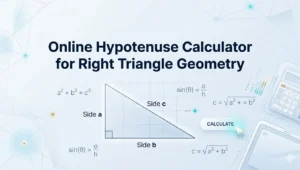
What Is a Hypotenuse Calculator?
A hypotenuse calculator is a digital math tool designed to quickly determine the length of the longest side of a right triangle. This side, known as the hypotenuse, sits opposite the right angle and plays a central role in geometry, trigonometry, and real-world measurements. Instead of manually applying formulas and performing calculations step by step, users can input known values and instantly receive accurate results.
At its core, this tool simplifies the process of solving right triangle problems. A right triangle is a geometric shape with one angle measuring exactly 90 degrees. The two sides that form this right angle are called the legs, while the side opposite it is the hypotenuse. Because of this unique structure, right triangles follow a predictable mathematical relationship that makes them highly useful in various fields.
Calculators help simplify geometry problems by reducing the time and effort needed to compute results manually. They eliminate repetitive arithmetic steps and reduce the likelihood of human error. In education, digital math tools like hypotenuse calculators support interactive learning, allowing students to explore concepts more intuitively. In professional settings, they enhance productivity and ensure precision in tasks that rely on geometric calculations.
The Basic Concept Behind Hypotenuse Calculations
The foundation of hypotenuse calculations lies in the Pythagorean theorem, one of the most well-known principles in mathematics. This theorem describes the relationship between the three sides of a right triangle. It states that the square of the hypotenuse is equal to the sum of the squares of the other two sides.
This relationship can be expressed as:
a² + b² = c²
Here, “a” and “b” represent the lengths of the two legs, while “c” represents the hypotenuse. Because of this equation, the hypotenuse is always the longest side of a right triangle. No matter the triangle’s size, this relationship remains constant.
Understanding the Right Triangle Structure
To fully grasp how a hypotenuse calculator works, it helps to understand the structure of a right triangle:
- Adjacent side: The side next to a given angle (excluding the hypotenuse).
- Opposite side: The side across from the angle being considered.
- Hypotenuse side: The longest side, always opposite the right angle.
These components form the basis for many geometric and trigonometric calculations. Recognizing their roles makes it easier to apply formulas correctly.
Visualizing Triangle Measurements in Geometry
Visualizing a triangle helps reinforce understanding. Imagine a ladder leaning against a wall. The ground and the wall form a right angle, while the ladder represents the hypotenuse. The distance along the ground and the height up the wall are the legs. This simple mental image demonstrates how the three sides relate to each other in a real-world context.
Why Students and Professionals Use Hypotenuse Calculators
Hypotenuse calculators are widely used because they offer convenience, accuracy, and efficiency. Students benefit from quick calculations that help them check their work and understand concepts more clearly. Instead of getting stuck on arithmetic, they can focus on learning the underlying principles.
Professionals in fields like engineering, construction, and design rely on these tools to minimize errors. Even small miscalculations can lead to significant issues in real-world projects. A reliable calculator ensures consistent results.
Another key advantage is speed. Manual calculations can be time-consuming, especially when dealing with decimals or large numbers. A digital tool provides instant answers, allowing users to move forward without delays. This combination of speed, accuracy, and ease of use makes hypotenuse calculators essential in both academic and professional environments.
How a Hypotenuse Calculator Works Using the Pythagorean Theorem
A hypotenuse calculator operates by applying the Pythagorean theorem automatically. Users input the lengths of the two legs, and the calculator processes the values using the formula. Behind the scenes, it performs squaring, addition, and square root operations within milliseconds.
The Mathematical Formula for Finding the Hypotenuse
The formula a² + b² = c² is the backbone of every hypotenuse calculation. Each variable has a specific meaning:
- a: Length of one leg
- b: Length of the other leg
- c: Length of the hypotenuse
To find the hypotenuse, the calculator squares both leg values, adds them together, and then takes the square root of the result. This ensures the final value represents the true length of the longest side.
Step-by-Step Process to Calculate the Hypotenuse
Even though calculators automate the process, understanding the steps is important:
- Identify the lengths of the two legs.
- Square each value (multiply each by itself).
- Add the squared values together.
- Take the square root of the sum.
This sequence guarantees an accurate result when performed correctly.
Example Calculation Using Real Numbers
Consider a triangle where one leg measures 3 units and the other measures 4 units:
- Square the numbers: 3² = 9 and 4² = 16
- Add them: 9 + 16 = 25
- Take the square root: √25 = 5
The hypotenuse is 5 units. This classic example demonstrates how simple and predictable the calculation can be.
Common Mistakes When Solving Hypotenuse Problems
Some common errors include:
- Forgetting to square the numbers
- Adding values before squaring
- Miscalculating square roots
- Confusing which side is the hypotenuse
Using a calculator helps avoid these mistakes by handling each step correctly.
Manual Calculation vs Using an Online Hypotenuse Calculator
Manual calculations offer educational value, helping learners understand the logic behind the formula. However, they require time and careful attention. Online calculators, on the other hand, provide immediate results with minimal effort.
In terms of speed, calculators are significantly faster. For accuracy, they reduce the risk of arithmetic errors. From a learning perspective, combining both approaches is ideal—students can practice manually while using calculators to verify their answers.
Key Features of an Online Hypotenuse Calculator for Accurate Results
Modern hypotenuse calculators come with a range of features designed to improve usability and precision.
Automatic Square Root Calculation
One of the most useful features is automatic square root computation. Users do not need to perform complex operations manually. The calculator delivers instant output, even for non-perfect squares.
This ensures high precision, especially when dealing with decimal values or scientific measurements.
Input Flexibility for Different Units
A good calculator supports multiple units, allowing users to work in:
- Meters
- Centimeters
- Inches
- Feet
This flexibility makes it suitable for various applications, from classroom exercises to construction projects.
Real-Time Geometry Problem Solving
Real-time processing allows users to experiment with different values and see immediate results. This interactive approach enhances understanding and encourages exploration.
Mobile-Friendly Math Tools
Many calculators are optimized for mobile devices, making them accessible anytime and anywhere. Students can use them during study sessions, while professionals can rely on them in the field.
Integration with Educational Platforms
Some tools integrate with learning platforms, providing additional features such as step-by-step explanations, visual diagrams, and practice exercises. This creates a more comprehensive learning experience.
Practical Applications of Hypotenuse Calculations in Real Life
Hypotenuse calculations are not limited to academic exercises. They play a crucial role in many real-world scenarios.
Hypotenuse Calculator in Construction and Architecture
In construction, accurate measurements are essential. Builders use hypotenuse calculations to determine diagonal distances, ensuring structures are properly aligned.
For roof design, the hypotenuse helps calculate the slope length. In staircase construction, it determines the length of the stringer, which supports the steps. Structural planning also relies on precise measurements to maintain stability and safety.
Use in Engineering and Physics
Engineers frequently apply the Pythagorean theorem when working with force vectors. By breaking forces into perpendicular components, they can calculate resultant forces accurately.
In mechanical design, hypotenuse calculations help determine distances between components. In physics, they are used to analyze motion, displacement, and energy relationships.
Navigation and Mapping Applications
Navigation systems rely on geometric principles to calculate distances. GPS technology often uses right triangle approximations to determine the shortest path between two points.
These calculations are essential for route optimization, helping users reach their destinations efficiently.
Surveying and Land Measurement
Surveyors use hypotenuse calculations to measure land accurately. By creating right triangle models, they can determine distances that are difficult to measure directly.
Distance Calculation in Geographic Systems
Geographic information systems (GIS) use similar principles to analyze spatial data. Hypotenuse calculations help determine distances, elevations, and boundaries, supporting urban planning and environmental studies.
Hypotenuse Calculator for Students Learning Geometry
A hypotenuse calculator is one of the most practical digital tools for students exploring geometry. Whether you are just starting with right triangles or preparing for advanced math exams, this tool simplifies calculations and improves understanding. Instead of getting stuck in repetitive manual work, learners can focus on concepts, patterns, and problem-solving strategies.
In today’s digital learning environment, math tools are evolving to become more interactive, accurate, and accessible. A hypotenuse calculator is not just about getting answers—it’s about building intuition and confidence in geometry. This article explores how it supports students, how to use it effectively, and why it stands out compared to other triangle calculators.
Supporting Middle School and High School Math Education
Geometry becomes more structured and important as students move from middle school to high school. The introduction of formulas, proofs, and problem-solving techniques can be overwhelming. A hypotenuse calculator helps bridge that gap by offering a practical way to verify results and understand relationships between triangle sides.
Geometry fundamentals
Geometry begins with shapes, angles, and measurements. Among these, triangles are fundamental because they appear in many real-world and mathematical contexts. Students learn about different types of triangles, including equilateral, isosceles, and scalene, but right triangles often take center stage due to their unique properties.
The Pythagorean theorem—one of the most important concepts in geometry—applies specifically to right triangles. It states that:
a² + b² = c²
Where:
- a and b are the legs (shorter sides)
- c is the hypotenuse (the longest side)
A hypotenuse calculator automates this formula, helping students instantly find the value of c when a and b are known.
Understanding right triangles
Right triangles are everywhere—from architecture and engineering to physics and computer graphics. Understanding them is essential for solving spatial problems.
A hypotenuse calculator allows students to:
- Visualize the relationship between sides
- Experiment with different values
- Quickly see how changes affect the triangle
This kind of exploration encourages deeper learning compared to memorizing formulas alone.
Homework and Exam Preparation
Students often face time pressure during homework and exams. A hypotenuse calculator becomes a valuable companion in these situations.
Faster problem solving
Manual calculations can be time-consuming, especially when dealing with square roots or decimal values. A calculator speeds up the process significantly. Instead of spending minutes on a single calculation, students can get results in seconds.
This allows more time for:
- Understanding the problem
- Reviewing mistakes
- Practicing additional questions
Checking answers
Even the most careful students make mistakes. A hypotenuse calculator acts as a reliable checking tool. After solving a problem manually, students can input the same values into the calculator to confirm accuracy.
This reinforces learning by:
- Identifying calculation errors
- Building confidence in correct solutions
- Encouraging independent verification
Interactive Learning with Digital Math Tools
Modern education increasingly relies on digital tools. A hypotenuse calculator fits perfectly into this trend by offering interactive learning experiences.
Visual Learning Benefits
Many calculators now include visual representations of triangles. This helps students connect numerical values with geometric shapes.
Benefits include:
- Better spatial understanding
- Easier recognition of patterns
- Improved retention of concepts
Seeing the triangle alongside the calculation makes learning more engaging and less abstract.
Improving Mathematical Confidence
Confidence plays a huge role in math success. When students repeatedly get correct answers and understand the process, their confidence grows.
A hypotenuse calculator supports this by:
- Reducing frustration
- Providing immediate feedback
- Encouraging experimentation
Over time, students become more comfortable tackling complex geometry problems.
Step-by-Step Guide to Using a Hypotenuse Calculator Online
Using a hypotenuse calculator is simple, but understanding each step ensures accurate and meaningful results.
Entering Triangle Side Values
The first step is to input the known side lengths of the triangle. These are usually the two legs (a and b).
Tips:
- Ensure values are positive numbers
- Double-check units before entering
- Avoid mixing measurement systems (e.g., meters and centimeters)
Selecting Measurement Units
Many calculators allow users to choose units such as:
- Meters (m)
- Centimeters (cm)
- Inches (in)
- Feet (ft)
Consistency is key. Using the same unit for both sides ensures accurate results.
Generating Accurate Hypotenuse Results
After entering values and selecting units, click the calculate button. The tool applies the Pythagorean theorem and provides the hypotenuse instantly.
Most calculators also:
- Display step-by-step solutions
- Show decimal approximations
- Offer rounding options
Example Calculation Scenario
Let’s say:
- Side a = 6 cm
- Side b = 8 cm
Using the formula:
- c = √(6² + 8²)
- c = √(36 + 64)
- c = √100
- c = 10 cm
The calculator performs these steps instantly and displays the result.
Understanding the Output Results
The result may include:
- Exact value (e.g., √100)
- Decimal approximation (e.g., 10.00)
- Visual triangle diagram
Students should learn to interpret both exact and approximate values, especially for exam settings.
Advantages of Using a Hypotenuse Calculator Compared to Manual Methods
While manual calculations are important for learning, calculators offer several advantages that enhance the overall experience.
Speed and Efficiency
One of the biggest benefits is speed. Complex calculations that involve square roots can take time when done manually.
A calculator:
- Reduces calculation time
- Allows more practice within limited time
- Supports quick revisions before exams
Accuracy in Mathematical Calculations
Human error is common, especially under pressure. A hypotenuse calculator minimizes mistakes by performing precise computations.
This is particularly useful for:
- Decimal values
- Large numbers
- Complex problem sets
Accessibility for Beginners
Beginners often struggle with formulas and calculations. A calculator makes geometry more approachable.
It provides:
- Simple input fields
- Instant results
- Clear explanations
Reducing Mathematical Errors
Errors often occur in:
- Squaring numbers incorrectly
- Adding values inaccurately
- Miscalculating square roots
A calculator eliminates these issues, allowing students to focus on understanding rather than arithmetic.
Simplifying Complex Geometry Tasks
As students progress, geometry problems become more complex. A hypotenuse calculator can handle advanced scenarios, including:
- Real-world measurement problems
- Multi-step geometry questions
- Integration with other math tools
Hypotenuse Calculator vs Other Triangle Calculators
There are many types of triangle calculators available. Each serves a different purpose, and understanding their differences helps students choose the right tool.
Right Triangle Calculator
A right triangle calculator is more comprehensive. It can calculate:
- Hypotenuse
- Angles
- Area
- Perimeter
While a hypotenuse calculator focuses specifically on finding c, a right triangle calculator offers a broader range of features.
Triangle Side Length Calculator
This tool calculates unknown sides based on given inputs. It may use:
- Pythagorean theorem
- Law of sines
- Law of cosines
It is useful for both right and non-right triangles, making it more versatile.
Distance Formula Calculator
The distance formula calculator is closely related to the hypotenuse concept. It calculates the distance between two points in a coordinate plane using:
d = √((x₂ – x₁)² + (y₂ – y₁)²)
This is essentially an application of the Pythagorean theorem in algebra and coordinate geometry.
Pythagorean Theorem Calculator
This calculator specifically solves equations based on the Pythagorean theorem. It can:
- Find any missing side
- Show step-by-step solutions
- Provide educational explanations
It overlaps heavily with hypotenuse calculators but offers more flexibility.
Geometry Solver Tools
Advanced geometry solver tools combine multiple features into one platform. These may include:
- Hypotenuse calculation
- Angle measurement
- Graph plotting
- Equation solving
They are ideal for students who want an all-in-one solution for geometry and beyond.
Expanding the Role of Hypotenuse Calculators in Modern Education
Beyond basic calculations, hypotenuse calculators are becoming part of a larger ecosystem of educational technology.
They integrate with:
- Online learning platforms
- Virtual classrooms
- Mobile learning apps
Students can now access these tools anytime, anywhere, making learning more flexible.
Real-World Applications of Hypotenuse Calculations
Understanding the hypotenuse is not limited to classroom exercises. It has practical applications in many fields:
- Architecture: Calculating roof slopes and structural dimensions
- Engineering: Designing components and measuring distances
- Physics: Resolving vector components
- Navigation: Determining shortest paths
- Computer graphics: Rendering shapes and animations
Using a hypotenuse calculator helps students connect theory with real-world use cases.
Tips for Maximizing Learning with a Hypotenuse Calculator
To get the most out of this tool, students should:
- Practice manual calculations first
- Use the calculator for verification
- Experiment with different values
- Analyze step-by-step solutions
- Combine with other geometry tools
This balanced approach ensures both conceptual understanding and practical efficiency.
Common Mistakes to Avoid
Even with a calculator, mistakes can happen. Watch out for:
- Entering incorrect values
- Mixing units
- Misinterpreting results
- Relying solely on the tool without understanding
Awareness of these issues helps maintain accuracy and learning quality.
Future Trends in Digital Geometry Tools
The future of math tools looks promising, with innovations such as:
- AI-powered tutoring systems
- Interactive 3D geometry visualization
- Voice-assisted calculations
- Personalized learning experiences
Hypotenuse calculators will likely evolve into more intelligent systems that guide students step-by-step.
Understanding the Pythagorean Theorem Behind Hypotenuse Calculators
The hypotenuse calculator is one of the simplest yet most powerful digital math tools available today. Behind its clean interface lies a concept that has shaped mathematics, engineering, physics, and even modern computing: the Pythagorean Theorem. This theorem provides a direct relationship between the sides of a right triangle and forms the backbone of countless calculations in both academic and real-world scenarios.
At its core, the Pythagorean Theorem states:
In a right triangle, the square of the hypotenuse is equal to the sum of the squares of the other two sides.
In equation form:
a² + b² = c²
Where:
- a and b are the legs (shorter sides)
- c is the hypotenuse (the longest side, opposite the right angle)
A hypotenuse calculator automates this formula, allowing users to quickly find missing values without manual computation. While the tool simplifies the process, understanding the underlying principle gives deeper insight and prevents common mistakes.
History of the Pythagorean Theorem
Although the theorem is named after the Greek mathematician Pythagoras (c. 570–495 BCE), evidence suggests that the relationship between triangle sides was known long before his time.
Ancient Babylonian clay tablets, such as Plimpton 322, show knowledge of Pythagorean triples dating back nearly 1,800 years before Pythagoras. Similarly, ancient Indian texts like the Sulba Sutras also described geometric relationships equivalent to the theorem.
Pythagoras and his followers were likely the first to formally prove the theorem, which is why it carries his name. In Greek mathematics, proof was as important as discovery. The idea that a mathematical relationship must be logically demonstrated rather than observed marked a turning point in scientific thinking.
Over centuries, the theorem has been revisited, expanded, and proven in hundreds of ways—from geometric rearrangements to algebraic demonstrations. Even modern mathematicians continue to explore new proofs, highlighting the theorem’s enduring significance.
Mathematical Proof of the Theorem
There are more than 300 known proofs of the Pythagorean Theorem. One of the most intuitive involves geometric rearrangement.
Imagine constructing a square with side length (a + b). Inside this square, place four identical right triangles, each with sides a, b, and c. The remaining empty space forms a smaller square with side length c.
By calculating the area in two ways:
- Total area of the large square: (a + b)²
- Area as sum of triangles and inner square: 4(½ab) + c²
Setting them equal:
(a + b)² = 2ab + c²
Expanding:
a² + 2ab + b² = 2ab + c²
Subtracting 2ab from both sides:
a² + b² = c²
This visual approach is especially helpful for students because it transforms abstract algebra into something concrete.
Another popular proof uses similarity of triangles, showing that smaller triangles inside a right triangle are proportional to the original, leading to the same relationship.
Applications in Modern Mathematics
The Pythagorean Theorem is far more than a classroom formula. It is embedded in many modern systems and technologies.
In coordinate geometry, the distance between two points (x₁, y₁) and (x₂, y₂) is calculated using a variation of the theorem:
distance = √[(x₂ − x₁)² + (y₂ − y₁)²]
This formula powers GPS navigation, mapping software, and location-based services. Without it, calculating precise distances on a grid would be significantly more complex.
In computer graphics, the theorem helps determine pixel distances, rendering shapes, and simulating 3D environments. Game engines rely heavily on these calculations to create realistic motion and perspective.
In physics, it appears in vector analysis. When two perpendicular forces act on an object, the resultant force is found using the same principle.
Geometry and Trigonometry Connections
The Pythagorean Theorem forms the foundation of trigonometry. Sine, cosine, and tangent ratios all relate back to right triangles and their side relationships.
For example:
- sin(θ) = opposite / hypotenuse
- cos(θ) = adjacent / hypotenuse
- tan(θ) = opposite / adjacent
These ratios, combined with the theorem, allow for solving complex geometric problems involving angles and distances.
The identity:
sin²(θ) + cos²(θ) = 1
is a direct extension of the Pythagorean Theorem applied to the unit circle.
Mathematical Modeling Applications
In data science and machine learning, the theorem is used to calculate distances in multi-dimensional space. One example is Euclidean distance, which measures similarity between data points.
This concept is crucial in:
- clustering algorithms
- recommendation systems
- image recognition
- anomaly detection
Even though the dimensions extend beyond two or three, the principle remains the same: summing squared differences and taking the square root.
Common Geometry Problems Solved with a Hypotenuse Calculator
A hypotenuse calculator simplifies many everyday and academic problems. Instead of manually squaring, adding, and finding square roots, users can input values and get instant results.
Finding the Missing Side of a Triangle
The most common use case is solving for a missing side when two sides are known.
Example:
If a = 6 and b = 8
c = √(6² + 8²) = √(36 + 64) = √100 = 10
This calculation is straightforward, but a calculator eliminates errors, especially with non-integer values.
Similarly, if the hypotenuse and one leg are known:
b = √(c² − a²)
This is often used in reverse calculations, such as determining height when diagonal length is known.
Calculating Diagonal Distance
Hypotenuse calculators are widely used to find diagonals in rectangles and squares.
For a rectangle with length L and width W:
Diagonal = √(L² + W²)
This is useful in:
- screen size measurements
- room layout planning
- material cutting
For example, a 1920×1080 screen uses diagonal calculations to determine display size in inches.
Determining the Shortest Path Between Two Points
In grid-based systems, the shortest path between two points is a straight line. The Pythagorean Theorem helps calculate this efficiently.
In navigation systems, while real-world paths may curve, the theorem provides a baseline distance estimate used in optimization algorithms.
Building Layout Calculations
Construction professionals frequently use hypotenuse calculations to ensure right angles and accurate measurements.
A common technique is the 3-4-5 rule:
- Measure 3 units on one side
- 4 units on another
- The diagonal should be exactly 5 units
If it matches, the angle is 90 degrees.
This method is still used on job sites because it is simple and reliable.
Engineering Design Calculations
Engineers apply the theorem in structural design, ensuring stability and proper alignment.
Examples include:
- calculating beam lengths
- designing trusses
- determining cable tension paths
Even small miscalculations can lead to structural weaknesses, which is why precise tools like hypotenuse calculators are essential.
Tips for Solving Hypotenuse Problems Faster
Speed and accuracy are both important in mathematics. While calculators help, mental strategies can significantly improve efficiency.
Recognizing Pythagorean Triples
Pythagorean triples are sets of integers that satisfy the theorem.
Common examples:
- 3, 4, 5
- 5, 12, 13
- 8, 15, 17
- 7, 24, 25
Recognizing these patterns allows you to skip calculations entirely.
For instance, if you see sides 9 and 12, you can scale the 3-4-5 triple by 3 to get 15 as the hypotenuse.
Using Estimation Techniques
When exact values are not necessary, estimation saves time.
Example:
√50 is between √49 (7) and √64 (8), so the answer is slightly above 7.
This approach is useful in exams and quick decision-making scenarios.
Understanding Triangle Relationships
Knowing how triangle sides relate helps prevent confusion.
Key points:
- The hypotenuse is always the longest side
- It is opposite the right angle
- Squared values must always be positive
Misidentifying sides is a common mistake that leads to incorrect results.
Quick Mental Math Tricks
Breaking numbers into smaller parts makes calculations easier.
Example:
√(81 + 16) = √97 ≈ 9.85
Instead of calculating from scratch, recognize that 97 is close to 100.
Another trick is memorizing squares up to at least 20:
- 10² = 100
- 15² = 225
- 20² = 400
This speeds up calculations significantly.
Avoiding Common Geometry Mistakes
Some frequent errors include:
- forgetting to square numbers
- mixing up legs and hypotenuse
- using incorrect units
- rounding too early
Always double-check inputs before using a calculator. Even small input errors can produce large discrepancies.
Future of Online Math Tools and Hypotenuse Calculators
Mathematical tools are evolving rapidly, moving beyond simple calculators into intelligent systems that guide users through problem-solving.
AI-Powered Geometry Solvers
Modern tools now use artificial intelligence to not only compute answers but also explain each step.
These systems can:
- identify problem types
- suggest formulas
- provide visual diagrams
- detect mistakes in real time
This transforms learning from passive calculation into interactive understanding.
Interactive Educational Platforms
Digital platforms are integrating hypotenuse calculators into broader learning ecosystems.
Features include:
- drag-and-drop triangle models
- real-time graph updates
- step-by-step walkthroughs
- adaptive difficulty levels
These tools are especially effective for students who benefit from visual and hands-on learning.
Smart Learning Tools for STEM Education
In STEM education, personalization is becoming a key trend.
Smart systems track user performance and adjust:
- problem complexity
- explanation depth
- practice frequency
This creates a tailored learning experience that improves retention and engagement.
Mobile Math Applications
Mobile apps make hypotenuse calculations accessible anywhere.
Modern apps include:
- camera-based equation recognition
- voice input
- offline functionality
- instant feedback
Students and professionals alike benefit from having powerful tools in their pockets.
Integration with Virtual Classrooms
As remote learning continues to grow, integration with virtual classrooms is becoming essential.
Hypotenuse calculators are now embedded in:
- online whiteboards
- collaborative problem-solving tools
- live tutoring platforms
Teachers can demonstrate solutions in real time while students follow along interactively.
Frequently Asked Questions About Hypotenuse Calculators
Understanding how to calculate the hypotenuse of a right triangle is one of the most fundamental skills in geometry. Whether you’re a student, engineer, architect, or simply someone brushing up on math basics, hypotenuse calculators make this task fast and accurate. But beyond just plugging numbers into a tool, there’s value in understanding how these calculators work, when to use them, and how reliable they really are.
In this guide, we’ll break down the most common questions people have about hypotenuse calculators, while also exploring related concepts like the Pythagorean theorem, right triangle formulas, measurement units, and the role of digital math tools in modern learning.
What is the easiest way to calculate a hypotenuse?
The easiest way to calculate a hypotenuse is by using the Pythagorean theorem, a simple yet powerful mathematical formula:
a² + b² = c²
Here:
- a and b are the lengths of the two shorter sides (often called legs)
- c is the hypotenuse (the longest side of a right triangle)
To find the hypotenuse:
- Square both known sides
- Add those squared values
- Take the square root of the result
Example
If side a = 3 and side b = 4:
- a² = 9
- b² = 16
- Sum = 25
- √25 = 5
So, the hypotenuse is 5.
Why calculators make it easier
While the formula itself is straightforward, manual calculation can become time-consuming with larger or decimal numbers. A hypotenuse calculator simplifies this process instantly by:
- Eliminating arithmetic errors
- Handling decimals and large numbers efficiently
- Providing results in seconds
Many online geometry tools also show step-by-step solutions, making them especially helpful for students learning the concept.
When mental math works
In some cases, you don’t even need a calculator. Certain right triangles follow well-known patterns called Pythagorean triples, such as:
- (3, 4, 5)
- (5, 12, 13)
- (8, 15, 17)
Recognizing these can save time and improve your mathematical intuition.
Can a hypotenuse calculator solve any triangle?
No, a hypotenuse calculator is specifically designed for right triangles, where one angle is exactly 90 degrees.
Why right triangles matter
The Pythagorean theorem only applies when:
- One angle = 90°
- The hypotenuse is opposite that right angle
If the triangle is not a right triangle, the formula no longer works directly.
What about other triangles?
For non-right triangles, different formulas are required:
Law of Cosines
Used when you know:
- Two sides and the included angle, or
- All three sides
Formula:
c² = a² + b² − 2ab cos(C)
Law of Sines
Used when:
- You know two angles and one side
- Or two sides and a non-included angle
These formulas are more complex, which is why general triangle calculators are often used instead of hypotenuse-specific tools.
Modern calculators and flexibility
Some advanced geometry calculators can:
- Detect triangle type
- Switch formulas automatically
- Solve both right and non-right triangles
However, a basic hypotenuse calculator is limited to right triangle calculations.
Is the Pythagorean theorem always accurate?
Yes, the Pythagorean theorem is mathematically exact—but only under the right conditions.
When it is perfectly accurate
The theorem works flawlessly when:
- The triangle is a true right triangle
- Measurements are precise
- There are no rounding errors
In pure mathematics, the formula is always correct.
Where errors can occur
In practical applications, small inaccuracies can appear due to:
Measurement limitations
Real-world measurements (e.g., construction, surveying) may not be perfectly exact.
Rounding and decimal precision
Digital tools may round numbers, especially when dealing with irrational square roots.
Input mistakes
Incorrect values entered into a calculator can lead to wrong results.
Real-world example
In construction, a builder may use the Pythagorean theorem to ensure a corner is square. However, slight measurement deviations (even a few millimeters) can affect the final outcome.
Why it still matters
Despite these limitations, the theorem remains:
- A cornerstone of geometry
- Widely used in physics, engineering, and architecture
- Essential for spatial calculations
Its reliability makes it one of the most trusted formulas in mathematics.
What units can be used in a hypotenuse calculator?
Hypotenuse calculators are flexible when it comes to units—as long as you stay consistent.
Common units
You can use:
- Meters (m)
- Centimeters (cm)
- Millimeters (mm)
- Inches (in)
- Feet (ft)
- Kilometers (km)
The calculator doesn’t depend on the unit itself—it simply processes numbers.
The golden rule: consistency
Both sides must use the same unit.
✔ Correct:
- a = 3 meters
- b = 4 meters
✘ Incorrect:
- a = 3 meters
- b = 400 centimeters (unless converted first)
Converting units
If needed, convert values before calculation:
- 1 meter = 100 centimeters
- 1 foot = 12 inches
Many advanced calculators include built-in conversion features, making this process seamless.
Why units matter in real applications
In fields like engineering or design:
- Unit consistency ensures accuracy
- Incorrect units can lead to costly mistakes
- Standardized measurements improve communication
For example, mixing metric and imperial units in a project can cause serious miscalculations.
Are online geometry calculators reliable?
In general, yes—online hypotenuse calculators and geometry tools are highly reliable, especially when developed by reputable sources.
Why they are trustworthy
Most calculators:
- Use standard mathematical formulas
- Perform calculations with high precision
- Are tested for accuracy
Many are built using proven algorithms and libraries that minimize computational errors.
What makes a good calculator?
A reliable geometry calculator should:
- Provide accurate results instantly
- Offer clear input fields
- Handle decimals and large numbers
- Display step-by-step solutions (optional but helpful)
Potential drawbacks
While generally dependable, there are a few things to watch for:
Input errors
Incorrect data will always produce incorrect results.
Poorly designed tools
Some low-quality sites may:
- Have bugs
- Lack precision
- Display misleading results
Over-reliance
Using calculators without understanding the concept can limit learning.
Best practices
To get the most out of online tools:
- Double-check your inputs
- Understand the underlying formula
- Use reputable platforms
- Compare results if unsure
The role of calculators in learning
Instead of replacing knowledge, calculators should:
- Reinforce understanding
- Save time on repetitive tasks
- Help visualize mathematical relationships
Additional Insights on Hypotenuse Calculations
To deepen your understanding, let’s explore a few related topics that often come up alongside hypotenuse calculators.
Why the hypotenuse is always the longest side
In a right triangle:
- The hypotenuse is opposite the 90° angle
- It always has the greatest length
This is because it spans the widest distance between two points in the triangle.
Applications in real life
Hypotenuse calculations are used in:
- Architecture (roof slopes, structural design)
- Navigation (distance between points)
- Physics (vector calculations)
- Computer graphics (distance formulas)
Distance formula connection
The Pythagorean theorem forms the basis of the distance formula in coordinate geometry:
Distance = √[(x₂ − x₁)² + (y₂ − y₁)²]
This is essentially the same principle applied to a coordinate plane.
Right triangle shortcuts
Some quick tips:
- If one side is 0, the hypotenuse equals the other side
- Doubling both sides doubles the hypotenuse
- Scaling a triangle keeps proportions consistent
Conclusion
Hypotenuse calculators are powerful tools that make solving right triangle problems quick and accessible. While the underlying math is simple, these tools enhance accuracy, save time, and support learning across various fields.
By understanding:
- How the Pythagorean theorem works
- When to use a calculator
- The importance of units and precision
- The limitations of digital tools
—you can use hypotenuse calculators more effectively and confidently.
Whether you’re solving homework problems or working on real-world projects, combining conceptual understanding with the convenience of modern tools is the smartest approach.