Pythagoras Equation Solver — Triangle Side Calculator
Find a missing side of a right triangle using the Pythagorean theorem (a² + b² = c²).
🎓 What is the Pythagorean Theorem?
The Pythagorean theorem is a fundamental relation in Euclidean geometry: a² + b² = c²
Where:
- a and b are the legs (sides forming the right angle)
- c is the hypotenuse (longest side, opposite the right angle)
✨ This calculator helps you find any missing side when you know the other two!
Calculator
⚡ Quick Presets - Popular Pythagorean Triples
Result
📐 Triangle Visualization
📊 Additional Calculations
🔢 Detailed Calculation Steps
🎯 Pythagorean Triple Information
📚 About the Pythagorean Theorem
The Pythagorean theorem is one of the most famous theorems in mathematics, discovered by the ancient Greek mathematician Pythagoras around 500 BC. It states that in a right triangle (a triangle with a 90° angle), the sum of the squares of the two legs equals the square of the hypotenuse: a² + b² = c².
Real-world applications:
- 🏗️ Construction & Architecture: Ensuring corners are perfectly square (right angles)
- 📍 Navigation & GPS: Calculating shortest distances on maps
- 📺 Screen Sizes: TV and monitor diagonal measurements
- 🎮 Computer Graphics: Distance calculations in 2D/3D games
- ⚽ Sports: Calculating distances and angles in field positioning
🧮 Formula Variations
c = √(a² + b²)
a = √(c² - b²)
b = √(c² - a²)
📏 Common Pythagorean Triples
| Leg a | Leg b | Hypotenuse c | Scale Factor |
|---|---|---|---|
| 3 | 4 | 5 | 1× (primitive) |
| 5 | 12 | 13 | 1× (primitive) |
| 8 | 15 | 17 | 1× (primitive) |
| 6 | 8 | 10 | 2× (3-4-5) |
| 9 | 12 | 15 | 3× (3-4-5) |
| 7 | 24 | 25 | 1× (primitive) |
| 20 | 21 | 29 | 1× (primitive) |
Whether you’re solving a homework assignment, checking engineering measurements, or simply refreshing your geometry skills, a pythagoras equation solver calculator can save time while improving accuracy. Instead of manually working through equations and square roots, an online calculator instantly determines the missing side of a right triangle using the well-known Pythagorean Theorem. This makes it an invaluable tool for students, teachers, professionals, and anyone who regularly works with geometric measurements.
The Pythagorean Theorem is one of the most fundamental concepts in mathematics. Expressed as a² + b² = c², it describes the relationship between the three sides of a right triangle, where c represents the hypotenuse—the longest side opposite the right angle. By entering any two known side lengths into a pythagoras equation solver calculator, users can quickly calculate the third side with impressive precision, eliminating the risk of manual calculation errors.
Today, online geometry calculators have become far more advanced than simple computing tools. Many modern calculators provide step-by-step solutions, support decimal and fractional values, display formulas used in the calculation, and even explain the reasoning behind each step. These educational features make them excellent learning resources rather than just answer generators, helping users understand the mathematical principles involved while completing calculations more efficiently.
A pythagoras equation solver calculator is useful in a wide variety of real-world situations. Students rely on it to complete classroom assignments and prepare for examinations, while architects and engineers use it to verify measurements during planning and construction projects. Surveyors calculate land distances, carpenters confirm accurate angles when building structures, and graphic designers apply the theorem when working with digital coordinates. Even hobbyists involved in woodworking, home renovation, or DIY projects can benefit from the speed and reliability of this practical mathematical tool.
One of the greatest advantages of using a digital calculator is its accessibility. Instead of performing lengthy calculations with pen and paper, users can solve right triangle problems instantly from a computer, tablet, or smartphone. Many online calculators are completely free, require no installation, and are available around the clock, making geometry calculations more convenient than ever before.
However, while these calculators simplify the calculation process, understanding the underlying mathematics remains essential. Knowing when the Pythagorean Theorem applies, recognizing the hypotenuse, selecting the correct formula, and interpreting the results correctly are important skills that extend beyond mathematics into science, engineering, architecture, navigation, and technology. A calculator should enhance learning rather than replace mathematical understanding.
This comprehensive guide explores everything you need to know about using a pythagoras equation solver calculator effectively. You’ll learn how the Pythagorean Theorem works, how online calculators perform calculations, how to solve different types of right triangle problems, and where this theorem is applied in everyday life and professional fields. The article also includes step-by-step examples, practical tips, common mistakes to avoid, comparisons with other geometry calculators, frequently asked questions, and expert insights to help both beginners and experienced users make the most of this powerful mathematical resource.
By the end of this guide, you’ll not only know how to use a pythagoras equation solver calculator confidently but also understand the mathematical concepts behind every calculation, allowing you to solve right triangle problems accurately in both academic and real-world situations.
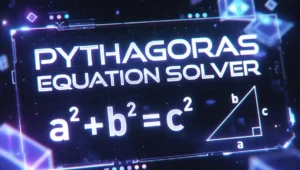
What Is a Pythagoras Equation Solver Calculator?
A Pythagoras equation solver calculator is a digital tool designed to quickly solve problems related to right triangles using the Pythagorean theorem. Instead of calculating square roots and rearranging formulas manually, users simply enter known side lengths and instantly get accurate results.
Today, online math calculators have become essential for students, engineers, architects, and professionals who need fast and reliable geometry calculations. A modern Pythagoras calculator can handle decimals, fractions, large measurements, and even provide step-by-step solutions.
Definition
A Pythagoras equation solver calculator is an online or software-based tool that calculates the missing side of a right triangle using the formula:
a² + b² = c²
The calculator automatically performs squaring, addition, subtraction, and square root operations to determine the unknown side.
How It Works
The calculator works by applying the Pythagorean theorem formula to the values entered by the user. You provide two known sides of a right triangle, and the calculator computes the third side instantly.
For example:
- Side a = 3
- Side b = 4
The calculator solves:
- 3² + 4² = c²
- 9 + 16 = 25
- c = √25
- c = 5
Why It Is Useful
Manual calculations can sometimes lead to mistakes, especially when working with large numbers or decimals. A Pythagoras equation solver calculator helps reduce errors and saves valuable time.
Key advantages include:
- Fast calculations
- Better accuracy
- Easy learning for beginners
- Helpful step-by-step explanations
- Supports academic and professional work
Who Can Benefit From It
Many different users can benefit from using a Pythagorean theorem calculator in daily activities and technical work.
Students
Students use the calculator to solve geometry homework, prepare for exams, and understand right triangle formulas more clearly.
Teachers
Teachers often use online math solver tools during classroom demonstrations and lesson planning.
Engineers
Engineers rely on triangle calculations for construction design, structural analysis, and measurement accuracy.
Architects
Architects use Pythagorean calculations when creating floor plans, roof angles, and building layouts.
Surveyors
Surveyors use right triangle formulas to measure distances, elevations, and land boundaries.
DIY Enthusiasts
Home improvement projects frequently involve angle and distance measurements where a triangle solver becomes very useful.
Understanding the Pythagorean Theorem Formula
The Pythagorean theorem is one of the most famous mathematical principles in geometry. It provides a simple relationship between the sides of a right triangle.
History Behind the Theorem
The theorem is named after the Greek mathematician Pythagoras, who lived around 570–495 BCE. However, historical evidence suggests that similar mathematical concepts existed earlier in Babylonian and ancient Indian mathematics.
Over centuries, the theorem became one of the foundations of geometry, engineering, architecture, and physics.
The Famous Equation
The standard Pythagorean theorem formula is:
a² + b² = c²
This equation applies only to right triangles.
a² + b² = c² Explained
The formula states that:
The sum of the squares of the two shorter sides equals the square of the longest side.
The longest side is called the hypotenuse.
What Each Variable Represents
- a = first leg of the triangle
- b = second leg of the triangle
- c = hypotenuse (longest side)
Example:
- a = 6
- b = 8
Then:
- 6² + 8² = c²
- 36 + 64 = 100
- c = 10
Why It Only Works for Right Triangles
The theorem works only when the triangle contains a 90-degree angle. Without a right angle, the side relationships are different and require other formulas such as the Law of Cosines.
How a Pythagoras Equation Solver Calculator Works
Modern online calculators use automated mathematical logic to produce instant results.
Input Values
Users enter two known sides of the triangle. These values can include:
- Whole numbers
- Decimals
- Fractions
- Large measurements
Automatic Formula Application
The calculator automatically determines which formula variation to use based on the missing side selected.
Examples:
- Finding hypotenuse:
c = √(a² + b²) - Finding a missing leg:
a = √(c² − b²)
Square Root Calculation
Square root calculations are often the most difficult part when solving manually. The calculator performs this instantly with high precision.
Instant Results
Most online triangle calculators provide results immediately after clicking the calculate button.
Step-by-Step Explanation
Advanced calculators also show:
- Squaring process
- Addition or subtraction
- Square root simplification
- Final answer
This helps users understand the solving method instead of simply getting the result.
How to Use a Pythagoras Equation Solver Calculator
Using a calculator is very simple, even for beginners.
Enter Two Known Sides
Input the values you already know from the right triangle.
Example:
- Side a = 5
- Side b = 12
Select the Missing Side
Choose whether you want to calculate:
- Side a
- Side b
- Hypotenuse c
Click Calculate
The system automatically applies the correct Pythagorean theorem equation.
Review the Solution
The calculator displays the complete result, including calculation steps if available.
Verify Your Answer
It is always good practice to verify the output manually for learning purposes.
For example:
- 5² + 12²
- 25 + 144
- 169
- √169 = 13
Solving Different Types of Pythagorean Problems
A good online Pythagoras calculator can solve various triangle problems.
Finding the Hypotenuse
This is the most common use case.
Formula:
c = √(a² + b²)
Example:
- a = 9
- b = 12
- c = 15
Finding Side A
Formula:
a = √(c² − b²)
Example:
- c = 13
- b = 12
- a = 5
Finding Side B
Formula:
b = √(c² − a²)
Solving Decimal Values
Example:
- a = 4.5
- b = 7.2
The calculator handles decimal precision automatically.
Solving Fraction Values
Example:
- a = 1/2
- b = 3/4
Modern calculators simplify fraction operations accurately.
Mixed Unit Calculations
Some advanced calculators can convert units automatically, although using consistent units is always recommended.
Pythagorean Formula Explained Step by Step
Understanding the process helps users build stronger math skills.
Solving for c
Formula:
c = √(a² + b²)
Steps:
- Square both sides
- Add the results
- Take the square root
Solving for a
Formula:
a = √(c² − b²)
Steps:
- Square c
- Square b
- Subtract
- Take square root
Solving for b
Formula:
b = √(c² − a²)
The process is similar to solving for side a.
Rearranging the Formula
The original formula can be rearranged depending on the missing variable.
Original:
- a² + b² = c²
Rearranged:
- a² = c² − b²
- b² = c² − a²
Worked Examples Using a Pythagoras Equation Solver Calculator
Examples make the theorem easier to understand in practical situations.
Example 1 Basic Triangle
Given:
- a = 3
- b = 4
Solution:
- c = 5
Example 2 Finding the Hypotenuse
Given:
- a = 8
- b = 15
Calculation:
- 8² + 15²
- 64 + 225
- 289
- c = 17
Example 3 Missing Leg
Given:
- c = 25
- b = 24
Calculation:
- 25² − 24²
- 625 − 576
- 49
- a = 7
Example 4 Decimal Numbers
Given:
- a = 2.5
- b = 6.1
The calculator provides a precise decimal answer quickly.
Example 5 Large Measurements
Given:
- a = 300
- b = 400
Result:
- c = 500
This is commonly used in construction measurements.
Example 6 Real Engineering Problem
An engineer needs to calculate the diagonal support beam of a rectangular frame:
- Height = 9 meters
- Width = 12 meters
Using the calculator:
- c = 15 meters
This ensures proper structural support design.
Right Triangle Calculator vs Pythagoras Equation Solver Calculator
These tools are similar but not always identical.
Similarities
Both tools:
- Solve right triangle problems
- Use the Pythagorean theorem
- Provide instant results
- Improve calculation accuracy
Differences
A right triangle calculator may include:
- Angle calculations
- Trigonometric functions
- Area and perimeter calculations
A Pythagoras equation solver calculator focuses mainly on side-length calculations.
Which One Should You Choose?
Choose based on your needs:
- Simple side calculations → Pythagoras calculator
- Advanced geometry problems → Right triangle calculator
Common Applications of the Pythagorean Theorem
The theorem is widely used across many industries and technologies.
Construction
Builders use it to verify square corners and accurate measurements.
Architecture
Architects apply triangle calculations in structural design and floor planning.
Surveying
Surveyors calculate distances and elevations across land areas.
Navigation
Ships and navigation systems use geometric calculations to estimate routes.
Aviation
Pilots and aviation software use triangle math for flight paths and altitude calculations.
Computer Graphics
Game engines and animation software use geometry calculations to render 3D environments.
Robotics
Robotic systems calculate movement distances and positioning using triangle mathematics.
Video Game Development
Game developers use Pythagorean calculations for character movement and collision detection.
GPS Mapping
GPS systems calculate shortest paths and positional coordinates using geometric principles.
Physics
Physics formulas involving force vectors and motion often rely on right triangle calculations.
Benefits of Using an Online Pythagoras Equation Solver Calculator
Online tools offer major advantages for both education and professional work.
Saves Time
Calculations that normally take several minutes can be completed instantly.
Improves Accuracy
Automated systems reduce human calculation errors.
Great for Homework
Students can quickly verify answers and learn solving methods.
Ideal for Exams
Practicing with calculators helps students understand formulas more efficiently.
Easy for Beginners
User-friendly interfaces make geometry easier for first-time learners.
Available Anytime
Most online calculators are accessible 24/7 from computers, tablets, and smartphones.
As online learning and digital engineering tools continue growing in 2026, Pythagoras equation solver calculators remain one of the most practical and widely used geometry resources available today.
Common Mistakes When Using a Pythagoras Equation Solver Calculator
A Pythagoras equation solver calculator can save time and make math problems easier. However, many users still make simple mistakes that lead to incorrect answers. Understanding these common errors helps students, teachers, and professionals use the calculator more effectively.
Using Non-Right Triangles
The Pythagorean theorem only works for right triangles. This means one angle must be exactly 90 degrees. Many users accidentally apply the formula to triangles that are not right-angled.
The correct formula is:a2+b2=c2
Where:
- a and b are the two shorter sides
- c is the hypotenuse
If the triangle does not contain a right angle, the calculator result will not represent the actual side lengths.
Quick Tip
Always check for the square corner symbol or verify the triangle type before entering values into the calculator.
Incorrect Units
Another common issue is mixing units during calculation. For example:
- One side entered in meters
- Another side entered in centimeters
This creates inaccurate results because the formula requires consistent units.
Example
Wrong:
- Side A = 3 meters
- Side B = 40 centimeters
Correct:
- Side A = 3 meters
- Side B = 0.4 meters
Modern online calculators sometimes include automatic unit conversion, but it is still important to verify the units manually.
Entering Wrong Values
Typing mistakes happen more often than people realize. A small error like entering 15 instead of 1.5 completely changes the answer.
Common input mistakes include:
- Missing decimal points
- Swapping side lengths
- Entering negative numbers
- Using commas incorrectly
Helpful Advice
Double-check every number before pressing calculate.
Confusing Legs and Hypotenuse
The hypotenuse is always the longest side in a right triangle. Some users mistakenly place it as one of the shorter sides.
Remember:
- The hypotenuse is opposite the right angle
- It must always be longer than the other two sides
If your calculator shows an impossible result, this may be the reason.
Forgetting Square Roots
When solving manually, many people forget the final square root step.
Example:32+42=9+16=25
The final answer is not 25. You must calculate:25=5
Most online Pythagoras calculators handle this automatically, reducing calculation errors.
Manual Calculation vs Online Calculator
Both manual calculations and online calculators have advantages. Choosing the right method depends on your goals, time, and learning level.
Speed
An online Pythagoras equation solver calculator is much faster than manual work. Results appear instantly after entering values.
This is especially useful for:
- Homework checking
- Engineering tasks
- Construction measurements
- Quick classroom exercises
Manual calculations take more time, especially with decimals or large numbers.
Accuracy
Online calculators reduce human error. They automatically process squares, square roots, and decimal calculations with high precision.
Manual solving can lead to mistakes such as:
- Arithmetic errors
- Wrong formula application
- Incorrect square roots
Still, understanding manual methods remains important for exams and conceptual learning.
Learning Value
Manual calculations improve problem-solving skills and mathematical understanding. Students learn how formulas work rather than depending completely on technology.
Online calculators are excellent for:
- Verification
- Practice support
- Faster learning feedback
The best learning approach combines both methods.
Best Situations for Each
Use Manual Calculation When:
- Taking exams without devices
- Learning the theorem for the first time
- Practicing algebra skills
Use Online Calculators When:
- Checking answers quickly
- Solving complex decimal problems
- Working in professional fields
- Saving time on repetitive tasks
Pythagoras Equation Solver Calculator for Students
Students at every educational level can benefit from using a Pythagoras calculator. The tool adapts well to different learning stages.
Elementary School
Young learners use the calculator to understand basic triangle relationships.
At this level, students focus on:
- Recognizing right triangles
- Learning squares and square roots
- Understanding geometric shapes
Interactive calculators with visual diagrams help children stay engaged.
Middle School
Middle school students begin solving practical geometry problems.
Typical exercises include:
- Finding missing sides
- Solving word problems
- Comparing triangle dimensions
A calculator helps students build confidence while learning mathematical logic.
High School
High school geometry becomes more advanced. Students often work with:
- Coordinate geometry
- Trigonometry basics
- Real-world applications
Many students use online calculators to verify homework and prepare for standardized tests.
College
College students in technical majors frequently apply the theorem in:
- Physics
- Architecture
- Computer graphics
- Engineering
- Data science
Professional-grade calculators with scientific precision become especially useful.
Competitive Exams
Exams like SAT, ACT, GRE, and engineering entrance tests often include right triangle questions.
A Pythagoras solver calculator helps students practice quickly and improve speed during preparation.
Key benefits include:
- Faster revision
- Immediate feedback
- Better accuracy tracking
Pythagoras Equation Solver Calculator in Real Life
The Pythagorean theorem is not limited to classrooms. It appears in many industries and daily situations.
Measuring Building Heights
Construction workers and surveyors use right triangle calculations to estimate building heights safely.
By measuring:
- Horizontal distance
- Diagonal length
They can calculate vertical height accurately.
Roof Construction
Roof design relies heavily on triangle calculations.
Builders use the theorem to determine:
- Roof slope
- Rafter length
- Structural alignment
Accurate measurements improve safety and material efficiency.
Ladder Safety
A ladder leaning against a wall forms a right triangle.
Using a Pythagoras calculator helps determine:
- Safe ladder angle
- Proper base distance
- Maximum reach height
This reduces workplace accidents.
TV Screen Size
Television dimensions are measured diagonally. The theorem helps calculate screen width and height based on aspect ratio.
Example uses include:
- Home theater setup
- Gaming monitor comparisons
- Office display planning
Drone Navigation
Modern drones use geometric calculations for movement and positioning.
Pythagorean calculations assist with:
- Flight distance estimation
- Obstacle mapping
- Navigation systems
This is common in robotics and GPS technology.
Land Measurement
Surveyors apply the theorem during land mapping and boundary calculations.
The calculator simplifies tasks such as:
- Plot measurements
- Diagonal distance calculations
- Area estimation support
Interior Design
Interior designers use triangle calculations for room planning.
Applications include:
- Furniture placement
- Wall spacing
- Tile alignment
- Lighting angles
Even simple room layouts often involve geometric measurements.
Tips for Solving Right Triangle Problems Faster
Speed and accuracy improve with consistent strategy and practice.
Memorize the Formula
The core formula should become automatic:a2+b2=c2
Memorization saves time during exams and practical calculations.
Identify the Hypotenuse
Always locate the longest side first.
The hypotenuse:
- Opposes the right angle
- Is never shorter than the legs
Correct identification prevents setup mistakes.
Double-Check Units
Use the same measurement units before calculating.
Convert values when necessary:
- cm to m
- inches to feet
- meters to kilometers
Consistent units ensure accurate results.
Estimate Before Calculating
Rough estimation helps detect impossible answers.
Example:
If sides are 6 and 8, the hypotenuse should be slightly above 10, not 50.
Estimation builds stronger mathematical intuition.
Practice Frequently
Frequent repetition improves:
- Speed
- Accuracy
- Confidence
Many online Pythagoras calculators now include quizzes and practice modes for students.
Advanced Concepts Related to the Pythagorean Theorem
The theorem also supports many advanced mathematical topics.
Distance Formula
The distance formula in coordinate geometry comes directly from the Pythagorean theorem.
Formula:d=(x2−x1)2+(y2−y1)2
This is widely used in:
- Mapping software
- Computer graphics
- GPS systems
Coordinate Geometry
Right triangles often appear on coordinate planes.
Students and professionals use the theorem to:
- Measure line segments
- Analyze shapes
- Solve geometric proofs
Coordinate geometry is essential in modern mathematics and engineering.
Three-Dimensional Pythagorean Theorem
The theorem extends into 3D space as well.
Formula:d=x2+y2+z2
Applications include:
- 3D modeling
- Architecture
- Physics simulations
- Virtual reality systems
Vector Magnitude
In physics and computer science, vectors represent direction and magnitude.
The magnitude formula is based on the Pythagorean theorem:∣v∣=x2+y2
This concept supports:
- Motion analysis
- Game development
- Machine learning algorithms
Euclidean Geometry
The Pythagorean theorem is one of the foundations of Euclidean geometry.
It helps define:
- Spatial relationships
- Geometric proofs
- Mathematical structures
Even advanced fields like topology and computational geometry build upon these principles.
Best Features to Look for in a Pythagoras Equation Solver Calculator
Not all calculators provide the same experience. Choosing the right tool can improve learning and efficiency.
Step-by-Step Solutions
Step-by-step explanations help users understand how answers are produced.
This feature is ideal for:
- Students
- Teachers
- Self-learners
It turns the calculator into an educational tool rather than just an answer generator.
Mobile Compatibility
Many users solve math problems directly from smartphones or tablets.
A responsive calculator should work smoothly on:
- Android devices
- iPhones
- Tablets
- Desktop browsers
Mobile optimization improves accessibility anywhere.
Scientific Precision
High-quality calculators support accurate decimal calculations.
This matters in fields like:
- Engineering
- Physics
- Construction
- Data analysis
Precision reduces costly measurement errors.
Fraction Support
Some geometry problems involve fractions instead of decimals.
A good calculator should simplify:
- Fraction input
- Fraction output
- Mixed-number conversion
This is especially useful for academic work.
Decimal Support
Decimal support is essential for modern measurements and scientific applications.
Look for calculators that allow:
- Multiple decimal places
- Rounding options
- Precision settings
Unit Conversion
Built-in conversion tools save time and prevent mistakes.
Useful conversions include:
- Inches to centimeters
- Feet to meters
- Miles to kilometers
This feature is valuable for international projects and technical work.
Printable Results
Printable reports help students and professionals keep records of calculations.
This feature is useful for:
- Homework submission
- Engineering documentation
- Construction planning
- Classroom worksheets
Some advanced calculators even generate downloadable PDF summaries for easy sharing and storage.
Frequently Asked Questions About Pythagoras Equation Solver Calculator
What is a Pythagoras equation solver calculator?
A Pythagoras equation solver calculator is an online math tool designed to solve problems based on the Pythagorean theorem. The theorem states that in a right triangle:a2+b2=c2
In this formula:
- a and b are the two shorter sides
- c is the hypotenuse, which is the longest side
The calculator automatically finds the missing side when you enter the other two values. Instead of calculating square roots and squares manually, users receive instant results with high accuracy.
Modern calculators often include:
- Step-by-step solutions
- Decimal support
- Unit conversion
- Triangle diagrams
- Formula explanations
- Mobile-friendly interfaces
These tools are popular among students, teachers, engineers, architects, and anyone working with geometry calculations.
Why It Matters in Real Life
The Pythagorean theorem is used far beyond classrooms. It appears in:
- Construction measurements
- Interior design layouts
- Computer graphics
- Navigation systems
- Surveying
- Physics equations
- Engineering projects
Because of its wide practical use, a reliable triangle solver calculator saves both time and effort.
Can it calculate any triangle?
No. A Pythagoras equation solver calculator only works for right triangles. A right triangle contains one angle equal to 90 degrees.
If the triangle is not a right triangle, the Pythagorean theorem cannot be applied directly. In those situations, other formulas are required, such as:
- Law of Sines
- Law of Cosines
- Heron’s Formula
How to Identify a Right Triangle
You can use the theorem itself to verify whether a triangle is right-angled.
For example:
- Side A = 3
- Side B = 4
- Side C = 5
Since:32+42=52 9+16=25
The triangle is a right triangle.
Many advanced geometry calculators can also perform this validation automatically.
Is it free to use?
Most online Pythagorean theorem calculators are completely free. Users can access them directly through a browser without downloading software.
Free versions usually include:
- Instant calculations
- Basic formulas
- Simple interfaces
- Mobile compatibility
Some premium platforms may offer additional features such as:
- Interactive graphing
- Advanced geometry tools
- Homework assistance
- Educational tutorials
- Ad-free experiences
Best Free Calculator Features
When choosing a free math solver, look for:
- Fast response time
- Clean design
- Accurate formulas
- Step-by-step explanations
- No forced registration
Many educational websites now provide AI-powered calculators that improve usability and learning support.
How accurate is it?
A quality Pythagoras equation solver calculator is highly accurate because it follows a fixed mathematical formula. Errors usually happen only when users enter incorrect values.
Factors That Affect Accuracy
Decimal Rounding
Some calculators round results to:
- 2 decimal places
- 4 decimal places
- Scientific notation
This may slightly change the displayed value but not the actual mathematical accuracy.
Unit Confusion
Entering mixed units can create incorrect results. For example:
- One side in meters
- Another side in centimeters
Always convert units before calculating.
Human Input Errors
Incorrect typing remains the most common issue. Double-check values before solving.
Accuracy in Educational and Professional Use
Modern online calculators are accurate enough for:
- School assignments
- Engineering estimates
- Architectural planning
- DIY measurements
- Technical calculations
However, professional engineering projects may still require manual verification and specialized software.
Can students rely on it for homework?
Yes, students can use a Pythagoras solver calculator as a learning aid. It helps verify answers, understand formulas, and improve problem-solving speed.
However, students should avoid depending on calculators without understanding the underlying concept.
Benefits for Students
Faster Learning
Interactive calculators reduce repetitive manual calculations and allow students to focus on understanding geometry concepts.
Step-by-Step Guidance
Some educational tools explain:
- Which formula is used
- How values are squared
- How numbers are added
- How square roots are calculated
This improves comprehension instead of simple memorization.
Homework Verification
Students can compare manual solutions with calculator results to detect mistakes.
Important Study Tip
Teachers often expect students to show complete working steps. Using a calculator should support learning, not replace mathematical reasoning.
Does it show calculation steps?
Many advanced calculators now provide detailed step-by-step solutions.
This feature is especially useful for:
- Middle school students
- High school geometry learners
- Online tutoring
- Exam preparation
Typical Calculation Breakdown
Suppose:
- Side A = 6
- Side B = 8
The calculator may display:
Step 1: Apply the Formula
a2+b2=c2
Step 2: Square the Numbers
62+82 36+64
Step 3: Add the Results
100
Step 4: Find the Square Root
c=100 c=10
This educational approach makes learning easier and more interactive.
What units does it support?
Most calculators support a wide variety of measurement units.
Common supported units include:
- Millimeters (mm)
- Centimeters (cm)
- Meters (m)
- Kilometers (km)
- Inches (in)
- Feet (ft)
- Yards (yd)
Why Unit Consistency Is Important
The theorem works correctly only when all sides use the same measurement unit.
For example:
Incorrect input:
- Side A = 5 meters
- Side B = 40 centimeters
Correct approach:
- Convert 40 centimeters into 0.4 meters first
Then calculate normally.
Automatic Unit Conversion
Some modern geometry calculators automatically convert units, reducing calculation mistakes and improving convenience.
Can it solve decimal values?
Yes. A Pythagoras equation solver calculator can easily solve decimal numbers.
Example:
- Side A = 5.5
- Side B = 7.2
Formula:5.52+7.22
The calculator processes decimal squares instantly and provides accurate results.
Why Decimal Support Matters
Decimal calculations are common in:
- Engineering
- Construction
- Physics
- Manufacturing
- Real estate measurements
Without calculator assistance, solving large decimal equations manually can become time-consuming.
Scientific and Precision Calculations
Advanced calculators may also support:
- Fractions
- Scientific notation
- High-precision decimal outputs
- Trigonometric integrations
These features are useful for technical and academic applications.
Can it calculate the hypotenuse?
Yes. Calculating the hypotenuse is the most common use of the Pythagorean theorem calculator.
The hypotenuse is the side opposite the right angle and always the longest side of the triangle.
Hypotenuse Formula
c=a2+b2
Example Calculation
If:
- Side A = 9
- Side B = 12
Then:c=92+122 c=81+144 c=225 c=15
Real-World Uses of Hypotenuse Calculations
Hypotenuse calculations appear in:
- Ladder positioning
- Roof design
- GPS navigation
- Diagonal distance measurements
- Screen size calculations
- Construction planning
This makes the calculator extremely practical for both education and industry.
Can professionals use it?
Absolutely. Professionals in technical fields often use Pythagorean theorem calculators for quick calculations and project estimations.
Industries That Use the Pythagorean Theorem
Construction
Builders use right triangle calculations to determine:
- Roof slopes
- Wall alignment
- Stair dimensions
- Structural diagonals
Engineering
Engineers apply the theorem in:
- Mechanical systems
- Electrical layouts
- Civil engineering
- Vector calculations
Architecture
Architects rely on geometric precision for:
- Floor plans
- Space optimization
- Structural balance
Computer Graphics and Gaming
The theorem also powers:
- 2D rendering
- Distance calculations
- Collision detection
- Animation systems
Why Professionals Still Use Simple Calculators
Even with advanced software available, quick-access online calculators remain useful for fast checks and rough estimates during planning stages.
Final Thoughts
Why Every Student Should Learn the Pythagorean Theorem
The Pythagorean theorem is one of the most important foundations in mathematics. It teaches logical thinking, geometry basics, and spatial understanding.
Students who master this concept often find it easier to understand:
- Algebra
- Trigonometry
- Physics
- Engineering mathematics
Beyond academics, the theorem builds practical problem-solving skills that apply to real-world situations.
Building Mathematical Confidence
Learning how triangles work helps students become more confident with measurements, formulas, and critical thinking.
Using a Pythagoras equation solver calculator can support this learning process by making practice faster and more interactive.
Choosing the Best Pythagoras Equation Solver Calculator
Not all calculators provide the same experience. A high-quality calculator should combine accuracy, simplicity, and educational value.
Features to Look For
User-Friendly Interface
A clean design improves usability and reduces confusion.
Step-by-Step Explanations
Detailed solutions help users understand the process instead of simply viewing the answer.
Mobile Compatibility
Responsive calculators work smoothly on smartphones, tablets, and desktops.
Fast Performance
Quick calculations improve productivity and learning efficiency.
Advanced Math Features
Some tools also include:
- Triangle area calculation
- Angle solving
- Coordinate geometry
- Trigonometry support
Choosing a reliable tool improves both speed and learning quality.
Combining Manual Skills with Digital Tools
Technology makes math easier, but manual calculation skills still matter.
Students and professionals benefit most when they combine:
- Concept understanding
- Formula memorization
- Logical reasoning
- Digital calculator efficiency
Why Balance Is Important
If users rely only on calculators, they may struggle during:
- Exams without devices
- Technical interviews
- Advanced math courses
Understanding the theory behind the formula remains essential.
Smart Learning Strategy
A good approach is:
- Solve manually first
- Use the calculator to verify results
- Review calculation steps
- Practice consistently
This method improves long-term mathematical ability.
Key Takeaways
A Pythagoras equation solver calculator is a powerful and practical tool for solving right triangle problems quickly and accurately.
Key points to remember:
- It works only for right triangles
- Most calculators are free online
- They support decimal values and multiple units
- Many provide step-by-step explanations
- Students and professionals both benefit from using them
- Understanding the theorem is still important even when using digital tools
As technology continues to improve educational tools, online geometry calculators are becoming smarter, faster, and more interactive than ever before.
Whether you are solving homework problems, designing structures, or checking measurements, a reliable Pythagorean theorem calculator can save time while improving accuracy and understanding.