30-60-90 Triangle Calculator
Compute all sides and view step-by-step formulas. Accessible, internationalized, and professional.
Inputs & Options
⚡ Quick Presets (Most Popular)
Results
📐 Area & Perimeter
🎨 Triangle Visualization
📊 Trigonometric Values
📝 Breakdown & Notes
- 30-60-90 triangle side ratios: short : long : hypotenuse = 1 : √3 : 2
🧮 Step-by-step Calculations
Provide one known side to compute the others. Formulas shown with substitutions.
📚 Understanding 30-60-90 Triangles
🎯 What is a 30-60-90 Triangle?
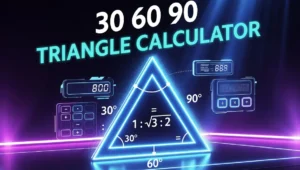
A 30-60-90 triangle is a special right triangle with angles of 30°, 60°, and 90°. It's derived from cutting an equilateral triangle in half. The sides always follow the ratio 1 : √3 : 2 (short : long : hypotenuse).
📐 Key Properties
- Ratio: If the short side = x, then long side = x√3, and hypotenuse = 2x
- Area: A = (1/2) × short × long = (x²√3)/2
- Special angles: Half of an equilateral triangle
- Pythagorean theorem verified: a² + b² = c² → x² + (x√3)² = (2x)²
🏗️ Real-World Applications
- Architecture & Construction: Roof truss design, stair construction
- Carpentry: Cutting wood at specific angles, miter joints
- Engineering: Structural support beams, bridge design
- Navigation: Trigonometric calculations for direction finding
- Computer Graphics: Isometric projection, 3D modeling
- Physics: Inclined plane problems, force vector decomposition
💡 Tips & Tricks
- Quick check: Hypotenuse should always be exactly 2× the short side
- Memory trick: Think "1-2-3": 1, √3, 2
- Drawing tip: Start with the short side, multiply by √3 for long side
- Common mistake: Don't confuse with 45-45-90 triangle (ratio 1:1:√2)
- Calculator shortcut: √3 ≈ 1.732 (memorize for quick estimates)
🔄 Comparison: Special Right Triangles
| Triangle Type | Angles | Side Ratio | Common Use |
|---|---|---|---|
| 30-60-90 | 30°-60°-90° | 1 : √3 : 2 | Architecture, equilateral triangles |
| 45-45-90 | 45°-45°-90° | 1 : 1 : √2 | Squares, isometric projection |
| 3-4-5 | ≈37°-53°-90° | 3 : 4 : 5 | Construction layout, squaring |
📖 Essential Formulas
📝 Example Problem
Problem: A roof truss needs to support a 60° angle at the peak. If the horizontal span is 10 meters, what should the rafter length be?
Solution:
- Recognize this forms a 30-60-90 triangle (half span creates 30° angle)
- Half span = 5m (this is the short side)
- Rafter (hypotenuse) = 2 × 5m = 10 meters
- Vertical rise = 5 × √3 ≈ 8.66 meters
The 30 60 90 triangle calculator is one of the most useful online tools for solving a special type of right triangle in just seconds. Whether you’re a student tackling geometry homework, a teacher preparing classroom examples, an engineer checking measurements, or simply someone who needs quick and accurate calculations, this calculator removes the guesswork from solving triangle problems.
Unlike ordinary right triangles, a 30-60-90 triangle follows a fixed relationship between its three sides. The shortest side, the longer side, and the hypotenuse always maintain the ratio of 1 : √3 : 2. Because this ratio never changes, finding a missing side becomes much easier once you know the length of just one side. Instead of performing multiple calculations by hand, an online calculator instantly provides accurate results while reducing the chance of mathematical errors.
Learning how this special triangle works is also an important step toward mastering geometry and trigonometry. Many mathematical concepts—including trigonometric identities, coordinate geometry, engineering design, architecture, and physics—rely on understanding special right triangles. For students preparing for standardized exams such as the SAT, ACT, GCSE, or other mathematics assessments, knowing how to solve a 30-60-90 triangle efficiently can save valuable time and improve problem-solving confidence.
One of the biggest advantages of using a dedicated calculator is its simplicity. Most tools require only a single known measurement, such as the short leg, the long leg, or the hypotenuse. Using established geometric formulas, the calculator immediately determines the remaining side lengths, perimeter, area, and other useful values depending on the available inputs. This makes it suitable for both beginners who are learning geometry for the first time and professionals who need reliable calculations during real-world projects.
Beyond the classroom, 30-60-90 triangles appear more often than many people realize. Architects use these geometric relationships when creating accurate structural designs. Engineers rely on them when calculating angles and distances. Surveyors apply similar principles while measuring land, and construction professionals use them to ensure precise layouts and structural alignment. Computer graphics, animation, robotics, and even navigation systems also make use of geometric relationships based on special right triangles.
Although modern calculators make solving these triangles effortless, understanding the underlying mathematics remains valuable. Knowing why the side ratio is always 1 : √3 : 2 helps build a stronger foundation in geometry and makes it easier to solve more advanced mathematical problems. Instead of memorizing formulas without context, learners can understand how these relationships are derived and when they should be applied.
This comprehensive guide explores everything you need to know about the 30 60 90 triangle calculator. You’ll learn the mathematical formulas behind the calculations, understand why this triangle is unique, discover step-by-step solving methods, compare manual calculations with online tools, and explore practical applications across education, engineering, construction, architecture, and technology. Along the way, you’ll also find worked examples, common mistakes to avoid, helpful calculation tips, and answers to frequently asked questions.
Whether your goal is to verify homework answers, solve professional geometry problems, or simply gain a deeper understanding of one of mathematics’ most important special right triangles, this guide will provide the knowledge and practical techniques needed to calculate side lengths accurately and confidently.
How a 30 60 90 Triangle Calculator Works
A 30 60 90 triangle calculator is a simple but powerful geometry tool designed to solve one of the most common special right triangle problems. Because every 30-60-90 triangle follows a fixed side ratio, the calculator can instantly determine missing sides, area, perimeter, and other values after receiving just one known measurement.
This type of calculator is widely used by students, teachers, engineers, architects, and anyone working with geometry or trigonometric ratios.
Input Options
Most modern calculators allow several input methods depending on the value you already know.
Short Leg
The short leg is the side opposite the 30-degree angle. It is considered the base value for most triangle equations because all other sides are derived from it.
If the short leg is represented as:
- x
Then:
- Long leg = x√3
- Hypotenuse = 2x
Long Leg
The long leg sits opposite the 60-degree angle. Since it equals the short leg multiplied by √3, calculators can reverse the formula to determine the other sides.
Formula:
- Short leg = long leg ÷ √3
Hypotenuse
The hypotenuse is the longest side and lies opposite the 90-degree angle.
Formula:
- Short leg = hypotenuse ÷ 2
Once the short leg is found, the remaining sides are calculated automatically.
Area
Some advanced calculators also accept the triangle’s area.
Area formula:
- Area = (short leg × long leg) ÷ 2
Using the standard side ratio, the calculator can solve the entire triangle from the area alone.
Perimeter
Perimeter represents the total length of all three sides.
Formula:
- Perimeter = short leg + long leg + hypotenuse
Since the side ratio is fixed, the calculator can work backward from the perimeter to determine each side length.
Mathematical Relationships Used
A 30-60-90 triangle is a special right triangle with predictable proportions:
- Short leg : Long leg : Hypotenuse
- 1 : √3 : 2
This constant relationship makes calculations extremely fast and accurate.
Automatic Formula Application
Once a known value is entered, the calculator automatically applies the correct 30-60-90 triangle formula without requiring manual work.
For example:
- Enter hypotenuse = 20
- Calculator instantly finds:
- Short leg = 10
- Long leg = 10√3
Instant Result Generation
Most calculators provide results instantly, including:
- Exact radical form
- Decimal approximations
- Area
- Perimeter
- Angle verification
This saves time and reduces calculation mistakes.
30 60 90 Triangle Formula Explained
The formulas behind this special right triangle come directly from its fixed geometric structure.
Side Ratio Formula
The most important formula is:
- x : x√3 : 2x
Where:
- x = short leg
- x√3 = longer leg
- 2x = hypotenuse
This ratio never changes regardless of triangle size.
Finding the Hypotenuse
If the short leg is known:
- Hypotenuse = 2 × short leg
Example:
- Short leg = 7
- Hypotenuse = 14
This is one of the easiest hypotenuse formula calculations in geometry.
Finding the Longer Leg
Formula:
- Longer leg = short leg × √3
Example:
- Short leg = 5
- Longer leg = 5√3 ≈ 8.66
Finding the Shorter Leg
If the longer leg is known:
- Short leg = longer leg ÷ √3
If the hypotenuse is known:
- Short leg = hypotenuse ÷ 2
Area Formula
The area of a 30-60-90 triangle is:
- Area = (1/2)(short leg)(long leg)
Substitute the ratio:
- Area = (1/2)(x)(x√3)
- Area = (x²√3)/2
Perimeter Formula
Using the standard ratio:
- Perimeter = x + x√3 + 2x
- Perimeter = 3x + x√3
This simplifies many geometry homework problems.
Understanding the 1 : √3 : 2 Ratio
The famous 1 : √3 : 2 side ratio is the foundation of every 30-60-90 triangle formula.
Why the Ratio Never Changes
All similar triangles maintain proportional side lengths. Since every 30-60-90 triangle contains the same angle measurements, their side relationships remain identical.
This property is what makes it a special right triangle.
Visual Interpretation
Imagine cutting an equilateral triangle in half.
You create:
- Two right triangles
- One 30-degree angle
- One 60-degree angle
- One 90-degree angle
The resulting sides naturally form the ratio:
- 1 : √3 : 2
Common Examples
Examples include:
| Short Leg | Long Leg | Hypotenuse |
|---|---|---|
| 1 | √3 | 2 |
| 2 | 2√3 | 4 |
| 5 | 5√3 | 10 |
| 10 | 10√3 | 20 |
Quick Memory Tricks
A simple memory trick:
- Short side = smallest number
- Hypotenuse = double the short side
- Long side = short side times √3
Many students remember it as:
“1, root 3, 2.”
Step-by-Step Guide to Using a 30 60 90 Triangle Calculator
Using the calculator is straightforward.
Example 1 – Given the Short Side
Known value:
- Short leg = 6
Results:
- Long leg = 6√3 ≈ 10.39
- Hypotenuse = 12
- Area ≈ 31.18
Example 2 – Given the Long Side
Known value:
- Long leg = 9√3
Calculation:
- Short leg = 9
- Hypotenuse = 18
Example 3 – Given the Hypotenuse
Known value:
- Hypotenuse = 24
Results:
- Short leg = 12
- Long leg = 12√3
Example 4 – Checking Homework Answers
Students often use calculators to verify:
- Geometry assignments
- SAT practice
- ACT math drills
- GCSE geometry exercises
This helps identify errors quickly.
Manual Calculation Without a Calculator
Although calculators are convenient, understanding manual methods is important for exams and foundational learning.
Finding Missing Side Lengths
Start with the side ratio:
- x : x√3 : 2x
Then identify which side is known.
Example:
If hypotenuse = 16:
- Short leg = 8
- Long leg = 8√3
Simplifying Square Roots
Radicals appear frequently in triangle equations.
Example:
- √12 = √(4 × 3)
- √12 = 2√3
Simplifying radicals keeps answers cleaner and more accurate.
Decimal Approximations
Sometimes decimal answers are required.
Useful approximation:
- √3 ≈ 1.732
Example:
- 5√3 ≈ 8.66
Verification Techniques
Quick ways to verify answers:
- Hypotenuse should always be largest
- Long leg should always exceed short leg
- Side ratio must match 1 : √3 : 2
Solving Common 30 60 90 Triangle Problems
These triangles appear constantly in academic testing and professional calculations.
Geometry Homework
Teachers frequently assign:
- Missing side problems
- Area calculations
- Perimeter exercises
- Proof-based questions
SAT Questions
The SAT commonly tests:
- Special right triangle recognition
- Fast side ratio calculations
- Exact trigonometric ratios
Knowing the formulas saves valuable exam time.
ACT Math Problems
ACT geometry questions often combine:
- Right triangle properties
- Algebraic equations
- Square root simplification
GCSE Geometry
In GCSE mathematics, students solve:
- Angle-based triangle problems
- Coordinate geometry
- Measurement applications
Engineering Applications
Engineers use these triangles for:
- Structural analysis
- Mechanical layouts
- Load calculations
- Design measurements
Comparing 30 60 90 Triangle Calculator vs 45 45 90 Triangle Calculator
Both calculators solve special right triangles, but their formulas differ significantly.
Side Ratios
30-60-90 triangle:
- 1 : √3 : 2
45-45-90 triangle:
- 1 : 1 : √2
Formula Differences
30-60-90 formulas involve:
- √3 relationships
- Unequal legs
45-45-90 formulas involve:
- Equal legs
- √2 hypotenuse
Typical Applications
30-60-90 triangles are common in:
- Trigonometry
- Engineering
- Architecture
45-45-90 triangles are common in:
- Squares
- Diagonal measurements
- Symmetrical design
Which One Should You Use?
Use:
- 30-60-90 calculator for unequal-leg special right triangles
- 45-45-90 calculator for equal-leg right triangles
Choosing the correct tool improves accuracy.
Relationship Between 30 60 90 Triangles and Trigonometry
These triangles are deeply connected to trigonometric ratios.
Sine Values
For a 30-degree angle:
- sin(30°) = 1/2
For a 60-degree angle:
- sin(60°) = √3/2
Cosine Values
Important values include:
- cosine 60 degrees = 1/2
- cosine 30 degrees = √3/2
Tangent Values
Common tangent relationships:
- tangent 30 degrees = 1/√3
- tangent 60 degrees = √3
Exact Trigonometric Ratios
These exact values are essential in:
- Algebra
- Calculus
- Physics
- Engineering
Memorizing them improves problem-solving speed.
Common Mistakes When Solving 30 60 90 Triangles
Even simple formulas can lead to errors if applied incorrectly.
Mixing Up the Side Ratio
A frequent mistake is reversing:
- √3
- 2
Always remember:
- Hypotenuse is largest
- Long leg contains √3
Incorrect Square Root Calculations
Students often miscalculate radicals.
Incorrect:
- √12 = √6
Correct:
- √12 = 2√3
Choosing the Wrong Known Side
Before calculating:
- Identify whether the known side is short, long, or hypotenuse
Using the wrong starting value produces incorrect results.
Rounding Too Early
Avoid rounding during intermediate steps.
Keep exact radical values until the final answer for better accuracy.
Real-Life Applications of 30 60 90 Triangles
These triangles are not just classroom concepts. They appear in many industries and technical fields.
Construction Projects
Builders use triangle ratios to:
- Measure roof angles
- Create support frames
- Ensure structural precision
Architecture
Architects apply special right triangle geometry when designing:
- Sloped roofs
- Staircases
- Symmetrical layouts
Roof Design
Roof pitch calculations frequently involve:
- 30-degree angles
- Load balancing
- Height measurements
Engineering Calculations
Engineers rely on triangle equations for:
- Force analysis
- Mechanical design
- Structural stability
Surveying
Surveyors use trigonometric ratios to calculate:
- Elevation
- Distance
- Land boundaries
Woodworking
Woodworkers use precise angle measurements for:
- Furniture construction
- Cabinet design
- Frame cutting
Computer Graphics
3D graphics engines use trigonometric ratios for:
- Object rendering
- Camera angles
- Animation systems
Robotics
Robotic movement systems use geometry to calculate:
- Motion paths
- Joint angles
- Sensor positioning
Navigation
Navigation systems rely on triangle mathematics for:
- Direction tracking
- Position calculations
- Mapping software
Using the Calculator for Education
A 30 60 90 triangle calculator is an effective educational tool for all learning levels.
Middle School Geometry
Students learn:
- Basic triangle properties
- Right triangle relationships
- Introductory radicals
High School Mathematics
High school courses introduce:
- Special right triangles
- Trigonometric ratios
- Exact values
Calculators help reinforce understanding through practice.
College Engineering Courses
Engineering students use these concepts in:
- Statics
- Physics
- Design analysis
- Calculus-based geometry
Online Learning Platforms
Digital education platforms increasingly include:
- Interactive triangle solvers
- Step-by-step explanations
- Real-time graphing
- Practice exercises
These tools make learning geometry more accessible and engaging for modern students.
Decimal vs Radical Form Results
A 30 60 90 triangle calculator usually provides answers in two formats: radical form and decimal form. Both are useful, but each serves a different purpose depending on the situation.
A 30 60 90 triangle is a special right triangle where the side ratio is always:
- Short side = x
- Long side = x3
- Hypotenuse = 2x
Because of this fixed relationship, calculators often return values involving square roots.
Exact Answers
Exact answers use radicals instead of rounded numbers. For example:
- 53
- 123
- 23
These forms preserve complete mathematical accuracy.
In geometry, algebra, and trigonometry, radical form is often preferred because it avoids rounding errors. Exact values are especially important in:
- Proof-based mathematics
- Symbolic calculations
- Academic testing
- Advanced engineering formulas
For example, if the short leg is 8:
- Long leg = 83
- Hypotenuse = 16
The radical form keeps the value perfectly accurate.
Decimal Approximation
Decimal approximations convert radicals into practical numerical values.
For example:
- 83≈13.856
This format is easier for:
- Measurements
- Construction projects
- Digital modeling
- Scientific calculators
- CAD software
Most online triangle calculators automatically provide decimal approximations for convenience.
Decimal answers are commonly rounded to:
- 2 decimal places
- 3 decimal places
- Engineering precision standards
When Each Format Is Preferred
Both formats are valuable, but the best choice depends on the task.
| Situation | Best Format |
|---|---|
| Geometry homework | Radical form |
| Engineering calculations | Decimal form |
| Mathematical proofs | Exact form |
| Construction measurements | Decimal approximation |
| Standardized tests | Often radical form |
| Real-world applications | Decimal form |
Using the correct format improves both accuracy and readability.
Understanding Precision and Rounding
Precision matters when solving 30 60 90 triangle problems. Even small rounding differences can affect measurements, calculations, and final results.
Significant Figures
Significant figures determine how precise a number should be.
For example:
- 7.2 has 2 significant figures
- 7.23 has 3 significant figures
- 7.230 has 4 significant figures
When using a triangle calculator, maintaining consistent significant figures helps ensure reliable answers.
Example:
If the short leg is:
- x=4.5
Then:
- Long leg = 4.53≈7.79
- Hypotenuse = 9.0
The level of precision should match the original measurement.
Engineering Precision
Engineering applications require strict accuracy standards.
In civil engineering, architecture, and manufacturing, even tiny measurement errors can create major structural problems.
Professionals often use:
- 3 to 6 decimal places
- Precision instruments
- Verification calculations
- Tolerance ranges
A 30 60 90 triangle calculator helps reduce manual calculation mistakes while maintaining consistent precision.
Classroom Requirements
In schools and universities, teachers may specify whether answers should be:
- Exact radicals
- Rounded decimals
- Simplified radicals
- Rounded to nearest tenth or hundredth
Students should always follow the required format.
For example:
If the hypotenuse is 20:
- Short side = 10
- Long side = 103
Depending on instructions, the final answer may remain in radical form or become:
- 17.32
Scientific Calculations
Scientific applications often combine geometry with trigonometry and physics.
Examples include:
- Force vectors
- Wave analysis
- Motion calculations
- Optics
- Astronomy
In these fields, precise decimal approximations are critical for accurate modeling and simulations.
Advanced Geometry Concepts Related to 30 60 90 Triangles
The 30 60 90 triangle appears throughout geometry because of its predictable proportions and symmetry.
Equilateral Triangles
A 30 60 90 triangle is created when an equilateral triangle is divided in half.
Suppose an equilateral triangle has side length 12.
Drawing an altitude creates two identical 30 60 90 triangles:
- Short leg = 6
- Long leg = 63
- Hypotenuse = 12
This relationship is one of the foundations of trigonometry.
Circle Geometry
30 60 90 triangles frequently appear inside circles.
For example:
- Central angles
- Inscribed polygons
- Hexagons
- Radius calculations
A regular hexagon can be divided into six equilateral triangles, which naturally produce multiple 30 60 90 triangles.
This concept is important in:
- Mechanical design
- Computer graphics
- Rotational symmetry
- CAD modeling
Coordinate Geometry
Coordinate geometry often uses special triangles to simplify calculations.
Example:
Points:
- A(0,0)
- B(4,0)
- C(4, 43)
form a 30 60 90 triangle.
Using coordinates allows easier calculation of:
- Slopes
- Distances
- Midpoints
- Angles
- Transformations
Coordinate methods are heavily used in engineering software and computer-aided drafting.
Similar Triangles
All 30 60 90 triangles are similar because they share identical angle measures.
This means:
- Corresponding sides maintain the same ratio
- Shapes remain proportional
- Scaling becomes predictable
Similarity helps solve unknown dimensions quickly without rebuilding calculations from scratch.
Geometric Proofs
Geometric proofs often rely on 30 60 90 triangle relationships.
Common proof topics include:
- Trigonometric identities
- Area formulas
- Polygon properties
- Symmetry relationships
- Distance theorems
Because the ratios are fixed, these triangles simplify complex geometric reasoning.
Practical Examples with Complete Solutions
Example A
Problem Statement
A 30 60 90 triangle has a short leg measuring 9 cm. Find the long leg and hypotenuse.
Solution
Use the standard ratio:
- Short leg = x
- Long leg = x3
- Hypotenuse = 2x
Substitute:
- x=9
Calculate:
- Long leg = 93
- Hypotenuse = 18
Decimal approximation:
- 93≈15.59
Final Answer
- Long leg = 93 or 15.59 cm
- Hypotenuse = 18 cm
Example B
Known Values
The hypotenuse of a 30 60 90 triangle is 24 meters.
Calculation Process
Since hypotenuse = 2x:2x=24
Solve for x:x=12
Now calculate the long leg:123
Decimal approximation:123≈20.78
Verification
Check ratio consistency:
- Short side = 12
- Long side ≈ 20.78
- Hypotenuse = 24
The proportions match the 30 60 90 triangle ratio.
Example C
Engineering Scenario
An engineer designs a support brace forming a 30-degree angle with the ground.
The shorter side measures 5 feet.
Construction Measurements
Apply the ratio:
- Long side = 53
- Hypotenuse = 10
Decimal approximation:
- Long side ≈ 8.66 feet
Accuracy Check
The engineer compares digital software measurements with manual calculations to confirm structural accuracy.
This process minimizes installation errors.
Example D
Classroom Exercise
Find the missing sides if the long leg equals 143.
Step-by-Step Solution
In a 30 60 90 triangle:x3=143
Therefore:x=14
Now calculate the hypotenuse:2x=28
Final values:
- Short leg = 14
- Long leg = 143
- Hypotenuse = 28
When Should You Use a 30 60 90 Triangle Calculator?
A 30 60 90 triangle calculator is useful in many educational and professional situations.
Academic Purposes
Students use triangle calculators for:
- Geometry homework
- Trigonometry exercises
- Exam preparation
- Online learning
- Practice problems
The calculator speeds up problem-solving while helping students understand triangle relationships.
Professional Engineering
Engineers frequently use special right triangle calculations in:
- Structural analysis
- Mechanical systems
- Road design
- Electrical engineering
- Robotics
Fast calculations improve workflow efficiency and reduce mistakes.
DIY Projects
Home improvement projects often involve angle measurements and diagonal calculations.
Examples include:
- Stair construction
- Roof framing
- Furniture building
- Shelving installation
A calculator helps homeowners achieve accurate cuts and alignments.
Architecture
Architects use geometric relationships when creating:
- Roof structures
- Floor plans
- Decorative patterns
- Spatial layouts
Precise triangle calculations improve design consistency.
Interior Design
Interior designers sometimes apply geometric principles for:
- Wall panel layouts
- Lighting angles
- Furniture spacing
- Decorative symmetry
Quick triangle calculations simplify planning and visualization.
Benefits of Using an Online 30 60 90 Triangle Calculator
Online calculators provide major advantages for students, professionals, and hobbyists alike.
Faster Calculations
Manual calculations take time and increase the chance of mistakes.
A calculator instantly computes:
- Missing sides
- Radical forms
- Decimal approximations
- Angle relationships
This improves productivity significantly.
Fewer Human Errors
Typing one known value into a calculator reduces arithmetic mistakes.
This is especially helpful for:
- Complex projects
- Repetitive calculations
- Technical work
- Engineering designs
Accurate geometry calculations are essential in professional environments.
Supports Learning
Educational calculators help users understand mathematical relationships visually and interactively.
Many students learn faster when they can:
- Compare exact and decimal answers
- Test different side lengths
- Verify homework solutions
- Practice repeatedly
Interactive learning strengthens geometry skills.
Mobile Accessibility
Most modern calculators work on:
- Smartphones
- Tablets
- Laptops
- Desktop computers
This flexibility allows users to solve geometry problems anywhere.
Time Savings
Quick calculations save valuable time in:
- Classrooms
- Construction sites
- Design studios
- Engineering offices
Instead of solving formulas manually every time, users can focus on analysis, planning, and decision-making.
A reliable 30 60 90 triangle calculator improves efficiency while maintaining mathematical accuracy.
Understanding the 30 60 90 Triangle Calculator
A 30 60 90 triangle is one of the most important special right triangles in mathematics. Because its side lengths always follow a fixed ratio, solving problems becomes much faster compared to using general trigonometry formulas.
A 30 60 90 triangle calculator helps students, teachers, engineers, architects, and DIY builders quickly find missing sides, area, perimeter, and other measurements without manually performing complicated calculations.
This triangle appears frequently in geometry, construction, physics, computer graphics, and real-world design projects. Knowing how its formulas work can save time and reduce mistakes.
What Makes a 30 60 90 Triangle Special?
A 30 60 90 triangle is a right triangle with three angles:
- 30°
- 60°
- 90°
Because the angles are fixed, the relationship between the sides never changes. This predictable relationship is what makes the triangle extremely useful in geometry and engineering calculations.
The sides always follow this ratio:
- Opposite 30° → shortest side
- Opposite 60° → longer leg
- Opposite 90° → hypotenuse
Standard Side Ratio
The ratio is:
1 : √3 : 2
This means:
- Short side = x
- Long side = x√3
- Hypotenuse = 2x
For example:
| Short Side | Long Side | Hypotenuse |
|---|---|---|
| 5 | 5√3 | 10 |
| 8 | 8√3 | 16 |
| 12 | 12√3 | 24 |
This consistent relationship allows a triangle calculator to instantly determine missing measurements.
How a 30 60 90 Triangle Calculator Works
The calculator uses predefined geometry formulas based on the special triangle ratio.
If You Know the Short Side
Formula:
- Long side = short side × √3
- Hypotenuse = short side × 2
Example:
If the short side is 7:
- Long side = 7√3 ≈ 12.12
- Hypotenuse = 14
If You Know the Long Side
Formula:
- Short side = long side ÷ √3
- Hypotenuse = 2 × short side
Example:
If the long side is 18:
- Short side ≈ 10.39
- Hypotenuse ≈ 20.78
If You Know the Hypotenuse
Formula:
- Short side = hypotenuse ÷ 2
- Long side = short side × √3
Example:
If the hypotenuse is 30:
- Short side = 15
- Long side ≈ 25.98
Real-Life Applications of 30 60 90 Triangles
These triangles are not only used in classrooms. They also appear in many practical fields.
Architecture and Construction
Builders often use triangular measurements when designing roofs, ramps, support beams, and stair structures.
Engineering
Mechanical and civil engineers use right triangle relationships to calculate force directions, distances, and structural angles.
Computer Graphics
Game developers and 3D designers use triangle geometry for rendering shapes and calculating object movement.
Navigation and Surveying
Surveyors use triangle calculations to measure land, elevation, and distances between points.
Benefits of Using a Triangle Calculator
Faster Calculations
You can instantly solve triangle dimensions without lengthy manual formulas.
Better Accuracy
A calculator reduces human error during square root and decimal calculations.
Easy for Students
Students learning geometry can verify homework answers quickly.
Useful for Professionals
Engineers and designers can speed up project calculations efficiently.
Common Formulas Used
Area Formula
Area of a 30 60 90 triangle:Area=21×base×height
If the short side is x:Area=2x(x3)
Perimeter Formula
P=x+x3+2x
Simplified:P=3x+x3
Pythagorean Theorem Verification
The triangle also satisfies:a2+b2=c2
Example:52+(53)2=102 25+75=100
Correct result.
Tips for Solving 30 60 90 Triangle Problems
Memorize the Ratio
The easiest shortcut is remembering:1:3:2
Once memorized, solving becomes much easier.
Identify the Short Side First
The shortest side always sits opposite the 30° angle.
Use Decimal Approximations Carefully
Since:3≈1.732
rounding too early may slightly affect final answers.
Double-Check with Pythagorean Theorem
This is one of the fastest ways to verify your calculations.
Common Mistakes to Avoid
Mixing Up Side Positions
Always identify which side is opposite each angle.
Incorrect Square Root Usage
Many students mistakenly use:2
instead of:3
Rounding Too Soon
Keep several decimal places during calculations for better accuracy.
Forgetting the Hypotenuse Rule
The hypotenuse is always the longest side and opposite the 90° angle.
Frequently Asked Questions
What is the ratio of a 30 60 90 triangle?
The ratio is:1:3:2
- Shortest side = 1
- Longer side = √3
- Hypotenuse = 2
This ratio always stays the same regardless of triangle size.
How do you calculate the missing side?
You use the side ratio formulas.
If the short side is known:
- Long side = short side × √3
- Hypotenuse = short side × 2
If another side is known, reverse the formulas accordingly.
Can I calculate area using only one side?
Yes. Since all sides follow a fixed ratio, one side is enough to determine the others.
For example, if the short side is x:Area=2x(x3)
This allows fast area calculation from only one measurement.
Is every right triangle a 30 60 90 triangle?
No. A 30 60 90 triangle is a special type of right triangle.
A regular right triangle may have completely different angle measurements and side ratios.
For example:
- 45 45 90 triangle
- 3 4 5 triangle
Both are right triangles but not 30 60 90 triangles.
Why is √3 used in the formula?
The value √3 comes from trigonometric relationships inside the triangle.
Using sine, cosine, and the Pythagorean theorem produces the fixed ratio:1:3:2
This is why the longer leg always contains √3.
Can the calculator solve decimals?
Yes. Modern triangle calculators handle:
- Decimals
- Irrational numbers
- Long precision values
Example:
If the short side is 4.5:
- Long side ≈ 7.79
- Hypotenuse = 9
Does it work with fractions?
Absolutely.
Fractions work the same way as whole numbers.
Example:
If the short side is:23
then:
- Long side = 233
- Hypotenuse = 3
Is it suitable for engineering calculations?
Yes, especially for:
- Structural design
- CAD software
- Mechanical calculations
- Architecture
- Surveying
However, high-precision engineering projects may require additional verification and professional-grade software.
Can students use it during exams?
That depends on the exam rules.
Many teachers allow scientific calculators but may restrict online tools or advanced geometry apps.
Students should always check exam policies before using any calculator.
What is the fastest way to verify an answer?
The fastest verification method is the Pythagorean theorem:a2+b2=c2
You can also quickly compare the sides against the standard ratio:1:3:2
If the numbers fit the ratio, the solution is usually correct.
Final Thoughts
A 30 60 90 triangle calculator is a powerful tool for solving geometry problems quickly and accurately. Because this special right triangle follows a fixed ratio, calculations become much easier than with standard trigonometry methods.
Whether you are a student learning geometry basics, an engineer handling measurements, or a designer working with angles and dimensions, understanding the 30 60 90 triangle can improve both speed and accuracy.
By mastering the formulas, ratios, and verification methods, you can confidently solve triangle problems in mathematics, construction, physics, and real-world applications.