🔵 Arc Length Calculator
Calculate arc length, sector area, chord length, and all circle sector properties
📐 What is Arc Length?
Arc length is the distance along the curved line making up the arc. It's a portion of the circumference of a circle, determined by the central angle and radius.
Formula: L = r × θ (where θ is in radians) or L = (θ/360°) × 2πr (where θ is in degrees)
📊 Circle Sector Parameters
💡 Note: Enter at least 2 values to calculate the remaining properties. The calculator will automatically compute all related measurements.
✨ Tip: Klik salah satu contoh untuk mengisi nilai sudut dan jari-jari secara otomatis, lalu tekan Calculate.
📊 Calculation Results
📝 Calculation Steps
� Visual Angle Comparison
📚 Understanding Arc Length & Circle Sectors
🎯 What is a Circle Sector?
A sector is the region bounded by two radii and the arc between them. Think of it as a "slice of pie" from a circle. The arc length is the curved distance along the edge of this slice.
📐 Key Formulas:
- Arc Length: L = r × θ (radians) or L = (θ/360°) × 2πr (degrees)
- Sector Area: A = ½ × r² × θ (radians) or A = (θ/360°) × πr² (degrees)
- Chord Length: c = 2r × sin(θ/2)
- Segment Area: A_segment = A_sector - ½r² × sin(θ)
- Segment Height: h = r × (1 - cos(θ/2))
- Sector Perimeter: P = L + 2r
🔄 Important Relationships:
- When θ = 360° (2π rad), the sector becomes a full circle
- When θ = 180° (π rad), the sector becomes a semicircle
- When θ = 90° (π/2 rad), the sector becomes a quarter circle
- Arc length is always greater than chord length (except when θ = 0)
- As angle approaches 0, arc length approaches chord length
- Sector area is proportional to the central angle
🌍 Real-World Applications:
- 🏗️ Architecture: Designing curved structures, arches, domes, and amphitheaters
- 🛣️ Road Design: Calculating curve lengths in highways, railways, and race tracks
- ⚙️ Engineering: Gear design, pulley systems, cam mechanisms, and rotating machinery
- 🎯 Sports: Track design, golf course layout, field measurements, and throwing circles
- 🌍 Navigation: Calculating distances on Earth's surface using latitude/longitude
- 🎨 Design: Creating circular patterns, decorative elements, and artistic compositions
- 🍕 Food Industry: Pizza slicing, cake portions, and pie servings
- 📊 Data Visualization: Pie charts and circular graphs
- 🎡 Amusement Parks: Ferris wheel design and carousel planning
- 🛰️ Astronomy: Calculating orbital paths and celestial measurements
💡 Practical Tips:
- Always convert angles to radians when using the formula L = r × θ
- For small angles (< 10°), arc length ≈ chord length (within 0.5% error)
- The ratio of arc length to radius gives the angle in radians
- Sector area is exactly half the product of arc length and radius: A = ½ × L × r
- Use the chord length to find the straight-line distance between arc endpoints
🧮 Formula Relationships
📏 Unit Conversions & Angle Reference
| Angle Units | Equivalent to 1 Radian |
|---|---|
| Degrees | 57.2958° |
| Gradians | 63.662 gon |
| Turns | 0.159155 tr |
| Arc Minutes | 3437.75′ |
| Arc Seconds | 206265″ |
| Common Angles | Degrees → Radians |
|---|---|
| 30° | π/6 ≈ 0.5236 rad |
| 45° | π/4 ≈ 0.7854 rad |
| 60° | π/3 ≈ 1.0472 rad |
| 90° | π/2 ≈ 1.5708 rad |
| 180° | π ≈ 3.1416 rad |
| 360° | 2π ≈ 6.2832 rad |
📐 Arc Length vs Chord Length Relationship
As the central angle increases, the difference between arc length and chord length grows
⚡ Quick Reference Guide
When to Use Arc Length
Use when measuring the actual curved distance along the circle's edge, such as in road curves or circular tracks.
When to Use Chord
Use when measuring the straight-line distance between two points on a circle, such as in construction or surveying.
Radians vs Degrees
Radians are preferred in calculus and physics. 1 radian = 57.3°. Always use radians in formulas like L = r × θ.
Sector vs Segment
Sector includes the two radii (pie slice). Segment is only the area between chord and arc (no radii).
Common Mistake
Don't forget to convert degrees to radians! Multiply degrees by π/180 or use the calculator's unit selector.
Validation Check
Arc length must always be ≥ chord length. If not, check your angle units and calculations.
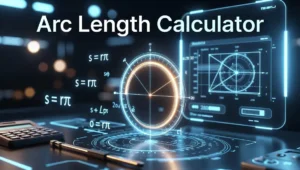
Arc length calculator is one of the most useful geometry tools for students, engineers, architects, designers, and anyone who needs to measure the distance along a curved path accurately. Instead of performing lengthy manual calculations, this tool helps determine the length of an arc quickly using values such as the radius and central angle of a circle.
Understanding arc length is essential because many real-world structures and systems involve curved shapes rather than straight lines. From bridges and highways to mechanical components and digital design projects, arc measurements play a critical role in ensuring precision and efficiency. While calculating the length of an arc manually is possible, using a reliable calculator can significantly reduce errors and save valuable time.
To fully understand how arc calculations work, it is important to learn the relationship between radius, diameter, circumference, central angles, and sectors. Once these concepts become clear, finding the length of any arc becomes much easier. Whether you are solving a school geometry problem, working on an engineering project, or simply exploring mathematical concepts, understanding arc measurement techniques can improve both accuracy and confidence.
This comprehensive guide explains everything you need to know about arc length calculations, including formulas, step-by-step methods, practical examples, degree and radian conversions, common mistakes, and real-world applications. By the end of this article, you will have a solid understanding of how to calculate arc length efficiently and how modern tools can simplify even the most complex geometry problems.
Understanding the Basics of Circle Geometry
Circle geometry is one of the most important branches of mathematics because it appears in countless real-world situations. From wheels and gears to planetary orbits and architectural domes, circles are everywhere. Understanding how circles work helps students, engineers, architects, designers, and scientists solve practical problems with greater accuracy.
One of the most useful concepts in circle geometry is arc length, which measures the distance along a curved portion of a circle. Arc length calculations are used in construction projects, road design, manufacturing processes, robotics, physics, and many other fields.
Before diving into arc length formulas and calculators, it is important to understand the basic elements that make up a circle.
Components of a Circle
A circle consists of several geometric elements that work together to define its shape and properties.
Radius
The radius is the distance from the center of the circle to any point on its circumference.
Key facts about radius:
- Represented by the letter r
- Half the length of the diameter
- Used directly in most circle formulas
- Plays a critical role in arc length calculations
For example, if a circle has a radius of 10 cm, every point on its edge is exactly 10 cm from the center.
Diameter
The diameter is the longest straight line that can be drawn inside a circle, passing through the center.
The relationship between diameter and radius is:d=2r
Where:
- d = diameter
- r = radius
If the radius is 8 meters, the diameter is 16 meters.
Circumference
The circumference is the total distance around a circle.
Formula:C=2πr
orC=πd
Circumference can be viewed as the circle’s perimeter.
Central Angle
A central angle is formed by two radii extending from the center of the circle.
Important characteristics:
- Vertex lies at the center
- Determines arc length
- Measured in degrees or radians
The larger the central angle, the longer the arc associated with it.
Chord
A chord is a straight line connecting two points on the circumference.
Characteristics include:
- May or may not pass through the center
- Diameter is the longest possible chord
- Frequently used in engineering and surveying
Sector
A sector is the region enclosed by:
- Two radii
- One arc
It resembles a slice of pizza.
Sector measurements often rely on arc length calculations.
Arc
An arc is a curved section of a circle’s circumference.
Types of arcs include:
Minor Arc
Less than 180 degrees.
Major Arc
Greater than 180 degrees.
Semicircle Arc
Exactly 180 degrees.
Arc length measures the distance along any of these curved sections.
Relationship Between Circle Elements
Every circle component is mathematically connected.
For example:
- Radius determines circumference
- Central angle determines arc length
- Arc length influences sector area
- Diameter affects radius calculations
Understanding these relationships helps simplify geometry problems and improves calculation accuracy.
Example
Suppose:
- Radius = 12 cm
- Central angle = 90°
Since 90° represents one-fourth of a full circle:Arc Length=36090×2π(12) =6π ≈18.85 cm
This demonstrates how radius and angle combine to determine arc length.
How Arc Length Fits Into Circle Geometry
Arc length acts as a bridge between linear and circular measurements.
Unlike a straight line distance, arc length measures the actual curved path between two points on a circle.
Applications include:
- Highway curves
- Roller coaster design
- Machine gears
- Robotics movement
- Aircraft navigation
- Circular track measurements
Without arc length calculations, many engineering and design projects would be impossible to complete accurately.
Arc Length Calculator: An Overview
Technology has transformed how mathematical calculations are performed. Instead of manually applying formulas every time, users can now rely on specialized geometry tools.
One of the most useful tools is the Arc Length Calculator.
What Does an Arc Length Calculator Do?
An arc length calculator automatically determines the length of an arc based on the information provided.
Typical inputs include:
- Radius
- Diameter
- Circumference
- Central angle
The calculator instantly computes the corresponding arc length.
This eliminates repetitive calculations and reduces the possibility of human error.
How Modern Calculators Simplify Geometry Problems
Modern online calculators provide several advantages:
Instant Results
Calculations are completed in seconds.
Reduced Errors
Automated formulas eliminate arithmetic mistakes.
Educational Support
Many calculators display:
- Formulas
- Intermediate steps
- Explanations
Accessibility
Most tools work on:
- Desktop computers
- Tablets
- Smartphones
Multi-Unit Support
Users can work with:
- Degrees
- Radians
- Meters
- Centimeters
- Inches
- Feet
Inputs Required for Arc Length Calculation
Different calculators may require different information.
Radius and Central Angle
This is the most common input combination.
Example:
- Radius = 15 cm
- Angle = 120°
Calculator computes the arc instantly.
Diameter and Angle
Some tools allow diameter input.
Example:
- Diameter = 30 cm
- Angle = 120°
Calculator converts diameter into radius automatically.
Circumference and Angle
Advanced calculators may use circumference directly.
Example:
- Circumference = 100 cm
- Angle = 90°
Arc length equals:36090×100 =25 cm
Common Outputs Generated by an Arc Length Calculator
Many calculators provide more than arc length.
Possible outputs include:
Arc Length
Primary result.
Sector Area
Area enclosed by the arc and two radii.
Chord Length
Straight-line distance between arc endpoints.
Circumference
Full perimeter of the circle.
Radius Verification
Checks consistency of inputs.
Advantages of Digital Geometry Tools
Digital calculators have become popular because they save time and improve reliability.
Benefits include:
Increased Speed
Manual calculations may take several minutes.
Calculators provide results almost instantly.
Improved Accuracy
Computers can process calculations with high precision.
Learning Assistance
Students can compare manual work against calculator results.
Convenience
Available online 24/7.
Professional Utility
Useful for:
- Engineers
- Architects
- Designers
- Surveyors
- Teachers
- Researchers
Arc Length Formula Explained
Understanding the formula behind arc length calculations helps users apply geometry concepts correctly and verify calculator outputs.
The Standard Arc Length Formula
The most widely used formula is:L=360θ×2πr
Where:
- L = Arc length
- θ = Central angle in degrees
- r = Radius
This formula calculates the proportional part of the circumference represented by the angle.
Understanding Each Variable in the Formula
Arc Length (L)
Represents the curved distance along the circle.
Measured in units such as:
- Centimeters
- Meters
- Inches
- Feet
Central Angle (θ)
Determines what fraction of the circle is being measured.
Examples:
- 90° = quarter circle
- 180° = half circle
- 360° = full circle
Radius (r)
Controls the size of the circle.
Larger radius means longer arcs.
Why Radius Plays a Critical Role
Radius directly affects circumference.
Since arc length is a fraction of circumference, increasing radius automatically increases arc length.
Example
Circle A:r=5
Circle B:r=10
Both have:θ=90°
Arc A:7.85
Arc B:15.71
Doubling radius doubles arc length.
The Importance of Measuring Angles Correctly
Angle measurement mistakes are among the most common calculation errors.
Examples:
Correct
90°
Incorrect
900°
A simple extra zero creates a completely different result.
Always verify:
- Unit type
- Angle value
- Calculator settings
Visual Interpretation of Arc Length
Imagine walking around the edge of a circular track.
If you complete:
- 25% of the circle, you travel 25% of the circumference.
- 50% of the circle, you travel 50% of the circumference.
- 75% of the circle, you travel 75% of the circumference.
Arc length simply measures that traveled curved distance.
Arc Length Formula Using Radians
Radians are often considered the natural language of mathematics.
Scientists, engineers, and mathematicians frequently use radians because they simplify formulas and calculations.
Why Mathematicians Prefer Radians
Radians provide a direct relationship between:
- Angle
- Radius
- Arc length
This relationship makes advanced calculations easier.
Benefits include:
Simpler Formulas
Many equations become shorter.
Better Compatibility with Calculus
Derivatives and integrals naturally use radians.
Improved Computational Efficiency
Software systems often operate internally using radians.
Formula for Arc Length in Radians
When the angle is measured in radians:L=rθ
Where:
- L = arc length
- r = radius
- θ = angle in radians
This is one of the simplest formulas in geometry.
Step-by-Step Calculation Process
Example:
Radius:r=8
Angle:θ=2
Calculation:L=8×2 L=16
Arc length equals 16 units.
Sample Problems Using Radians
Example 1
Radius = 5
Angle = 3 radiansL=5×3 L=15
Example 2
Radius = 12
Angle = 1.5 radiansL=12×1.5 L=18
Example 3
Radius = 20
Angle = 0.75 radiansL=15
Common Mistakes When Working with Radians
Using Degree Values in Radian Formulas
Incorrect:L=10×90
Correct:
Convert 90° to radians first.
Calculator Mode Errors
Scientific calculators often have:
- Degree mode
- Radian mode
Using the wrong mode produces incorrect answers.
Rounding Too Early
Keep several decimal places during intermediate calculations.
This improves final accuracy.
Arc Length Formula Using Degrees
While radians are often preferred in higher mathematics, degrees remain the most commonly used angle measurement system in schools, workplaces, engineering drawings, and everyday applications. Because many people naturally think in degrees, understanding how to calculate arc length using degree measurements is essential.
An arc length calculator typically supports both degrees and radians, allowing users to work in whichever unit is most convenient.
Converting Degrees into Arc Length
A full circle contains:360∘
The circumference of a circle is:C=2πr
If an angle represents only a portion of the circle, then the corresponding arc length represents the same fraction of the circumference.
This leads to the degree-based arc length formula:L=360θ×2πr
Where:
- L = arc length
- θ = central angle in degrees
- r = radius
This formula is intuitive because it directly compares the angle to the full 360-degree circle.
Formula for Degree-Based Calculations
The standard formula can also be written in simplified form:L=180πrθ
Both formulas produce identical results.
Why the Simplified Formula Works
Starting with:L=360θ×2πr
Simplify:L=3602πrθ
Reduce:L=180πrθ
Many engineers and mathematicians prefer this version because it requires fewer operations.
Practical Examples
Example 1: Quarter Circle
Given:
- Radius = 10 cm
- Angle = 90°
Calculation:L=36090×2π(10) L=5π L≈15.71 cm
Example 2: Half Circle
Given:
- Radius = 8 m
- Angle = 180°
Calculation:L=360180×2π(8) L=8π L≈25.13 m
Example 3: Small Arc
Given:
- Radius = 20 ft
- Angle = 30°
Calculation:L=36030×2π(20) L≈10.47 ft
Comparing Degree and Radian Methods
Both methods calculate the same physical distance.
Degree Method
Advantages:
- Familiar to most people
- Common in education
- Easy visualization
Disadvantages:
- Requires fraction conversion
Radian Method
Advantages:
- Simpler formula
- Preferred in calculus
- Efficient for computers
Disadvantages:
- Less intuitive for beginners
Example Comparison
Radius:r=12
Angle:90∘
Convert to radians:90∘=2π
Degree formula:L=36090×2π(12) L=6π
Radian formula:L=12×2π L=6π
Same result.
Accuracy Considerations
To improve precision:
Use Exact Values During Calculations
Instead of:π=3.14
Use:π=3.14159265
Avoid Early Rounding
Keep full decimal values until the final step.
Verify Angle Units
Always confirm whether the angle is:
- Degrees
- Radians
Many calculation errors originate from unit confusion.
How an Arc Length Calculator Works
Arc length calculators appear simple on the surface, but behind every calculation is a set of mathematical procedures designed to produce accurate results quickly.
Understanding how these tools work helps users trust the results and identify potential input errors.
Calculation Process Behind the Tool
The calculator generally follows these steps:
Step 1: Receive Inputs
The user enters values such as:
- Radius
- Diameter
- Circumference
- Central angle
Step 2: Validate Data
The calculator checks:
- Numeric validity
- Positive radius values
- Acceptable angle ranges
Step 3: Convert Inputs if Needed
Examples:
- Diameter converted to radius
- Degrees converted to radians
- Unit conversions
Step 4: Apply Formula
The correct arc length equation is selected automatically.
Step 5: Display Results
The tool outputs:
- Arc length
- Supporting calculations
- Additional geometry data
Mathematical Logic Used by Calculators
Most arc length calculators rely on straightforward geometry equations.
If degrees are selected:L=360θ×2πr
If radians are selected:L=rθ
The calculator determines which formula applies based on user settings.
Instant Results and Automation
One reason online calculators are so popular is speed.
A manual calculation may require:
- Formula selection
- Unit conversion
- Multiplication
- Verification
A calculator performs these operations instantly.
Benefits include:
- Reduced workload
- Faster problem solving
- Improved productivity
Accuracy Compared to Manual Calculations
Computers excel at repetitive arithmetic.
Advantages include:
Consistent Precision
Calculators can handle many decimal places.
Reduced Human Error
Common mistakes eliminated:
- Arithmetic errors
- Formula selection errors
- Conversion mistakes
Reliable Repetition
Thousands of calculations can be completed without fatigue.
Calculator Features to Look For
Not all calculators offer the same functionality.
Useful features include:
Degree and Radian Support
Allows flexibility for different users.
Automatic Conversion
Converts between units instantly.
Formula Display
Shows how results are obtained.
Mobile Compatibility
Works on smartphones and tablets.
Educational Explanations
Helpful for students and teachers.
Multi-Output Capability
Displays:
- Arc length
- Chord length
- Sector area
- Circumference
Step-by-Step Guide to Using an Arc Length Calculator
Although most arc length calculators are user-friendly, following a structured approach ensures accurate results.
Entering Radius Values Correctly
The radius is one of the most important inputs.
Tips
Always verify:
- Correct unit
- Correct numerical value
- Positive measurement
Example
Correct:
Radius = 15 cm
Incorrect:
Radius = -15 cm
Negative radius values are physically impossible.
Inputting Central Angles
The central angle determines how much of the circle is represented by the arc.
Common Angle Values
- 30°
- 45°
- 60°
- 90°
- 180°
- 270°
Verification Tip
Double-check drawings and diagrams before entering values.
A small angle mistake can significantly affect results.
Choosing Degrees or Radians
Most calculators include a selection option.
Degree Mode
Use when angles are written with ° symbols.
Examples:
- 45°
- 90°
- 120°
Radian Mode
Use when angles are expressed as:
- π/2
- π
- 2π
- 1.5 radians
Choosing the wrong mode is one of the most common user errors.
Reviewing Results
After calculation, review the output carefully.
Check:
Units
Is the answer displayed in:
- cm
- m
- ft
- in
Magnitude
Does the result seem reasonable?
For example:
A tiny angle should not produce an arc longer than the entire circumference.
Verifying Calculations Manually
Even when using calculators, manual verification is valuable.
Example
Radius:10
Angle:90∘
Calculator result:15.71
Manual check:L=36090×2π(10) L=15.71
Matching results confirm accuracy.
Arc Length Calculator Examples
Practical examples help demonstrate how arc length calculators are used in real situations.
Example 1: Simple Circle Arc
Given:
- Radius = 5 cm
- Angle = 60°
Calculation:L=36060×2π(5) L=5.24 cm
Result:
Arc length = 5.24 cm
Example 2: Arc Length Using Degrees
Given:
- Radius = 12 m
- Angle = 150°
Calculation:L=360150×2π(12) L≈31.42 m
Result:
31.42 meters
Example 3: Arc Length Using Radians
Given:
- Radius = 7
- Angle = 2 radians
Calculation:L=7(2) L=14
Result:
14 units
Example 4: Large Radius Calculation
Given:
- Radius = 500 m
- Angle = 40°
Calculation:L=36040×2π(500) L≈349.07 m
Applications:
- Highway design
- Railway planning
- Infrastructure projects
Example 5: Engineering Application
A gear rotates through:120∘
Radius:25 mm
Calculation:L=360120×2π(25) L≈52.36 mm
This arc distance helps engineers determine rotational movement.
Example 6: Architecture Design Example
An architect designs an archway with:
- Radius = 4 m
- Angle = 135°
Calculation:L=360135×2π(4) L≈9.42 m
This measurement helps estimate material requirements.
Arc Length and Sector Area Relationship
Arc length and sector area are closely connected concepts in circle geometry.
Understanding one often helps calculate the other.
Understanding Circle Sectors
A sector is a region enclosed by:
- Two radii
- One arc
Common examples include:
- Pizza slices
- Pie charts
- Fan blades
- Circular gardens
Formula for Sector Area
When angle is measured in degrees:A=360θπr2
Where:
- A = sector area
- θ = angle
- r = radius
How Arc Length Influences Sector Calculations
Arc length determines the curved boundary of the sector.
Longer arcs generally correspond to:
- Larger sectors
- Greater enclosed area
Because both formulas depend on the same angle and radius, they are naturally related.
Relationship Formula
Using radians:A=21rL
Where:
- A = sector area
- r = radius
- L = arc length
This formula is particularly useful in engineering and physics.
Solving Combined Geometry Problems
Many real-world tasks require both values.
Example:
Given:
- Radius = 10 m
- Angle = 90°
Arc length:15.71 m
Sector area:78.54 m2
Both measurements may be necessary for design and planning.
Practical Examples
Example 1: Circular Park
A park includes a 120° section.
Radius:
20 m
Arc length:41.89 m
Sector area:418.88 m2
Example 2: Stadium Design
Architects often calculate:
- Curved seating boundaries
- Surface areas
- Material requirements
Arc length and sector area work together to support these calculations.
Arc Length vs Chord Length
Arc length and chord length are often confused because both involve two points on a circle.
However, they measure very different things.
Key Differences Between Arc and Chord
Arc Length
Measures the curved path between two points.
Chord Length
Measures the straight-line distance between two points.
The chord is always shorter than the corresponding arc unless the arc length approaches zero.
When to Use Arc Length
Arc length is appropriate when measuring:
- Curved roads
- Circular tracks
- Gear movement
- Archways
- Curved structures
When Chord Length Is More Appropriate
Chord length is useful for:
- Structural supports
- Cable spans
- Bridge components
- Direct distance calculations
Mathematical Comparison
Chord length formula:c=2rsin(2θ)
Arc length formula:L=360θ×2πr
orL=rθ
Depending on the application, one measurement may be more useful than the other.
Real-World Applications
Arc Length
- Highway curves
- Roller coasters
- Stadium design
- Circular pathways
Chord Length
- Truss systems
- Bridge construction
- Structural engineering
- Surveying measurements
Understanding the distinction prevents design errors and improves calculation accuracy.
Conclusion
Arc length is one of the most practical and widely used concepts in circle geometry. It connects angular measurements with real-world distances, making it essential in mathematics, engineering, architecture, physics, robotics, surveying, computer graphics, and many other disciplines. Whether calculating the curve of a highway, designing a dome, programming a robotic arm, or creating a 3D model, understanding arc length helps ensure accuracy and efficiency.
Key Takeaways About Arc Length Calculation
Several fundamental principles form the foundation of arc length calculations:
- Arc length measures the distance along a curved portion of a circle.
- The result depends primarily on two factors: the radius and the central angle.
- Arc length can be calculated using either degrees or radians.
- The degree-based formula is:
L=360θ×2πr
- The radian-based formula is:
L=rθ
- Correct unit conversions and accurate input values are critical for reliable results.
By mastering these concepts, users can confidently solve both academic and professional geometry problems.
Why Arc Length Remains Important
Despite advances in technology and automated calculation tools, arc length remains a core mathematical concept because curved measurements appear throughout the modern world. Transportation systems, industrial machinery, architectural structures, digital design software, and scientific research all rely on accurate arc calculations.
As industries continue to adopt advanced technologies such as artificial intelligence, automation, and digital modeling, the importance of geometric precision is only increasing. Arc length calculations provide the foundation for many of these innovations.
Choosing the Right Arc Length Calculator
A high-quality arc length calculator should offer:
- Support for both degrees and radians
- Fast and accurate calculations
- Mobile-friendly functionality
- Clear formula explanations
- Educational guidance for students and teachers
- Additional outputs such as sector area and chord length
The best calculators not only provide answers but also help users understand the mathematical process behind those answers.
Improving Mathematical Skills Through Practice
While calculators are valuable tools, developing a strong understanding of the underlying formulas remains important. Regular practice helps improve:
- Problem-solving skills
- Mathematical reasoning
- Accuracy
- Confidence in geometry
Combining manual calculations with digital tools creates the most effective learning approach. Users gain both conceptual understanding and practical efficiency.
Final Thoughts on Geometry and Measurement
Geometry is more than an academic subject—it is a language used to describe and shape the world around us. Arc length is a perfect example of how a seemingly simple mathematical idea can have applications across countless industries and everyday situations.
From students learning the basics of circle geometry to engineers designing complex infrastructure projects, the ability to calculate arc length accurately remains an essential skill. By understanding the relationships between radius, angle, circumference, sectors, and arcs, users can approach geometric challenges with greater confidence and precision.
Whether you choose to calculate arc length manually or use a modern arc length calculator, mastering this concept will strengthen your mathematical foundation and provide practical benefits in education, technology, science, and professional applications for years to come.