🧪 Cylinder Volume Calculator
Simple Guide to Volume of Cylinder Formula — Calculate volume, surface area, and more with full unit conversion
Volume of a Cylinder Formula: V = π × r² × h
Where r = radius, h = height, and π ≈ 3.14159265358979
You can also enter the diameter instead of radius — the calculator handles both automatically.
V = π × r² × h
Lateral Surface Area = 2πrh | Base Area = πr² | Total Surface Area = 2πr(r + h)
📏 Cylinder Dimensions
🔢 What to Calculate
📊 Calculation Results
🧮 Step-by-Step Calculation
📐 Measurement Breakdown
🔄 Volume Unit Conversions
| Unit | Value | Description |
|---|
📚 About the Cylinder Volume Formula
V = π × r² × h — The volume of a cylinder equals Pi times the square of the radius times the height.
Why π × r²? This is the area of the circular base. Multiplying by height gives the total 3D volume.
Lateral Surface Area (LSA): The curved side surface only — like the label on a can. Formula: 2πrh
Total Surface Area (TSA): Includes both circular bases plus the curved side. Formula: 2πr(r + h)
Real-world uses: Calculating tank capacity, pipe volume, concrete pillars, cans, tubes, silos, and any cylindrical container.
Base Circumference: The perimeter of the circular base. Formula: C = 2πr. Useful for wrapping, labeling, or banding a cylinder.
Hollow Cylinder: A pipe or tube. Volume = π × h × (R² − r²) where R = outer radius, r = inner radius.
Tip: 1 cm³ = 1 mL, so volume in cm³ directly equals volume in milliliters — handy for liquid measurements.
Tip: 1 m³ = 1,000 Liters = 1,000,000 mL. Great for large tank calculations.
In mathematics, engineering, and everyday practical situations, measuring the space inside an object is extremely important. One of the most common shapes found in both natural and man-made structures is the cylinder. From water tanks and beverage cans to industrial pipes and gas containers, cylindrical shapes appear almost everywhere in modern life. Because of this, understanding how to determine the volume of cylinder structures has become an essential skill for students, engineers, technicians, and even homeowners.
A cylinder volume calculator is a digital tool designed to quickly determine how much space exists inside a cylindrical object. Instead of performing manual calculations using formulas and mathematical constants, users can simply enter key measurements such as radius and height to obtain an accurate result instantly. This makes the calculation process easier, faster, and more reliable, especially when working with large projects or technical measurements.
The concept behind calculating cylindrical volume comes from basic geometry. A cylinder is a three-dimensional shape consisting of two parallel circular bases connected by a curved surface. Because its base is circular, the mathematical constant π (pi) plays a crucial role in determining its internal capacity. The combination of the circle’s area and the cylinder’s height allows us to compute how much space the object can hold.
Understanding this measurement is not just an academic exercise. In the real world, industries rely heavily on accurate volume calculations. Engineers use them when designing storage tanks, pipelines, and hydraulic systems. Architects apply the concept when estimating the capacity of structural columns or cylindrical components in buildings. Manufacturers depend on precise measurements when producing containers, batteries, and mechanical parts.
In addition to professional applications, volume calculations are also widely used in education. Geometry students often learn about cylinders as part of their introduction to three-dimensional shapes. By practicing these calculations, learners develop a stronger understanding of spatial reasoning, measurement units, and mathematical formulas.
The rise of digital technology has made these calculations even more accessible. Online tools and mobile apps allow anyone to use a cylinder volume calculator without needing advanced mathematical skills. With only a few inputs, users can instantly determine the volume of cylinder objects in different units such as cubic centimeters, liters, or cubic meters. These tools are especially useful for quick estimates in construction, science experiments, and engineering projects.
Another advantage of modern calculation tools is their ability to handle unit conversions automatically. In many cases, measurements may be taken in centimeters while results are required in liters or gallons. Instead of performing several conversion steps manually, digital calculators simplify the process and minimize the risk of human error.
As industries continue to evolve and rely more on data-driven design, accurate geometric calculations remain essential. Whether someone is designing a fuel tank, estimating the capacity of a water reservoir, or solving a geometry problem in school, knowing how to determine the volume of cylinder shapes is an invaluable skill.
This guide will explore everything related to cylindrical volume measurement. It will explain the geometry behind cylinders, the mathematical formula used to calculate their volume, and the practical benefits of using a cylinder volume calculator. Along the way, you will also learn about real-world applications, common mistakes to avoid, and tips for obtaining accurate measurements.
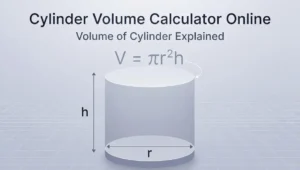
Understanding the Formula for Volume of Cylinder
When dealing with three-dimensional shapes, the cylinder is one of the most common and practical forms you’ll encounter. From water tanks to pipes and even beverage cans, understanding how to calculate the volume of a cylinder is essential in both academic and real-world scenarios. This guide breaks down the formula, explains each component, and shows how it’s applied in everyday situations.
Standard Mathematical Formula for Cylinder Volume
The standard formula used to calculate the volume of a cylinder is:
V = πr²h
This formula is simple yet powerful. It helps determine how much space exists inside a cylindrical object.
- V represents volume
- π (pi) is a mathematical constant
- r stands for radius
- h represents height
By multiplying the area of the circular base (πr²) with the height (h), you get the total volume.
Radius (r) in Cylinder Calculations
The radius is the distance from the center of the circular base to its edge. Getting this value correct is crucial because the formula squares the radius, meaning even small errors can significantly impact the result.
To measure the radius accurately:
- Use a ruler or measuring tape across the circle’s diameter
- Divide the diameter by 2
It’s important to distinguish between radius and diameter:
- Diameter = full width across the circle
- Radius = half of the diameter
Mistaking one for the other is a common error in cylinder volume calculations.
Height (h) of the Cylinder
The height refers to the vertical distance between the two circular bases. It must be measured in a straight line from top to bottom, not along the curved surface.
Accurate height measurement ensures reliable volume results. Even a slight tilt in measurement can produce incorrect values, especially in engineering contexts.
The Role of Pi (π) in Geometry
The constant π (pi) is approximately equal to 3.14159, although many calculations use 3.14 for simplicity.
Pi is essential because it relates to the properties of circles. Since the base of a cylinder is circular, π becomes a fundamental part of the formula. Without it, calculating circular area—and therefore volume—would not be possible.
Step-by-Step Example of Calculating Cylinder Volume
Let’s walk through a few examples to make things clearer.
Example with Known Radius and Height
Imagine a cylinder with:
- Radius = 5 cm
- Height = 10 cm
Using the formula:
V = π × (5²) × 10
V = π × 25 × 10
V = 250π ≈ 785 cubic centimeters
Example Using Diameter Instead of Radius
If the diameter is given instead of radius, divide it by 2 first.
Example:
- Diameter = 8 cm → Radius = 4 cm
- Height = 12 cm
V = π × (4²) × 12
V = π × 16 × 12
V = 192π ≈ 603.19 cubic centimeters
Example in Real-World Units (Liters or Cubic Meters)
Suppose a water tank has:
- Radius = 0.5 meters
- Height = 2 meters
V = π × (0.5²) × 2
V = π × 0.25 × 2
V = 0.5π ≈ 1.57 cubic meters
Since 1 cubic meter = 1000 liters:
Volume ≈ 1570 liters
Converting Cylinder Volume Units
Understanding unit conversion is essential when applying cylinder volume in practical contexts.
Cubic Centimeters to Liters
1,000 cubic centimeters (cm³) equals 1 liter.
So, if you calculate a volume of 2000 cm³, that equals 2 liters.
Cubic Meters to Gallons
1 cubic meter equals approximately 264.17 gallons (US).
This conversion is often used in industrial and international contexts.
Practical Unit Conversion Tips
- Always keep units consistent before calculating
- Convert only after finding the volume
- Use reliable conversion factors for accuracy
These tips help prevent common mistakes in volume calculations.
How a Cylinder Volume Calculator Works
A cylinder volume calculator is a digital tool that simplifies the process of finding volume. Instead of manual calculations, users can input values and get instant results.
Basic Inputs Required in a Cylinder Volume Calculator
Most calculators require the following inputs:
- Radius input – the most common parameter
- Diameter input option – useful alternative when radius isn’t known
- Height input – necessary for calculating total volume
These inputs ensure flexibility for different types of problems.
Automatic Calculation Process
Once the values are entered, the calculator performs the computation automatically.
Mathematical Logic Used in Online Calculators
The tool applies the formula V = πr²h behind the scenes. It also converts diameter to radius when needed and ensures unit consistency.
Instant Output Generation
Results are generated instantly, often with multiple unit options such as liters, cubic meters, or gallons.
Advantages of Using an Online Volume of Cylinder Calculator
Using a calculator offers several benefits:
Faster Calculations
Manual calculations can take time, especially with complex units. Calculators provide results in seconds.
Reduced Human Error
Since the formula is applied automatically, the chance of mistakes is significantly reduced.
Suitable for Students and Professionals
From students learning geometry to engineers working on large-scale projects, these tools are widely useful.
Features Found in Modern Cylinder Volume Calculator Tools
Today’s online calculators come with advanced features that enhance usability.
Unit Conversion Options
Users can switch between different measurement units without recalculating manually.
Visual Cylinder Diagrams
Some tools include diagrams that help users understand the shape and dimensions visually.
Mobile-Friendly Calculation Tools
Modern calculators are optimized for smartphones, making them accessible anytime and anywhere.
Real-Life Applications of Volume of Cylinder Calculations
The concept of cylinder volume is not just theoretical—it has wide applications in daily life and various industries.
Cylinder Volume in Engineering and Construction
Calculating Water Tank Capacity
Engineers use cylinder volume formulas to determine how much water a tank can hold. This is essential for residential, commercial, and agricultural planning.
Estimating Concrete Pillar Volume
In construction, cylindrical pillars require precise volume calculations to estimate the amount of concrete needed.
Pipe Capacity Calculations
Pipes are cylindrical, so calculating their internal volume helps determine fluid capacity and flow efficiency.
Industrial Applications of Cylinder Volume
Fuel Storage Tanks
Fuel tanks often use cylindrical designs. Accurate volume calculations ensure proper storage and safety compliance.
Chemical Containers
In chemical industries, precise volume measurement is critical to avoid overflow or incorrect mixing ratios.
Hydraulic Cylinders
Hydraulic systems rely on cylinder volume to determine pressure and movement efficiency in machinery.
Educational Uses of Cylinder Volume Calculations
Geometry Learning in Schools
Students learn the cylinder volume formula as part of basic geometry. It helps build a strong mathematical foundation.
STEM Education Projects
Cylinder volume calculations are often used in science and engineering projects, encouraging practical learning.
Math Competitions and Problem Solving
Understanding how to calculate volume quickly and accurately is a valuable skill in competitive mathematics.
Step-by-Step Guide to Using a Cylinder Volume Calculator
A cylinder volume calculator is one of the most practical digital tools for students, engineers, and DIY enthusiasts. Whether you’re estimating water storage, designing a tank, or solving geometry problems, understanding how to use this calculator correctly ensures accurate and reliable results. This guide walks you through the full process—from measuring dimensions to interpreting outputs—using simple, clear English.
Measuring the Cylinder Dimensions
Before using any cylinder volume calculator, you need precise measurements. The accuracy of your result depends entirely on how carefully you measure the cylinder.
Measuring Diameter with a Ruler or Tape
To find the diameter, measure the distance across the circular base of the cylinder. Use a ruler for small objects or a measuring tape for larger ones. Make sure to measure straight across the center—this is critical.
If you only need the radius, remember this simple formula:
- Radius = Diameter ÷ 2
Many online volume calculators allow you to input either the diameter or radius, but always double-check which one is required to avoid errors.
Determining Accurate Height
The height of a cylinder is the vertical distance from the base to the top. Place your measuring tool parallel to the side of the cylinder and ensure it’s straight. Even a small tilt can affect your measurement.
For irregular placements (like tilted containers), measure the true vertical height, not the slanted edge.
Entering Data Into a Cylinder Volume Calculator
Once you have your measurements, the next step is entering them into the calculator.
Inputting Radius or Diameter
Most cylinder volume calculators online provide options to input either:
- Radius (r)
- Diameter (d)
Be consistent. If the calculator asks for radius but you input diameter, your result will be incorrect. Some advanced calculators automatically convert diameter to radius, but not all do.
Choosing Measurement Units
Units matter more than you might think. Common units include:
- Centimeters (cm)
- Meters (m)
- Inches (in)
- Feet (ft)
Always ensure that both radius and height use the same unit system. Mixing units (like cm and meters) will lead to inaccurate results. Many tools also let you switch units instantly, which is helpful for international projects.
Interpreting the Calculation Results
After entering your data, the calculator will provide a result almost instantly. Understanding what that result means is essential.
Understanding Cubic Units
The volume of a cylinder is always expressed in cubic units, such as:
- cm³ (cubic centimeters)
- m³ (cubic meters)
- in³ (cubic inches)
This represents the total space inside the cylinder. For example, a water tank volume might be expressed in liters, where:
- 1 liter = 1000 cm³
Converting Results for Practical Use
In real-life applications, you may need to convert the result. For example:
- Cubic meters to liters (multiply by 1000)
- Cubic inches to gallons (commonly used in the US)
Many modern volume conversion tools are integrated into calculators, making this process fast and efficient.
Differences Between Cylinder Volume and Cylinder Surface Area
Many people confuse volume with surface area, but they measure completely different things.
What Is Cylinder Surface Area
Surface area refers to the total area covering the outside of a cylinder. It is especially important in manufacturing, painting, or coating processes.
Lateral Surface Area
The lateral surface area only includes the side of the cylinder (excluding top and bottom). The formula is:
- 2πrh
This is useful when calculating materials like labels or wraps.
Total Surface Area
The total surface area includes:
- Top circle
- Bottom circle
- Curved surface
Formula:
- 2πr² + 2πrh
This is used when you need to cover the entire cylinder.
Formula Comparison
Understanding formulas helps avoid confusion when using geometry tools.
Volume Formula vs Surface Area Formula
- Volume of cylinder: πr²h
- Surface area of cylinder: 2πr² + 2πrh
The key difference is that volume deals with space inside, while surface area deals with external coverage.
When to Calculate Surface Area Instead of Volume
You should calculate surface area when:
- Painting or coating a cylinder
- Wrapping materials (like labels)
- Heat transfer analysis in engineering
Use volume when:
- Filling liquids or gases
- Storage capacity planning
- Material estimation for contents
Types of Cylinders in Geometry and Engineering
Cylinders are not all the same. Different types are used in both theoretical geometry and practical engineering.
Right Circular Cylinder
This is the most common type of cylinder.
Characteristics
- Bases are perfectly circular
- Sides are perpendicular to the base
- Height is straight and vertical
This type is typically used in basic geometry calculations and educational examples.
Example Applications
- Water tanks
- Soda cans
- Storage containers
Most cylinder volume formulas are based on this shape.
Oblique Cylinder
An oblique cylinder is slightly tilted.
Geometric Differences
- The sides are not perpendicular to the base
- The top is shifted relative to the bottom
Despite the tilt, the volume formula remains the same.
Volume Calculation Principles
Even with a slanted shape, the volume is still:
- πr²h
However, the height must be measured vertically—not along the slanted edge.
Hollow Cylinders
Also known as cylindrical shells, these have empty space inside.
Inner and Outer Radius Concept
A hollow cylinder has:
- Outer radius (R)
- Inner radius (r)
The volume formula becomes:
- πh(R² − r²)
This accounts for the empty space in the center.
Practical Uses in Pipes and Tubes
Hollow cylinders are widely used in:
- Plumbing pipes
- Industrial tubing
- Mechanical components
Understanding their volume is crucial for fluid flow calculations and material estimation.
Common Mistakes When Calculating Volume of Cylinder
Even with a calculator, mistakes can still happen. Here are the most common ones to avoid.
Confusing Diameter with Radius
This is one of the biggest errors. Always remember:
- Radius = half of diameter
Using the wrong value can double or halve your result incorrectly.
Using Incorrect Measurement Units
Mixing units (like cm and m) leads to incorrect calculations. Always standardize your units before inputting data into any geometry calculator.
Rounding Pi Too Early in Calculations
Pi (π ≈ 3.14159) should not be rounded too early. Many calculators handle this automatically, but if you’re calculating manually, keep π as precise as possible until the final step.
Misreading Cylinder Height
Height must be measured vertically. Misreading it—especially in oblique cylinders—can significantly affect the final volume.
Cylinder Volume Calculator vs Manual Calculation
Understanding how to calculate the volume of a cylinder is essential in many fields, from engineering and construction to everyday applications like measuring water tanks or containers. While the traditional manual method using formulas is still widely taught, digital cylinder volume calculators are becoming increasingly popular. Each approach has its own advantages depending on the situation.
Speed Comparison
When it comes to speed, a cylinder volume calculator clearly has the upper hand. By simply entering the radius and height, users can get instant results without going through multiple calculation steps. This is especially useful in time-sensitive environments such as construction sites or manufacturing processes.
Manual calculation, on the other hand, requires applying the formula:V=πr2h
Even though the formula is straightforward, it can take longer when dealing with multiple cylinders or complex measurements. For quick estimations or repetitive tasks, digital tools significantly reduce time and effort.
Accuracy and Precision
Accuracy is critical in volume calculations, especially in engineering projects. Online cylinder volume calculators and software tools minimize human error by automating the computation process. As long as the input values are correct, the output will be highly precise.
Manual calculations are prone to small mistakes, such as incorrect squaring of the radius or rounding errors in π (pi). However, when done carefully, manual methods can still provide accurate results and help users better understand the underlying mathematical concept.
Best Scenarios for Each Method
Manual calculation is ideal for educational purposes and situations where digital tools are not available. It helps students and professionals grasp the fundamentals of geometry and spatial measurement.
On the other hand, cylinder volume calculators are best suited for professional environments, large-scale projects, and scenarios requiring repeated calculations. They are also helpful when dealing with complex variations like hollow cylinders or partial volumes.
Advanced Cylinder Volume Calculations
As applications become more complex, basic formulas may not be sufficient. Advanced cylinder volume calculations are often required in engineering and scientific contexts.
Calculating Volume of a Hollow Cylinder
A hollow cylinder, also known as a cylindrical shell, is commonly used in pipes, tubes, and mechanical components.
Formula Explanation
To calculate the volume of a hollow cylinder, you subtract the inner cylinder volume from the outer cylinder volume:V=πh(R2−r2)
Where:
- R = outer radius
- r = inner radius
- h = height
This formula is essential in industries like piping systems, where material thickness plays a crucial role in design and cost estimation.
Partial Cylinder Volume Calculations
In real-world scenarios, cylinders are not always completely filled. For example, a horizontal tank may only be partially filled with liquid. Calculating partial cylinder volume requires more advanced geometry, often involving segment area formulas and trigonometric functions.
These calculations are commonly used in fuel storage, wastewater treatment, and chemical processing industries.
Multi-Cylinder Systems in Engineering
Many engineering systems involve multiple cylinders connected together, such as hydraulic systems, engines, or pipeline networks. In these cases, total volume is calculated by summing the volumes of individual cylinders.
Using a cylinder volume calculator for multi-cylinder systems ensures consistency and reduces the risk of cumulative errors, especially when dealing with varying dimensions.
Practical Examples of Volume of Cylinder Calculations
To better understand how cylinder volume calculations are applied, let’s explore some practical examples from everyday life and industry.
Water Tank Capacity Calculation
A common application is determining the capacity of a cylindrical water tank. By knowing the radius and height, you can calculate how much water the tank can hold.
For example:
- Radius = 1 meter
- Height = 3 meters
V=π(1)2(3)≈9.42 cubic meters
This is equivalent to approximately 9,420 liters of water. Such calculations are essential for household planning, agriculture, and water resource management.
Fuel Storage Cylinder Example
Fuel tanks are often cylindrical in shape. Accurate volume calculation is crucial for safety and efficiency.
If a fuel tank has:
- Radius = 0.5 meters
- Height = 2 meters
V≈1.57 cubic meters
This helps in estimating fuel capacity and monitoring consumption.
Industrial Pipe Volume Estimation
In industrial settings, pipes transport liquids and gases over long distances. Engineers need to calculate the internal volume to determine flow rates and capacity.
Using the hollow cylinder formula, they can estimate how much fluid the pipe can hold, which is critical for system design and optimization.
Beverage Can Volume Example
Even everyday objects like beverage cans are cylindrical. A standard can typically has:
- Radius ≈ 3.3 cm
- Height ≈ 12 cm
V≈410 cubic centimeters
This calculation helps manufacturers ensure consistent product volume and packaging standards.
Digital Tools and Online Cylinder Volume Calculator Platforms
With technological advancements, digital tools have become the preferred method for volume calculations. They offer convenience, speed, and enhanced accuracy.
Scientific Calculator Tools
Scientific calculators are a basic yet powerful tool for cylinder volume calculations. They allow users to input formulas directly and handle constants like π with high precision.
They are widely used in academic settings and by professionals who prefer manual control with computational support.
Engineering Software
Advanced engineering software such as CAD (Computer-Aided Design) programs and simulation tools can calculate cylinder volumes as part of larger design processes. These platforms often include 3D modeling capabilities, allowing users to visualize structures and compute volumes simultaneously.
Such tools are essential in mechanical engineering, civil engineering, and manufacturing industries.
Mobile Apps for Volume Calculations
Mobile apps provide a portable solution for engineers, students, and technicians. Many apps include built-in cylinder volume calculators with user-friendly interfaces and unit conversion features.
These apps are particularly useful for on-site calculations where access to computers may be limited.
Web-Based Cylinder Volume Calculator Tools
Online cylinder volume calculators are among the most accessible tools available today. Users can simply enter dimensions and instantly receive results without installing any software.
Many web-based platforms also support advanced calculations, including hollow cylinders and partial volumes. They often include additional features like unit conversion, step-by-step explanations, and integration with other geometry calculators.
These tools are ideal for quick calculations, learning purposes, and professional use alike, making them a valuable resource in both academic and industrial contexts.
Tips for Accurate Cylinder Measurements
Accurately measuring a cylinder is essential in fields like engineering, manufacturing, construction, and even education. Whether you’re calculating the volume of a pipe, a tank, or a simple container, small errors in measurement can lead to significant discrepancies in results. Below are practical and up-to-date tips to help you achieve precise cylinder measurements every time.
Use Precise Measuring Tools
The foundation of accurate measurement starts with the right tools. Using low-quality or inappropriate instruments can introduce errors before calculations even begin. For measuring a cylinder’s radius or diameter, tools such as digital calipers or micrometers are highly recommended. These devices provide higher precision compared to traditional rulers or tape measures.
For larger cylinders, like storage tanks or industrial pipes, laser distance meters or measuring tapes with millimeter markings are ideal. According to recent engineering practice standards, tools with a tolerance of ±0.01 mm are commonly used in precision manufacturing environments.
Choosing the right tool not only improves accuracy but also increases efficiency. In modern workflows, many professionals now pair measuring devices with digital recording apps to reduce manual errors.
Measure Multiple Times
One of the simplest yet most effective techniques for ensuring accuracy is repetition. Measuring the same dimension multiple times helps identify inconsistencies and reduces the impact of human error.
For example, when measuring the diameter of a cylinder, take readings at different angles. Cylinders may appear perfectly round, but slight deformations can occur due to manufacturing imperfections or wear over time. Averaging multiple measurements provides a more reliable value.
In quality control processes, it’s standard practice to measure at least three times and calculate the average. This approach is widely used in industries like automotive manufacturing and aerospace engineering, where precision is critical.
Convert Units Before Calculating
Unit consistency is a key factor in accurate calculations. A common mistake is mixing units—such as using centimeters for radius and meters for height—without proper conversion. This can lead to incorrect volume results.
Before applying the cylinder volume formula (V = πr²h), ensure all measurements are in the same unit system. For example, convert everything to meters if you’re working within the SI system.
With the increasing use of online cylinder volume calculators, many tools now include automatic unit conversion features. However, it’s still important to double-check inputs to avoid costly errors, especially in professional applications.
Understand Measurement Tolerances
Measurement tolerance refers to the allowable deviation in a dimension. Understanding this concept is essential when working with real-world objects, as no measurement is perfectly exact.
For instance, if a cylinder’s diameter is measured as 10 cm with a tolerance of ±0.1 cm, the actual value could range between 9.9 cm and 10.1 cm. This variation directly affects the calculated volume.
In engineering projects, tolerance analysis helps determine whether a component will function properly within acceptable limits. Modern digital tools often include tolerance settings, allowing users to simulate best-case and worst-case scenarios.
By considering tolerances, you can make more informed decisions and avoid potential design or manufacturing issues.
Future of Digital Geometry Calculators
As technology evolves, geometry calculators are becoming more advanced, intelligent, and integrated into broader digital ecosystems. The traditional manual calculation is rapidly being replaced by smart tools that enhance accuracy and productivity.
Smart Engineering Calculation Tools
Today’s engineering tools go beyond basic calculations. Smart geometry calculators can handle complex shapes, perform real-time computations, and even store previous results for future reference.
Many platforms now offer cloud-based solutions, enabling engineers and students to access their calculations from any device. These tools often include built-in formulas, visual aids, and step-by-step solutions, making them valuable for both beginners and professionals.
Recent data from the global engineering software market shows a steady increase in demand for digital calculation tools, driven by the need for efficiency and error reduction. This trend highlights the growing importance of reliable online cylinder volume calculators in everyday workflows.
AI-Powered Geometry Calculators
Artificial intelligence is transforming how we approach mathematical computations. AI-powered geometry calculators can analyze user input, suggest corrections, and even predict potential errors before calculations are completed.
For example, if a user inputs an unusually large radius compared to height, the system might prompt a review to ensure accuracy. Some advanced tools also provide contextual explanations, helping users understand the underlying concepts rather than just delivering results.
In 2025 and beyond, AI integration is expected to become a standard feature in educational and professional tools. This innovation not only improves accuracy but also enhances learning and decision-making processes.
Integration with CAD and 3D Design Software
One of the most exciting developments is the integration of geometry calculators with CAD (Computer-Aided Design) and 3D modeling software. This allows users to calculate cylinder volume directly within design environments, eliminating the need to switch between tools.
For instance, engineers can model a cylindrical component and instantly obtain its volume, surface area, and other properties. This seamless integration reduces workflow interruptions and minimizes the risk of data entry errors.
Modern CAD platforms also support parametric design, where changes to dimensions automatically update calculations. This feature is particularly useful in industries like architecture, product design, and manufacturing, where precision and adaptability are crucial.
Conclusion: Why Cylinder Volume Calculator Tools Are Essential
Cylinder volume calculations may seem straightforward, but accuracy and efficiency are vital, especially in professional settings. With the help of modern tools and best practices, achieving reliable results has never been easier.
Summary of Key Concepts
To measure a cylinder accurately, it’s important to use precise tools, repeat measurements, maintain consistent units, and understand tolerances. These steps form the foundation of reliable calculations.
Additionally, the evolution of digital geometry calculators—from basic tools to AI-powered systems—has significantly improved how we approach mathematical problems.
Benefits of Understanding Volume of Cylinder
Understanding how to calculate the volume of a cylinder is more than just a mathematical skill. It has practical applications in various fields, including engineering, construction, manufacturing, and even everyday tasks like determining the capacity of containers.
Accurate volume calculations help optimize material usage, reduce waste, and improve overall efficiency. In industrial settings, this knowledge can lead to cost savings and better resource management.
Moreover, having a solid grasp of cylinder volume formulas enhances problem-solving abilities and builds confidence in handling more complex geometric concepts.
Encouragement to Use Online Cylinder Volume Calculator Tools
In today’s digital age, leveraging online tools is a smart and efficient way to perform calculations. Online cylinder volume calculators offer speed, accuracy, and convenience, making them an essential resource for students, professionals, and hobbyists alike.
These tools often include additional features such as unit conversion, visual representations, and error-checking mechanisms. By incorporating them into your workflow, you can save time and reduce the risk of mistakes.
As technology continues to advance, the role of digital calculators will only become more significant. Embracing these tools not only simplifies calculations but also keeps you aligned with modern best practices in geometry and engineering.