mcg to mg Converter - Microgram to Milligram Calculator
Free Online Tool for Accurate Medication Dosage Conversion
Quick Conversion Formula: 1 milligram (mg) = 1,000 micrograms (mcg or µg)
This free mcg to mg converter helps you accurately convert between micrograms and milligrams for medications, vitamin supplements, and scientific measurements. Perfect for healthcare professionals, patients, and anyone needing precise dosage calculations.
⚠️ Medical Safety Notice: Always consult with a healthcare professional or pharmacist before taking any medication or supplement. Incorrect dosage conversions can be dangerous to your health. This tool is for informational purposes only.
How to Use the mcg to mg Conversion Calculator
Your Conversion Results
In many areas of modern life—especially health, nutrition, and science—accurate measurement is extremely important. Even a very small difference in quantity can significantly affect results, whether it is a medication dosage, a vitamin supplement, or a laboratory experiment. This is where understanding unit conversions becomes essential. One of the most common small-unit conversions used in healthcare and nutrition is the conversion between micrograms and milligrams. A mcg to mg converter helps simplify this process and ensures accuracy when dealing with tiny measurements.
Micrograms (mcg) and milligrams (mg) are both metric units used to measure mass. They represent very small quantities, much smaller than grams, which makes them especially useful for substances that must be measured precisely. Vitamins, hormones, medications, and chemical compounds are often measured in micrograms or milligrams because even a tiny difference can impact effectiveness and safety.
For example, many dietary supplements list ingredients such as vitamin B12, vitamin D, or folic acid in micrograms. However, some medical references or dosage guidelines may present the same nutrients in milligrams. Without proper conversion, this difference in units could lead to confusion or incorrect interpretation of dosage information. Using a reliable mcg to mg converter makes it easy to translate these measurements quickly and accurately.
Another reason this conversion is widely used is the growing popularity of health tracking and nutritional awareness. Today, many people read supplement labels carefully and monitor their nutrient intake. When comparing products or understanding recommended daily allowances, consumers may need to convert between micrograms and milligrams. This simple calculation helps them better understand how much of a nutrient they are consuming.
The need for accurate conversions is even more critical in the medical field. Healthcare professionals regularly work with precise dosages, especially when prescribing medications that require strict measurement control. A small mistake in converting units could result in incorrect dosage instructions. Therefore, tools such as a mcg to mg converter are commonly used in clinical settings to ensure accuracy and patient safety.
Beyond healthcare and nutrition, microgram-to-milligram conversion also appears frequently in scientific research. Laboratories often deal with extremely small quantities of chemicals and biological compounds. Researchers rely on accurate unit conversions to maintain consistency in experiments and to report results using standardized measurement systems.
Fortunately, converting between micrograms and milligrams is relatively simple once you understand the relationship between the two units. Because the metric system is based on powers of ten, conversions follow a predictable pattern. However, many people still prefer using digital tools to perform the calculation instantly without risk of error. Online calculators and automated conversion tools have made this process much faster and more convenient.
Today, a mcg to mg converter can be found in many forms, including online calculators, mobile apps, health tracking platforms, and educational websites. These tools allow users to enter a value in micrograms and instantly receive the equivalent value in milligrams. This convenience is particularly useful for students, healthcare workers, nutritionists, and anyone who regularly deals with small measurement units.
Understanding how to convert micrograms to milligrams is also an important basic skill for students studying science, medicine, or nutrition. Learning how these units relate to each other helps build a strong foundation in the metric system and improves overall measurement literacy.
In this guide, we will explore everything you need to know about microgram-to-milligram conversion. You will learn the difference between mcg and mg, the mathematical formula behind the conversion, and practical examples that make the concept easy to understand. We will also look at common situations where this conversion is used, such as supplement labeling, medical prescriptions, and laboratory measurements.
By the end of this article, you will have a clear understanding of how a mcg to mg converter works, why it is useful, and how to apply it confidently in everyday situations. Whether you are reading a nutrition label, calculating a medication dosage, or studying scientific measurements, mastering this simple conversion will help ensure accuracy and clarity in handling small units of measurement.
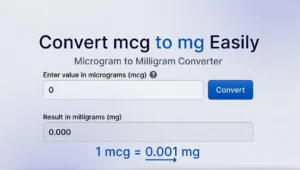
Understanding the Difference Between mcg and mg
In science, medicine, and nutrition, measurements must be extremely precise. Even a tiny difference in dosage can significantly affect health outcomes. That’s why units such as micrograms (mcg) and milligrams (mg) are commonly used to measure very small quantities of substances, especially vitamins, minerals, and medications.
Although both units represent fractions of a gram, they differ greatly in scale. Understanding the difference between mcg and mg, as well as how to convert between them, is essential when reading nutrition labels, supplement facts, or medical prescriptions.
This guide explains the meaning of micrograms and milligrams, their key differences, and how to perform quick mcg to mg conversions accurately.
What Is a Microgram (mcg)?
A microgram, abbreviated as mcg (sometimes written as µg), is a unit of mass in the metric system used to measure extremely small quantities.
Definition of Microgram
A microgram represents one-millionth of a gram.
In numeric terms:
- 1 microgram (mcg) = 0.000001 grams
Because this value is so small, micrograms are typically used in areas where precision is crucial, such as pharmaceutical dosing, vitamin measurements, and laboratory research.
Common nutrients measured in micrograms include:
- Vitamin B12
- Vitamin D
- Folic acid (folate)
- Biotin
- Iodine
Relationship to Grams
To understand micrograms better, it helps to see how they fit within the metric system hierarchy:
- 1 gram (g) = 1000 milligrams (mg)
- 1 milligram (mg) = 1000 micrograms (mcg)
This means:
- 1 gram = 1,000,000 micrograms
Because of this relationship, micrograms are ideal when measuring very small nutrient doses or trace minerals.
Scientific Notation Explanation
Scientists often represent micrograms using scientific notation to simplify extremely small numbers.
For example:
- 1 mcg = 1 × 10⁻⁶ grams
Scientific notation helps researchers and healthcare professionals work with precise measurements without writing long strings of zeros.
What Is a Milligram (mg)?
A milligram, abbreviated mg, is another metric unit used to measure small quantities of mass, but it is larger than a microgram.
Definition of Milligram
A milligram represents one-thousandth of a gram.
In numeric terms:
- 1 mg = 0.001 grams
Because milligrams are larger than micrograms, they are used for slightly higher dosages of medications and nutrients.
Common Uses in Medicine and Supplements
Milligrams are one of the most frequently used measurement units in healthcare. Many medications, vitamins, and supplements are measured in milligrams.
Common examples include:
- Vitamin C (often 500 mg or 1000 mg)
- Magnesium supplements
- Pain relievers such as ibuprofen (200 mg tablets)
- Antibiotic dosages
- Calcium supplements
Milligrams are also widely used on nutrition facts labels, making them familiar to most consumers.
mcg vs mg: Key Differences Explained
Although micrograms and milligrams both measure mass, the difference between them is significant.
The key relationship is:
1 milligram (mg) = 1000 micrograms (mcg)
This means a milligram is 1,000 times larger than a microgram.
Scale Comparison
Here is a simplified scale:
- 1 gram (g)
- 1 milligram (mg) = 1/1000 gram
- 1 microgram (mcg) = 1/1,000,000 gram
Or expressed differently:
- 1000 mcg = 1 mg
Understanding this scale helps prevent mistakes when converting between units.
Real-Life Examples
To see the difference in practice:
- A Vitamin B12 supplement may contain 500 mcg
- A Vitamin C tablet may contain 500 mg
Even though both numbers look similar, 500 mg is actually 1000 times larger than 500 mcg.
Microgram vs Milligram in Nutrition Labels
Nutrition labels often use both mcg and mg depending on the nutrient amount.
Examples:
Microgram-based nutrients:
- Vitamin B12
- Vitamin D
- Biotin
- Selenium
Milligram-based nutrients:
- Vitamin C
- Calcium
- Magnesium
- Potassium
Understanding the difference helps consumers interpret daily value percentages and recommended nutrient intake correctly.
Microgram vs Milligram in Medical Prescriptions
In medical prescriptions, accurate dosing is critical.
Doctors may prescribe medications measured in:
- mcg for very potent substances
- mg for standard medications
For example:
- Thyroid medication (Levothyroxine) is often prescribed in mcg
- Pain medication may be prescribed in mg
A simple unit mistake could lead to overdosing or underdosing, which is why pharmacists double-check conversions carefully.
mcg to mg Converter Explained
Converting micrograms to milligrams is straightforward once you understand the relationship between the two units.
Because 1 mg equals 1000 mcg, converting between them simply involves division by 1000.
The Basic Conversion Formula
The standard conversion formula is:
mg = mcg ÷ 1000
This rule works because a milligram contains one thousand micrograms.
For example:
- 1000 mcg ÷ 1000 = 1 mg
This conversion factor makes calculations easy whether you are working with vitamin dosages, supplement labels, or medication amounts.
Manual Calculation Method
If you don’t have access to a calculator or converter tool, you can easily perform the conversion manually.
Follow these steps:
- Identify the value in micrograms (mcg).
- Divide the number by 1000.
- The result will be in milligrams (mg).
Another way to think about it is moving the decimal point three places to the left.
Example Calculations
Here are some common conversion examples.
100 mcg to mg
100 ÷ 1000 = 0.1 mg
500 mcg to mg
500 ÷ 1000 = 0.5 mg
1000 mcg to mg
1000 ÷ 1000 = 1 mg
These examples show how quickly values can be converted when you know the simple rule.
Using an Online mcg to mg Converter Tool
Many people prefer using an online microgram to milligram converter because it eliminates manual calculation errors.
Benefits of converter tools include:
Speed
You can convert values instantly without doing math.
Accuracy
Automated calculators reduce the risk of conversion mistakes.
Convenience
Many tools allow you to convert multiple units, including:
- mcg to mg
- mg to mcg
- mg to grams
- mcg to grams
Online converters are especially useful for health professionals, students, and anyone comparing supplement dosages.
Quick mcg to mg Conversion Table
Conversion tables provide a quick reference when working with frequently used values.
They are commonly used in pharmacy, healthcare settings, and nutritional planning.
Common Conversion Values
| Micrograms (mcg) | Milligrams (mg) |
|---|---|
| 1 mcg | 0.001 mg |
| 10 mcg | 0.01 mg |
| 50 mcg | 0.05 mg |
| 100 mcg | 0.1 mg |
| 500 mcg | 0.5 mg |
| 1000 mcg | 1 mg |
These values are among the most commonly referenced when reading vitamin labels or supplement dosage instructions.
Microgram to Milligram Conversion Chart
Below is an extended chart that provides additional reference points.
| Micrograms (mcg) | Milligrams (mg) |
|---|---|
| 25 mcg | 0.025 mg |
| 75 mcg | 0.075 mg |
| 150 mcg | 0.15 mg |
| 200 mcg | 0.2 mg |
| 250 mcg | 0.25 mg |
| 400 mcg | 0.4 mg |
| 600 mcg | 0.6 mg |
| 800 mcg | 0.8 mg |
| 900 mcg | 0.9 mg |
| 1500 mcg | 1.5 mg |
This chart can be especially helpful when comparing recommended daily nutrient intake levels.
Printable Conversion Chart
Many healthcare providers and students prefer a printable microgram to milligram conversion chart for quick reference.
A printable chart can be useful for:
- Medical training materials
- Pharmacy reference sheets
- Nutrition education
- Classroom science lessons
Keeping a chart nearby helps reduce errors when working with small measurement units.
Conversion Chart for Medical Dosage
In clinical settings, conversion charts are essential for accurate medication dosing.
Healthcare professionals often rely on quick-reference charts when working with:
- Hormone medications
- Thyroid drugs
- Vitamin injections
- Pediatric dosing
- High-potency medications
Using standardized charts ensures patient safety and consistent dosage calculations.
Practical Uses of mcg to mg Converter in Everyday Life
In modern health, nutrition, and science, accurate measurement is extremely important. Many substances—especially vitamins, medications, and laboratory chemicals—are measured in very small units. Two of the most common units used are micrograms (mcg) and milligrams (mg).
A microgram (mcg) is one-thousandth of a milligram.
1 mg = 1,000 mcg
Because the difference between these units is large, converting them correctly is essential to avoid mistakes in nutrition, medicine, and scientific work. A mcg to mg converter helps people quickly translate these measurements and ensures safe and accurate usage.
In everyday life, these conversions are used more often than many people realize—from reading supplement labels to calculating medication dosages.
Nutritional Supplements
One of the most common places people encounter microgram measurements is on vitamin and supplement labels. Many nutrients are required by the body in extremely small amounts, so manufacturers list them in micrograms instead of milligrams.
Understanding the conversion between mcg and mg can help consumers make better health decisions and avoid confusion when comparing products.
Vitamin B12 Dosage
Vitamin B12 plays an essential role in red blood cell production, brain function, and DNA synthesis. Because the body only needs small amounts of this vitamin, it is typically measured in micrograms.
For example:
- A typical supplement may contain 500 mcg of Vitamin B12
- Converted to milligrams, this equals 0.5 mg
Many health professionals recommend daily intake levels that vary by age, diet, and health conditions. People following vegetarian or vegan diets often take higher B12 supplements because plant-based diets may contain limited natural sources.
Vitamin D Dosage
Vitamin D supports bone health, immune function, and calcium absorption. Supplement labels frequently list Vitamin D in micrograms.
Examples include:
- 10 mcg Vitamin D = 0.01 mg
- 25 mcg Vitamin D = 0.025 mg
- 50 mcg Vitamin D = 0.05 mg
Because vitamin D supplements can vary widely in strength, a mcg to mg converter helps users understand the exact amount they are taking.
Folate Measurements
Folate (Vitamin B9) is another nutrient commonly listed in micrograms. It is particularly important for pregnant women because it supports fetal brain and spinal cord development.
Typical folate supplement amounts include:
- 400 mcg = 0.4 mg
- 800 mcg = 0.8 mg
Healthcare professionals often recommend specific folate intake levels, making accurate unit conversion especially useful.
Medical Prescriptions
Beyond supplements, many medications are prescribed using microgram measurements. In medical settings, precise dosage is critical because even small variations can significantly affect patient outcomes.
Hormone Therapy
Hormone treatments often require very small and precise dosages, which is why micrograms are commonly used.
Examples include:
- Estrogen therapy
- Testosterone micro-dosing
- Growth hormone treatment
Doctors may adjust hormone levels gradually, and converting between mcg and mg helps maintain accurate treatment plans.
Thyroid Medications
Thyroid medications such as levothyroxine are typically prescribed in micrograms.
Common dosages include:
- 25 mcg
- 50 mcg
- 75 mcg
- 100 mcg
When converted:
- 100 mcg = 0.1 mg
Because thyroid hormones regulate metabolism, even a small dosing error can cause symptoms like fatigue, heart palpitations, or weight changes. This makes accurate conversions extremely important.
Scientific and Laboratory Measurements
Microgram measurements are not limited to healthcare. Scientists and laboratory technicians also rely heavily on these units when working with extremely small quantities.
Chemical Compounds
In chemistry and environmental science, substances are often measured in micrograms when analyzing trace elements or contaminants.
Examples include:
- Heavy metal detection in water
- Nutrient concentration in soil samples
- Trace minerals in food analysis
Using a mcg to mg converter allows researchers to easily move between units depending on the scale of their experiment.
Pharmaceutical Production
The pharmaceutical industry frequently works with microgram quantities during drug formulation.
In early drug development stages, active compounds may only be present in tiny amounts. Researchers measure these substances carefully to ensure safety, effectiveness, and consistent manufacturing standards.
mcg to mg Converter in Nutrition and Dietary Supplements
Understanding measurement units is essential for anyone who takes vitamins, minerals, or nutritional supplements. Since many nutrients are required in small amounts, micrograms are widely used on supplement labels.
A mcg to mg converter helps users quickly interpret supplement information and compare different products.
Understanding Supplement Labels
Supplement labels often contain several units of measurement such as mg, mcg, IU (International Units), or percentages of daily value.
Learning how to convert these values helps consumers better understand the amount of nutrients they are consuming.
Why Vitamins Are Often Listed in mcg
Many vitamins are listed in micrograms because the body requires only tiny amounts of them. Listing them in milligrams would create very small decimal numbers.
For example:
- Vitamin B12: 1000 mcg instead of 1 mg
- Folate: 400 mcg instead of 0.4 mg
Using micrograms makes labels easier to read and reduces the risk of misinterpretation.
Common Nutrients Measured in Micrograms
Several essential nutrients are typically measured in micrograms due to their potency and the small amounts needed by the body.
These include:
- Vitamin B12
- Vitamin D
- Folate
- Selenium
- Biotin
- Iodine
Understanding conversions like Vitamin B12 mcg to mg, Vitamin D mcg to mg, and Folate mcg to mg can help consumers better evaluate supplement dosages.
Recommended Daily Intake Measurements
Health organizations provide recommended daily intake levels for essential nutrients. These values are often listed in micrograms.
Examples include approximate adult recommendations:
- Vitamin B12: 2.4 mcg daily
- Vitamin D: 10–20 mcg daily depending on age and sunlight exposure
- Folate: 400 mcg daily
These recommendations highlight how small the required quantities are, reinforcing the need for accurate measurement units.
Safe Supplement Dosage Calculations
Some supplements contain doses much higher than daily requirements. For instance, Vitamin B12 supplements commonly contain 500 mcg or even 1000 mcg.
Without understanding mcg to mg conversion, consumers might misunderstand how large these amounts actually are.
A converter helps prevent confusion and supports safe supplement use.
How Healthcare Professionals Use Microgram to Milligram Conversions
In healthcare environments, precise measurements are essential. Doctors, pharmacists, and nurses frequently convert between micrograms and milligrams when calculating medication doses.
Mistakes in these conversions can lead to incorrect treatments, which is why medical professionals follow strict measurement standards.
Medication Dosage Calculations
Certain medications require extremely small amounts of active ingredients. As a result, prescriptions may be written in either micrograms or milligrams depending on the drug.
Healthcare professionals often convert units when:
- Adjusting medication strength
- Preparing injections
- Calculating pediatric doses
- Compounding medications
Importance of Precise Dosage
Small measurement differences can have a large impact on the body. For example, giving 1 mg instead of 1 mcg would result in a dose that is 1,000 times stronger.
Because of this risk, healthcare providers double-check conversions when calculating medication amounts.
Preventing Dosage Errors
Unit conversion mistakes are one of the most common causes of medication errors. Clear labeling, standardized systems, and digital calculators help reduce these risks.
Common Mistakes in Unit Conversion
Some frequent errors include:
- Confusing mcg with mg
- Misplacing decimal points
- Incorrect rounding during calculations
Using digital tools like a mcg to mg converter helps reduce these mistakes and improves patient safety.
Hospital Measurement Standards
Hospitals follow strict protocols when handling medication measurements. Many healthcare systems require:
- Electronic prescription systems
- Automated dosage calculators
- Double verification by pharmacists
These practices ensure accurate medication administration.
Pharmaceutical Industry Practices
Drug manufacturers also rely on precise measurement systems. During pharmaceutical production, every ingredient must be measured accurately to maintain consistent drug potency.
Pharmaceutical companies often use advanced equipment capable of measuring quantities at the microgram level.
mcg to mg Conversion in Scientific Research
Scientific research frequently deals with extremely small quantities of substances. Because of this, microgram-to-milligram conversions play a key role in many experiments and studies.
Role in Pharmacology
Pharmacology focuses on how drugs interact with the body. Researchers measure active compounds carefully during drug development.
Drug Formulation Measurements
When scientists design new medications, they test different concentrations of active ingredients. These concentrations may start at microgram levels before being scaled up for larger production.
Precise conversions ensure that test results remain accurate and reproducible.
Laboratory Experiments
Many laboratory experiments involve measuring small chemical samples.
Examples include:
- DNA and protein analysis
- Microbial research
- Toxicology studies
- Nutrient analysis in food science
Researchers often switch between mcg and mg units depending on the scale of their measurements.
Importance of Accurate Measurement Units
Accurate measurement units are essential for scientific consistency. Standardized units allow researchers around the world to replicate experiments and compare results.
The metric system, which includes micrograms and milligrams, provides a reliable framework for scientific measurement.
Understanding mcg to mg conversions ensures clarity, accuracy, and safety in fields ranging from nutrition and healthcare to pharmaceutical development and laboratory research.
Advantages of Using an Online mcg to mg Converter
Converting micrograms (mcg) to milligrams (mg) is a common task in health, nutrition, pharmacy, and science education. Although the conversion itself is simple mathematically, many people still make mistakes when doing it manually. This is why online mcg to mg converters have become widely used tools.
A digital converter helps users perform accurate unit conversions instantly without needing to remember formulas or perform manual calculations. From healthcare professionals to students, these tools improve efficiency and reduce errors.
Below are some of the key advantages of using an online mcg to mg converter.
Speed and Convenience
One of the biggest benefits of using an mcg to mg calculator is the speed of conversion. Instead of calculating values manually, users simply enter a number and get the result instantly.
For example:
- 1000 mcg = 1 mg
- 500 mcg = 0.5 mg
- 250 mcg = 0.25 mg
Online converters process these calculations in seconds. This makes them especially useful for people who frequently work with nutritional supplements, medication dosages, or laboratory measurements.
The convenience factor is also important. Instead of opening a calculator or remembering formulas, users can perform conversions directly through a browser or mobile device.
Reduced Calculation Errors
Manual conversions can easily lead to mistakes, especially when dealing with decimals. Since 1 milligram equals 1000 micrograms, a simple misplaced decimal can result in incorrect values.
Online converters eliminate this risk by applying the correct formula automatically. This is particularly valuable in fields where precision is critical, such as:
- Medical dosing
- Nutrition tracking
- Pharmaceutical calculations
- Scientific research
Even a small miscalculation in dosage units can lead to incorrect results. A reliable microgram to milligram converter ensures consistent accuracy every time.
Accessibility Across Devices
Another major advantage of modern conversion tools is accessibility. Most unit conversion tools are designed to work across multiple devices.
Users can access the same converter whether they are on a phone, laptop, or tablet.
Mobile
Mobile access allows users to convert units quickly while on the go. This is especially useful for:
- Pharmacists checking medication amounts
- Fitness enthusiasts tracking supplement intake
- Students solving science problems
Many mobile-friendly converters load instantly in a web browser without requiring downloads.
Desktop
Desktop versions are often used in professional settings such as laboratories, hospitals, and offices. Larger screens make it easier to work with multiple values or conversion tables.
Desktop tools may also include additional features such as:
- Batch conversions
- Exportable tables
- Integration with spreadsheets
Web Tools
Web-based conversion tools are the most flexible option because they do not require installation. Users simply open a website and perform conversions instantly.
Many web tools also include related features such as:
- Metric unit converters
- Nutrition calculators
- Medical dosage calculators
- Measurement conversion charts
This makes them useful for a wide range of applications.
Integration with Health Apps
Modern health technology often integrates unit conversion tools directly into applications. Fitness trackers, nutrition apps, and medication management platforms frequently include built-in converters.
For example, a nutrition app may convert vitamin values automatically between:
- mcg (micrograms)
- mg (milligrams)
- IU (international units)
This helps users interpret supplement labels and dietary recommendations more easily.
Educational Benefits for Students
Students studying chemistry, biology, pharmacy, or medicine regularly encounter metric unit conversions. An mcg to mg converter provides a practical learning tool that reinforces measurement concepts.
Instead of spending excessive time on calculations, students can focus on understanding the underlying scientific principles.
Using digital converters also helps learners become familiar with modern scientific tools commonly used in professional environments.
How to Build Your Own mcg to mg Converter
Creating a simple mcg to mg converter is easier than many people think. Since the conversion formula is straightforward, you can build a functional tool using basic math, spreadsheets, or even a simple web calculator.
Learning how to create your own converter can also improve your understanding of metric unit conversion.
Using Simple Mathematical Formulas
The basic formula for converting micrograms to milligrams is:
mg = mcg ÷ 1000
This works because:
- 1 mg = 1000 mcg
- 1 mcg = 0.001 mg
Example calculations:
- 2000 mcg ÷ 1000 = 2 mg
- 750 mcg ÷ 1000 = 0.75 mg
- 125 mcg ÷ 1000 = 0.125 mg
Using this formula, you can convert any value from micrograms to milligrams quickly.
Many basic calculators or coding scripts simply apply this equation automatically when the user enters a value.
Creating a Spreadsheet Converter
Spreadsheets like Microsoft Excel or Google Sheets are perfect tools for building a customizable unit converter.
You can design a simple table where users input a value in micrograms and the spreadsheet automatically calculates the equivalent milligrams.
This approach is useful for:
- Students learning measurement conversions
- Nutrition tracking spreadsheets
- Pharmacy dosage tables
- Research data sheets
Excel or Google Sheets Formula
In a spreadsheet, the formula is very simple.
If cell A2 contains the microgram value, you can convert it using:
=A2/1000
The result will automatically appear in the next cell.
Example Spreadsheet Formula
Example table:
| Micrograms (mcg) | Milligrams (mg) |
|---|---|
| 1000 | =A2/1000 |
| 500 | =A3/1000 |
| 250 | =A4/1000 |
When the formula is applied, the results become:
- 1000 mcg → 1 mg
- 500 mcg → 0.5 mg
- 250 mcg → 0.25 mg
This method allows you to build a quick mcg to mg conversion calculator within minutes.
Automating Conversion Tables
Spreadsheets can also be used to create automated conversion tables.
For example, you can generate a full reference table like:
| mcg | mg |
|---|---|
| 10 | 0.01 |
| 50 | 0.05 |
| 100 | 0.1 |
| 500 | 0.5 |
| 1000 | 1 |
These tables are useful for quick reference in classrooms, laboratories, or nutrition guides.
Common Mistakes When Converting mcg to mg
Even though the conversion formula is simple, many people still make mistakes when converting micrograms to milligrams.
Understanding these common errors can help prevent inaccurate results.
Misreading Nutrition Labels
Nutrition labels often list vitamins and minerals using different units.
For example:
- Vitamin D may be listed in mcg
- Calcium may be listed in mg
People sometimes assume these units represent similar values, but they differ by a factor of 1000.
Misinterpreting these numbers can lead to confusion about daily nutrient intake.
Confusing mcg with mg
One of the most common mistakes is confusing micrograms (mcg) with milligrams (mg).
This mistake can be serious in medical or pharmaceutical contexts.
For example:
- 1000 mcg = 1 mg
- 1 mg = 1000 mcg
If someone incorrectly treats them as equal values, the dosage calculation will be wrong.
Incorrect Decimal Placement
Decimal errors are another frequent issue.
For example:
Correct conversion:
- 250 mcg = 0.25 mg
Incorrect conversion:
- 250 mcg = 25 mg
A misplaced decimal point dramatically changes the result.
Real-Life Examples of Conversion Errors
In healthcare and nutrition, small measurement mistakes can have noticeable consequences.
Examples include:
- Incorrect supplement dosage calculations
- Misinterpreting vitamin intake levels
- Laboratory measurement errors
These mistakes are why automated converters are widely recommended.
Tips to Avoid Mistakes
To avoid errors when converting mcg to mg:
- Always remember the 1000 conversion factor
- Double-check decimal placement
- Use reliable unit conversion calculators
- Verify numbers from nutrition or medication labels
- Keep a quick conversion chart nearby
These simple steps can greatly reduce the risk of miscalculation.
mcg to mg Converter for Students and Education
Unit conversion is an essential part of science and mathematics education. Understanding how to convert between micrograms and milligrams helps students build a strong foundation in metric measurement systems.
Digital converters make learning these concepts easier and more interactive.
Learning Metric Units
The metric system is based on powers of ten, making it ideal for scientific measurements.
Important relationships include:
- 1 gram (g) = 1000 milligrams (mg)
- 1 milligram (mg) = 1000 micrograms (mcg)
Learning these relationships helps students understand how units scale across different magnitudes.
Using Converters in Science Classes
Teachers often use online unit converters to demonstrate measurement relationships during science lessons.
These tools help visualize how values change when converting between units.
For example, a teacher might show how:
- 10,000 mcg converts to 10 mg
- 500 mcg converts to 0.5 mg
This visual demonstration helps students understand the conversion process more clearly.
Teaching Unit Conversion Easily
Using digital tools in the classroom can simplify complex concepts.
Students can experiment with different values in a converter and observe how results change. This interactive approach encourages deeper learning and problem-solving skills.
Converters also reduce the frustration that sometimes comes with repeated manual calculations.
Classroom Activities
Teachers can incorporate conversion exercises into classroom activities such as:
- Creating metric conversion charts
- Building spreadsheet converters
- Comparing manual vs automated calculations
- Practicing real-world nutrition label conversions
These activities make learning more engaging and practical.
Practice Conversion Exercises
Students can practice with examples like:
- Convert 3000 mcg to mg
- Convert 125 mcg to mg
- Convert 750 mcg to mg
Answers:
- 3000 mcg = 3 mg
- 125 mcg = 0.125 mg
- 750 mcg = 0.75 mg
Regular practice improves accuracy and reinforces metric system understanding.
Digital Tools and Calculators for mcg to mg Conversion
Today, a wide range of digital tools are available to perform mcg to mg conversions quickly and accurately. These tools are used by professionals, students, and everyday users who need reliable unit conversions.
Online Conversion Websites
Many websites offer free microgram to milligram converters. These tools typically require only a single input field where users enter a value.
Features often include:
- Instant calculations
- Reverse conversions (mg to mcg)
- Conversion charts
- Multiple measurement units
These websites are widely used because they are easy to access from any device.
Mobile Apps for Unit Conversion
Mobile applications provide another convenient way to perform conversions.
Popular unit converter apps often support dozens or even hundreds of measurement types, including:
- Weight and mass
- Length and distance
- Temperature
- Scientific units
Users can quickly switch between units without needing separate tools.
Integrated Health Calculators
Many health platforms include built-in dosage calculators and nutrition converters.
Examples include:
- Vitamin intake calculators
- Medication dosage tools
- Nutrition tracking apps
These integrated systems automatically convert values between units, helping users interpret nutritional data correctly.
Benefits of Automated Conversion Systems
Automated systems provide several advantages:
- Instant and accurate calculations
- Reduced human error
- Faster workflow for professionals
- Easy access across multiple devices
These benefits make digital conversion tools essential in modern health and education environments.
Choosing a Reliable Conversion Tool
Not all conversion tools are created equal. When selecting an mcg to mg converter, consider the following factors:
- Accuracy of calculations
- User-friendly interface
- Mobile compatibility
- Additional metric conversion features
- Trusted platform or developer
Choosing a reliable tool ensures consistent and dependable results for both everyday use and professional applications.