Sphere Volume Calculator
Calculate sphere volume with multiple input types, hollow sphere mode, material mass, unit conversion, and sphere comparison.
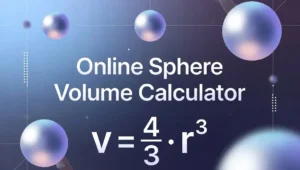
Formula: Volume = (4/3) × π × r³ | Hollow: V = (4/3) × π × (R³ − r³)
Choose input type: Radius, Diameter, Circumference, or Surface Area. Units are handled automatically.
Calculation Result
Input Breakdown
-
Calculation Steps
Educational Notes
🔄 Sphere Comparison
| Property | Sphere 1 | Sphere 2 | Ratio (S2/S1) |
|---|
Volume Unit Conversions
| Unit | Total Volume |
|---|
Geometry is one of the most fascinating branches of mathematics because it helps us understand the shapes and structures that exist in the world around us. Among the many three-dimensional shapes studied in geometry, the sphere is one of the most important and widely recognized forms. From planets and bubbles to sports balls and industrial tanks, spherical shapes appear in countless real-world situations. Because of this, understanding the volume of a sphere becomes essential in many scientific, engineering, and educational contexts.
The concept of volume refers to the amount of space that an object occupies in three-dimensional space. When dealing with spherical objects, calculating this space accurately helps people determine capacity, size relationships, and physical properties. For example, engineers may need to calculate the internal capacity of spherical containers, scientists might estimate the volume of planets or droplets, and students often learn sphere calculations as part of their basic geometry studies.
Traditionally, determining the volume of a sphere requires applying a mathematical formula that involves the radius of the sphere and the constant π (pi). While the formula itself is not extremely complicated, performing manual calculations can sometimes take time, especially when working with larger numbers or when repeated calculations are needed. This is where modern digital tools become extremely helpful.
A Sphere Volume Calculator is an online or software-based tool designed to instantly compute the volume of a spherical object once the radius or diameter is entered. Instead of solving the formula step by step, users simply input the necessary measurement, and the calculator performs the calculation automatically. This not only saves time but also reduces the chances of human error in complex calculations.
Today, digital calculators for geometry are widely used by students, teachers, engineers, architects, and researchers. These tools are especially valuable in situations where accuracy and efficiency are important. For instance, a student solving homework problems can quickly verify answers, while a designer working with 3D models may need rapid calculations when adjusting object dimensions.
Another advantage of a Sphere Volume Calculator is accessibility. Many of these tools are available online for free and can be used directly through web browsers, mobile apps, or integrated scientific calculators. Some even support multiple measurement units such as centimeters, meters, inches, or feet, allowing users to perform calculations in whichever system they prefer.
Beyond convenience, using digital geometry tools also supports better understanding of mathematical concepts. When learners can experiment with different radius values and instantly see how the volume changes, they gain deeper insight into how spherical geometry works. This interactive learning approach makes mathematics more engaging and easier to grasp.
Understanding spherical measurements is also important in fields such as physics, astronomy, engineering, manufacturing, and computer graphics. Astronomers, for example, estimate the volumes of planets and stars to understand their mass and density. Engineers may calculate spherical volumes when designing tanks, ball bearings, or pressure vessels. Meanwhile, in the world of 3D modeling and video game design, spherical objects must be measured precisely to create realistic environments.
In this article, we will explore everything you need to know about the Sphere Volume Calculator and the mathematical concept behind the volume of a sphere. We will discuss the fundamental formula, explain how the calculation works step by step, and show how digital tools simplify the process. In addition, we will examine real-world applications, common mistakes people make when calculating spherical volume, and advanced concepts related to spherical geometry.
Whether you are a student learning geometry, a teacher explaining mathematical principles, or a professional who frequently works with 3D measurements, understanding sphere volume calculations is a valuable skill. By combining mathematical knowledge with modern calculator tools, anyone can perform accurate and efficient spherical volume calculations with ease.
Understanding the Concept of Volume of a Sphere
What is the Volume of a Sphere in Geometry
In 3D geometry sphere concepts, the volume of a sphere refers to the amount of space enclosed within a perfectly round three-dimensional object. A sphere is defined as a set of points that are all at the same distance from a central point, known as the center.
The definition of sphere volume is straightforward: it measures how much space exists inside the spherical shape. This is different from surface area, which only describes the outer boundary.
The relationship between radius and volume is crucial. The volume grows rapidly as the radius increases because the radius is raised to the power of three (cubed). This means even a small change in radius significantly affects the total volume.
In simple geometric terms, if you imagine inflating a ball, the amount of air inside represents its volume. The bigger the radius, the more space it holds.
Historical Background of the Sphere Volume Formula
The sphere volume formula has roots in classical mathematics. Ancient Greek mathematicians, especially Archimedes, played a major role in discovering and proving the formula.
Archimedes demonstrated that the volume of a sphere is exactly two-thirds the volume of a cylinder that encloses it. This was a groundbreaking discovery in geometric volume calculation and is still taught today.
Over time, this formula became a foundation in mathematical geometry formulas, influencing the development of calculus and modern physics.
Why Sphere Volume Calculation is Important
Understanding spherical shape measurement is more than just a math exercise—it has real-world importance.
In science, calculating sphere volume is essential for:
- Studying planets and stars
- Measuring particles in physics and chemistry
- Understanding fluid dynamics
In engineering and architecture, it helps in:
- Designing storage tanks
- Creating domes and curved structures
- Manufacturing spherical components
In education and research, it builds a foundation for:
- Advanced geometry
- Engineering mathematics
- Computer simulations
Real-World Examples of Sphere Volume
Sphere volume is everywhere in daily life.
- Sports balls: Basketballs and soccer balls are nearly perfect spheres. Their volume affects performance, bounce, and air pressure.
- Planetary bodies: Earth, the Moon, and other planets are roughly spherical, making volume calculations essential in astronomy.
- Industrial tanks and containers: Spherical tanks are used for storing gases and liquids because they distribute pressure evenly.
These examples show how 3D shape calculator tools and formulas are applied beyond the classroom.
Sphere Volume Formula Explained Step by Step
Standard Mathematical Formula for Volume of a Sphere
The standard sphere volume equation is:V=34πr3
Where:
- V = Volume of the sphere
- r = Radius of the sphere
- π (Pi) ≈ 3.14159
This formula is one of the most important in geometric volume calculation and is widely used in both academic and professional fields.
Understanding Radius in Sphere Calculations
The radius is the distance from the center of the sphere to its surface. It is the most important measurement when calculating volume.
The difference between radius and diameter:
- Radius (r) = half of the diameter
- Diameter (d) = 2 × radius
To convert diameter to radius:r=2d
Understanding this conversion is essential when using a sphere diameter formula or when working with real-world measurements.
Why Pi (π) is Used in Sphere Volume Formula
The constant π (pi) appears in all calculations involving circles and spheres. This is because a sphere is a 3D extension of a circle.
Pi represents the ratio of a circle’s circumference to its diameter, and it plays a key role in:
- Circular geometry
- Spherical calculations
- Trigonometry and calculus
Without π, accurate sphere volume calculations would not be possible.
Step-by-Step Manual Calculation of Sphere Volume
Example Calculation Using Radius
Problem:
Find the volume of a sphere with a radius of 5 cm.
Solution:
Step 1: Write the formulaV=34πr3
Step 2: Substitute the valueV=34π(5)3
Step 3: Calculate the cube53=125
Step 4: MultiplyV=34×3.14159×125
Step 5: Final resultV≈523.6cm3
Example Using Diameter Instead of Radius
Problem:
A sphere has a diameter of 10 cm. Find its volume.
Solution:
Step 1: Convert diameter to radiusr=210=5cm
Step 2: Use the formulaV=34πr3
Step 3: Substitute and calculateV=34π(5)3=523.6cm3
This shows how easy it is to calculate volume using radius once the conversion is done.
What is a Sphere Volume Calculator
Definition of a Sphere Volume Calculator
A sphere volume calculator is a digital tool designed to automatically compute the volume of a sphere using the correct mathematical formula.
It is part of modern online sphere calculator systems that simplify complex calculations for students, teachers, engineers, and researchers.
How an Online Sphere Volume Calculator Works
Most sphere volume tools follow a simple process:
- Input the radius or diameter
- The system applies the sphere volume formula
- The result is displayed instantly
These tools rely on pre-programmed mathematical geometry formulas, ensuring accurate and fast results.
Advantages of Using a Sphere Volume Calculator
Using a digital math calculator offers several benefits:
- Faster calculations: No need for manual computation
- Reduced errors: Eliminates mistakes in formulas
- User-friendly: Ideal for beginners and professionals
- Versatile: Works for different units and measurements
It is especially useful in exams, engineering tasks, and scientific research.
Types of Sphere Calculators Available Online
There are different types of 3D shape calculator tools available:
- Basic volume calculators: Focus only on sphere volume
- Advanced geometry calculators: Include surface area and other shapes
- Scientific calculator integrations: Combine multiple math functions in one platform
These tools make spherical shape measurement easier, faster, and more accurate in today’s digital world.
How to Use a Sphere Volume Calculator Correctly
Using a sphere volume calculator may seem simple, but getting accurate results depends on how you input data and handle unit conversions. Whether you’re working on a school assignment, engineering project, or scientific analysis, following the right steps ensures precise outcomes.
Step-by-Step Guide to Using the Calculator
To make the most of a sphere measurement calculator, follow this structured process:
- Enter sphere radius
The radius is the most critical input. Make sure you’re entering the correct value from your measurement or problem. This is often referred to as the radius input calculator step. - Select unit measurement
Choose the unit that matches your data—this ensures your result is consistent and meaningful. - Click calculate
Once the input is ready, run the calculation. Most tools use the standard formula:
Volume = (4/3) × π × r³ - Review result
Double-check the output, including units. If something looks off, verify your input and unit selection.
Input Units Commonly Used
Different fields use different units, so it’s important to select the right one:
- centimeters (cm)
- meters (m)
- inches (in)
- feet (ft)
Using consistent units helps avoid errors in your geometry unit conversion process.
Converting Units for Accurate Sphere Volume Calculation
Accurate conversions are essential when your measurements and required outputs differ.
Metric to Imperial Conversion
If you’re converting between systems:
- 1 inch = 2.54 cm
- 1 foot = 30.48 cm
- 1 meter ≈ 3.281 feet
Always convert the radius before calculating volume to avoid compounding errors.
Scientific Units Conversion
In scientific contexts, units like millimeters (mm) or kilometers (km) may be used. For example:
- 1 meter = 1,000 millimeters
- 1 kilometer = 1,000 meters
Precision matters here, especially in research and advanced calculations.
Practical Applications of Sphere Volume Calculation
Understanding sphere volume goes beyond theory—it has real-world uses across multiple industries.
Applications in Physics and Astronomy
Sphere calculations are widely used in space-related studies.
- Planet volume estimation
Scientists estimate the volume of planets using radius data gathered from telescopes and satellites. - Space science calculations
From modeling stars to calculating gas clouds, the astronomy sphere measurement plays a key role in understanding the universe.
Engineering and Industrial Uses
Engineers frequently rely on engineering sphere calculation in design and manufacturing.
- Storage tanks
Spherical tanks are used for gas storage due to their strength and efficiency. Knowing the spherical tank volume is essential for capacity planning. - Ball bearings
Precision components like ball bearings require exact volume and size calculations. - Spherical containers
Used in industries such as food processing and chemicals.
Medical and Scientific Research
Sphere volume calculations also support innovation in science and healthcare.
- Cell modeling
Many biological cells are approximated as spheres for easier analysis. - Biological structures
Researchers use sphere models to study tumors, bacteria, and microscopic organisms.
Educational Use for Students and Teachers
In education, sphere calculations are a core part of geometry learning.
- Teaching geometry concepts
Students learn how volume formulas apply to real shapes. - Visualizing 3D shapes
Tools help learners better understand spatial relationships and dimensions.
Comparing Manual Calculation vs Sphere Volume Calculator
Choosing between manual methods and digital tools depends on your goal and context.
Manual Geometry Calculation
Using the traditional formula by hand has its benefits.
Advantages:
- Builds conceptual understanding
- Useful in exams where calculators may not be allowed
Limitations:
- Time-consuming
- Higher risk of calculation errors
This method is often referred to as manual sphere calculation.
Digital Calculator Method
Modern tools offer a faster alternative.
Benefits:
- Instant results
- High precision
- Reduces human error
An automated geometry calculator is especially helpful for complex or repeated calculations.
When to Use Each Method
Choosing the right approach depends on your situation:
- Classroom learning
Manual calculation helps students grasp the fundamentals. - Professional engineering tasks
A fast sphere volume computation tool is more practical and efficient.
In most real-world scenarios, combining both methods—understanding the formula and using a calculator—provides the best results.
Common Mistakes When Calculating the Volume of a Sphere
Even though the formula for the volume of a sphere looks simple, many people still make avoidable errors. Understanding these common pitfalls can significantly improve your accuracy and confidence in geometry calculations.
Confusing Radius and Diameter
One of the most frequent sphere calculation mistakes is mixing up the radius and the diameter. The formula for volume uses the radius (r), not the diameter. Since the diameter is twice the radius, using it directly in the formula can result in a volume that is 8 times larger than it should be.
Quick tip:
Always divide the diameter by 2 before plugging it into the formula.
Incorrect Unit Conversion
Another common geometry formula error involves inconsistent units. For example, using centimeters for radius but expecting the answer in meters can lead to incorrect results.
Math calculation tip:
Convert all measurements into the same unit before calculating, and remember that volume units are cubic (e.g., cm³, m³).
Forgetting the Cube in r³
The formula for the volume of a sphere is:V=34πr3
Forgetting to cube the radius is a classic mistake. This drastically changes the result and is often due to rushing through calculations.
Tip:
Double-check that you are multiplying the radius by itself three times.
Rounding Errors in Pi Values
Using a rough approximation of π (like 3.14) is fine for basic calculations, but excessive rounding too early can lead to noticeable errors in more precise work.
Best practice:
Use π from a calculator or keep more decimal places until the final step.
Advanced Sphere Volume Concepts
Once you’ve mastered the basics, you can explore more complex variations of sphere volume calculations used in engineering, physics, and advanced geometry.
Hollow Sphere Volume Calculation
A hollow sphere (like a ball with thickness) requires calculating the difference between two volumes.
- Outer radius (R)
- Inner radius (r)
Formula:V=34π(R3−r3)
This method is widely used in hollow sphere volume problems, such as pipes, tanks, and shells.
Hemisphere Volume Formula
A hemisphere is simply half of a sphere.V=32πr3
This half sphere calculation is common in real-world objects like domes and bowls.
Spherical Segment Volume
A spherical segment represents a portion of a sphere cut by a plane. The formula is more complex and depends on the height and radius.
This type of partial sphere geometry appears in fluid dynamics, tank design, and architecture.
Multi-Sphere Volume Calculations
In some cases, you may need to calculate the total volume of multiple spheres or overlapping spheres. This is common in packing problems and simulations.
Tip:
Calculate each sphere separately, then sum the volumes or adjust for overlaps when necessary.
Sphere Volume in Modern Technology
Sphere volume calculations are not just academic—they play a crucial role in modern digital and engineering applications.
Computer Graphics and 3D Modeling
In 3D design tools, spheres are fundamental shapes used in rendering objects, lighting, and textures. Accurate 3D modeling sphere volume calculations ensure realistic visuals and scaling.
Video Game Physics Engines
Game engines rely on sphere calculations for collision detection. Spheres are often used as bounding shapes because they are efficient and easy to compute.
Artificial Intelligence and Simulation
AI systems and simulations frequently involve modeling spherical objects, such as particles, planets, or molecules. Accurate volume calculations help simulate realistic environments.
CAD Software Applications
In engineering design tools, sphere volume is essential for designing components like tanks, bearings, and pressure vessels. CAD geometry calculations ensure precision and safety in real-world applications.
Building Your Own Sphere Volume Calculator
Creating your own calculator is a great way to understand the formula and apply it in practical scenarios.
Basic Formula Implementation
At its core, a sphere volume calculator only needs one input: the radius.V=34πr3
You can implement this formula in almost any programming language or tool.
Calculator Using Spreadsheet (Excel / Google Sheets)
You can easily build a calculator using spreadsheets:
Example formula:
=(4/3)*PI()*A1^3
Where A1 contains the radius.
This method is perfect for quick calculations and experimenting with different values using spreadsheet sphere formula techniques.
Simple Web Calculator Using JavaScript
A basic web calculator can be built with JavaScript:
function calculateVolume(radius) {
  return (4/3) * Math.PI * Math.pow(radius, 3);
}
This is a simple example of geometry calculator code that can be expanded with user input and UI elements.
Mobile App Integration
You can also integrate sphere calculations into mobile apps, especially educational or engineering tools. Many apps use built-in math libraries to handle calculations efficiently.
Educational Benefits of Using Sphere Volume Tools
Using digital tools for geometry can significantly enhance learning and understanding.
Helping Students Understand 3D Geometry
Interactive tools make abstract concepts more concrete. Students can visualize how changing the radius affects the volume, making geometry learning tools highly effective.
Interactive Learning with Math Tools
Hands-on experience with calculators and simulations encourages engagement. Instead of memorizing formulas, students learn by doing.
Improving Problem-Solving Skills
Working with real-time calculations helps students identify patterns, debug errors, and build confidence in solving complex problems.
Supporting STEM Education
Sphere volume tools play an important role in STEM geometry concepts, especially in fields like physics, engineering, and computer science. They bridge the gap between theory and real-world application.
Frequently Asked Questions About Sphere Volume Calculator
What is the fastest way to calculate the volume of a sphere
The fastest way to calculate the volume of a sphere is by using the standard formula:
V = (4/3) × π × r³
Where r is the radius of the sphere. For quick results, most people rely on a sphere volume calculator online, which eliminates manual computation and reduces human error. You simply input the radius (or diameter), and the calculator instantly returns the result.
If you are doing it manually, using a scientific calculator with a built-in π (pi) button speeds things up significantly. For professionals working in engineering or physics, software tools like CAD programs or geometry apps can calculate volume automatically as part of a larger workflow.
Can I calculate sphere volume using diameter
Yes, you can absolutely calculate the volume of a sphere using the diameter. Since the diameter is twice the radius, you just need to convert it first:
r = d / 2
Then substitute it into the formula:
V = (4/3) × π × (d/2)³
This simplifies to:
V = (π × d³) / 6
This version is especially useful in real-world applications where diameter is easier to measure than radius, such as in pipes, balls, tanks, or industrial components.
Are online sphere calculators accurate
Online sphere volume calculators are generally very accurate, especially those built with reliable mathematical engines. Most calculators use precise values of π (up to many decimal places) and follow standard formulas.
However, accuracy still depends on:
- The correctness of your input (radius or diameter)
- The number of decimal places you choose
- Whether the calculator rounds results
For scientific or engineering purposes, it’s best to use trusted tools and double-check critical calculations.
What units are used for sphere volume
Sphere volume is always expressed in cubic units because it represents three-dimensional space. Common units include:
- Cubic meters (m³)
- Cubic centimeters (cm³)
- Cubic millimeters (mm³)
- Cubic inches (in³)
- Cubic feet (ft³)
For example, if the radius is measured in centimeters, the resulting volume will be in cubic centimeters. Maintaining unit consistency is essential to avoid errors.
Can sphere volume be calculated without π
Technically, π is an essential part of the formula, so you cannot calculate the exact volume of a sphere without it. However, you can use approximations like:
- π ≈ 3.14
- π ≈ 22/7
These approximations are often sufficient for basic calculations or educational purposes. In high-precision fields such as aerospace engineering or scientific research, more accurate values of π are required.
Tips for Accurate Sphere Volume Calculations
Double-Check Radius Measurements
One of the most common sources of error is incorrect measurement of the radius. Always ensure that:
- You are measuring from the center to the surface
- Your measuring tool is calibrated
- You convert diameter to radius correctly
Even a small mistake in radius can significantly affect the final volume because the value is cubed.
Use Reliable Calculator Tools
Using a trusted sphere volume calculator online can save time and improve accuracy. Look for tools that:
- Support multiple units
- Provide step-by-step solutions
- Allow decimal precision control
Advanced tools may also include geometry calculators, 3D shape calculators, and integration with engineering software.
Maintain Unit Consistency
Always use the same unit throughout your calculation. Mixing units (e.g., centimeters and meters) will lead to incorrect results.
For example:
- Convert all measurements to meters before calculating
- Or keep everything in centimeters consistently
This is especially important in fields like construction, physics, and manufacturing.
Avoid Rounding Too Early
Rounding numbers too soon can introduce cumulative errors, especially when dealing with cubic calculations. Instead:
- Keep full precision during intermediate steps
- Round only the final result
This practice ensures better accuracy, particularly in technical and academic contexts.
Future of Geometry Calculators and Digital Math Tools
AI-Powered Math Calculators
Modern AI-powered math tools are transforming how we approach geometry. These tools can:
- Solve complex equations instantly
- Provide explanations step-by-step
- Adapt to user skill levels
In the future, AI will likely offer predictive assistance, helping users understand not just the result, but the reasoning behind it.
Integration with Educational Platforms
Geometry calculators are increasingly integrated into online learning platforms and digital classrooms. Students can now:
- Visualize shapes in real time
- Perform interactive calculations
- Receive instant feedback
This integration enhances learning efficiency and makes abstract concepts like sphere volume more tangible.
Interactive 3D Geometry Visualization
One of the most exciting developments is interactive 3D visualization. Users can:
- Rotate and explore spheres in 3D space
- Adjust radius dynamically
- See how volume changes in real time
This is particularly useful in education, architecture, and product design, where spatial understanding is crucial.
Voice-Activated Math Tools
With the rise of smart assistants, voice-activated math tools are becoming more common. You can simply say:
“Calculate the volume of a sphere with radius 5 cm”
And get instant results. This hands-free approach is convenient for multitasking professionals and enhances accessibility.
Conclusion: Why Sphere Volume Calculators Are Essential Tools
Understanding the volume of a sphere is a fundamental concept in geometry that applies to many real-world scenarios—from engineering and physics to manufacturing and education. Whether you’re calculating the capacity of a tank, designing a ball, or solving academic problems, this formula plays a critical role.
Using a sphere volume calculator offers clear advantages:
- Saves time and effort
- Minimizes calculation errors
- Supports multiple units and formats
- Enhances productivity in technical tasks
For students, engineers, and researchers, modern digital tools make complex calculations faster and more accessible than ever before. Embracing these tools not only improves accuracy but also deepens your understanding of geometric principles.
In a world driven by data and precision, geometry remains a cornerstone of science and technology—and tools like sphere volume calculators ensure that anyone can apply it efficiently and confidently.