Cubic Feet to Gallons Calculator
Convert volume from cubic feet to gallons with precise, international results for US and Imperial systems.
Use this professional calculator to convert cubic feet into US gallons, Imperial gallons, and liters.
All inputs include accessibility labels, input validation, description links, and quick popular presets for instant conversion.
Input Details
🔥 Most Popular Volumes
Conversion Result
Calculation Breakdown
📊 Real-World Volume Comparisons
| Common Object | Equivalent | Visual |
|---|---|---|
| Standard 55-gallon drum | 🛢️ | |
| Bathtub (80 gallons) | 🛁 | |
| Cubic yard (concrete/soil) | 🧱 | |
| Olympic pool (2,500,000L) | 🏊 | |
| Car gas tank (15 gal) | ⛽ | |
| Water bottle (1 liter) | 🍾 |
📚 Volume Conversion Guide
Conversion Formulas:
• Cubic Feet to US Gallons: Volume (gal) = Volume (ft³) × 7.48052
• Cubic Feet to Imperial Gallons: Volume (gal) = Volume (ft³) × 6.22884
• Cubic Feet to Liters: Volume (L) = Volume (ft³) × 28.3168466
• Cubic Feet to Cubic Meters: Volume (m³) = Volume (ft³) × 0.0283168466
💡 Did You Know?
• A US gallon is about 3.785 liters, while an Imperial gallon is about 4.546 liters (20% larger!)
• The Imperial system is used in the UK and some Commonwealth countries
• 1 cubic foot can hold approximately 7.48 gallons of water weighing about 62.4 pounds
Common Applications:
🏗️ Construction: Calculate water tank capacity, pool volume, concrete mixing
🌊 Plumbing: Size water heaters, storage tanks, and piping systems
🚜 Agriculture: Irrigation planning and water storage calculations
🏭 Industrial: Chemical storage, process engineering, HVAC systems
📊 Visual Volume Representation
Note: This calculator is intended for volume conversion only. For liquid density or mass calculations, use a dedicated density converter.
Understanding how to convert cubic feet to gallons is an essential skill for homeowners, engineers, contractors, farmers, aquarium enthusiasts, pool owners, and anyone who works with liquid storage or volume measurements. Whether you’re estimating the capacity of a water tank, calculating the amount of water needed to fill a swimming pool, or planning an irrigation system, knowing how these two units relate can save both time and money while improving accuracy.
Although cubic feet and gallons are both units used to measure volume, they serve different purposes. Cubic feet measure three-dimensional space, making them ideal for calculating the size of containers, rooms, tanks, and storage areas. Gallons, on the other hand, are commonly used to measure liquids such as water, fuel, chemicals, and beverages. Because many real-world projects involve both solid dimensions and liquid capacity, converting between these units is a routine task across residential, commercial, industrial, and agricultural applications.
For example, imagine you’ve purchased a water storage tank with dimensions listed in feet. While those dimensions tell you the physical size of the tank, they don’t immediately reveal how much water it can actually hold. By converting the tank’s volume from cubic feet into gallons, you gain a practical understanding of its storage capacity. The same principle applies when calculating pool volume, designing plumbing systems, selecting aquarium equipment, or estimating the amount of rainwater that can be collected in a storage reservoir.
One of the reasons this conversion can be confusing is that there are two commonly used gallon standards. The U.S. gallon is widely used throughout the United States and several other countries, while the Imperial gallon is primarily associated with the United Kingdom and a few Commonwealth nations. Because these two gallon measurements represent different volumes, using the wrong conversion factor can lead to significant errors, especially in engineering projects, manufacturing, or commercial water management.
Fortunately, converting cubic feet into gallons is much simpler than many people expect. Once you understand the conversion formula and know which gallon standard to apply, you can calculate liquid capacity in just a few seconds. Even better, modern calculators and conversion tools make the process almost effortless, though understanding the underlying mathematics remains valuable for verifying results and avoiding mistakes.
This comprehensive guide is designed to provide everything you need to know about cubic feet to gallons conversions. You’ll learn the standard formulas for both U.S. and Imperial gallons, discover easy step-by-step calculation methods, and explore practical examples drawn from everyday situations. We’ll also cover conversion charts, common mistakes to avoid, industry-specific applications, and tips for achieving accurate measurements in real-world projects.
Whether you’re calculating the volume of a fish tank, sizing a rainwater harvesting system, estimating the capacity of an industrial storage tank, or simply trying to understand measurement conversions more confidently, this guide offers clear explanations that are suitable for beginners while still providing valuable insights for experienced professionals.
By the end of this article, you’ll be able to convert cubic feet into gallons quickly and accurately, understand when each gallon standard should be used, and apply these calculations confidently in construction, plumbing, agriculture, environmental management, manufacturing, and countless everyday situations.
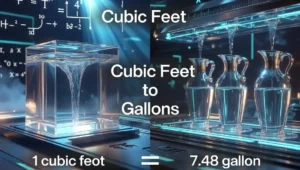
What Does Cubic Feet to Gallons Mean?
Understanding cubic feet to gallons conversion is important in many industries and everyday situations. From calculating the size of a water tank to estimating how much liquid a swimming pool can hold, this conversion helps people measure volume accurately and efficiently.
Cubic feet and gallons are both units used to measure volume, but they are used in different ways. Cubic feet are commonly associated with space and dimensions, while gallons are more practical for measuring liquids such as water, fuel, and chemicals.
Definition of Cubic Feet
A cubic foot is a unit of volume in the imperial and US customary measurement systems. It represents the amount of space inside a cube that measures 1 foot long, 1 foot wide, and 1 foot high.
Unit of Volume
Cubic feet are widely used to measure three-dimensional space. The abbreviation is usually written as ft³ or cu ft.
Used in Construction
In construction projects, cubic feet are used to calculate:
- Concrete volume
- Excavation size
- Building materials
- Room capacity
Builders often rely on cubic feet measurements when estimating costs and material requirements.
HVAC Applications
Heating, ventilation, and air conditioning systems frequently use cubic feet measurements to determine airflow and room volume. HVAC professionals calculate cubic feet to select properly sized equipment.
Shipping and Logistics
Shipping companies measure cargo space in cubic feet to optimize storage and transportation efficiency. Freight capacity and warehouse planning depend heavily on volume calculations.
Water Storage
Large storage tanks, reservoirs, and industrial containers are often measured in cubic feet before converting the value into gallons for practical use.
Definition of Gallons
A gallon is a liquid volume measurement commonly used in the United States and several other countries.
Liquid Measurement
Gallons are designed specifically for measuring liquids such as:
- Water
- Fuel
- Milk
- Chemicals
- Oil
Everyday Applications
Most people encounter gallons in daily life when buying gasoline, filling water containers, or calculating household water consumption.
Fuel Industry
Gas stations display fuel prices per gallon in countries using the US customary system.
Water Storage
Water tanks, pools, and irrigation systems are usually rated in gallons because the measurement is easier to visualize.
Agriculture
Farmers use gallons to measure pesticides, fertilizers, and irrigation water requirements.
Why Convert Cubic Feet into Gallons?
Converting cubic feet into gallons makes volume easier to understand, especially when dealing with liquids.
Easier Visualization
Most people can imagine gallons more easily than cubic feet. Saying a tank holds “500 gallons” is more intuitive than saying it holds “66.84 cubic feet.”
Water Capacity
Water systems are usually designed around gallon measurements for residential and commercial applications.
Tank Sizing
Manufacturers often provide tank dimensions in feet but storage capacity in gallons.
Plumbing Systems
Plumbers use gallon conversions to estimate water flow, pressure, and storage requirements.
Engineering Calculations
Mechanical and civil engineers regularly convert between cubic feet and gallons when designing systems involving liquid storage and movement.
Cubic Feet to Gallons Conversion Formula
There are two major gallon systems used worldwide: the US gallon and the Imperial gallon.
Standard US Gallon Formula
The standard conversion formula for US gallons is:
1 cubic foot = 7.48052 US gallons
Formula:Gallons (US)=Cubic Feet×7.48052
Example:
If a tank has a volume of 10 cubic feet:10×7.48052=74.8052
So, the tank holds approximately 74.81 US gallons.
Imperial Gallon Formula
The UK Imperial gallon uses a different conversion value.
1 cubic foot = 6.22883 Imperial gallons
Formula:Gallons (Imperial)=Cubic Feet×6.22883
Example:10×6.22883=62.2883
This equals approximately 62.29 Imperial gallons.
Understanding Conversion Constants
The conversion constants differ because the US gallon and Imperial gallon are not the same size.
- US gallon: 231 cubic inches
- Imperial gallon: 277.42 cubic inches
Since the Imperial gallon is larger, fewer Imperial gallons fit inside one cubic foot.
US Gallons vs Imperial Gallons
Many people confuse these two systems, but they are significantly different.
What is a US Gallon?
A US gallon equals:
- 3.785 liters
- 231 cubic inches
It is the standard gallon measurement used in the United States.
What is an Imperial Gallon?
An Imperial gallon equals:
- 4.546 liters
- 277.42 cubic inches
It is larger than the US gallon.
Which One Should You Use?
Use the correct system depending on your location and industry requirements.
- Use US gallons for American measurements
- Use Imperial gallons for some UK-based applications
Countries Using Each Measurement
Countries Primarily Using US Gallons
- United States
- Some Latin American industries
Countries Using Imperial Gallons
- United Kingdom (limited applications)
- Some Caribbean regions
Many countries now use liters as the primary liquid measurement.
Cubic Feet to Gallons Conversion Chart
Quick conversion charts simplify calculations without needing a calculator.
Small Volume Conversion Table
| Cubic Feet | US Gallons | Imperial Gallons |
|---|---|---|
| 0.1 | 0.748 | 0.623 |
| 0.25 | 1.87 | 1.56 |
| 0.5 | 3.74 | 3.11 |
| 1 | 7.48 | 6.23 |
| 2 | 14.96 | 12.46 |
| 5 | 37.40 | 31.14 |
Medium Volume Table
| Cubic Feet | US Gallons | Imperial Gallons |
|---|---|---|
| 10 | 74.81 | 62.29 |
| 20 | 149.61 | 124.58 |
| 30 | 224.42 | 186.86 |
| 40 | 299.22 | 249.15 |
| 50 | 374.03 | 311.44 |
Large Volume Table
| Cubic Feet | US Gallons | Imperial Gallons |
|---|---|---|
| 100 | 748.05 | 622.88 |
| 250 | 1870.13 | 1557.21 |
| 500 | 3740.26 | 3114.42 |
| 1000 | 7480.52 | 6228.83 |
How to Convert Cubic Feet to Gallons Step by Step
There are several easy ways to perform the conversion.
Manual Calculation
Step-by-step process:
- Measure the volume in cubic feet
- Multiply by 7.48052 for US gallons
- Round the answer if necessary
Example:15×7.48052=112.21
Result: 112.21 US gallons
Calculator Method
Online conversion calculators provide instant results.
Advantages include:
- Faster calculations
- Reduced errors
- Easy unit switching
- Mobile-friendly access
Spreadsheet Method
Spreadsheet software like Excel or Google Sheets can automate conversions.
Formula example in Excel:
=A1*7.48052This is useful for handling large datasets or engineering calculations.
Mobile Conversion Apps
Many mobile apps support volume conversion tools.
Popular features include:
- Offline conversion
- Multiple measurement units
- Tank calculators
- Water capacity estimators
Real-Life Examples of Cubic Feet to Gallons
Volume conversion plays an important role in many real-world situations.
Residential Water Tanks
Homeowners often need to calculate water storage capacity for backup systems and emergency supplies.
Swimming Pools
Pool capacity is commonly estimated using cubic dimensions converted into gallons for chemical treatment and maintenance planning.
Aquariums
Fish tank sizes are frequently calculated in gallons even when dimensions are measured in feet.
Rainwater Harvesting
Rainwater collection systems depend on accurate gallon estimates to maximize storage efficiency.
Irrigation Systems
Agricultural irrigation systems require precise water calculations to avoid waste and improve crop performance.
Water Delivery Trucks
Water transport companies calculate truck capacity in gallons for billing and logistics.
Industrial Storage Tanks
Factories and processing facilities store chemicals and liquids in large tanks measured using cubic feet and gallons.
Septic Systems
Septic tank sizing often involves cubic foot calculations converted into gallons for regulatory compliance.
Water Tank Capacity Using Cubic Feet to Gallons
Water tank calculations vary depending on the tank shape.
Cylindrical Tanks
Formula for cylinder volume:V=πr2h
After calculating cubic feet, multiply by 7.48052 to convert into US gallons.
Example
A cylindrical tank with:
- Radius: 3 feet
- Height: 8 feet
Volume:3.1416×32×8=226.19 cubic feet
Gallons:226.19×7.48052=1692.09
Capacity: Approximately 1,692 gallons
Rectangular Tanks
Formula:V=Length×Width×Height
Example:
- Length: 10 ft
- Width: 5 ft
- Height: 4 ft
10×5×4=200 cubic feet
Converted:200×7.48052=1496.10
Capacity: About 1,496 gallons
Underground Tanks
Underground storage tanks are widely used for:
- Fuel storage
- Rainwater systems
- Emergency water reserves
Accurate gallon conversion helps ensure safety compliance and proper capacity planning.
Elevated Tanks
Elevated water tanks provide gravity-fed water pressure in residential and municipal systems.
Engineers calculate:
- Structural load
- Water weight
- Maximum gallon capacity
- Distribution pressure
Proper cubic feet to gallons conversion ensures reliable system performance and efficient water management.
Cubic Feet to Gallons for Swimming Pools
Converting cubic feet to gallons is one of the most common calculations in pool maintenance and water management. Pool owners, contractors, and maintenance teams rely on accurate volume measurements to determine water capacity, chemical treatment levels, filtration requirements, and heating efficiency.
In the United States, the standard conversion is:
- 1 cubic foot = 7.48052 US gallons
- 1 cubic foot = 6.22884 UK gallons
Most residential and commercial pool calculations use US gallons.
Above-Ground Pools
Above-ground pools are usually circular or oval, making volume calculations relatively simple. Once the pool dimensions are known, cubic feet can be converted into gallons to estimate water needs accurately.
For example:
- A pool containing 500 cubic feet of water equals approximately:
- 3,740 gallons
This calculation helps with:
- Chlorine dosing
- Filter sizing
- Pump capacity
- Water replacement planning
Many modern above-ground pool systems now include smart monitoring devices that automatically estimate water volume and chemical balance in real time.
In-Ground Pools
In-ground pools come in many shapes, including rectangular, kidney-shaped, and freeform designs. Because of varying depths and curves, volume estimation often requires more detailed calculations.
Professionals commonly divide irregular pools into sections and calculate the cubic footage separately before converting to gallons.
Accurate conversions are essential for:
- Automated cleaning systems
- Saltwater chlorination
- Energy-efficient heating
- Leak detection
Large residential pools can hold anywhere from 10,000 to 30,000 gallons, while commercial facilities may exceed 100,000 gallons.
Hot Tubs
Hot tubs contain far less water than swimming pools, but precision matters even more because chemicals become concentrated quickly.
Most hot tubs hold between:
- 200 to 600 gallons
Converting cubic feet to gallons ensures:
- Proper sanitizer levels
- Safe pH balancing
- Efficient heating cycles
- Reduced water waste
A hot tub measuring 40 cubic feet would contain approximately 299 gallons.
Spa Calculations
Spas often include multiple chambers, seating areas, and water features. Engineers and installers calculate total cubic volume to determine:
- Jet pump performance
- Water circulation rates
- Heater requirements
- Drainage systems
Luxury spa installations increasingly use digital modeling software to calculate gallon capacity before construction begins.
Aquarium Volume Conversion
Aquarium enthusiasts frequently convert cubic feet into gallons to determine the proper environment for fish, coral, and aquatic plants.
Volume accuracy directly impacts water quality and aquatic health.
Freshwater Aquariums
Freshwater tanks are generally easier to maintain than marine systems, but water volume still determines:
- Filtration requirements
- Fish stocking limits
- Oxygen levels
- Water treatment schedules
A tank with 10 cubic feet of internal space holds approximately 74.8 gallons.
Popular freshwater setups include:
- Community aquariums
- Planted tanks
- Cichlid habitats
- Breeding systems
Saltwater Tanks
Saltwater aquariums require extremely precise water measurements because salinity levels must remain stable.
Marine aquarium owners use gallon conversions to calculate:
- Salt mix quantities
- Protein skimmer capacity
- Reef dosing schedules
- Water circulation flow
Even small conversion mistakes can stress coral and marine fish.
Fish Tank Planning
Before purchasing a tank, hobbyists often estimate cubic feet to determine the final gallon capacity.
This helps with:
- Choosing fish species
- Planning filtration systems
- Selecting aquarium stands
- Managing electrical equipment
Larger tanks usually provide more stable water conditions than smaller aquariums.
Water Replacement Calculations
Routine water changes are critical for healthy aquariums.
By converting cubic feet into gallons, owners can quickly determine:
- 10% water changes
- 25% cleaning cycles
- Emergency replacement volumes
Automated aquarium systems increasingly use sensors and smart pumps to calculate replacement needs automatically.
Construction Applications
Construction professionals regularly convert cubic feet to gallons for fluid handling, material estimation, and infrastructure planning.
Concrete Mixing
Water plays a critical role in concrete quality.
Builders use gallon conversions to ensure:
- Correct water-to-cement ratios
- Consistent curing strength
- Reduced cracking risks
- Improved structural durability
On large commercial projects, inaccurate water measurements can compromise structural integrity.
Excavation
Excavation projects often involve estimating groundwater or storage capacity.
Examples include:
- Retention ponds
- Utility trenches
- Underground vaults
- Foundation pits
Converting cubic feet into gallons helps contractors manage pumping systems and drainage operations.
Water Storage
Storage tanks are commonly rated in gallons, while engineering drawings may use cubic feet.
Accurate conversion supports:
- Tank sizing
- Emergency reserve planning
- Municipal infrastructure design
- Industrial water management
Building Design
Architects and engineers use volume calculations in sustainable building systems such as:
- Rooftop water storage
- Graywater recycling
- HVAC fluid systems
- Fire protection systems
Modern building information modeling (BIM) software can automatically perform these conversions during design stages.
Agricultural Uses
Agriculture depends heavily on accurate water volume calculations to improve efficiency and reduce waste.
Irrigation Planning
Farmers convert cubic feet into gallons to estimate irrigation demand for crops.
This supports:
- Drip irrigation systems
- Sprinkler networks
- Water budgeting
- Drought management
Precision irrigation technology has become increasingly important due to global water shortages.
Livestock Water Supply
Different animals require different daily water volumes.
Gallons are commonly used to estimate water consumption for:
- Cattle
- Poultry
- Horses
- Dairy farms
Storage tanks and trough systems are often measured in cubic feet during installation.
Greenhouses
Greenhouses rely on carefully controlled watering systems.
Volume calculations help manage:
- Nutrient mixing
- Humidity control
- Hydroponic reservoirs
- Cooling systems
Smart greenhouse automation systems now monitor water usage continuously.
Crop Management
Modern crop management combines volume calculations with environmental data.
Farm operators use gallon estimates for:
- Fertigation
- Chemical spraying
- Soil moisture balancing
- Water conservation programs
Accurate conversion improves sustainability and reduces operating costs.
Industrial Applications
Many industries depend on precise fluid volume conversion for safety and operational efficiency.
Chemical Storage
Chemical tanks are often designed in cubic feet but managed operationally in gallons.
This is essential for:
- Safety compliance
- Spill prevention
- Inventory management
- Hazardous material handling
Manufacturing
Manufacturing facilities use liquid volume calculations in:
- Food processing
- Beverage production
- Pharmaceutical systems
- Textile manufacturing
Automated production lines frequently rely on digital sensors for real-time gallon tracking.
Cooling Systems
Industrial cooling systems circulate massive amounts of water.
Converting cubic feet into gallons helps determine:
- Cooling tower capacity
- Pump performance
- Thermal efficiency
- Water treatment requirements
Fire Suppression Tanks
Fire protection systems require strict volume standards.
Gallons are used to verify:
- Emergency reserves
- Sprinkler system flow rates
- Fire pump performance
- Regulatory compliance
Large commercial facilities may store hundreds of thousands of gallons for fire suppression.
Environmental Applications
Environmental engineers use cubic feet to gallon conversions in sustainability and conservation projects.
Rainwater Collection
Rainwater harvesting systems collect runoff from rooftops and paved areas.
Volume conversion helps determine:
- Storage tank sizing
- Overflow planning
- Irrigation potential
- Water savings
Residential rainwater systems have become increasingly popular in urban sustainability programs.
Stormwater Systems
Cities use stormwater infrastructure to reduce flooding and erosion.
Engineers calculate gallon capacity for:
- Drainage channels
- Retention basins
- Underground tunnels
- Flood control systems
Climate change has increased the importance of accurate stormwater planning.
Water Conservation
Water conservation programs rely on precise usage tracking.
Converting cubic feet into gallons allows households and businesses to:
- Monitor consumption
- Detect leaks
- Reduce utility costs
- Improve efficiency
Many smart water meters now display real-time gallon usage.
Sustainable Building Projects
Green building certifications often require detailed water calculations.
These include:
- LEED projects
- Eco-friendly housing
- Net-zero developments
- Water recycling systems
Accurate volume conversion supports long-term sustainability goals.
Common Mistakes When Converting Cubic Feet to Gallons
Small conversion mistakes can create significant problems in engineering, maintenance, and water treatment.
Using the Wrong Gallon Standard
One of the biggest mistakes is confusing:
- US gallons
- Imperial gallons
The two systems produce different results, which can affect calculations dramatically.
Incorrect Decimal Placement
Misplacing decimals can multiply errors quickly.
For example:
- 74.8 gallons can accidentally become 748 gallons
This may lead to overfilling or improper chemical dosing.
Confusing Cubic Feet with Square Feet
Square feet measure area, while cubic feet measure volume.
This mistake commonly occurs in construction and storage planning.
Rounding Errors
Excessive rounding may reduce accuracy in sensitive systems such as:
- Aquariums
- Chemical tanks
- Laboratory equipment
Using precise values minimizes operational risks.
Conversion Tips for Better Accuracy
Accurate calculations improve efficiency, reduce waste, and prevent costly mistakes.
Always Verify Units
Check whether measurements use:
- Feet
- Inches
- Meters
- Gallons
- Liters
Mixed measurement systems often create confusion.
Use Consistent Measurement Systems
Avoid combining metric and imperial units unless necessary.
Consistency improves:
- Engineering accuracy
- Communication
- Project planning
Double-Check Tank Dimensions
Incorrect dimensions produce incorrect gallon estimates.
Always verify:
- Length
- Width
- Height
- Average depth
Consider Temperature Effects
Liquids expand slightly with temperature changes.
In highly sensitive industrial systems, thermal expansion may affect total gallon capacity.
Cubic Feet to Gallons Calculator Guide
Online calculators simplify conversion tasks and reduce human error.
How Online Calculators Work
Most calculators multiply cubic feet by the standard conversion factor:
- 1 cubic foot × 7.48052 = US gallons
Advanced tools may also support:
- Metric conversion
- Tank shape calculations
- Liquid type adjustments
Advantages of Automatic Calculators
Digital calculators provide several benefits:
- Faster results
- Reduced mistakes
- Mobile accessibility
- Automatic unit conversion
Many professional systems now integrate cloud-based calculation tools.
Manual vs Digital Calculations
Manual calculations offer flexibility and educational value, while digital tools improve speed and convenience.
Professionals often use both methods for verification.
Features to Look For
A good volume conversion calculator should include:
- Multiple unit support
- Precision controls
- Mobile compatibility
- Shape-based formulas
- Export functions
Cubic Feet Compared with Other Volume Units
Understanding related volume units improves conversion accuracy across industries.
Cubic Inches
There are:
- 1,728 cubic inches in 1 cubic foot
This unit is commonly used for smaller containers and engine displacement.
Cubic Yards
One cubic yard equals:
- 27 cubic feet
Construction and landscaping industries frequently use cubic yards.
Cubic Meters
One cubic meter equals approximately:
- 35.3147 cubic feet
Metric systems dominate international engineering projects.
Liters
One cubic foot equals approximately:
- 28.3168 liters
Liters are widely used worldwide for liquid measurement.
Milliliters
One cubic foot equals:
- 28,316.8 milliliters
This conversion is useful in laboratories and medical industries.
Barrels
In the oil industry:
- 1 barrel = 42 US gallons
Barrel conversions are critical in petroleum logistics.
Quick Conversion Reference
Quick reference values help speed up calculations.
Cubic Feet to Liters
| Cubic Feet | Liters |
|---|---|
| 1 | 28.32 |
| 5 | 141.58 |
| 10 | 283.17 |
| 50 | 1,415.84 |
Cubic Feet to Cubic Meters
| Cubic Feet | Cubic Meters |
|---|---|
| 1 | 0.0283 |
| 10 | 0.283 |
| 100 | 2.83 |
Gallons to Cubic Feet
| Gallons | Cubic Feet |
|---|---|
| 1 | 0.1337 |
| 10 | 1.337 |
| 100 | 13.37 |
Gallons to Liters
| Gallons | Liters |
|---|---|
| 1 | 3.785 |
| 5 | 18.93 |
| 10 | 37.85 |
| 100 | 378.54 |
Industries That Frequently Use Cubic Feet to Gallons
Many industries depend on volume conversion every day.
Plumbing
Plumbers use gallon conversions for:
- Water heaters
- Pipe systems
- Drainage design
- Pressure testing
HVAC
HVAC systems rely on fluid calculations for:
- Chillers
- Cooling loops
- Heat exchangers
- Refrigeration systems
Oil and Gas
The oil industry uses volume conversion in:
- Fuel storage
- Pipeline systems
- Refinery operations
- Transportation logistics
Agriculture
Agriculture requires accurate water planning for:
- Irrigation
- Livestock systems
- Fertilizer mixing
- Reservoir management
Marine Industry
Ships and offshore facilities calculate gallons for:
- Ballast systems
- Fuel tanks
- Freshwater storage
- Waste management
Municipal Water Systems
Cities manage enormous water volumes every day.
Conversions support:
- Water treatment plants
- Distribution systems
- Emergency reserves
- Utility monitoring
Civil Engineering
Civil engineers use volume calculations for:
- Infrastructure planning
- Drainage systems
- Retention basins
- Tunnel construction
Environmental Science
Environmental scientists rely on gallon conversion for:
- Water quality monitoring
- Ecosystem analysis
- Pollution control
- Sustainability studies
Accurate measurements support better environmental decision-making and long-term resource management.
Frequently Asked Questions
How many gallons are in one cubic foot?
One cubic foot equals approximately:
- 7.48052 US gallons
- 6.22884 UK (Imperial) gallons
This conversion is commonly used in water storage, fuel systems, aquariums, construction projects, and industrial volume calculations. The difference depends on which gallon measurement standard you use.
For quick reference:
| Cubic Feet | US Gallons | UK Gallons |
|---|---|---|
| 1 | 7.48 | 6.23 |
| 5 | 37.40 | 31.14 |
| 10 | 74.81 | 62.29 |
| 50 | 374.03 | 311.44 |
| 100 | 748.05 | 622.88 |
Is the conversion different in the UK?
Yes, the conversion changes because the UK uses the Imperial gallon, while the United States uses the US gallon.
Key Difference Between US and UK Gallons
| Measurement Standard | Gallon Size |
|---|---|
| US Gallon | 3.785 liters |
| UK Imperial Gallon | 4.546 liters |
Because the Imperial gallon is larger, fewer UK gallons fit into one cubic foot.
Why This Matters
Using the wrong gallon standard can create serious calculation errors in:
- Water treatment systems
- Fuel tank sizing
- Shipping containers
- Pool volume calculations
- Agricultural irrigation systems
Always verify whether your project uses US customary units or Imperial units before converting.
Can I convert gallons back to cubic feet?
Absolutely. You simply reverse the formula.
US Gallons to Cubic Feet Formula
Cubic Feet = US Gallons ÷ 7.48052UK Gallons to Cubic Feet Formula
Cubic Feet = UK Gallons ÷ 6.22884Example Calculation
If you have 100 US gallons:
100 ÷ 7.48052 = 13.37 cubic feetThis reverse conversion is useful for:
- Storage planning
- Engineering calculations
- Plumbing systems
- Tank capacity estimation
Why do online calculators give different answers?
Different calculators may produce slightly different results because of:
Rounding Methods
Some tools round values to:
- 7.48
- 7.4805
- 7.48052
The difference is tiny for small calculations but can become significant in large-scale industrial measurements.
Different Gallon Standards
Some calculators automatically use US gallons, while others use UK Imperial gallons.
Precision Settings
Engineering software often uses higher decimal precision than standard consumer calculators.
Unit Assumptions
Certain tools may assume:
- Dry gallons
- Liquid gallons
- Metric conversions
Always check the calculator’s unit settings before relying on the result.
Which gallon should I use?
The correct gallon depends on your location and application.
Use US Gallons If You Are Working With:
- American plumbing systems
- US fuel measurements
- Residential water tanks in the US
- Most online calculators from US websites
Use UK Imperial Gallons If You Are Working With:
- Older British systems
- Certain Commonwealth engineering projects
- UK-based liquid storage references
Industry Tip
Most international engineering and scientific projects now prefer:
- Liters
- Cubic meters
- Metric measurements
However, gallons and cubic feet remain extremely common in construction, HVAC, and water management industries.
Is this conversion exact?
The conversion is mathematically precise when using official standards.
Exact US Conversion
1 cubic foot = 7.48051948 US gallonsExact UK Conversion
1 cubic foot = 6.22883546 Imperial gallonsFor everyday use, rounding to two decimal places is usually acceptable.
Recommended Accuracy Levels
| Use Case | Recommended Precision |
|---|---|
| Household calculations | 2 decimals |
| Construction projects | 3 decimals |
| Engineering systems | 5+ decimals |
| Scientific research | Maximum precision |
Can I use this for fuel?
Yes, cubic feet to gallons conversion is commonly used for fuel storage systems.
Common Fuel Applications
- Diesel tanks
- Aviation fuel storage
- Marine fuel systems
- Industrial fuel containers
However, fuel calculations sometimes also require:
- Temperature correction
- Pressure adjustment
- Density calculations
Important Note
Fuel expands and contracts with temperature changes, so gallon capacity may vary slightly under different environmental conditions.
Does water temperature affect the conversion?
Technically, yes — but usually only in high-precision applications.
Why Temperature Matters
Liquids expand when heated and contract when cooled.
For normal residential or commercial calculations, the difference is minimal. But in industries like:
- Chemical processing
- Oil and gas
- Scientific laboratories
- Pharmaceutical manufacturing
temperature compensation becomes important.
Example
Warm water occupies slightly more volume than cold water, even though the mass stays the same.
How accurate are online converters?
Most reputable online conversion tools are highly accurate for everyday use.
Reliable Converter Features
Look for calculators that provide:
- Unit selection options
- Decimal precision control
- Formula transparency
- Instant reverse conversion
- Mobile-friendly interfaces
Common Accuracy Problems
Some low-quality tools may:
- Use outdated formulas
- Round too aggressively
- Mix US and UK units
- Display inconsistent decimals
When accuracy matters, verify calculations manually or use professional engineering software.
What’s the fastest way to calculate large volumes?
For large-scale conversions, speed and consistency matter.
Best Methods for Fast Calculations
Use Spreadsheet Formulas
Excel and Google Sheets can instantly convert thousands of values.
Example formula:
= CubicFeet * 7.48052Use Dedicated Conversion Calculators
Professional calculators reduce manual errors and save time.
Create Reference Charts
Conversion charts are excellent for:
- Field technicians
- Construction workers
- Engineers
- Warehouse managers
Use Mobile Apps
Modern engineering and measurement apps allow real-time conversion on job sites.
Expert Tips for Accurate Volume Measurement
Measuring Irregular Containers
Irregular shapes can make volume calculations challenging.
Best Practices
Divide the Shape Into Sections
Break complex containers into:
- Rectangles
- Cylinders
- Triangles
- Curved sections
Then calculate each area separately.
Use Water Displacement
For oddly shaped objects, water displacement provides highly accurate measurements.
Consider Internal Obstacles
Pipes, supports, or curved edges can reduce usable capacity.
Recommended Tools
| Tool | Best Use |
|---|---|
| Laser distance meter | Large tanks |
| Flexible measuring tape | Curved surfaces |
| Ultrasonic sensors | Industrial systems |
| Digital volume scanners | Complex structures |
Recording Dimensions Correctly
Accurate dimensions are the foundation of reliable conversions.
Essential Measurement Rules
Measure in Consistent Units
Avoid mixing:
- Inches and feet
- Gallons and liters
- Metric and imperial systems
Record Exact Decimals
Even small mistakes can multiply in large calculations.
Double-Check Measurements
Professionals often verify measurements at least twice before final calculations.
Common Recording Mistakes
- Swapping width and height
- Forgetting unit labels
- Rounding too early
- Misreading tape measures
Avoiding Measurement Errors
Even experienced professionals can make conversion mistakes.
Most Common Errors
Using the Wrong Gallon Standard
This remains one of the biggest issues worldwide.
Incorrect Formula Usage
Always confirm whether you’re converting:
- Cubic feet to gallons
- Gallons to cubic feet
- Liters to gallons
Ignoring Container Thickness
Tank wall thickness can reduce actual usable volume.
Estimating Instead of Measuring
Visual estimation often causes major inaccuracies.
Error Reduction Strategies
- Use calibrated tools
- Keep detailed records
- Standardize measurement procedures
- Train staff on unit systems
Choosing the Right Conversion Tool
The best conversion tool depends on your needs.
Basic Calculators
Ideal for:
- Quick household calculations
- Small DIY projects
- Educational purposes
Engineering Software
Better for:
- Industrial systems
- Fluid dynamics
- Infrastructure planning
- HVAC design
Mobile Conversion Apps
Useful for:
- On-site measurements
- Construction projects
- Field inspections
Features to Look For
A high-quality conversion tool should include:
- Multiple unit systems
- Real-time updates
- Reverse calculations
- Export options
- Precision controls
Conclusion
Understanding how to convert cubic feet to gallons is essential for many industries and everyday tasks. Whether you’re calculating water storage, fuel capacity, aquarium volume, or industrial tank measurements, using the correct conversion formula ensures accurate results.
The most important concept to remember is that gallon standards differ between the United States and the United Kingdom. One cubic foot equals approximately 7.48 US gallons or 6.23 UK Imperial gallons, and choosing the wrong standard can create costly errors.
For the best accuracy:
- Always verify your unit system
- Measure dimensions carefully
- Use reliable conversion tools
- Avoid premature rounding
- Double-check calculations for large projects
Conversion charts, spreadsheet formulas, and professional online calculators can dramatically improve efficiency while reducing manual mistakes. By following proper measurement practices and understanding the differences between gallon standards, you can handle volume conversions confidently and accurately in both personal and professional applications.